Introduction
TL;DR Every sales team knows the feeling. The inbox fills with new contacts. The CRM shows hundreds of names. Reps stare at the list and wonder where to begin.
Some of those names will buy. Most will not. The trick is knowing which is which before you waste a week.
This guide explains Qualified Leads vs. Unqualified Leads in plain language. You will learn what each type looks like. You will see how top teams sort them. You will read about scoring models, qualification frameworks, and useful tools. You will also learn what to do with the leads that do not fit today.
Good qualification changes results. Reps close more deals. Marketing proves its value. Leaders forecast with confidence. Customers get a better experience because they talk to a rep who understands their needs.
Poor qualification does the opposite. Reps chase dead ends. Marketing celebrates lead counts that never turn into revenue. Everyone feels frustrated.
Read on to build a simple system your whole team can follow. You do not need a large budget. You need clear rules and steady habits.
Table of Contents
What Is a Lead in B2B Sales?
A lead is a person or company that shows interest in what you sell. The interest may look small. A visitor downloads an ebook. A manager fills out a contact form. A director signs up for a webinar. Each action creates a record in your system.
Not every lead has the same value. Some leads have budget and a real problem. Others have curiosity and free time. Sales teams need to see that difference early.
Lead Generation vs. Lead Qualification
Lead generation brings people in. It uses content, ads, events, referrals, and outreach. The goal is volume and reach. Marketing usually owns this work.
Lead qualification sorts the people who come in. It checks fit and readiness. It decides who deserves a sales conversation now, who needs more time, and who should not enter the pipeline at all.
Both jobs matter. Generation without qualification floods your team with noise. Qualification without generation leaves reps with nothing to work. Healthy teams run both jobs in balance.
Why Sorting Starts Early
Time is the scarcest resource on a sales team. A rep can hold only so many conversations each day. Each call spent on a poor fit removes a call from a strong prospect. Early sorting protects that time and points effort toward real opportunities.
Understanding Qualified Leads vs. Unqualified Leads
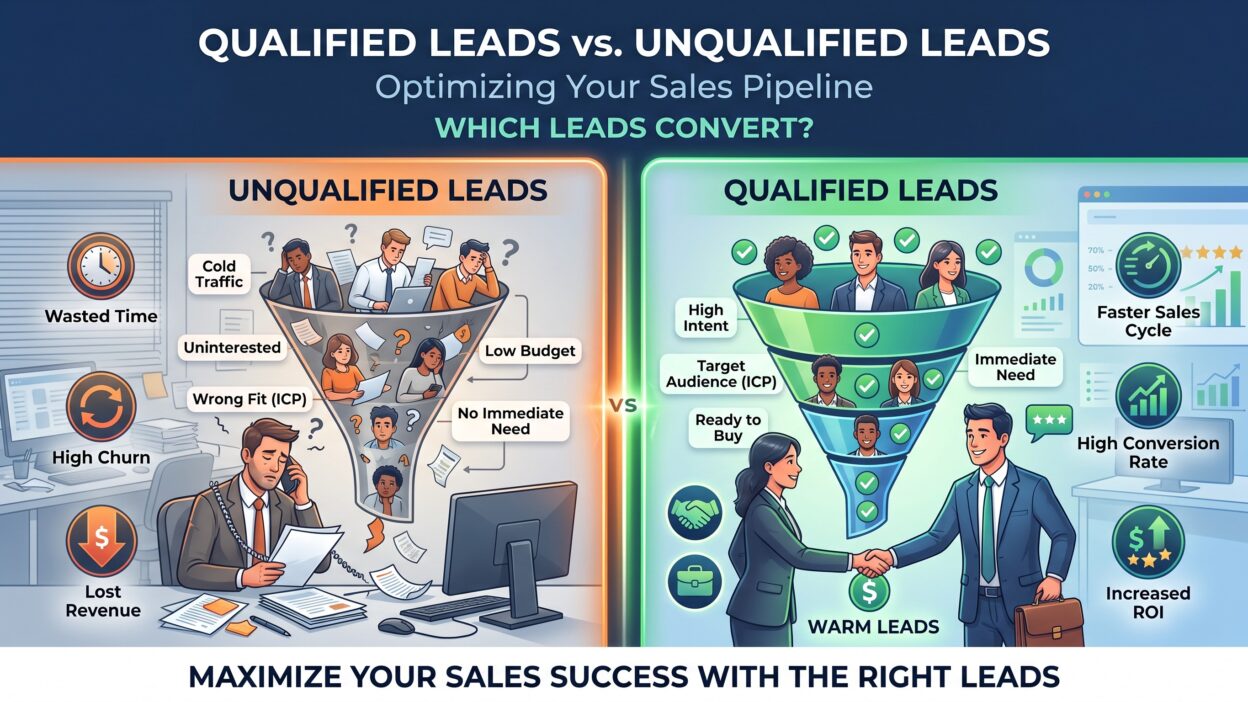
The core idea is simple. A qualified lead matches your target customer and shows signs of buying intent. An unqualified lead misses on one or both counts.
What Makes a Lead Qualified
A qualified lead fits your ideal customer profile. The company operates in your target industry. It has the right size. It sits in a region you serve. The contact holds a role with influence over the purchase.
Interest matters too. A qualified lead engages with your content in meaningful ways. They visit the pricing page. They compare plans. They request a demo. They reply to a rep and ask smart questions.
Resources complete the picture. The lead has budget or a path to budget. The lead has authority or access to those with authority. A timeline exists. The need feels urgent enough to act within a reasonable period.
When fit, interest, and resources line up, sales should act fast.
What Makes a Lead Unqualified
An unqualified lead misses the mark. The company may fall outside your target market. A student downloads a whitepaper for a class project. A competitor grabs your pricing guide. A small firm wants a product built for large enterprises.
Some unqualified leads fit your profile but lack readiness. They like your content but have no plan to buy this year. They have no budget. They have no authority. They want information, not a solution.
Unqualified does not mean worthless forever. Many of these contacts become buyers later. The label describes today, not tomorrow. Smart teams keep those contacts in a nurture program and check back over time.
Why Qualified Leads vs. Unqualified Leads Matters for Your Business
The gap between the two groups shapes almost every sales metric you track.
Conversion rate rises when reps focus on qualified prospects. A rep who talks to ten strong leads will close more deals than a rep who talks to fifty weak ones. Quality beats quantity in the pipeline every time.
Sales cycles shrink. Qualified buyers already know their problem. They have budget in place. They move through evaluation faster. Unqualified contacts stall, disappear, or ask for endless information.
Costs fall. Every hour a rep spends on a poor fit carries a price. Salary, tools, and opportunity all count. Clean qualification cuts that waste and lowers your cost of acquisition.
Forecasts improve. Leaders trust pipeline numbers when qualification rules stay consistent. A pipeline packed with unqualified deals produces wild forecasts and unpleasant surprises at quarter end.
Morale improves as well. Reps hate chasing ghosts. Marketing teams hate hearing that their leads are junk. Shared standards reduce blame. Both teams feel proud when a lead turns into revenue.
Customer experience benefits. Buyers appreciate a rep who understands their situation. They feel respected when nobody pushes a product that does not fit. Trust builds from the first call.
Finally, marketing spend gets smarter. Data on qualified outcomes shows which channels deliver real buyers. Budget flows toward those channels. Weak channels lose funding.
The Lead Stages: From Subscriber to Sales Qualified Lead
Most companies map leads along a simple path. Names vary, but the logic stays the same.
Subscribers and Raw Leads
Raw leads join your list with little context. They subscribe to a newsletter or download a free guide. Marketing knows little beyond an email address. These contacts start at the top of the funnel.
Marketing Qualified Leads
A marketing qualified lead, or MQL, shows enough interest and fit to justify closer attention. The contact has engaged several times. Perhaps they read multiple articles, attended a webinar, and opened many emails. Marketing scores the lead and marks it ready for a deeper look.
An MQL still needs a human check. The lead has warmed up but has not confirmed a need.
Sales Qualified Leads
A sales qualified lead, or SQL, has passed a rep’s review. A conversation confirmed budget, authority, need, and timing. The prospect wants to explore a purchase. The rep opens an opportunity in the CRM and starts the formal sales process.
Opportunities and Customers
Opportunities move through evaluation, proposal, and negotiation. Won deals become customers. Lost deals return to nurture or close out with notes on what went wrong.
Clear stage definitions prevent confusion. Write them down. Share them across teams. Review them each quarter.
How to Identify Qualified Leads
Several proven methods help you decide. Most teams combine two or three.
Use a Framework Like BANT
BANT stands for budget, authority, need, and timeline. Sales reps ask questions that reveal each factor. Does the company have money set aside? Does this contact sign off or influence the decision? Does the problem hurt enough to demand action? Does the buyer plan to act within a set window?
BANT works well for straightforward sales. Complex deals may need a deeper model. Frameworks such as MEDDIC and CHAMP add layers like champion, decision process, and pain metrics. Pick the one that matches your sales motion.
Compare Leads to Your Ideal Customer Profile
Your ideal customer profile describes the companies that win most often, stay longest, and spend the most. Study your best customers. Note their industry, size, technology, and challenges. Score new leads against that pattern.
A lead that matches the profile deserves priority. A lead that misses the pattern deserves a second look before anyone invests time.
Watch Behavior Signals
Behavior tells the truth about intent. Repeat visits to pricing pages stand out. So do demo requests, trial signups, and comparison searches. A prospect who reads three case studies in a week signals serious research.
Track email replies too. A short message that asks about implementation carries more weight than a dozen newsletter opens.
Ask Direct Questions
Tools help, but conversation confirms. Train reps to ask open questions. What problem are you trying to solve? What happens if you do nothing? Who else joins this decision? What does success look like in six months?
Listen more than you talk. Prospects reveal fit and readiness when they feel heard.
Verify Data
Check company details in your CRM. Confirm size, industry, and location. Check the contact’s title and role. Outdated data hides good leads and inflates bad ones. A quick verification step saves hours later.
Warning Signs of Unqualified Leads
Patterns repeat. Once you know them, you spot them quickly.
Wrong fit shows up first. The company falls outside your target size, industry, or region. The product cannot solve their problem. A polite conversation will not change that reality.
No authority creates dead ends. The contact has no say in the decision and no access to someone who does. Reps can still gather information from such contacts, but they should not treat them as buyers.
No budget stalls deals. The prospect loves the product but cannot pay. Some leads hope for a free version. Others plan to wait until next year. Both need a different approach.
No urgency drags timelines. The contact says “maybe someday” and shows no reason to act. Without pain, no purchase happens.
Poor engagement raises flags. The lead ignores emails, skips calls, and never opens your content after the first download. Interest may have faded before it began.
Bad data hides problems. Fake names, personal email addresses, and mismatched company details often signal low intent or even spam.
Competitors and researchers join your list too. They gather ideas or price points. Watch for contacts from rival firms and academic domains.
Unqualified signals do not always mean disqualification. Some contacts fix one gap over time. A lead with no budget today may receive funding next quarter. Record what you learn and set a follow-up date.
Lead Scoring: Sort Qualified Leads vs. Unqualified Leads at Scale
Manual review works for small lists. Growing teams need a system that scales. Lead scoring supplies it.
Lead scoring assigns points to contacts. Two categories drive the model. Fit points reflect who the lead is. Interest points reflect what the lead does.
Building a Fit Score
Award points for traits that match your ideal customer. A director at a mid-size software firm might earn twenty points. A student might lose ten. Company size, industry, job title, and location all play a role. Add negative points for signals such as free email addresses or competitor domains.
Building an Interest Score
Award points for actions. A blog view earns a few points. A pricing page visit earns more. A demo request earns the most. Subtract points for inactivity. A lead who goes silent for sixty days should lose some score.
Setting Thresholds
Choose a score at which a lead becomes an MQL. Choose a higher score at which reps get an alert. Test the numbers against past wins. Look at deals you closed. Check what scores those leads had at each stage. Adjust the thresholds until the model reflects real results.
Keeping the Model Fresh
Buyer behavior shifts. Products change. Markets move. Review your scoring model every quarter. Ask sales which high-scoring leads disappointed them. Ask which low-scoring leads surprised them. Adjust weights based on those answers.
Many marketing automation tools and CRMs include scoring features. Some use predictive models that learn from past deals. Even a simple spreadsheet model beats guesswork. Start simple and improve with data.
Sales and Marketing Alignment on Lead Quality
Qualification succeeds only when sales and marketing agree on the rules. Disagreement breeds conflict. Marketing hands over leads that sales rejects. Sales complains that leads lack quality. Marketing complains that sales never follows up.
Alignment ends that cycle.
Start with shared definitions. Sit in one room and write down what counts as an MQL and an SQL. Include both fit and behavior criteria. Give examples of real leads that passed and failed. Nothing beats concrete cases.
Set a service-level agreement. Marketing promises a certain volume and quality of leads. Sales promises a response time and a set number of follow-up attempts. Both sides track their commitments. Review the numbers together each month.
Build a feedback loop. Reps should mark why they reject a lead. Options might include wrong industry, no budget, wrong contact, or bad timing. Marketing reads those reasons and adjusts targeting, content, and scoring. The loop turns frustration into data.
Share dashboards. Both teams should see the same pipeline reports in the CRM. Shared data ends debates about whose numbers are right.
Meet often. A short weekly sync keeps issues small. A deeper monthly review covers trends and experiments.
Share goals. When both teams own pipeline and revenue targets, they stop arguing about Qualified Leads vs. Unqualified Leads and start solving problems together. Shared goals shift the conversation from blame to teamwork.
What to Do With Unqualified Leads
Throwing away every lead that fails today’s test wastes future revenue. Smart teams sort them into paths.
Nurture the Promising Ones
Some leads fit your profile but lack timing or budget. Place them in a lead nurturing program. Send helpful content on a steady schedule. Share guides, case studies, and industry news. Avoid heavy sales language. The goal is to stay useful and stay visible.
Track engagement. A nurtured lead who begins to visit your pricing page may deserve a fresh look. Automated alerts help reps catch those moments.
Redirect the Wrong Fits
Some contacts need a different solution. Refer them to a partner or a lower-tier product if one exists. A helpful referral builds goodwill. The contact may remember you when a better fit arises. They may also recommend you to peers.
Remove the Bad Data
Spam, fake entries, and competitors clutter your database. Delete or suppress them. Clean lists improve email deliverability and reporting accuracy. Fewer junk records mean sharper insights.
Close the Loop Politely
Reps should send a short, respectful message when they decide not to pursue a lead. Explain that the product does not fit the current need. Offer a resource. Invite the contact to return later. A kind exit protects your brand.
Recycle Leads on a Schedule
Set a rule to review dormant leads every quarter. Check for job changes, funding news, and new engagement. Timing changes fast in business. A lead that stalled in March may be ready in September.
Tools That Help You Qualify Leads
Technology does not replace judgment. It speeds the work.
A CRM stores every contact, activity, and deal. It creates one shared record for sales and marketing. Custom fields let you track qualification criteria. Automated workflows route leads to the right rep.
Marketing automation platforms track behavior across email, web, and forms. They apply lead scoring rules and trigger alerts. They also power nurture sequences for leads that need more time.
Data enrichment tools fill gaps. They add company size, revenue, technology, and industry to each record. Better data gives better scores.
Chatbots and forms capture qualification data at the first touch. A short form asks about company size, role, and timeline. A chatbot can route high-intent visitors straight to a live rep.
Conversation intelligence tools record and analyze sales calls. They reveal which questions uncover real buyers. Managers use those insights to coach reps.
Intent data providers show which companies research topics related to your product. Those signals help reps reach out at the right moment.
Choose tools that fit your team size and process. Start with a CRM and a scoring model. Add more layers as you grow.
Common Mistakes When Sorting Qualified Leads vs. Unqualified Leads
Teams repeat the same errors. Awareness helps you avoid them.
Vague definitions cause the most damage. If nobody agrees on what “qualified” means, each rep decides alone. Results vary and reports lose meaning. Write clear criteria and test them on real leads.
Overreliance on one signal misleads teams. A high score from many email opens might mean nothing. A contact who opens every newsletter may never buy. Combine fit and behavior before you decide.
Ignoring fit creates false hope. Engagement from a company outside your target market still leads nowhere. Lots of activity does not fix a bad match.
Rejecting leads too fast costs revenue. A lead that seems cold today may warm up next quarter. Route those contacts to nurture instead of the trash.
Passing leads too early burns reps. Handing over a contact who only downloaded one ebook wastes sales time. Reps then lose faith in marketing.
Never updating the model keeps errors alive. Markets move. Old rules produce old results. Schedule regular reviews.
Skipping follow-up on qualified leads wastes the work. Speed matters. A hot lead who waits two days may sign with a competitor. Set response time targets and track them.
Ignoring feedback from sales breaks the loop. Reps see what happens on real calls. Their insights sharpen your criteria.
Last, treating qualification as a one-time event limits growth. Leads change over time. Check fit and readiness at every stage of the pipeline.
Metrics That Show Whether Your Qualification Works
Numbers reveal whether your system helps or hurts.
Track the lead-to-MQL rate. It shows how many raw leads meet your marketing threshold. A very high rate may mean loose standards. A very low rate may mean poor targeting.
Track the MQL-to-SQL rate. It shows how often sales accepts marketing’s picks. A low rate signals a mismatch between definitions. Investigate the reasons for rejection.
Track the SQL-to-opportunity and opportunity-to-win rates. These numbers show how well qualified leads convert into revenue. Compare them across channels and segments.
Measure sales cycle length. Strong qualification shortens the path from first contact to signed contract.
Measure lead response time. Fast follow-up correlates with higher conversion.
Measure cost per qualified lead. Divide marketing spend by the number of leads that reach SQL. This figure shows which channels deliver value.
Look at rejection reasons. A pattern of “wrong industry” tells you to adjust targeting. A pattern of “no budget” tells you to add a budget question earlier.
Review these numbers monthly. Share them with both teams. Small improvements add up. A five percent gain at each stage compounds across the funnel.
Frequently Asked Questions
What is the biggest difference between Qualified Leads vs. Unqualified Leads?
Fit and readiness set them apart. A qualified lead matches your target customer and shows real intent to buy. An unqualified lead misses on fit, interest, budget, authority, or timing. The label reflects today’s situation and can change.
How do I know when a lead is sales ready?
A sales-ready lead meets your fit criteria and shows strong behavior signals. The lead requests a demo, asks about pricing, or replies to outreach with clear questions. A rep then confirms budget, authority, need, and timeline during a short conversation.
What is the difference between an MQL and an SQL?
An MQL meets marketing’s scoring threshold. An SQL passes a sales rep’s review. The MQL shows interest. The SQL confirms a real opportunity.
Should I delete unqualified leads?
Delete spam, fake entries, and competitors. Keep leads with future potential in a nurture program. Review them on a regular schedule.
How many questions should a rep ask to qualify a lead?
Keep it short. Three to five focused questions usually reveal fit and readiness. Long interrogations frustrate prospects. Let the conversation flow naturally.
Can automation qualify leads without human input?
Automation handles the first pass well. Scoring, routing, and alerts save time. A human conversation still confirms details and builds trust. The best systems combine both.
How often should I update my lead scoring model?
Review it every quarter. Update it when your product, market, or target customer changes. Use closed deal data to guide adjustments.
Does lead qualification differ for B2B and B2C?
Yes. B2B deals involve longer cycles, multiple decision makers, and larger budgets. B2C purchases often close faster with a single buyer. B2B qualification checks company fit and buying group roles in addition to individual interest.
Read More:-Best B2B Marketing Automation Platforms: A Complete Buyer’s Guide
Conclusion

Great sales results start with great sorting. Teams that understand Qualified Leads vs. Unqualified Leads spend time where it counts. They close more deals. They waste less money. They build trust with customers from the first conversation.
A qualified lead fits your ideal customer profile and shows real intent. An unqualified lead misses on fit or readiness. Neither label lasts forever. Buyers change. Companies grow. Timing shifts.
Build a system that reflects that reality. Define your stages in writing. Use a framework such as BANT for live conversations. Score leads on fit and behavior. Align sales and marketing around shared rules. Send promising contacts to nurture and remove the noise.
Measure everything. Watch conversion rates, response times, and rejection reasons. Adjust each quarter.
Start this week. Gather your sales and marketing leaders. Write one shared definition of a qualified lead. Review your last ten closed deals and note what they had in common. Build a simple scoring sheet from those patterns.
Small steps create big change. A focused pipeline turns effort into revenue.