Introduction
TL;DR Food brands face a hard question. Which research tool deserves your budget? Two names come up in almost every meeting. One has decades of trust. The other has fast AI and a fresh approach.
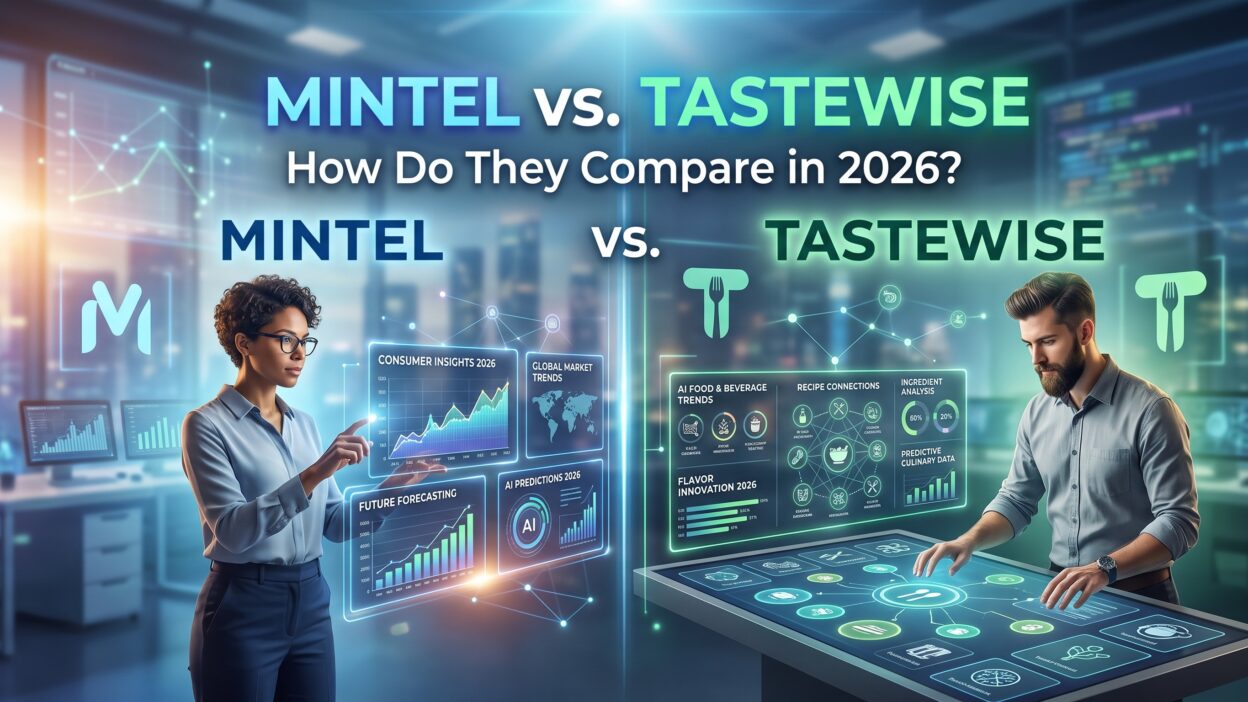
This guide explains Mintel vs. Tastewise in plain language. You will learn what each platform does. You will see how their data differs. You will compare speed, depth, coverage, and cost. You will also learn which type of team fits each tool.
The two products do not solve the same problem. One helps you understand a market. The other helps you spot what people want right now. Some teams need both. Some teams need only one.
Picking wrong wastes money. A large subscription sits unused when the tool does not match your questions. A wise choice saves months of guesswork.
You do not need a research degree to decide. You need clear goals and a few honest questions. Read on and build a simple shortlist.
Table of Contents
What Is Mintel?
Mintel is a market intelligence company. It started in London in 1972. Companies use it to study consumers, categories, and competitors. The firm covers many industries. Food and drink form one large part. Beauty, personal care, household goods, pet, and health form others.
Mintel covers food, drink, beauty, pet, health, and household products through analyst reports, consumer surveys, and a global product launch database. Research analysts write much of the content. They add context, opinion, and forecasts.
Reports and Analyst Expertise
Reports sit at the heart of the offer. Analysts study a category and explain its size, its drivers, and its risks. Readers get charts, survey results, and strategic advice. Strategy teams love this depth. Executives trust the brand name.
The Global New Products Database
The Global New Products Database, called GNPD, tracks launches around the world. Mintel describes tracking more than 45,000 new products each month across 86 economies. Teams use it to see what competitors ship. They study ingredients, claims, packaging, and pricing. The database supports benchmarking and gap analysis.
Consumer Surveys and Forecasts
Mintel runs consumer surveys in many markets. The results show attitudes and habits. Analysts turn the data into predictions. The yearly food and drink predictions reach far into the future. The 2026 predictions map trends through 2030 and beyond.
Mintel gives you a trusted view of the whole landscape.
What Is Tastewise?
Tastewise is a younger company. It started in Tel Aviv in 2017. It focuses only on food and beverage. Brands, retailers, and restaurant groups use it to spot demand early.
Tastewise describes itself as a generative AI consumer intelligence platform for food and beverage that studies real-time consumption data across social media, menus, and home cooking. The team wants to move users from a signal to an action.
Real-Time Data Sources
The platform pulls from menus, recipes, social posts, and online retail. It watches which dishes appear on restaurant menus. It tracks which recipes people search for. It tracks what people discuss online. One comparison cites more than one billion real-time consumer signals each month across 39 markets.
AI Agents and Outputs
Tastewise leans on AI agents. A user asks a question in plain language. The system searches its data and builds an answer. It can also draft outputs such as sell-in stories, campaign briefs, and concept ideas. The Sales Agent builds account-specific sell-in stories from live menu data, competitive positioning, and demand signals.
Fast Trend Detection
Speed defines the product. A new ingredient may show up on a menu or a video before any report covers it. Tastewise aims to catch that moment. Innovation teams use it to test ideas and follow rising flavors.
Tastewise gives you a live view of what people want now.
Mintel vs. Tastewise at a Glance
A quick summary helps before the details. Here is the core difference in Mintel vs. Tastewise.
Mintel helps teams understand a category, while Tastewise helps teams produce the output that moves a decision forward. Another way to say it: Mintel maps the competitive landscape. Tastewise maps the demand landscape.
Scope differs first. Mintel serves many industries. Tastewise serves food and beverage only. A beauty brand will find Mintel useful and Tastewise irrelevant. A food company may find value in both.
Data type differs next. Mintel relies on analyst research, surveys, and launch tracking. Tastewise relies on machine analysis of menus, recipes, and social data. One offers curated judgment. The other offers raw speed.
Time horizon differs too. Mintel shines at long-range planning. Its reports look across quarters and years. Tastewise shines at short-range action. It shows movement this week and this month.
Output style differs as well. Mintel delivers reports, databases, and expert commentary. Tastewise delivers dashboards, AI answers, and ready-made briefs.
Cost structure differs. Mintel sells reports and subscriptions across a broad range. Tastewise sells software access built for food teams. Pricing sections below explain more.
Company news matters here. One comparison reports that Mintel bought Black Swan Data in June 2025, which narrows the AI gap between the two firms. Expect Mintel to add more predictive tools over time.
No single winner exists. The right pick depends on your questions.
Data Sources and Coverage Compared
Data quality drives every insight. Look closely at what each platform collects.
Mintel’s Data Strengths
Mintel collects survey answers directly from consumers. It records product launches through a global tracking network. Analysts add interviews, sales data, and desk research. The mix gives a stable, verified picture.
The launch database stands out. You can search by ingredient, claim, brand, or country. You can see how many products carry a “low sugar” label in one market. You can compare that number with another market. Few tools match that depth for competitor tracking.
Geographic reach is wide. Mintel reports cover dozens of countries. Global brands value that spread.
Tastewise’s Data Strengths
Tastewise collects digital behavior. It captures menu additions, recipe searches, social engagement, and retail listings. One source reports that Tastewise claims menus from four million foodservice locations. Treat such figures as vendor claims and ask for proof in a demo.
Freshness stands out. New data arrives constantly. A flavor that starts to climb this month shows up quickly. That timing helps product developers and chefs.
Where Each Falls Short
Mintel data can lag. Surveys take time. Reports take time. A trend may already run hot before a report explains it.
Tastewise data can mislead. A social spike may reflect a short fad. Menu listings show what operators try, not what customers buy. Smart users check both signals before they commit money.
A Simple Example
Imagine a beverage team that studies sugar reduction. The team might use Mintel to see how many consumers cut sugar, then use Tastewise to check whether “low sugar lemonade” rises on menus and in online talk. Each tool answers a different half of the question.
Features and Workflow Compared
Features shape daily use. Consider how your team will work.
Research and Reporting
Mintel excels at structured research. You search a topic and find a report. The report follows a clear format. It explains the market, the shoppers, the competition, and the outlook. Teams cite these reports in decks and board memos. The format suits formal planning cycles.
Trend Tracking
Tastewise excels at trend tracking. A live tracker shows rising and falling topics by category. You filter by cuisine, ingredient, diet, or occasion. You see growth rates and links to real examples. The view feels more like a dashboard than a library.
AI Assistance
Tastewise puts AI at the center. Users build custom agents without code. The agents run tasks such as trend summaries, concept checks, and pitch decks. The system also connects to tools where teams already work.
Mintel now adds AI features to its own products. The Black Swan Data purchase supports that push. Expect more predictive tools from Mintel over time. Check the current feature list during a demo, because both roadmaps move fast.
Sales and Marketing Support
Tastewise reaches into commercial work. Sales reps use it to prepare pitches for retailers and restaurant operators. Marketers use it to plan campaigns around rising topics.
Mintel supports these tasks through insight and consulting. Its consultants advise on opportunities. The help feels more like guidance than software.
Ease of Use
Tastewise favors self-service. A new user can ask a question and get an answer in minutes. Mintel favors depth. New users may need time to learn the database and the report library. Both vendors offer training. Ask about onboarding before you sign.
Pricing in Mintel vs. Tastewise
Cost matters to every buyer. Neither vendor lists full prices on its own site, so expect a sales call.
One third-party comparison lists US Mintel reports at $4,995 each and one public Tastewise price of $5,000 per month per user. Treat those numbers as a starting point. Vendors change prices often. Real quotes depend on the plan, the number of users, the markets, and the contract length.
How Mintel Pricing Works
Mintel sells access in tiers. You may buy single reports. You may buy a subscription to a set of categories. You may add the launch database as a separate product. Large firms often sign multi-year deals across many teams. Costs rise with scope.
How Tastewise Pricing Works
Tastewise sells platform access. Price depends on the seats, the data modules, and the AI agent features. Mid-size and large firms make up most of the base. Small brands may find the entry cost high.
Questions to Ask Before You Buy
Ask what the base price includes. Ask about user limits. Ask how much extra data or extra markets cost. Ask about renewal increases. Ask for a trial or a pilot on your real questions. Get every number in writing.
Compare cost against the decisions each tool supports. A tool that guides one successful launch can repay its price many times over.
Which Platform Fits Which Team?
Match the tool to the job. Use these examples to picture your own team.
Choose Mintel When You Need Broad Market Context
Strategy teams need context. They study category size, growth, and long-term shifts. They prepare investor updates and annual plans. Mintel serves them well. Multi-category companies benefit most. A firm that sells food, beauty, and household goods can use one vendor for all three.
Consultants and agencies also value the report library. They cite trusted sources in client work. The Mintel brand adds weight to a recommendation.
Choose Tastewise When You Need Fast Food Signals
Product developers need early clues. They want to know which flavor, format, or diet trend gains speed. Tastewise gives that view. Restaurant groups use it to shape menus. Retail category managers use it to support new listings. Marketing teams use it to time campaigns.
Fast-moving snack, beverage, and foodservice brands gain the most. Their windows for action are short.
Use Both When Budgets Allow
Many firms pair the tools. One review notes that the smartest organizations often use one platform to understand the market with confidence and the other to find opportunity in real time. Mintel sets the strategy. Tastewise checks live demand. Together they cut risk.
Consider Other Options
Other vendors compete in this space. Euromonitor and Kantar compete on breadth. Innova Market Insights runs close to Mintel on launch tracking. Datassential goes deep on US foodservice. List a few names in your shortlist before you decide.
A Simple Test
Write your top five research questions. Sort them into two groups. Group one asks “what does the market look like?” Group two asks “what do people want right now?” The larger group points to your best fit.
Strengths and Limits of Each Tool
Every platform carries trade-offs. Honest lists prevent surprises.
Mintel Strengths
Mintel earns trust through long history. Analysts add expert judgment. The launch database covers a huge range. Multi-industry coverage suits diverse portfolios. Reports work well in formal presentations.
Mintel Limits
Cost can run high for small teams. Reports move at analyst speed. Food-specific trend detection feels less immediate than a live tracker. Some users find the platform dense at first.
Tastewise Strengths
Tastewise moves fast. The AI interface lowers the barrier for new users. Food-only focus means the data model fits the job. Outputs such as sell-in stories save preparation time. The platform links insight to action.
Tastewise Limits
Scope stays narrow. Non-food categories fall outside the offer. Social and menu data can show hype, not lasting demand. AI answers need human review. Some outputs reflect vendor claims that you should verify. Access costs can challenge small budgets.
What This Means for You
Neither weakness cancels the strengths. Each gap points to a use case. Fill the gaps with a second source or a human expert. Smart teams treat any single platform as one input, not the final word.
How to Run a Fair Trial of Both Platforms
Never buy from a slide deck. Test with your own questions.
Start with a real project. Pick a live decision, such as a new flavor line or a menu change. Write down the exact questions you need answered.
Request demos from both vendors. Ask them to answer your questions live. Watch how they search, filter, and export results. Notice how long each answer takes.
Check the depth of the answers. Ask for sources behind each claim. Ask how the tool handles conflicting signals. A good vendor explains limits without dodging.
Invite the people who will use the tool. Include a product manager, an analyst, and a marketer. Their feedback matters more than any sales pitch.
Compare outputs. Pull the same topic from both platforms. Look for overlap and gaps. Note which answer you would trust in a meeting.
Score each tool on a simple sheet. Rate accuracy, speed, ease of use, coverage, and value. Add comments. Share the sheet with your team and your finance lead.
Ask for references. Talk to customers in your category. Ask about support, renewals, and hidden costs. Past buyers tell you what sales reps skip.
Negotiate the contract. Ask for a pilot period, flexible seats, and clear renewal terms. Vendors often bend on terms when you show a strong shortlist.
Frequently Asked Questions
What is the main difference in Mintel vs. Tastewise?
Mintel focuses on structured research, surveys, and launch tracking across many industries. Tastewise focuses on real-time food and beverage signals with AI tools. One explains the market. The other shows current demand.
Is Tastewise a replacement for Mintel?
Not for most teams. Tastewise covers food and beverage only. Mintel covers many sectors and offers analyst-written reports. Some food teams may drop one tool if their needs are narrow.
Which tool is better for food startups?
Startups need speed and low cost. Tastewise may suit trend discovery. The price may challenge tiny budgets. Ask both vendors about entry plans. Free reports, trade articles, and public data can fill gaps early on.
Which platform suits restaurants and foodservice?
Tastewise leans toward menu and operator data. Restaurant groups use it to shape offers. Datassential also serves this space well. Mintel offers foodservice coverage too, though its strength lies in consumer research and packaged goods.
Does Mintel use AI now?
Yes, Mintel has added AI capabilities and expanded through acquisition. Check its current product pages for the latest tools. Roadmaps change quickly.
How accurate are trend predictions?
No tool predicts perfectly. Human judgment still matters. Compare signals across sources. Test ideas with real consumers before large launches.
Can I try either platform for free?
Both vendors usually offer demos. Free trials vary by plan and region. Ask the sales team what a pilot includes.
How often should I review my research tools?
Review them once a year. Check usage, cost, and results. Markets and products change. Your tools should keep pace.
Read More:-Verified Data for AI Agents: How GTM AI Grounds Agent Output
Conclusion

Choosing a research platform shapes how your team sees the market. A good tool sharpens every launch. A poor fit drains budget and patience.
Mintel brings depth, history, and broad coverage. Tastewise brings speed, AI, and a tight focus on food and beverage. The gap between them reflects two different ways to learn about consumers. One studies the market. The other listens to daily behavior.
Start with your goals. Write your key questions. Request demos. Test both platforms on a live project. Involve the people who will use the tool every week.
Keep your expectations realistic. No platform replaces judgment. Data supports decisions. People make them.
Revisit your choice each year. Vendors add features. Prices shift. Your needs grow.
The Mintel vs. Tastewise debate has no universal winner. It has a right answer for your team. Find it through a clear test, and invest with confidence.