Introduction
TL;DR Revenue teams used to wait. They waited for campaigns to warm up. They waited for leads to raise their hand. They waited for pipeline to build itself organically. That era is over.
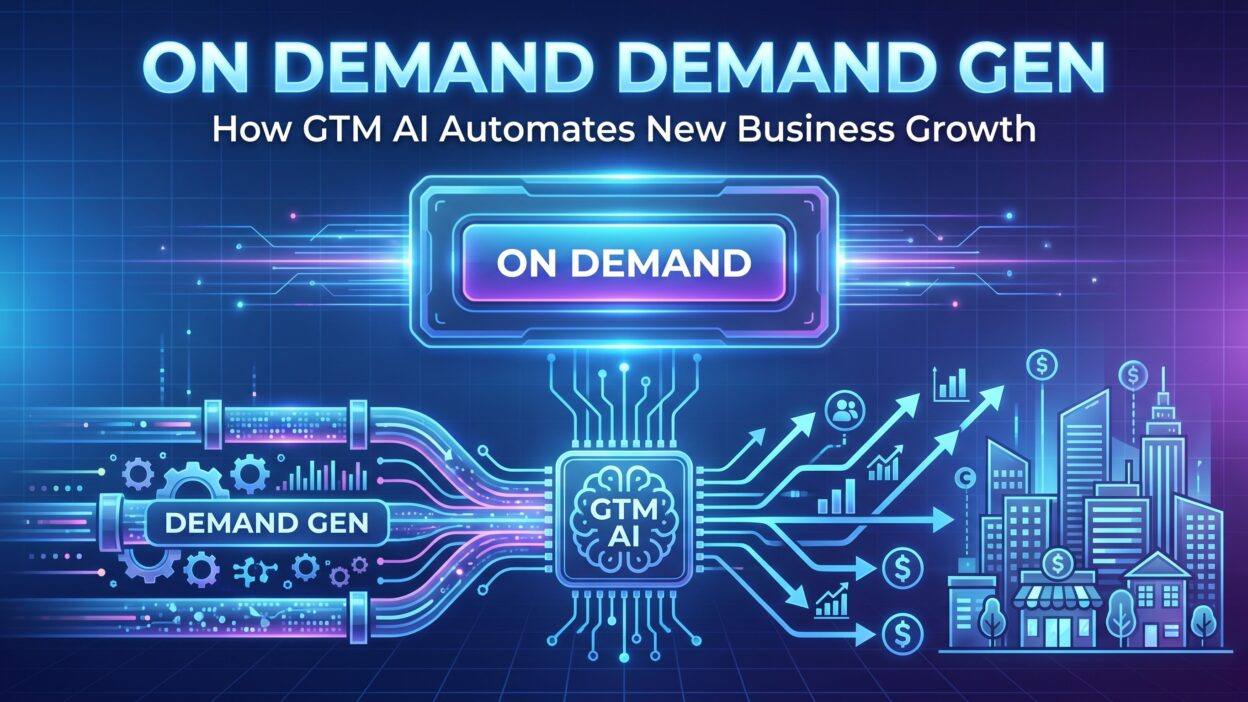
Go-to-market AI has flipped the demand gen model entirely. The best teams no longer react to market signals. They anticipate them. They act on them in real time. They generate pipeline on demand, not on luck.
This blog breaks down how GTM AI powers a smarter, faster demand gen engine. It covers the full picture, from identifying intent to automating outreach to measuring what actually drives revenue.
Table of Contents
What GTM AI Means for Modern Demand Gen
Go-to-market AI refers to artificial intelligence tools embedded directly into your sales and marketing execution layer. These tools do not just analyze data. They act on it. They trigger workflows, personalize content, and surface insights at the exact moment a team needs them.
For demand gen specifically, GTM AI changes three things. It changes how teams identify demand. It changes how teams create and distribute content. It changes how teams measure campaign performance against pipeline outcomes.
Traditional demand gen relied heavily on manual judgment. A marketer decided which segments to target. A writer created generic content. A campaign manager waited weeks for enough data to optimize. GTM AI compresses all of that.
AI-powered demand gen operates at a speed and scale no human team can match manually. It runs experiments continuously. It personalizes at the account level automatically. It shifts budget toward what works without waiting for a monthly review meeting.
The Shift From Campaign-Led to Signal-Led Demand Gen
Campaign-led demand gen runs on a calendar. A team plans a campaign, builds assets, launches on a fixed date, and hopes the market is ready. Signal-led demand gen runs on buyer behavior instead.
GTM AI monitors thousands of signals simultaneously. Website behavior, content consumption, job changes, funding announcements, and technology adoption all feed into a live signal layer. When a signal pattern indicates buying intent, the system acts immediately.
This shift turns demand gen from a push activity into a pull activity. The market tells you when to engage. AI tells you who to engage. Your team shows up with the right message at the exact right moment.
Why AI Fits Perfectly Into the Demand Gen Stack
Demand gen requires processing enormous volumes of data across channels, personas, and accounts simultaneously. Human teams hit capacity limits fast. AI does not.
AI handles pattern recognition, content generation, audience segmentation, channel optimization, and attribution modeling at scale. Each of these tasks used to require dedicated headcount. Now they run continuously inside your existing tech stack.
The teams seeing the biggest demand gen gains in 2026 are not the ones with the biggest budgets. They are the ones who integrated AI into every layer of their pipeline generation process.
How GTM AI Identifies and Captures Demand Before Competitors Do
The biggest competitive advantage in demand gen today is timing. Getting to a buyer before competitors do determines whether you lead the evaluation or fight for second place. AI creates that timing advantage systematically.
Demand gen used to mean waiting for a prospect to fill out a form and enter your funnel. Today it means identifying which companies are actively in-market before they ever raise their hand. That intelligence is what AI unlocks.
Using Intent Data to Drive Proactive Demand Gen
Intent data platforms track content consumption across thousands of publisher websites. When a company researches topics relevant to your solution, that activity generates an intent signal. AI processes these signals and ranks accounts by buying likelihood.
High-intent accounts enter your demand gen workflows automatically. They receive targeted ads. Their key contacts get personalized email sequences. Sales receives a prioritized list of accounts to pursue that day.
This approach to demand gen transforms the top of your funnel. You stop chasing cold accounts and start engaging warm ones. Your pipeline quality rises. Sales cycle length drops. Cost per opportunity decreases.
AI-Powered ICP Matching for Smarter Demand Gen Targeting
Your ideal customer profile determines which accounts deserve demand gen investment. AI continuously refines your ICP by analyzing patterns in your closed-won data. It identifies which attributes most strongly correlate with fast closes and high lifetime value.
These refined ICP attributes feed directly into your targeting layer. Your demand gen campaigns reach companies that look like your best customers, not just companies that fit a broad firmographic filter.
AI also flags accounts that match your ICP but have not yet entered your funnel. These are your highest-priority cold accounts for proactive demand gen outreach. Going after them first before intent signals appear gives you a first-mover advantage.
Automating Content Creation and Distribution in Demand Gen
Content is the fuel of demand gen. Without a consistent stream of relevant, high-quality content, campaigns run dry. Buyers disengage. Pipeline stalls. AI solves the content production bottleneck entirely.
AI content tools generate first drafts, suggest angles, repurpose long-form assets into channel-specific formats, and personalize messaging at the account and persona level. What used to take a week now takes hours.
Scaling Personalized Content Without Scaling Headcount
Personalization is the difference between demand gen that converts and demand gen that gets ignored. Generic content earns generic results. Account-specific, persona-relevant content earns attention and response.
GTM AI pulls data from your CRM, intent platforms, and enrichment tools to generate personalized content at scale. An email to the CFO at a manufacturing company reads completely differently from an email to the CTO at a SaaS company. AI creates both versions automatically.
This level of personalization used to require a team of copywriters working accounts one by one. Now it runs automatically as part of your demand gen workflow. Every account gets a tailored experience without additional headcount.
AI-Driven Content Distribution Across Demand Gen Channels
Creating great content solves only half the problem. Distribution determines whether the right buyer sees it at the right time. AI optimizes content distribution by analyzing which channels, formats, and timing combinations drive the most engagement per account.
Paid social campaigns adjust audience parameters automatically based on engagement data. Email send times optimize based on recipient behavior patterns. LinkedIn ads rotate creative based on account-level performance signals.
A well-integrated demand gen stack runs this optimization continuously. Budget shifts to the best-performing channels in real time. Underperforming assets pause automatically. Your team focuses on strategy while AI handles the execution mechanics.
GTM AI and Sales: Closing the Demand Gen to Revenue Gap
Demand gen creates pipeline potential. Sales converts it into revenue. The handoff between the two functions determines whether all that upstream investment actually pays off. AI bridges this gap with shared data and automated workflow triggers.
Too many demand gen programs produce engaged accounts that sales never prioritizes correctly. The account touched seven pieces of content, visited the pricing page twice, and attended a webinar. The sales rep still treats them like a cold prospect. AI prevents this failure.
Account Scoring That Connects Demand Gen to Sales Priorities
AI-powered account scoring synthesizes engagement data, intent signals, ICP fit, and CRM history into a single score per account. This score tells sales exactly which demand gen accounts deserve immediate attention.
When a demand gen account crosses a score threshold, an alert fires to the assigned sales rep. The alert includes the account’s full engagement history, the intent signals driving the score, and suggested next steps. The rep arrives in the conversation fully informed.
This connected workflow eliminates the friction that kills most demand gen investments. Marketing stops handing leads over a wall. Sales stops ignoring accounts they know nothing about. Both teams work from the same account intelligence in real time.
AI Sales Assistants That Accelerate Demand Gen Conversions
AI sales assistants help reps convert demand gen pipeline faster. They surface relevant case studies, suggest email templates based on the account’s profile, and flag when an account re-engages after a period of silence.
Conversation intelligence tools analyze sales calls and identify which talk tracks resonate most with accounts from specific industries or company sizes. These insights feed back into demand gen messaging so future campaigns improve continuously.
The loop between demand gen and sales intelligence creates a self-improving revenue system. The more deals you work, the smarter your targeting and messaging becomes. AI makes this feedback loop automatic.
Measuring Demand Gen ROI With AI-Powered Attribution
Measuring demand gen effectiveness has always been difficult. Buyers interact with eight to twelve touchpoints before closing. Crediting the right touchpoints with the right influence determines which programs get more budget and which get cut.
Traditional attribution models oversimplify this complexity. First-touch and last-touch attribution both misrepresent reality. AI-powered attribution models analyze the full buyer journey and assign fractional credit to every meaningful interaction.
Moving Beyond Vanity Metrics in Demand Gen Reporting
Impressions, clicks, and form fills look good on a dashboard. They do not tell you whether your demand gen program is actually building revenue. AI reporting layers shift the focus to pipeline influence, deal velocity, and revenue attribution.
Connect your demand gen data to your CRM outcomes. Track which content pieces appear in the journey of closed-won accounts. Identify which channels produce the fastest pipeline velocity. Optimize around revenue, not activity.
Leadership gains confidence in demand gen investment when reports speak in revenue terms. AI attribution makes this translation automatic. Every campaign connects directly to pipeline and closed business rather than proxy engagement metrics.
Predictive Analytics That Improve Future Demand Gen Performance
AI does not just measure what happened. It predicts what will happen. Predictive analytics models use your historical demand gen data to forecast which current accounts will convert and which campaigns will generate the most pipeline next quarter.
These forecasts guide budget allocation decisions before campaigns launch. You stop running programs based on gut feel and start running them based on modeled likelihood of success. Your demand gen budget works harder with every cycle.
Predictive models also identify when your current demand gen programs start showing diminishing returns. They flag the signal before performance visibly drops. Your team can adjust strategy proactively instead of reactively.
Building an AI-Powered Demand Gen Tech Stack for 2026
The right tech stack determines how effectively your team can execute AI-driven demand gen at scale. Not every tool needs to be cutting-edge. The priority is integration. Data must flow seamlessly between your platforms.
A modern demand gen stack in 2026 typically includes a CRM, a marketing automation platform, an intent data provider, a content intelligence tool, an AI writing assistant, a conversation intelligence platform, and a multi-touch attribution model. Each tool serves a specific function in the pipeline.
Essential AI Tools That Power Demand Gen Execution
CRM platforms like Salesforce and HubSpot now embed AI natively. They score leads, predict close likelihood, and recommend next best actions without requiring separate tools. Start with your CRM’s built-in AI features before adding new platforms.
Intent data providers like Bombora, G2 Buyer Intent, and TechTarget Priority Engine supply the demand-side signals your demand gen program needs to prioritize accounts accurately. These platforms feed data directly into your CRM and marketing automation workflows.
AI writing tools like Claude or Jasper accelerate content production without sacrificing quality. They generate email copy, ad creative, landing page content, and personalized outreach at the account level. Human editors review and approve final output.
How to Integrate Your Demand Gen Stack Without Creating Data Silos
The most common failure point in AI-powered demand gen is data fragmentation. Intent signals sit in one platform. CRM data sits in another. Email engagement lives in a third. When these systems do not talk to each other, the AI cannot synthesize a complete picture.
Use native integrations wherever they exist. Supplement with middleware tools like Zapier or Make to connect platforms that lack direct integrations. Build a centralized data warehouse if your team has the technical resources to manage one.
The goal is a unified account view. Every team member and every AI system should access the same account data simultaneously. This shared data layer is what makes AI-powered demand gen function as a system rather than a collection of disconnected tools.
Frequently Asked Questions About AI-Powered Demand Gen
How quickly can AI improve demand gen pipeline results?
Most teams see measurable improvements within the first 60 to 90 days of implementing AI-powered demand gen workflows. Intent-driven targeting typically shows faster pipeline velocity from the first campaign cycle.
Full impact compounds over time as AI models learn from your data. The longer your tools run, the more accurate your scoring, targeting, and content recommendations become. Demand gen performance improves continuously as the system accumulates data.
Does AI replace demand gen marketers or support them?
AI supports demand gen marketers rather than replacing them. It handles repetitive execution tasks, data analysis, and workflow automation. Marketers focus on strategy, creative direction, and cross-functional alignment.
The best demand gen teams in 2026 combine human strategic judgment with AI execution speed. Neither works as well alone. The combination consistently outperforms both traditional manual teams and fully automated systems without human oversight.
What is the biggest mistake in AI-powered demand gen implementation?
The most common mistake is adopting AI tools without cleaning the underlying data first. AI amplifies whatever data quality exists in your system. Poor CRM data produces poor AI recommendations. Data quality audit should come before AI implementation.
The second most common mistake is measuring AI-powered demand gen programs with the same vanity metrics used for traditional campaigns. AI-driven programs require revenue-centric measurement from day one. Set the right metrics before launch.
Can small marketing teams benefit from AI demand gen tools?
Small teams benefit most from AI demand gen tools because the leverage is greatest. A team of three with strong AI tooling can execute demand gen programs that previously required a team of ten. The cost per pipeline opportunity drops significantly.
Start with tools that serve multiple functions. An AI-powered marketing automation platform that also handles intent scoring and email personalization delivers more value than three separate point solutions requiring manual integration.
How does AI handle demand gen across different market segments?
AI excels at running simultaneous demand gen programs across multiple segments without additional headcount. Each segment receives tailored content, targeting parameters, and scoring logic based on its specific characteristics and conversion patterns.
Segment-specific learning happens in parallel. AI identifies which messages resonate with mid-market accounts while simultaneously optimizing for enterprise accounts. Each segment’s program improves independently based on its own performance data.
The Future of Demand Gen: Always-On Revenue Generation
The destination for AI-powered demand gen is an always-on revenue generation system. Not a campaign that runs for six weeks and pauses. Not a program that needs quarterly planning cycles to restart. A continuous, self-optimizing pipeline engine.
This system monitors your total addressable market in real time. It identifies which accounts move into an active buying phase. It launches personalized engagement sequences automatically. It alerts sales at the exact moment human intervention creates the most value.
The always-on demand gen model does not eliminate human marketers. It elevates them. They stop executing repetitive tasks and start making high-leverage strategic decisions about positioning, messaging, and market expansion.
Teams that build this system in 2026 create a structural competitive advantage. Their pipeline does not depend on campaign launches. It does not require perfect timing from a quarterly plan. It runs and improves every day regardless of what else is happening in the business.
Read More:-Engaging Customers, Expanding Revenue: 5 Marketing Success Stories
Conclusion

The shift to AI-powered demand gen is not a future trend. It is the current competitive reality. Teams that still run purely manual, campaign-calendar-driven programs are losing ground to teams that operate signal-led, AI-automated pipelines.
Start by auditing your data quality. Clean your CRM. Define your ICP using closed-won patterns. Layer intent data on top of your firmographic targeting. Connect your demand gen engagement data to your sales workflows.
Replace vanity metric reporting with revenue attribution. Give your sales team account intelligence, not just contact lists. Let AI handle execution optimization while your marketers focus on strategy and creative direction.
Every component of modern demand gen improves when you add AI to the execution layer. Targeting gets sharper. Content gets more relevant. Timing gets more precise. Measurement gets more accurate. Pipeline grows faster.
The companies winning new business at scale in 2026 built their demand gen engine on AI infrastructure. The window to gain a first-mover advantage in your market is still open. Build the engine now.