Introduction
TL;DR B2B marketing runs on data. The question is no longer whether your team collects data. The question is where that data comes from and how much you can trust it. First-Party vs Third-Party Data has become one of the most important decisions a B2B marketing or sales team makes this year. One data type comes straight from your own audience. The other comes through outside vendors and shared networks. Each one carries different accuracy, different cost, and different compliance risk.
This guide breaks down First-Party vs Third-Party Data in plain language. You will learn what each type means, how B2B teams collect it, and which one deserves more of your budget going forward.
Marketing leaders, RevOps teams, and sales operations managers all face this decision differently depending on their goals. A demand generation team weighs First-Party vs Third-Party Data against pipeline targets. A compliance officer weighs the same decision against legal exposure. This guide speaks to all three perspectives so your whole revenue team can align around one clear strategy.
Table of Contents
What Is First-Party Data
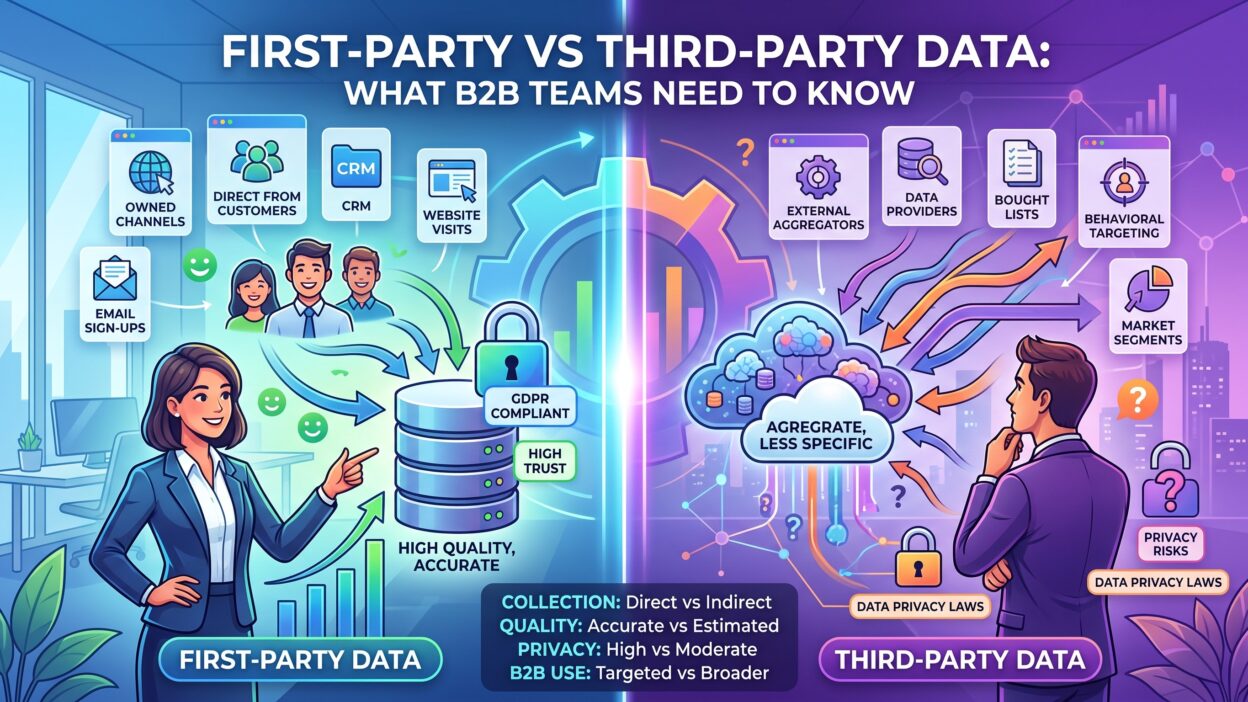
First-party data comes directly from your own audience. A visitor fills out a demo request form on your website. A customer opens your email and clicks a link. A prospect attends your webinar and answers a poll question. Every one of these actions creates first-party data.
Your company owns this data outright. Nobody buys it from a broker. Nobody licenses it through a third-party network. It sits inside your own CRM, your own marketing automation tool, and your own analytics dashboard.
This ownership gives first-party data a real advantage inside the First-Party vs Third-Party Data conversation. You know exactly where each data point came from. You know exactly when the person consented to share it. This traceability matters more every year as privacy rules tighten across regions.
B2B teams collect first-party data through several channels. Website forms capture contact details and firmographic information. Product usage data shows how customers actually use your platform. Sales call notes capture objections and buying signals no outside vendor could ever provide.
Common Sources of First-Party Data
Website analytics track page visits, session length, and content downloads tied to a known contact. CRM records store deal history, past purchases, and account notes your reps build over time. Email engagement data shows opens, clicks, and reply patterns across your subscriber list. Customer support tickets reveal pain points and product gaps directly from the people who use your product daily.
What Is Third-Party Data
Third-party data comes from outside sources unrelated to your direct customer relationships. A data broker aggregates information from multiple websites, apps, and public records. Your company then buys or licenses access to that aggregated dataset.
This data type built the foundation of digital advertising for over a decade. Ad platforms used third-party cookies to track visitors across websites and build broad audience segments. B2B teams bought intent data, firmographic lists, and contact databases from outside vendors to fill pipeline gaps quickly.
Scale stands out as the biggest strength inside the First-Party vs Third-Party Data comparison. A vendor database might hold millions of contacts across industries your own website never reached. This scale helps teams enter new markets or launch account-based campaigns without years of organic list building.
Accuracy tells a different story. Third-party records go stale fast. A contact changes jobs. A company merges or shuts down. Nobody updates the record until months later, if ever. B2B teams that lean too heavily on third-party sources often chase contacts who left a company long ago.
Common Sources of Third-Party Data
Data broker platforms sell firmographic and contact lists built from public records and web scraping. Intent data vendors track content consumption across publisher networks and sell aggregated buying signals. Third-party cookies still track some cross-site browsing behavior, though their reach has narrowed sharply across major browsers.
First-Party vs Third-Party Data: Core Differences
Both data types serve a purpose, but they differ across several important dimensions. B2B teams need to understand these differences before they build a data strategy around either one.
Collection Method
First-party data comes from direct interaction between your brand and your audience. A form fill, a purchase, a support ticket, each action builds this dataset one real interaction at a time.
Third-party data comes through indirect collection. A vendor gathers data across many unrelated sources, then bundles it into a product your team buys. You never interact with the person directly during collection.
Accuracy and Freshness
First-party data usually stays fresher because your own systems update it constantly. A customer updates their email address and your CRM reflects that change immediately.
Third-party data updates far less often. A vendor refreshes their database on their own schedule, sometimes only once or twice a year. This lag creates real accuracy problems for time-sensitive B2B campaigns.
Cost Structure
First-party data costs time and infrastructure to build. You invest in forms, tracking tools, and CRM systems, but you own the output forever once you build it.
Third-party data costs money upfront through licensing or subscription fees. You pay repeatedly for continued access, and the moment you stop paying, your access disappears.
Compliance Risk
First-party data carries lower compliance risk because you control the consent process directly. You know exactly what a person agreed to share and when they agreed to share it.
Third-party data carries higher compliance risk. You often cannot trace exactly how a vendor originally collected each record. Regulations like GDPR and CCPA put real pressure on companies that cannot show a clear consent trail.
Personalization Depth
First-party data supports deep personalization because it reflects real behavior tied to your product and your brand. You can trigger an email based on an actual page a prospect viewed on your site.
Third-party data supports broader targeting but shallower personalization. You might know a prospect’s job title and industry, but you rarely know their actual interest in your specific product.
Why This Comparison Matters More for B2B Teams Right Now
Third-party cookies have not disappeared the way the industry expected a few years ago. Google reversed its plan to fully block third-party cookies in Chrome, and Chrome still allows them today under a user-choice model. Safari and Firefox still block most third-party cookies by default, though. This patchwork creates real inconsistency for teams that built campaigns around cross-site tracking.
This shifting landscape makes the First-Party vs Third-Party Data decision more urgent, not less. A strategy built entirely around third-party cookies still faces partial blocking across major browsers. A strategy built around first-party data works no matter what any single browser decides next.
B2B buying cycles also favor first-party data naturally. A B2B purchase often takes months and involves several stakeholders. Your own website visits, content downloads, and product trial data capture this journey far better than an outside vendor list ever could.
Privacy regulation adds another layer of urgency. New state privacy laws continue to roll out across the United States, and international rules keep tightening as well. Teams that depend heavily on third-party data face growing legal exposure with every new regulation.
Buyer trust plays a role too. B2B buyers increasingly expect brands to know their actual history and actual context. A generic outreach email built from a purchased list feels disconnected compared to a message that references a real product interaction.
The Shift Toward a Hybrid Approach
Most mature B2B teams do not choose one side of First-Party vs Third-Party Data completely. They build a strong first-party foundation first, then use third-party data to fill specific gaps like new market entry or account discovery. This hybrid approach captures the strengths of both without over-relying on either one.
Benefits of First-Party Data for B2B Marketing
Trust builds faster when your outreach reflects a real relationship. A prospect notices when your email references their actual product usage instead of a generic industry pitch. This relevance drives higher reply rates and shorter sales cycles.
Personalization becomes far easier with first-party data as your foundation. Your team can trigger campaigns based on real behavior instead of broad assumptions about a job title or industry.
Cost efficiency improves over time as well. You pay upfront to build the systems that capture first-party data, but you avoid repeated licensing fees once those systems run. Many B2B teams see their cost per lead drop once first-party channels mature.
Compliance gets simpler too. You control the consent language, the opt-in process, and the storage location for every record. This control makes audits and regulatory requests far less stressful for your legal team.
Long-term value compounds the longer you invest. A first-party database built over three years reflects three years of real customer relationships. A third-party database bought last month reflects someone else’s snapshot from an unknown point in time.
Building Trust Through Transparent Data Collection
B2B buyers respond well when a brand explains why it collects certain data. A short note near a form field that explains how you will use the information builds real trust. This transparency turns data collection into a relationship-building moment instead of a hidden background process.
Some companies go a step further and let prospects view or edit the data stored about them. This level of transparency feels rare in B2B software today, so it stands out immediately. Prospects remember brands that treat their information with this kind of respect.
Limitations of Third-Party Data Today
Accuracy remains the biggest limitation. Job changes happen constantly in B2B roles, and most third-party databases lag months behind reality. A sales rep who reaches out to a contact who left the company six months ago wastes time and looks unprepared.
Browser restrictions continue to fragment third-party cookie tracking across different platforms. A campaign built entirely around cross-site cookie tracking now reaches a shrinking, inconsistent share of total web traffic.
Differentiation suffers too. Every competitor in your space can buy the exact same third-party list from the exact same vendor. This shared access makes it hard to stand out when everyone reaches the same prospects with similar messaging.
Compliance risk grows heavier every year. Regulators increasingly ask companies to prove clear consent for every data point they use. Third-party vendors rarely provide the detailed consent trail modern privacy law expects.
How to Build a Strong First-Party Data Strategy
Audit Your Current Data Sources
Start by mapping every place your company already collects data. List your website forms, your product analytics, your support ticket system, and your sales CRM. Most B2B teams find far more first-party data already sitting unused than they expected.
Create More Direct Capture Points
Add value exchanges that encourage prospects to share information willingly. A useful calculator, a detailed industry report, or a product trial all give visitors a real reason to share contact details. Avoid gated content that offers little real value in return, since this approach damages trust over time.
Centralize Data Inside One System
Scattered data across five different tools creates blind spots. Connect your website analytics, CRM, and marketing automation platform so every team sees the same customer picture. This single view prevents duplicate outreach and missed opportunities.
Build Clear Consent Processes
Write plain-language consent notices near every form field. Tell visitors exactly what you collect and exactly how you plan to use it. Clear consent protects your company legally and builds real trust with your audience at the same time.
Enrich First-Party Data Carefully
Some teams enrich their first-party records with select third-party data points like company size or industry classification. This light-touch enrichment adds useful context without replacing your core first-party foundation. Choose enrichment vendors that document their data sources clearly.
Train Your Sales Team to Capture Data Too
Sales conversations generate rich first-party data that often goes unrecorded. Train reps to log objections, buying triggers, and stakeholder details inside your CRM after every call. This habit turns every sales conversation into a lasting data asset.
When Third-Party Data Still Adds Value
Third-party data still plays a role inside a broader First-Party vs Third-Party Data strategy, especially for specific use cases. New market entry benefits from third-party firmographic data when your own first-party database holds little history in that market yet.
Account-based marketing programs often use third-party intent data to identify accounts researching a solution category before those accounts ever visit your website. This early signal helps sales teams prioritize outreach before a competitor reaches the same account first.
Competitive displacement campaigns sometimes rely on third-party technology data that shows which tools a target account currently uses. This context helps sales reps craft a more relevant pitch during early outreach.
Choose third-party vendors carefully when you do use this data. Ask each vendor how they collect and update their records. A vendor who cannot explain their consent process clearly deserves real scrutiny before your team signs a contract.
Measuring the Return on Your First-Party Data Investment
Track pipeline influenced by first-party channels separately from pipeline sourced through third-party lists. This split shows leadership exactly which investment drives real revenue over time. Most teams find first-party channels produce lower volume but higher close rates.
Watch your cost per qualified lead across both data types over several quarters. First-party costs often look higher in month one, since you pay for tools and content before any leads arrive. Costs usually drop below third-party benchmarks once your capture systems mature and start running on their own.
Monitor data decay rates too. Pull a sample of your first-party records and a sample of your third-party records every six months. Check how many contacts still hold accurate job titles and current employers. This simple audit shows the real accuracy gap between First-Party vs Third-Party Data sources inside your own database.
Survey your sales team about lead quality regularly. Reps notice quickly when a lead list wastes their time with outdated contacts. Their feedback often reveals data quality problems before any dashboard metric catches the issue.
Report these findings to leadership in plain terms every quarter. Show cost, close rate, and data freshness side by side for each source. This clear reporting builds the internal case for continued investment in first-party infrastructure.
Setting Realistic Timelines for First-Party Growth
First-party data programs take real time to build meaningful scale. A brand new capture system might only produce a few hundred qualified contacts in its first quarter. Growth compounds after that, since each new campaign, each new piece of content, and each new product feature adds fresh data points to your foundation. Set expectations with leadership early so nobody expects overnight results from a system built for long-term compounding value.
Common Mistakes B2B Teams Make
Many teams treat first-party and third-party data as interchangeable inside one shared database. This mixing creates confusion about which records carry verified consent and which do not. Keep clear tags that separate your data sources from the start.
Some teams over-invest in third-party lists without building first-party capture systems first. This approach creates short-term pipeline but no lasting owned audience. Balance both investments from the beginning instead of leaning entirely on one side.
Other teams collect first-party data but never activate it inside real campaigns. A CRM full of unused behavioral data provides no value sitting idle. Build workflows that actually trigger action based on the data you already hold.
Some teams skip a clear governance policy entirely. Nobody owns the decision about which data type feeds which campaign, so different teams pull from different sources inconsistently. Assign one owner who sets clear rules for how your company handles First-Party vs Third-Party Data across every department.
FAQs About First-Party vs Third-Party Data
What is the main difference in First-Party vs Third-Party Data? First-party data comes directly from your own audience through direct interaction. Third-party data comes from outside vendors who aggregate information across many unrelated sources.
Is first-party data always more accurate than third-party data? Generally yes, since your own systems update in real time as customers interact with your brand. Third-party databases update on a vendor’s schedule, which often lags months behind reality.
Do B2B teams still need third-party data at all? Many teams still use third-party data for new market entry or account-based marketing. Most mature teams treat it as a supplement rather than their primary data foundation.
How does privacy regulation affect First-Party vs Third-Party Data decisions? Regulations like GDPR and CCPA increase legal exposure for companies that cannot trace clear consent. First-party data usually carries a clearer consent trail than data purchased from outside vendors.
Are third-party cookies still active in 2026? Chrome still allows third-party cookies under a user-choice model after Google reversed its original deprecation plan. Safari and Firefox continue to block most third-party cookies by default, which creates inconsistent tracking across browsers.
How should a B2B team start shifting toward first-party data? Start with an audit of existing data sources across your website, CRM, and support systems. Then build clear consent processes and direct capture points that encourage prospects to share information willingly.
Read More:-Multi-Threading Campaigns by Persona
Conclusion

First-Party vs Third-Party Data is not a simple either-or decision for most B2B teams. First-party data gives you accuracy, trust, and long-term ownership over your audience relationships. Third-party data still offers scale and speed for specific use cases like new market entry.
The strongest B2B strategies build a solid first-party foundation first. They add third-party data only where it fills a real, specific gap. This balanced approach protects your team from shifting privacy rules and shrinking third-party cookie access across browsers.
Start with an honest audit of your current data sources today. Build clearer capture points across your website and sales process. The First-Party vs Third-Party Data balance you choose now will shape how well your team targets, personalizes, and converts B2B buyers for years to come.