Introduction
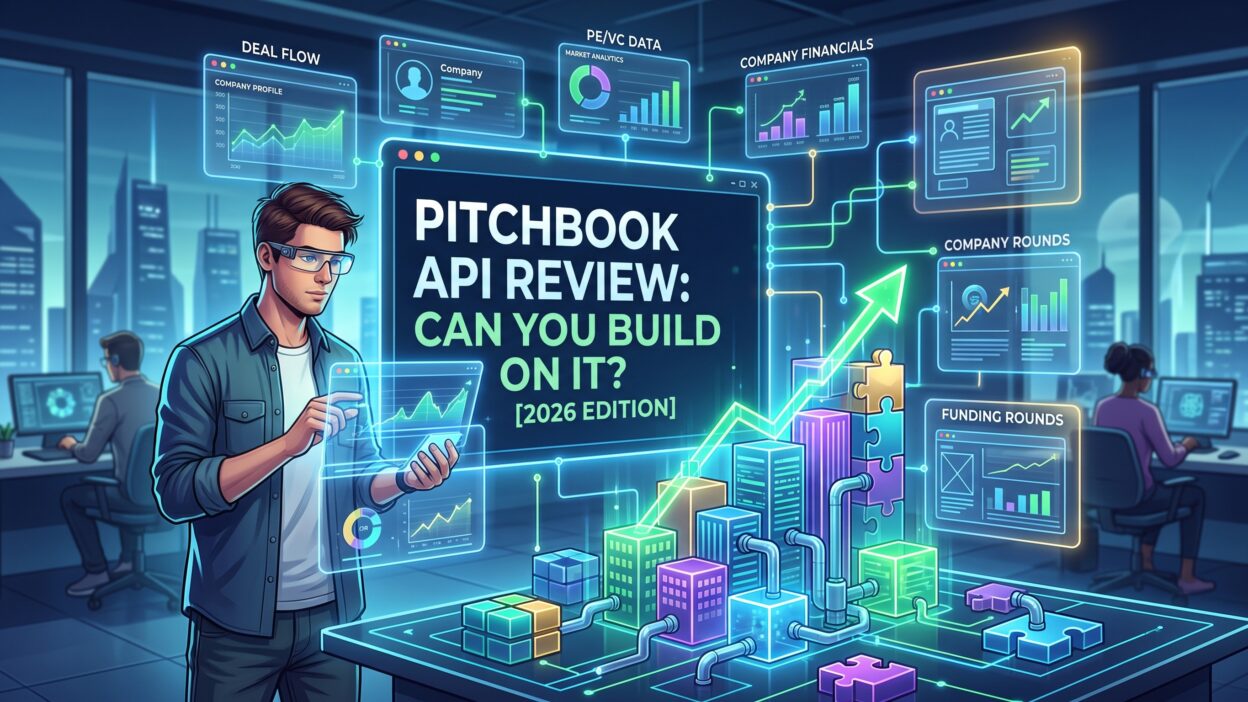
TL;DR Developers keep asking the same question before they sign anything. Can you actually build a real integration on the PitchBook API, or does the platform keep its best data locked behind a sales call? This PitchBook API Review answers that question with real detail, not marketing language.
This PitchBook API Review pulls from PitchBook’s own help documentation, its public product pages, and current 2026 technical write-ups from developers who went through the access process themselves.
Most people land on a PitchBook API Review after hitting the same wall. They want private capital market data inside their own product, their CRM, or their deal-sourcing tool. They search for endpoint docs and find almost nothing public. This PitchBook API Review exists to fill that gap and tell you exactly what you get once you do sign a contract.
PitchBook built its reputation on research quality, not open developer access. A team of over a thousand analysts refreshes records multiple times a day, and that human research layer is exactly what makes the dataset valuable in the first place. But that same enterprise-first posture shapes every part of the developer experience, from how you request access to how much you can test before paying anything. This PitchBook API Review treats that tradeoff as the central story, not a footnote.
Table of Contents
What Is the PitchBook API?
PitchBook runs one of the largest private capital datasets anywhere. This PitchBook API Review starts with what the API actually exposes, since that scope decides everything downstream.
What Data It Actually Covers
The API surfaces PitchBook’s core entity types through a RESTful JSON interface. Companies, investors, deals, funds, people, limited partners, and service providers all sit inside this one data model. Coverage spans venture capital, private equity, mergers and acquisitions, and private credit. The underlying dataset tracks millions of companies and hundreds of thousands of investors, refreshed multiple times a day by PitchBook’s own research team.
Each entity type breaks down further into relational sub-endpoints rather than one flat record per company or deal. A single company profile might link out to financing rounds, cap table changes, and connected people records, each reachable through its own call. This structure lets you pull exactly the data slice your integration needs instead of downloading an entire bloated payload every time.
Why Developers Search for This Review
Teams building deal-sourcing tools, fund benchmarking dashboards, or CRM enrichment pipelines all land here for the same reason. They need investment data that public sources cannot match, and PitchBook holds that data. The question this PitchBook API Review keeps circling back to is access, not accuracy. The data itself is strong. Getting to it takes real effort.
A second group shows up too: engineering leads scoping a build before committing budget. They want to know upfront whether the API supports their specific use case, what the integration timeline looks like, and whether the rate limits will handle their expected call volume. This PitchBook API Review answers those planning questions directly, using the clearest information available without a signed contract in hand.
PitchBook API Access and Authentication
Access works nothing like a typical developer signup, and this section of the PitchBook API Review matters most for anyone planning a launch timeline.
The Contract Gate Before You Write Any Code
There is no developer portal, no self-serve key generator, and no free trial for the API itself. The API sits inside PitchBook’s Direct Data product line, and getting it requires a standalone contract separate from a regular platform subscription. Existing PitchBook customers start through a plugins section inside their platform dashboard. New customers contact the Direct Data team directly and wait for a provisioning process to finish before receiving any credentials at all.
Authentication runs on API keys or token-based credentials, though the exact mechanics stay undocumented in public. Header placement, token expiry rules, and whether multiple keys are supported are details only a signed contract reveals. Single sign-on works for the core PitchBook platform, but it does not extend to the Direct Data API itself.
This gate exists for a reason worth understanding rather than just resenting. PitchBook’s data carries real licensing weight behind it: analyst research, historical financing records, and professional contact details that took real work to compile and verify. Any contract you sign will spell out usage rules around storage, redistribution, and whether records can train external models. Read that section closely, since a technically working integration can still violate a data license if your product exposes records beyond what the agreement permits.
Sandbox Access and Onboarding
PitchBook does offer a sandbox environment on request, giving contracted developers a space to test calls before going live in production. The Direct Data team walks new customers through onboarding during this phase, which suits a large enterprise buyer with a dedicated integration team. A solo developer or a small startup evaluating options gets none of that hand-holding without first committing financially.
PitchBook API Core Capabilities
Once access opens up, the actual data model covers real ground. This PitchBook API Review breaks down each major entity type developers work with, section by section, so you know exactly what each corner of the dataset gives you.
Companies and Deals
Company and deal endpoints form the center of the dataset. Financing details, deal stock information, and company attributes span millions of companies and millions of tracked investments across VC, private equity, and M&A activity. A team building a CRM enrichment pipeline pulls financing history and valuation data directly through these endpoints, keeping a portfolio database current without manual research every quarter.
Deal-level records include the transaction size, the round type, participating investors, and post-money valuation where disclosed. That granularity matters for a fund tracking its own portfolio companies against market comparables, since raw headline numbers rarely tell the full story without the surrounding transaction context attached.
Investors, Funds, and Limited Partners
Investor, fund, and limited partner data rounds out the fundraising side of the platform. Fund records include performance metrics, and LP profiles carry commitment history alongside mandate details. A fundraising intelligence tool tracking allocation preferences across hundreds of thousands of limited partners draws its data directly from this layer.
People and Service Providers
Person-level records cover executives, board members, advisors, and investment professionals across the private capital ecosystem. Service provider data adds law firms, accounting firms, and other deal advisors into the same relational structure. Together, this layer lets a developer connect a deal to the actual humans and firms behind it, not just the transaction numbers.
The VC Exit Predictor
One feature stands out from a typical financial data API. PitchBook includes access to a machine learning model called the VC Exit Predictor, which estimates exit probability for venture-backed companies. Reported accuracy sits around seventy-five percent, and top-decile predicted companies show a meaningfully higher likelihood of an actual exit event. A quantitative deal-sourcing tool built on this signal gets a real edge most financial data providers simply do not offer.
Configurable Universe and the Data Feed
Developers define a configurable universe, a scoped set of entities filtered by criteria like location or industry, and the API delivers near-real-time updates within that defined scope. This design favors targeted monitoring over exhaustive crawling. For bulk extraction needs, PitchBook points developers toward a separate Data Feed product instead, which delivers scheduled file batches to cloud storage destinations on a daily, weekly, monthly, or quarterly cadence. The API handles live queries. The Data Feed handles bulk delivery. Together they cover both access patterns, though each requires its own separate setup.
PitchBook API Documentation, SDKs, and Rate Limits
Technical evaluation gets harder here, and any honest PitchBook API Review has to say so plainly.
The Documentation Problem
Full endpoint documentation sits behind platform authentication and stays invisible to anyone without a signed contract. No public OpenAPI specification exists. No Swagger interface, no Postman collection you can download freely, and no code examples appear anywhere on PitchBook’s public site. A developer comparing this API against competitors cannot inspect request shapes or response schemas before committing money. Most data providers in this same category publish their reference docs openly, letting a team assess fit before signing anything.
A short internal help page does exist, describing the API in general terms and pointing contracted clients toward a fuller endpoint overview document. That overview stays locked behind the same authentication wall, so anyone still evaluating the platform gets marketing language rather than technical specification.
No SDKs, No Webhooks
PitchBook publishes no official SDK in any programming language. Every integration runs on raw HTTP calls, and your team owns the full authentication layer, error handling, and retry logic from scratch. Webhooks do not exist either. There is no push-notification pattern for real-time updates, so any workflow needing instant alerts on new deals or funding rounds has to poll the API on a schedule instead.
Undisclosed Rate Limits
No rate limit numbers appear in any public documentation. Constraints get set per contract, negotiated directly with the Direct Data team, and a developer planning capacity cannot estimate throughput before that negotiation happens. The API description hints at a design built for scoped, targeted queries against a limited entity universe rather than high-volume bulk pulls, which lines up with PitchBook steering large-scale needs toward its separate Data Feed product instead.
PitchBook API Pricing in 2026
Cost estimation stays genuinely difficult here, and this section of the PitchBook API Review gives you the clearest picture available without a sales call.
Two Separate Contracts
API access requires at minimum two layered agreements. The base PitchBook platform subscription comes first, priced by seat count and firm type without any published list price. The Direct Data contract sits on top of that as a separate, additional agreement, also quote-only and negotiated independently. You cannot get API access without first holding an active platform subscription underneath it.
Platform license terms typically run one to three years, billed upfront rather than month to month. That commitment structure suits an established investment firm planning multi-year infrastructure, but it makes the API a poor fit for a fast-moving startup wanting to test a hypothesis over a single quarter.
What a Developer Cannot Estimate
No per-call metering appears anywhere public. No credit-pack pricing, no minimum plan tier, and no published dollar figure exist on PitchBook’s site for either the platform or the Direct Data add-on. Total cost for a developer includes the platform subscription, the Direct Data contract, and whatever engineering time your team spends building the integration itself. Budgeting accurately means talking to sales early, since no public number gets you close to a real estimate on your own.
Third-party pricing trackers that monitor enterprise software deals suggest platform costs alone can run into meaningful five-figure territory annually for smaller teams, climbing higher for larger seat counts. Treat any such figure as a rough starting point rather than a firm quote, since PitchBook negotiates every deal individually based on your specific firm profile.
Can You Build a Full Integration on the PitchBook API?
This is the exact question the title asks, and the honest answer splits into two real parts.
What the API Covers Well
For anything inside private capital market intelligence, the answer leans strongly positive. Deal data, fund performance, LP commitment history, company financing records, and the exit prediction model all sit inside one coherent, well-maintained dataset. A team building deal-sourcing tools, portfolio monitoring dashboards, or fund benchmarking systems gets everything needed for that specific job. Nothing about the private market data itself feels incomplete or thin.
The B2B Contact Intelligence Gap
The gap opens once your build needs to move from investment data toward actual outreach. PitchBook’s API tells you a company raised a Series C at a specific valuation with named investors attached. It says nothing about who the VP of Engineering is at that company, what their verified email address looks like, or what technology stack their team runs day to day. There is no contact enrichment layer here, no direct-dial phone numbers, no buyer intent signals, and no org chart traversal. Ask the API to identify a decision-maker worth calling, and it has nothing to return, because that question sits entirely outside its documented scope.
Closing the Gap With a Second Data Source
Teams solve this the same way every time: pair PitchBook’s investment data with a dedicated B2B contact intelligence API. PitchBook identifies which companies matter based on funding activity, valuation trends, or exit probability. A separate contact database then supplies verified emails, direct-dial numbers, and org chart context for the actual people at those companies. Your integration layer bridges both, turning a raw deal signal into an actionable outreach list a sales or business development team can work from immediately. Answer the title question honestly, and it comes down to this: yes, you can build a real integration on the PitchBook API, but only within the boundary of private market data. Anything past that boundary needs a second source working alongside it.
PitchBook API Pros and Cons
A fair scorecard belongs in every serious PitchBook API Review, not just praise for a well-known data brand.
Coverage across companies, deals, investors, funds, and people stands genuinely strong, and few public data sources match the depth here. The relational endpoint structure lets you pull only the fields your integration actually needs, and near-real-time updates within a configured universe keep monitoring workflows current. The VC Exit Predictor adds a quantitative signal most financial data APIs simply do not offer at all.
On the downside, private documentation blocks any real evaluation before a contract gets signed. No published rate limits leave capacity planning as a guessing game until sales negotiations finish. No SDKs and no webhooks mean more engineering overhead than comparable APIs in this same category. And as this PitchBook API Review already covered, the entire B2B contact intelligence layer stays completely absent, forcing every serious outreach workflow toward a second vendor.
PitchBook API Alternatives Worth Considering
Any balanced PitchBook API Review should point toward real alternatives in the same space.
Crunchbase runs a public-facing API with far more accessible documentation and a genuine free tier for testing, though its depth on private fund performance and LP data trails PitchBook noticeably. Preqin focuses heavily on fund and LP intelligence for institutional investors, appealing to a narrower but deeper use case than PitchBook’s broader company coverage. S&P Capital IQ serves large financial institutions with a comparable scope, though its own API access process carries similarly heavy enterprise friction. Affinity leans toward relationship intelligence for dealmakers rather than raw market data, making it a complement rather than a direct substitute for most build scenarios.
Dealroom and Tracxn round out the field for teams focused more heavily on early-stage venture data across global markets, each offering somewhat more transparent pricing pages than PitchBook while trading away some depth on later-stage private equity and credit deals. None of these fully replaces PitchBook’s specific combination of breadth and research-backed accuracy, but each solves a piece of the puzzle PitchBook’s contract-gated model makes harder to test upfront.
Who Should Build on the PitchBook API in 2026
Enterprise investment firms already running a PitchBook platform subscription get the clearest path forward, since the contract negotiation folds naturally into an existing vendor relationship. Deal-sourcing platforms and fund analytics vendors serving institutional clients benefit most from the VC Exit Predictor and the depth of fund performance data available nowhere else at this scale. Teams building CRM enrichment tools for venture and private equity firms should plan for a real sales cycle before any engineering work begins, since no self-serve path exists anywhere in the process. Startups or smaller teams hoping to prototype quickly against a free trial should look elsewhere first, since PitchBook’s API offers no such option at any tier. Anyone whose product also needs to reach actual decision-makers at target companies should budget for a second, dedicated contact intelligence API from day one rather than discovering that gap mid-build.
Research and academic teams occasionally request access too, usually through a discounted institutional license rather than the standard commercial contract. That path still runs through the same sales process, just with different pricing at the end of the negotiation.
FAQs About the PitchBook API
Is the PitchBook API free to use? No. Access requires a paid platform subscription plus a separate Direct Data contract, both quote-only and negotiated through sales. PitchBook offers a free trial of its core platform, but that trial does not include API access at any point.
What is the PitchBook API rate limit? PitchBook does not publish rate limits anywhere in its public documentation. Constraints get negotiated per contract with the Direct Data team, and the API appears designed for scoped, targeted queries rather than high-volume bulk extraction, which PitchBook routes toward its separate Data Feed product instead.
Does the PitchBook API have official SDKs? No. PitchBook publishes no maintained SDK or client library in any language. Every integration runs on raw HTTP requests, and your team handles authentication, retries, and error handling entirely on its own.
Can I build a full recruiting-style outreach integration on the PitchBook API alone? Not entirely. The API covers private capital market data thoroughly: companies, deals, investors, funds, and people tied to specific transactions. It offers no verified contact emails, phone numbers, or org chart data, so any outreach workflow needs a second B2B contact intelligence source paired alongside it.
Does the PitchBook API support webhooks? No. There is no push-notification or event-driven delivery pattern documented anywhere publicly. Real-time monitoring requires polling the API on a schedule instead, while bulk scheduled delivery runs through the separate Data Feed product.
How long does PitchBook API access take to set up? Timelines depend on your existing relationship with PitchBook. A current platform customer typically moves faster through the Direct Data contract process than a brand-new customer, who needs both a platform subscription and a Direct Data agreement negotiated before any credentials arrive.
Is there a sandbox environment for testing the PitchBook API? Yes. PitchBook provisions a sandbox on request for contracted clients, giving developers a safe space to test calls before a production launch. This access opens only after signing a contract, not before, so it does not help with pre-purchase evaluation.
Read More:-Consensus API Review 2026: Can You Build a Custom Demo Workflow on It?.
Conclusion

This PitchBook API Review answered the core question honestly: yes, you can build a real integration on the PitchBook API, provided your project stays inside private capital market data. Companies, deals, investors, funds, LPs, and people all come through a well-structured, research-backed dataset that few competitors match in depth.
The friction sits entirely around access and evaluation. No public documentation, no published rate limits, no SDKs, and no self-serve trial mean every serious evaluation starts with a sales conversation rather than a line of test code. Budget real time for that process if your roadmap depends on a fast answer. The one gap this PitchBook API Review keeps returning to is contact intelligence. PitchBook tells you which companies matter based on funding activity. It says nothing about who to call there or how to reach them. Pair it with a dedicated B2B contact data source, and that gap closes cleanly. Build without that second layer, and your deal data stays sharp while your outreach stays exactly where it started: manual.