Introduction
TL;DR Recruiting teams pick Workable for its all-in-one hiring and HR platform. This Workable API Review asks the practical question behind that choice. Can you actually build real recruiting workflows on top of the API, or does the platform hold key pieces back? This Workable API Review walks through authentication, endpoints, webhooks, rate limits, and pricing, then answers the build question directly.
This Workable API Review draws on Workable’s own interactive documentation and current 2026 technical guides written by developers who tested the endpoints in production.
Engineers searching for a Workable API Review usually already know what they want to build. Maybe a custom careers page needs live job data. Maybe an internal dashboard needs candidate pipeline stats pulled automatically. Whatever the trigger, the answer depends on scope, and this Workable API Review breaks that scope down section by section.
Table of Contents
What Is the Workable API?
Workable runs a full REST API covering recruiting and core HR functions in one surface. Anyone opening a Workable API Review for the first time should know this upfront: the API goes well past applicant tracking alone.
REST Architecture and Current Version
The API sits at a subdomain-based URL unique to each account, following the pattern of your company name plus workable.com plus a versioned API path. Workable keeps the current release actively maintained, with the version number visible right in the documentation itself. Every response comes back as JSON, and there is no GraphQL alternative anywhere in the platform. A developer wanting GraphQL would need to wrap the REST layer themselves.
Who Searches for This Review
Three groups show up repeatedly in Workable API Review searches. Internal engineering teams want to sync candidate and employee data with a data warehouse or a BI tool. Product teams building HR tech tools want a pre-built connector into Workable’s ecosystem. Recruiting operations teams want to automate repetitive tasks like moving candidates through stages or triggering onboarding once someone gets hired. Each group needs a slightly different piece of the API, and knowing which piece up front saves real setup time.
Workable API Authentication Explained
Getting authenticated access takes far less friction here than on many competing ATS platforms, and this section of the Workable API Review covers exactly how that access works.
Bearer Tokens and Scope-Based Access
Every paid Workable plan includes API access, no separate developer signup required. You generate a token directly inside account settings, and that token appears only once at creation, so you need to store it securely right away. Every request carries the token inside a standard Authorization header using the Bearer scheme.
Two token types exist side by side. Account tokens cover most day-to-day operations: jobs, candidates, employees, departments, time off, and time tracking. User tokens handle a narrower set of sensitive actions, most notably approving or rejecting an offer, since Workable deliberately keeps that step tied to an actual human account rather than a generic service credential.
Scopes narrow what each token can touch. A token scoped to read-only candidate access cannot modify a single record, while a separate token scoped for employee writes can update HR data without ever touching offers. This granularity beats a flat all-or-nothing API key, and it matters most for teams running several integrations against the same Workable account at once. One real constraint worth flagging early: the API does not support cross-origin requests, so it runs server-side only. A browser-based application cannot call it directly and needs a backend proxy in front of it.
The MCP Server for AI Agents
Workable built a dedicated MCP server exposing dozens of tools for AI agent workflows, covering recruiting actions alongside HR tasks like time off and performance reviews. This surface uses a different authentication flow than the standard REST API. AI clients register themselves automatically through a dynamic registration standard, skipping manual credential setup entirely. For a team wiring Claude or another AI assistant into recruiting operations, this MCP layer removes a real chunk of integration work that a raw API alone would require.
Workable API Core Endpoints and Data Model
Every real Workable API Review needs to map the actual resources a developer touches, since the platform spans far more ground than a typical applicant tracker.
Jobs and the Public Careers Feed
Job endpoints handle listing, retrieving, and configuring postings, including the application form questions and pipeline stages tied to each role. A separate public endpoint requires no authentication at all and simply lists published jobs, which makes it the natural choice for a custom careers page. Building a branded job board on your own site becomes straightforward once you route through this open endpoint instead of the authenticated surface, since no API credentials ever need to leave your backend.
Candidates, the Deepest Resource Group
Candidate endpoints cover the fullest slice of the API by far. You can list candidates on a specific job, create new ones, retrieve full profiles, move a candidate between stages, disqualify or reinstate someone, copy a candidate to a different job, tag records, submit evaluations, and attach internal comments. Profile data includes contact details, resume links, social profiles across dozens of networks, and structured fields for education and work history.
This depth supports a real production use case: a CRM sync that pushes qualified sales contacts into Workable as candidates, tags them automatically by source, and pulls evaluation scores back out for reporting once a hiring manager reviews them.
Requisitions, Offers, and Talent Pool
Requisition endpoints manage the pre-job approval chain, covering headcount requests and budget routing, though this surface only activates for accounts running Workable’s Hiring Plan feature. Offer endpoints require user tokens specifically, reinforcing that approval decisions stay tied to a real person rather than an automated script. Talent pool endpoints let you build a long-term candidate database outside any active job pipeline, though reading from that pool through the API currently carries real limitations worth testing before you commit to a design.
Employees, Time Off, and Performance Reviews
Once a candidate becomes an employee, the API keeps working. Employee endpoints cover creating and updating records, retrieving org chart data, and managing attached documents. Time-off endpoints handle requests, approvals, balances, and policy configuration, while time-tracking endpoints support both individual entries and bulk uploads capped at five hundred records per call. Performance review templates round out the HR side, letting a system manage review cycles programmatically rather than through manual setup every quarter.
Workable API Webhooks and Event Coverage
Real-time automation depends on webhooks working well, and this Workable API Review found a functional but narrow event catalog here.
Supported Candidate and Employee Events
Webhooks run through a dedicated subscription endpoint, and setting one up takes a target URL plus an event type. Candidate coverage includes two events: a new candidate joining a job, and a candidate advancing between pipeline stages. Employee coverage runs wider, covering record creation, updates, publishing, onboarding completion, and time-off changes. Subscriptions can filter by job or by a specific pipeline stage, which lets a team subscribe only to a hired-stage trigger and kick off onboarding automatically the moment that happens.
Where the Event Catalog Falls Short
Gaps show up quickly for anyone planning a broader automation layer. There is no event for offer approvals, no trigger for requisition changes, no notification for job status updates, and no signal when an interview gets scheduled. A workflow depending on any of those moments has to poll the REST endpoints on a schedule instead of reacting in real time. Worth noting too: there is no dedicated event for candidate disqualification specifically, so a receiver has to inspect the payload data itself to detect that particular state change.
Workable API Rate Limits and Documentation
Every other part of the developer experience here stays well documented. Rate limits are the clear exception, and this section of the Workable API Review flags that gap directly.
The Undocumented Ceiling
Workable’s public documentation publishes no specific request-per-second figures, no burst allowances, and no per-tier quota tables anywhere. Independent developer reports and community bug trackers point to a real ceiling around ten requests every ten seconds on standard account tokens, with a meaningfully higher allowance for OAuth and partner-level tokens. None of that appears in the official docs though, which means a team planning a production sync has to discover actual throttling behavior through live testing rather than reading a published number ahead of time. Exceeding whatever the real limit turns out to be returns a standard 429 response, and response headers do carry remaining-quota information you can parse programmatically even without a documented baseline number.
No First-Party SDKs
Workable publishes no official SDK in any programming language, so every direct integration runs on raw HTTP calls from the ground up. The platform’s real answer to this gap is a set of unified API partnerships instead. Several third-party unified API platforms offer pre-built Workable connectors bundled inside a broader ATS and HRIS abstraction layer, letting a team skip building the auth and pagination logic themselves. The tradeoff is real too: those unified layers typically expose a smaller slice of the full API surface, so a build needing Workable-specific features like custom attributes or requisition workflows may still need a direct integration alongside the unified one.
Workable API Pricing in 2026
Cost structure here differs from most ATS platforms in one specific way worth understanding before you commit engineering time.
What Each Plan Includes
API access ships bundled into every paid tier rather than sitting behind a separate developer contract. The entry-level plan starts a bit under three hundred dollars monthly and includes full API access alongside data export and webhook support. A higher mid-tier plan bundles several premium add-ons like video interviews and texting on top of the same API access. The top enterprise-facing tier adds a dedicated account manager and single sign-on, billed annually only.
Headcount-Based Cost Scaling
Pricing scales by total company headcount rather than by recruiter seat count, which means unlimited users can join the platform at no extra license cost. This structure rewards a company with many hiring managers and few active recruiters, since everyone gets access without paying per seat. It works against a company with a large, stable headcount and low hiring volume, since that company pays a premium rate tied to size rather than actual recruiting activity. For a developer budgeting an integration project, treat the API itself as included cost and the headcount band as the real line item worth negotiating.
Can You Build Recruiting Workflows on the Workable API?
This is the exact question in the title, and this Workable API Review answers it directly with real nuance attached.
What the API Handles End to End
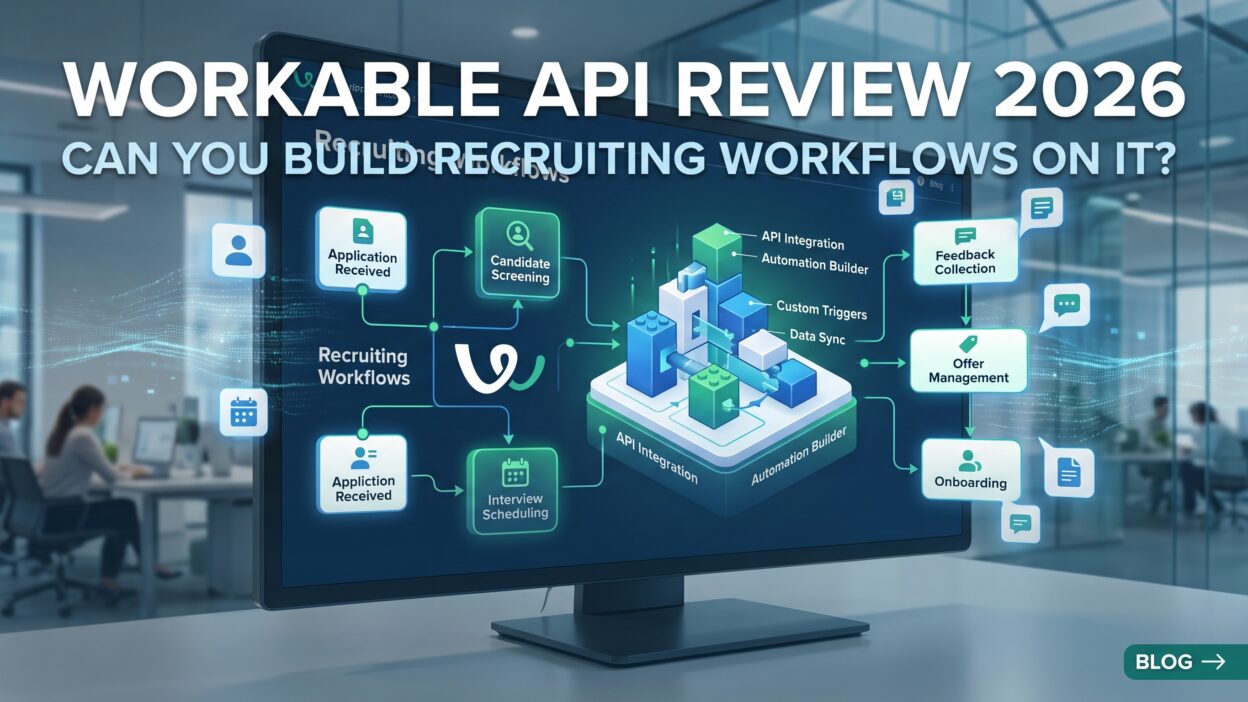
For anything happening inside active recruiting operations, the answer runs strongly positive. Job creation, candidate movement through pipeline stages, offer approval chains, requisition routing, and the full post-hire employee lifecycle all sit inside documented, well-scoped endpoints. A team building a custom careers portal, a CRM-to-candidate sync, or an internal recruiting analytics dashboard has genuinely everything needed inside this one API surface. Recruiting workflows in the narrow sense, meaning the mechanics of moving people through a hiring process, work well here.
The B2B Intelligence Gap
The gap opens once a workflow needs more than pipeline mechanics. Workable’s API knows a candidate’s name, resume, and current stage. It knows nothing about that candidate’s current employer beyond whatever the candidate typed into a form field themselves. There is no company database behind this API, no technographic data, no org chart for outside companies, and no way to verify whether a listed employer is actually accurate or current. Ask the API which companies show hiring signals worth targeting for outbound sourcing, and it returns nothing, since that question sits entirely outside its documented scope.
Closing the Gap With a Second Data Source
Teams solve this the same way every time: pair Workable’s pipeline management with a dedicated B2B intelligence API running alongside it. A separate data provider searches for candidates matching a specific target profile, verifies contact details, and enriches company data before anything ever reaches Workable. Once a recruiter decides to pursue someone, that enriched profile flows into Workable as a new candidate record. Workable manages everything from that point forward. The upstream data source handles everything before it. Answering the title question honestly means saying yes with a condition attached: yes for recruiting workflows once a candidate exists in your system, and only partially if you expect the API alone to also handle sourcing and company intelligence.
Workable API Pros and Cons
A fair scorecard belongs in any serious Workable API Review, not just a feature list copied from a marketing page.
Coverage across the full recruiting and HR lifecycle stands out immediately, spanning jobs, candidates, offers, requisitions, employees, time off, and performance reviews inside one coherent API. Scope-based tokens give real access control without requiring a heavier OAuth setup, and the dedicated MCP server puts AI agent integration within reach at no extra cost. Bundling API access into every paid plan, with no separate developer contract required, keeps the barrier to entry genuinely low compared to enterprise-gated competitors.
Weaknesses cluster around documentation and integration overhead. Rate limits stay undocumented in any official source, forcing teams to discover real throughput limits through production testing. No first-party SDK exists in any language, so every direct integration handles authentication and retries by hand. Webhook event coverage stays notably thin, missing triggers for offers, requisitions, and job status changes entirely. And as this Workable API Review already covered, the B2B intelligence layer simply does not exist inside this API at all.
Workable API Alternatives Worth Considering
Any balanced Workable API Review should point toward comparable platforms worth evaluating side by side.
Greenhouse runs a mature REST API popular with recruiting analytics vendors, generally requiring a heavier enterprise sales process than Workable’s straightforward bundled access. Lever offers a similar REST surface built around a CRM-style pipeline model, gated behind a partner program for any multi-tenant integration. BambooHR leans harder into core HR functionality with recruiting as a secondary feature, appealing to teams whose primary need sits closer to employee management than active sourcing. Unified API platforms deserve real consideration too, since several vendors already maintain pre-built Workable connectors alongside support for Greenhouse and Lever inside one normalized interface, letting a product team support all three without maintaining three separate integration codebases from scratch.
Who Should Build on the Workable API in 2026
Internal engineering teams at companies already running Workable get the most direct path, since API access ships with every paid plan and requires no separate approval process. HR tech vendors building AI-assisted recruiting tools should look closely at the MCP server, since it removes a real chunk of integration work compared to a raw REST build. Teams building a custom careers page should route through the public unauthenticated jobs endpoint rather than the full authenticated API, since it was purpose-built for exactly that job and needs no credentials at all. Companies planning heavy production-volume syncs should budget real testing time upfront to discover actual rate-limit behavior, since no published number exists to plan around in advance. Recruiting teams running active outbound sourcing campaigns need to plan for a second, dedicated B2B data source from day one, since Workable alone cannot identify or verify candidates who have not already entered its system.
FAQs About the Workable API
Is the Workable API free to use? Not on its own, but access ships bundled into every paid plan starting under three hundred dollars monthly. There is no separate API fee or metered charge, and no permanent free tier exists outside a limited trial period.
What is the Workable API rate limit? Workable does not publish an official rate limit figure anywhere in its documentation. Independent testing by developers points to roughly ten requests every ten seconds on standard tokens, with a meaningfully higher allowance available through OAuth or partner-level tokens.
Does the Workable API have official SDKs? No. Workable publishes no maintained SDK in any language. The platform instead supports several unified API partnerships that offer pre-built Workable connectors, though those typically expose a smaller subset of the full endpoint catalog than a direct integration.
Can I build a full sourcing and recruiting workflow using only the Workable API? You can build a complete pipeline-management workflow, covering everything from job posting through employee onboarding. You cannot source new candidates or verify company data through this API alone, since that intelligence layer sits entirely outside its documented scope.
Does the Workable API support GraphQL? No. Workable runs a REST API exclusively, returning JSON responses across every endpoint. A team wanting a GraphQL interface needs to build that wrapper layer themselves on top of the existing REST surface.
What events does the Workable API support through webhooks? Candidate events cover two triggers: new candidate creation and pipeline stage changes. Employee events cover five triggers: record creation, updates, publishing, onboarding completion, and time-off changes. There is no webhook coverage for offers, requisitions, or job status updates.
Does Workable offer an MCP server for AI agents? Yes. Workable runs a dedicated MCP server exposing recruiting and HR tools for AI agent workflows, available across every paid plan at no additional cost. It uses a separate authentication flow from the standard REST API, letting AI clients register automatically without manual credential setup.
Read More:-Seamless.AI HubSpot Integration: Complete Setup Guide [2026]
Conclusion

This Workable API Review answered the title question directly: yes, you can build real recruiting workflows on the Workable API, as long as those workflows stay focused on managing candidates who already exist inside your system. Authentication runs through clean, scope-based tokens, endpoints cover the complete hiring and HR lifecycle, and the dedicated MCP server opens real doors for AI-assisted recruiting automation.
Rate limits stay undocumented, which means real capacity planning happens through testing rather than reading a published number. The one gap this Workable API Review keeps returning to is intelligence. Workable manages a candidate’s journey beautifully once that person enters your pipeline. It says nothing about which companies deserve outbound attention or which candidates you have not found yet. Pair the Workable API with a dedicated B2B intelligence source, and that gap closes cleanly. Build without that second layer, and your pipeline stays well organized while your sourcing stays exactly where it started: manual.