Introduction
TL;DR Account-based marketing has changed how B2B teams work. Companies no longer waste budget chasing unqualified leads. They focus on high-value accounts from day one. The best ABM platforms make this possible at scale.
In 2026, the ABM software market is more competitive than ever. New AI features, better data integrations, and stronger analytics define the top tools. This guide covers the 10 best ABM platforms available right now. It also explains what to look for before you buy.
Table of Contents
What Is Account-Based Marketing and Why Does It Matter?
Account-based marketing (ABM) is a B2B strategy. It targets specific companies instead of broad audiences. Sales and marketing teams align around a shared list of target accounts. Every campaign, message, and touchpoint gets tailored to those accounts.
ABM drives higher ROI than traditional lead generation. Studies show ABM delivers better pipeline quality. Deal sizes grow. Sales cycles shrink. The best ABM platforms give teams the tools to execute this at scale.
In 2026, ABM is not optional for enterprise B2B teams. It is a core growth strategy. Without the right platform, execution becomes slow and fragmented. The right tool ties everything together: data, targeting, engagement, and measurement.
What to Look for in the Best ABM Platforms
Choosing an ABM platform is a significant decision. Many vendors claim to offer the best ABM platforms, but features vary widely. Here are the key areas to evaluate.
Account Intelligence and Data
Strong ABM starts with clean, accurate account data. The platform must identify your ideal customer profile. It should surface buying signals and intent data. Without this, targeting remains guesswork.
Multi-Channel Engagement
The best ABM platforms reach accounts across channels. Display ads, email, LinkedIn, and website personalization all matter. A platform that covers only one or two channels limits your reach.
CRM and Marketing Automation Integration
Your ABM tool must connect with your existing stack. Salesforce, HubSpot, Marketo, and similar tools need clean data flow. Disconnected systems create data silos. Silos kill campaign performance.
Measurement and Attribution
ABM measurement is different from traditional demand generation. You track account engagement, pipeline influence, and deal progression. The best ABM platforms provide account-level dashboards. They show which campaigns move accounts through the funnel.
Ease of Use and Support
A powerful platform is useless if the team cannot use it. Onboarding time, UI quality, and customer support all matter. Look for platforms with strong documentation and responsive support teams.
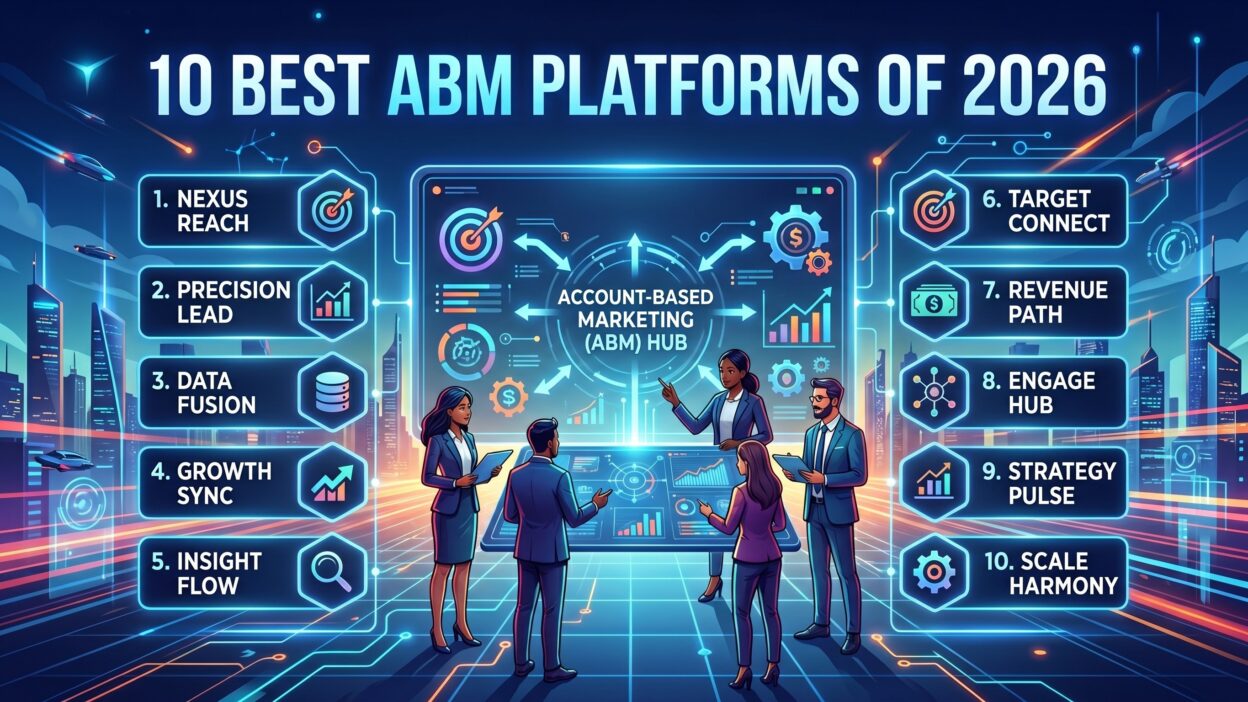
10 Best ABM Platforms of 2026
Below are the top 10 picks for the best ABM platforms in 2026. Each platform has distinct strengths. Match the platform to your team size, budget, and go-to-market motion.
1. Demandbase — Best for Enterprise ABM
Demandbase is one of the original ABM platforms. It has grown into a full go-to-market suite. The platform covers account intelligence, advertising, engagement, and analytics. Enterprise teams with large target account lists rely on Demandbase heavily.
Demandbase uses AI to identify accounts showing buying intent. It combines first-party and third-party data for richer signals. The advertising module serves display and LinkedIn ads to target accounts. Account scoring helps sales teams prioritize outreach.
The platform integrates with Salesforce, Marketo, HubSpot, and many other tools. Reporting is detailed and customizable. Demandbase is expensive, but enterprise teams get strong ROI. It earns a top spot among the best ABM platforms for large organizations.
2. 6sense — Best AI-Powered ABM Platform
6sense is widely regarded as one of the best ABM platforms for AI-driven insights. Its Revenue AI engine predicts which accounts are in-market. It identifies where accounts sit in the buying journey before they fill out a form.
6sense maps anonymous research activity to known companies. It shows which keywords, topics, and competitors accounts are researching. This data helps marketing craft highly relevant messaging. Sales teams know when to reach out and what to say.
The platform integrates with major CRM and MAP tools. Its orchestration features automate outreach across email, ads, and SDR workflows. 6sense is a premium option. It delivers outstanding results for mid-market and enterprise B2B teams.
3. Terminus — Best for Multi-Channel ABM Execution
Terminus built its reputation on account-based advertising. It expanded into a full multi-channel ABM suite. The platform covers display ads, email signatures, chat, and web personalization. Teams use it to surround target accounts with consistent messaging.
Terminus integrates directly with Salesforce and HubSpot. Its account hub gives sales and marketing a shared view of account engagement. The chat module connects website visitors to sales reps in real time. Terminus suits mid-market teams that need broad channel coverage.
Pricing is competitive within the best ABM platforms space. Onboarding is straightforward. Customer support earns strong marks. Terminus is a solid choice for teams building their first ABM program.
4. RollWorks — Best ABM Platform for Growing Teams
RollWorks targets mid-market B2B companies. It offers account identification, targeting, and measurement in one platform. The tool is more affordable than Demandbase or 6sense. This makes it accessible for teams scaling their ABM programs.
RollWorks pulls intent data from Bombora. It pairs that with its own account scoring model. Display ads run across a large partner network. LinkedIn integration enables social ad targeting for the same accounts.
HubSpot and Salesforce integrations are strong. Reporting shows account engagement and pipeline impact. RollWorks is one of the best ABM platforms for teams that want enterprise features at a mid-market price point.
5. HubSpot ABM Tools — Best for HubSpot Users
HubSpot added native ABM tools to its CRM platform. For teams already on HubSpot, this is a natural choice. There is no additional integration work required. Data flows seamlessly between marketing, sales, and service hubs.
HubSpot ABM features include ideal customer profile (ICP) identification, account-level reporting, and company scoring. Target account lists sync directly with HubSpot workflows. Email sequences and ad campaigns get triggered by account activity.
HubSpot ABM works best for SMBs and mid-market companies. It lacks the depth of dedicated ABM platforms. However, it is one of the best ABM platforms for teams that prioritize simplicity and native CRM integration.
6. Madison Logic — Best for Content-Led ABM
Madison Logic focuses on content syndication and intent data. It helps B2B marketers reach in-market accounts with targeted content. The platform distributes content across a large publisher network. Accounts receive relevant content at the right stage of their journey.
Madison Logic partners with Bombora for intent signals. It identifies accounts actively researching relevant topics. Campaigns get optimized toward accounts showing the strongest buying signals. Measurement shows which content influences pipeline.
The platform integrates with Marketo, Eloqua, HubSpot, and Salesforce. Madison Logic suits marketers who lead with content. It earns a strong position among the best ABM platforms for content-driven demand generation teams.
7. Jabmo — Best ABM Platform for Manufacturing and Industrial B2B
Jabmo serves a niche but important segment. It focuses on manufacturing, industrial, and life sciences companies. These sectors have long sales cycles and complex buying committees. Jabmo tailors its ABM approach for these industries.
The platform provides account-level analytics and multi-channel engagement. It tracks anonymous account visits and matches them to target accounts. Campaigns run across display, email, and content channels. Sales teams get alerts when target accounts show increased engagement.
Jabmo integrates with major CRM platforms. Its industry-specific templates and workflows speed up setup. For industrial B2B marketers, Jabmo is one of the best ABM platforms available in 2026.
8. Triblio (Foundry ABM) — Best for Orchestration
Triblio, now part of Foundry, offers strong campaign orchestration capabilities. It lets marketers coordinate ads, web personalization, and sales plays from one platform. The orchestration engine triggers actions based on account engagement signals.
Triblio connects account intent data with campaign execution. When an account hits a certain engagement score, the platform triggers a sales alert or an ad campaign. This closes the gap between data and action. Teams move faster and more efficiently.
The platform integrates with Salesforce and Marketo. Reporting covers both account engagement and campaign performance. Triblio earns its place among the best ABM platforms for teams that want sophisticated workflow automation.
9. Metadata.io — Best for Paid Media ABM
Metadata.io specializes in B2B paid media automation. It connects to LinkedIn, Facebook, and Google Ads. The platform automates campaign management and budget optimization. Targeting uses first-party CRM data and intent signals.
Metadata.io runs experiments across ad variations automatically. It identifies the highest-performing combinations and allocates budget accordingly. This saves time and improves ad performance. Marketing teams stop wasting budget on underperforming ads.
The platform integrates with HubSpot, Salesforce, and Marketo. It suits demand generation teams running heavy paid media programs. Metadata.io is one of the best ABM platforms for marketers who want to maximize ROI from digital advertising.
10. Clearbit (Now Breeze by HubSpot) — Best for Data Enrichment in ABM
Clearbit, acquired by HubSpot and rebranded as Breeze Intelligence, powers data enrichment for ABM programs. It identifies anonymous website visitors and matches them to company records. Target account lists get enriched with firmographic and technographic data.
Breeze Intelligence feeds clean, accurate data into ABM campaigns. Sales teams know exactly who is visiting the website. Marketing teams segment accounts based on company size, industry, and technology stack. This data precision lifts campaign performance significantly.
The tool integrates natively with HubSpot and works with other CRM platforms via API. For teams that want to sharpen their account data quality, Breeze Intelligence deserves consideration as one of the best ABM platforms for data-led ABM programs.
Comparing the Best ABM Platforms: A Quick Overview
Each platform in this list targets a slightly different use case. Demandbase and 6sense lead for enterprise teams with large budgets. RollWorks and Terminus are strong for mid-market companies. HubSpot ABM suits teams already invested in that ecosystem.
Madison Logic wins for content syndication. Jabmo is the clear choice for industrial sectors. Metadata.io stands out for paid media automation. Triblio excels at orchestration. Breeze Intelligence fills the data enrichment gap.
No single platform is best for every company. Evaluate each option against your team size, budget, tech stack, and go-to-market strategy. Request demos. Run pilot programs. The best ABM platforms should deliver measurable pipeline impact within the first 90 days.
How to Choose the Right ABM Platform for Your Business
Start with your ICP. Know which accounts you want to target. Understand how large your target account list is. Some platforms handle thousands of accounts. Others optimize for focused lists of 200 to 500 accounts.
Map your current tech stack. Check which platforms integrate natively with your CRM and MAP. Poor integrations create data quality problems. Data quality problems hurt campaign performance.
Define your primary ABM use case. Is it advertising? Intent data? Content distribution? Orchestration? Match the platform’s core strength to your primary need. Secondary features matter less than the core capability.
Set a realistic budget. The best ABM platforms range from $20,000 to $300,000 per year. Factor in onboarding, implementation, and training costs. Ask about customer success support included in the contract.
Talk to reference customers. Speak with companies similar in size and industry. Ask about time to value. Find out what challenges they faced during onboarding. This intelligence is more valuable than any vendor demo.
ABM Trends Shaping the Best ABM Platforms in 2026
AI-powered intent data is standard in 2026. Every major platform now uses machine learning to surface buying signals. The quality of the AI model separates the best ABM platforms from average ones.
Buying committee targeting has become more sophisticated. Platforms now track multiple stakeholders within one account. They serve different messages to different personas based on role and engagement history.
First-party data is now central to ABM strategy. As third-party cookies disappear, platforms rely more on CRM data and owned website data. Platforms that help enrich and activate first-party data deliver stronger results.
Revenue intelligence integration is growing. ABM platforms now connect with conversation intelligence tools like Gong and Chorus. This gives marketing teams insight into what happens after an MQL becomes an opportunity.
Frequently Asked Questions About the Best ABM Platforms
What is the best ABM platform for small businesses?
HubSpot ABM tools and RollWorks are the most accessible options for smaller teams. They offer strong features at a lower price point. HubSpot works best for teams already using the HubSpot CRM. RollWorks suits teams that want dedicated ABM capabilities without enterprise pricing.
How much do the best ABM platforms cost?
Pricing varies significantly. Entry-level plans start around $15,000 to $25,000 per year. Enterprise platforms like Demandbase and 6sense can exceed $100,000 annually. Most platforms offer custom pricing based on account volume, seats, and features.
Do ABM platforms replace marketing automation tools?
No. The best ABM platforms complement marketing automation. They do not replace it. ABM platforms handle account targeting, intent data, and advertising. Marketing automation handles email nurture, lead scoring, and campaign execution. The two tools work together.
How long does it take to see results from ABM platforms?
Most teams see early engagement metrics within 30 to 60 days. Pipeline impact typically shows up at the 90-day mark. Full program optimization takes six to twelve months. Set realistic expectations with leadership before launch.
What data integrations matter most in ABM platforms?
CRM integration is the most critical. Salesforce and HubSpot are the most common. Marketing automation integrations with Marketo, Eloqua, or Pardot come next. Intent data providers like Bombora and G2 Buyer Intent are also important for enriching account signals.
Can ABM platforms support international campaigns?
Yes. Most of the best ABM platforms support global campaigns. Check for GDPR compliance and data residency options if targeting European accounts. Some platforms have stronger coverage in specific geographies. Verify regional data quality before committing.
Read More:-3 Key Takeaways From Scott Brinker: The Man Behind the Martech Supergraphic
Conclusion

The best ABM platforms in 2026 give B2B teams a real competitive edge. They combine intelligent data, multi-channel execution, and precise measurement. The result is more pipeline, better win rates, and shorter sales cycles.
Demandbase, 6sense, Terminus, and RollWorks lead the market for most use cases. HubSpot ABM, Jabmo, Madison Logic, Triblio, Metadata.io, and Breeze Intelligence each fill specific niches with strength.
Your choice should match your team’s maturity, budget, and primary ABM use case. Start small. Prove value fast. Scale what works. The best ABM platforms make that journey faster and more efficient.
ABM is not a campaign. It is a long-term go-to-market motion. Invest in the right platform. Align your sales and marketing teams around it. The results will follow.