Introduction
TL;DR A buyer lands on your pricing page. They have questions. The answer is not obvious from the page copy. They open a chat window. No one is there. They close the tab and move to a competitor.
That scenario plays out hundreds of times a day on B2B websites. B2B live chat exists to stop that from happening. It puts a real person or a smart bot in front of your best prospects at the exact moment they want answers.
This guide covers everything marketing and sales teams need to know about B2B live chat in 2026. You will learn how it works, why it drives pipeline, how to set it up the right way, and which tools lead the market. By the end, your team will have a clear path to a chat program that converts.
B2B buying journeys are long. Decisions involve multiple stakeholders. Budget cycles are slow. Any tool that shortens the path from question to conversation deserves serious attention. B2B live chat is that tool. It creates synchronous moments in an otherwise asynchronous sales process.
Table of Contents
What Is B2B Live Chat?
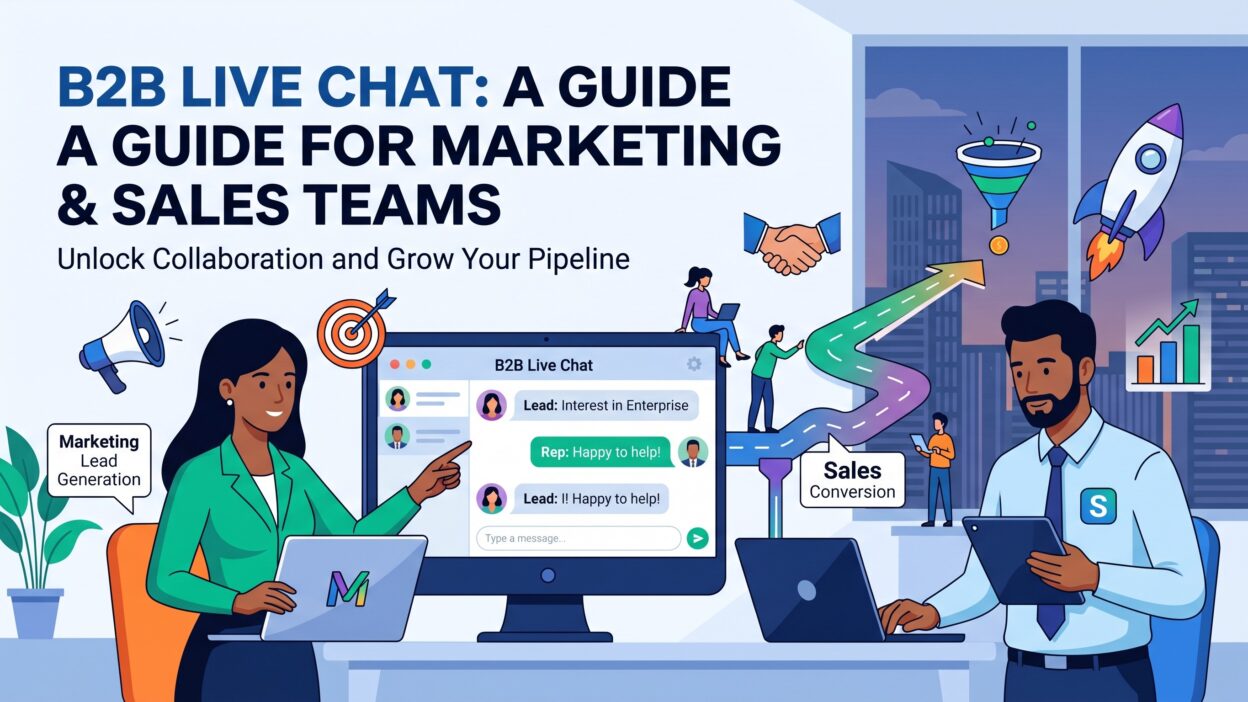
B2B live chat is a real-time messaging channel embedded on a business website or web application. It allows buyers to start a conversation with a sales rep, marketing team, or support agent directly from the browser. No email required. No phone call needed. Just a question and an immediate response.
B2B live chat differs from B2C chat in both audience and purpose. B2C chat often handles order tracking and returns. B2B live chat handles complex product questions, demo requests, qualification conversations, and objection handling. The conversations are longer, more technical, and higher stakes.
Modern B2B live chat platforms combine human agents with AI-powered bots. Bots handle initial qualification, routing, and off-hours coverage. Human reps take over when the conversation reaches a certain point of complexity or buying intent. This hybrid model keeps response times fast without burning out the sales team.
B2B live chat sits inside the broader conversational marketing category. It works alongside email, paid media, and inbound content. Its unique value is immediacy. A prospect asking a question in chat is showing real-time intent. That signal is more actionable than a content download or a cold call list.
In 2026, B2B live chat has evolved well beyond a simple chat widget. The best platforms identify the account behind the visitor, route conversations to the right rep, and trigger automated plays based on the pages the visitor has browsed. It is a revenue tool, not just a support feature.
Why B2B Live Chat Matters for Revenue Teams
Speed is the primary reason B2B live chat drives revenue. Harvard Business Review research has shown that B2B companies responding to inquiries within five minutes are far more likely to have a meaningful conversation than those who wait even 30 minutes. Chat makes sub-minute response times possible.
Pipeline quality improves with B2B live chat. A prospect who initiates a conversation is self-selecting as engaged. They are not a cold name on a list. They chose to reach out. That act of reaching out signals a level of intent that most top-of-funnel channels cannot replicate.
Sales cycles shorten when chat is part of the process. A rep can qualify a prospect, answer objections, and book a demo in a single chat session. That same process over email might take three days and six messages. Chat compresses the timeline. Compressed timelines mean faster revenue.
Website conversion rates increase with well-placed B2B live chat. A visitor who interacts with chat converts to a meeting or lead at a significantly higher rate than one who browses anonymously. Chat gives the website a voice. That voice catches visitors before they bounce.
Account-based marketing programs benefit significantly from B2B live chat. When a target account visits the website, chat can trigger an alert to the account owner. The rep engages in real time. The conversation happens while the account is actively researching. This timing advantage is one of the most valuable capabilities the channel offers.
How B2B Live Chat Works: The Technical Basics
A B2B live chat system starts with a script or widget installed on the website. The widget loads when a page renders. It may appear as a chat button in the corner, a proactive pop-up message, or a full-page conversational form depending on the configuration.
Visitor Identification
Most modern B2B live chat platforms identify the company behind an anonymous visitor using reverse IP lookup. When a visitor lands on the site, the platform checks their IP address against a database of company records. Within seconds, the system knows which company is visiting, what industry they are in, and how large the company is.
This account identification layer changes how chat gets used. Instead of treating every visitor the same, the platform can serve different chat experiences to different account segments. A visitor from a target account gets a personalized greeting from their assigned rep. A visitor from an unknown company gets a qualification bot.
Routing Logic
B2B live chat platforms use routing logic to decide who receives an incoming conversation. Routing criteria include visitor company, account ownership in the CRM, visitor page, conversation topic, and time of day. Good routing logic ensures every conversation reaches the right person fast.
CRM integration powers smart routing. When a visitor is identified as a contact in the CRM, the platform routes to their assigned rep automatically. If the rep is unavailable, the system falls back to a backup rep or a bot sequence that captures the question and books a meeting. No conversation should go unrouted.
Bot and Human Handoff
The bot handles the first layer of every B2B live chat interaction in most configurations. It greets the visitor, asks qualifying questions, and determines intent. If the visitor is a strong fit and a rep is available, the bot hands off to the human rep in real time. The rep picks up mid-conversation with full context.
Handoff quality matters. A clunky handoff where the visitor has to repeat themselves kills the experience. The best B2B live chat platforms pass conversation history, visitor identification data, and CRM context to the rep instantly. The rep arrives informed. The visitor feels known. The conversation accelerates.
Off-Hours Coverage
B2B buyers do not keep business hours. Research and website visits happen evenings, weekends, and across time zones. B2B live chat platforms handle off-hours traffic with automated sequences. The bot qualifies the visitor, captures their question, and offers a calendar link to book a meeting with the right rep.
Off-hours chat converts at lower rates than live conversations. But it still captures intent that would otherwise go to a contact form or disappear entirely. A prospect who books a meeting through an off-hours bot sequence is a warm, self-qualified lead. That is a far better outcome than a bounce.
B2B Live Chat vs. Chatbots: Understanding the Difference
Many teams confuse B2B live chat with chatbots. They are related but not the same. Understanding the distinction helps teams deploy each capability correctly.
B2B live chat is a channel. It is the real-time messaging interface embedded on the website. A chatbot is a software agent that automates responses within that channel. B2B live chat can run entirely with human agents, entirely with bots, or with a hybrid of both. The channel is the container. The bot is one type of content inside it.
Chatbots excel at scale. A single bot handles hundreds of simultaneous conversations. It qualifies visitors, routes requests, books meetings, and answers FAQs without human involvement. This scalability makes bots essential for any B2B live chat program running significant website traffic.
Human agents excel at nuance. A buyer with a complex technical question, a pricing objection, or a competitive concern needs a human. Bots follow scripts. Humans adapt. The best B2B live chat programs use bots for volume and humans for value. Neither replaces the other. They work together.
Conversational AI has blurred the line significantly in 2026. Large language model-powered bots can now handle more nuanced conversations than their rule-based predecessors. Some B2B live chat platforms use AI agents that can answer detailed product questions, handle objections, and personalize responses based on account data. But even the best AI agent benefits from a smooth handoff to a human rep for high-value opportunities.
Setting Up B2B Live Chat for Maximum Pipeline Impact
Deploying a chat widget and hoping for leads is not a strategy. Effective B2B live chat requires deliberate setup. These steps move a chat program from passive to pipeline-generating.
Define Your Chat Audience
Not every website visitor should trigger a live chat experience. Define which visitor segments are worth engaging in real time. High-traffic pages with low intent, like blog posts and job listing pages, do not need aggressive chat. Pricing pages, product pages, demo pages, and comparison pages do.
Use your ICP scoring model to define chat prioritization rules. A visitor from a company matching your ICP criteria gets a proactive chat. A visitor from a company outside your ICP gets a bot or no chat at all. This segmentation keeps the sales team focused on conversations that can convert.
Write Proactive Chat Messages That Do Not Feel Pushy
Proactive chat messages trigger automatically based on visitor behavior. A visitor who spends 60 seconds on the pricing page gets a message. A visitor who views a product demo page twice gets a different message. The message content must feel helpful, not intrusive.
Keep proactive messages short and specific to the page. A pricing page visitor might see: ‘Questions about our pricing? I am happy to walk you through it.’ A visitor on a competitor comparison page might see: ‘Comparing your options? I can share how we stack up.’ Specificity builds relevance. Relevance drives engagement.
Build Your Routing Rules Around CRM Data
CRM integration is the backbone of smart B2B live chat routing. Connect your chat platform to Salesforce or HubSpot. Pull in account ownership data, opportunity stage, and contact history. When a known contact initiates a chat, route to their rep immediately.
Set fallback rules for every routing scenario. If the primary rep is unavailable, the conversation goes to a backup. If no rep is available at all, the bot takes over and books a meeting. No conversation should fall into a dead end. Every routing path must end in either a live conversation or a booked next step.
Train Your Reps on Chat Etiquette
Chat conversations differ from email and phone. Responses must be fast. Messages must be concise. Multiple short messages work better than one long paragraph. Reps who treat chat like email write long responses that make visitors wait and then scroll. That friction kills the conversation.
Train reps to confirm intent quickly, ask one qualifying question at a time, and move toward a meeting or demo within the first few exchanges. Chat is not a venue for a full discovery call. It is a venue for a warm first touch that leads to a scheduled conversation. Keep the goal in sight from the first message.
Set Up Meeting Booking Inside Chat
The single highest-value action in a B2B live chat conversation is booking a meeting. Integrate a calendar booking tool directly into the chat interface. When a conversation reaches meeting-worthy intent, the rep or bot sends a calendar link without breaking the flow of the conversation.
Instant meeting booking eliminates the back-and-forth of scheduling. The prospect picks a time, confirms, and receives a calendar invite within the chat window. The sales rep has a booked meeting. The prospect has a confirmed next step. The whole process takes under three minutes when the booking tool is embedded correctly.
Top B2B Live Chat Tools in 2026
The B2B live chat market has matured significantly. Several platforms lead the category with distinct strengths. Match the tool to your team structure, CRM, and budget.
Drift
Drift pioneered the conversational marketing category and remains one of the most widely used B2B live chat platforms. Its account-based chat capabilities identify target account visitors and route them to assigned reps instantly. Drift integrates deeply with Salesforce, HubSpot, and Marketo. Its bot builder handles complex qualification flows without code. Enterprise B2B teams with high website traffic use Drift as their primary pipeline generation channel.
Intercom
Intercom covers B2B live chat, product tours, and customer support in one platform. Its Messenger product handles inbound conversations from both prospects and customers. The AI agent, Fin, handles a high percentage of support and qualification conversations automatically. Intercom suits teams that want one platform for sales and support chat rather than separate tools for each function.
Qualified
Qualified focuses exclusively on pipeline generation for Salesforce users. It identifies target account visitors in real time and alerts account executives immediately. The rep can jump into a live conversation with the visitor before they leave the site. Qualified’s Pipeline Cloud combines live chat, chatbots, and AI meeting scheduling. It is the strongest option for enterprise Salesforce shops running account-based go-to-market programs.
HubSpot Live Chat
HubSpot includes a native live chat tool as part of its CRM platform. For teams already on HubSpot, this is a low-friction starting point. The chat conversations sync directly to contact records. Workflows trigger based on chat activity. Routing uses HubSpot owner fields. It lacks the advanced account identification and proactive targeting features of dedicated B2B live chat platforms, but it handles the basics well for teams at an earlier stage of chat maturity.
Chili Piper Distro
Chili Piper focuses on inbound lead conversion and meeting booking. Its chat and form routing products route inbound conversations and leads to the right rep instantly, then book a meeting without friction. It does not have the same breadth of bot-building features as Drift or Intercom, but it excels at the core use case of turning an engaged website visitor into a booked meeting within minutes.
Warmly
Warmly is a newer entrant that combines account identification, intent data, and B2B live chat in one lightweight platform. It identifies which companies are on the site, scores them against the ICP, and triggers rep alerts for high-fit visitors. Its chat widget initiates conversations based on account signals. Warmly suits teams that want account-based chat without the full enterprise price tag of Drift or Qualified.
B2B Live Chat Metrics That Matter
A B2B live chat program without measurement is guesswork. Track these metrics to understand performance and identify where the program needs improvement.
Chat Volume by Page and Segment
Track how many chat conversations start on each page and from which account segments. This data reveals which pages generate the most intent signals. It also shows whether ICP-fit accounts are engaging at higher rates than non-ICP visitors. Volume data guides decisions about where to add or remove proactive chat triggers.
Response Time
Response time is the most critical operational metric in B2B live chat. Track first response time from rep and bot separately. Track median response time across all conversations. Set an internal SLA and monitor compliance weekly. A rep who consistently takes five minutes to respond in chat is costing the team conversations that could become pipeline.
Conversation-to-Meeting Rate
This metric measures how many chat conversations result in a booked meeting. It is the core conversion metric for a pipeline-focused B2B live chat program. A low conversation-to-meeting rate signals a problem with either routing quality, rep training, or conversation length. Benchmark this rate and set improvement targets each quarter.
Pipeline Sourced by Chat
Track the total pipeline value sourced from B2B live chat conversations. This metric justifies the investment and proves the program’s revenue contribution. Use UTM parameters and CRM attribution to tie closed-won deals back to their originating chat conversation. When leadership sees the pipeline number, chat gets the resources it deserves.
Bot Containment Rate
Bot containment rate measures what percentage of conversations the bot resolves without human involvement. A high containment rate is good for support use cases. For a pipeline-focused B2B live chat program, a very high containment rate might mean the bot is qualifying out too many prospects before a rep can engage. Balance containment efficiency with human touch for high-intent conversations.
Common Mistakes B2B Teams Make with Live Chat
Most B2B live chat programs underperform not because the technology fails, but because the implementation is sloppy. These are the most common mistakes and how to avoid them.
Deploying Chat Without Routing Rules
A chat widget without routing rules sends every conversation to a shared inbox. The fastest rep wins. The wrong rep gets deals outside their territory. This creates chaos and frustration. Build routing rules before the widget goes live. Every conversation must have a clear owner before the first message arrives.
Using Generic Bot Scripts
A bot that says ‘Hi there! How can I help you today?’ tells the visitor nothing about your company and does nothing to personalize the experience. Generic scripts produce generic engagement rates. Write bot scripts specific to each page, each visitor segment, and each stage of the buying journey. Specific messages feel relevant. Relevant messages get responses.
Treating Chat as a Support Channel Only
Many B2B teams deploy live chat for customer support and ignore the sales opportunity entirely. A prospect landing on the pricing page at 2 PM on a Tuesday is not there for support. They are researching a purchase. A well-configured B2B live chat program catches that prospect with a sales-focused experience, not a support ticket form.
Letting Response Times Slip
Chat creates an expectation of speed. A visitor who sends a chat message and waits three minutes for a reply has already mentally moved on. They may still be on the page, but their attention has wandered. Set a strict response time SLA. Monitor it daily. A chat program with slow response times destroys the core value proposition of the channel.
Failing to Connect Chat to CRM
Chat conversations that do not sync to the CRM produce no lasting value. The rep has a great conversation. The contact record in Salesforce shows nothing. The conversation history disappears. The next rep who talks to that prospect starts from zero. CRM integration is not optional. Every chat conversation, bot interaction, and meeting booking must log to the contact and account record automatically.
Frequently Asked Questions About B2B Live Chat
What is the best B2B live chat software in 2026?
The best B2B live chat platform depends on your CRM and go-to-market motion. Salesforce users running account-based programs should evaluate Qualified. Teams on HubSpot with moderate chat needs can start with HubSpot’s native tool. Enterprise teams wanting the most mature bot-building and targeting capabilities should evaluate Drift. Teams focused on instant meeting booking should look at Chili Piper. There is no single best platform. The right fit depends on your tech stack and pipeline goals.
How is B2B live chat different from a contact form?
A contact form is asynchronous. A visitor fills it out. The form goes to a queue. A rep follows up hours or days later. B2B live chat is synchronous. The conversation happens in real time. The visitor gets answers immediately. The rep qualifies the prospect and books a meeting in the same session. Chat dramatically reduces the time from first question to booked meeting compared to any form-based process.
Does B2B live chat work for complex enterprise sales?
Yes. Enterprise sales have long cycles but many micro-moments where speed matters. A senior IT leader visiting your security page at 9 AM wants a fast answer about compliance certifications. A procurement team member on your pricing page needs a quick explanation of volume discounts. B2B live chat handles these micro-moments. It does not replace the full enterprise sales motion. It accelerates entry into it.
How do you staff a B2B live chat program?
Staffing depends on conversation volume and coverage goals. Most mid-market B2B companies start with a small team of sales development reps or inside sales reps covering core business hours. Bots handle off-hours traffic. As volume grows, dedicated chat specialists become viable. The key is setting clear ownership. Every chat conversation needs a defined owner. Shared inbox approaches without clear routing create slow response times and ownership confusion.
What pages should have B2B live chat enabled?
Prioritize high-intent pages first. Pricing pages, product or solution pages, demo request pages, and competitive comparison pages generate the highest-quality chat conversations. Add chat to the homepage for broad coverage. Blog pages can have chat enabled but warrant a lighter-touch experience since intent is lower. Add proactive triggers selectively based on time-on-page and scroll depth rather than on every page load.
Can B2B live chat integrate with ABM platforms?
Yes. Most leading B2B live chat platforms integrate with ABM tools like 6sense, Demandbase, and RollWorks. When an account reaches a target engagement threshold in the ABM platform, the chat tool can trigger a proactive conversation. Account data from the ABM platform enriches the chat routing rules. The rep knows exactly which target account is on the site before the first message arrives. This ABM-to-chat workflow is one of the highest-converting motions in modern B2B pipeline generation.
How do you measure ROI from B2B live chat?
Track pipeline sourced directly from chat conversations using CRM attribution. Compare close rates of chat-sourced pipeline to other lead sources. Measure time-to-demo for chat-sourced leads versus form-sourced leads. Calculate the cost per meeting booked through chat versus outbound SDR activity. When these numbers are tracked and compared, the ROI of a well-run B2B live chat program is usually among the strongest of any channel in the marketing and sales mix.
Read More:-CRM Implementations Cost An Estimated $4.6 Billion Annually, New Analysis Says
Conclusion

B2B buying has changed. Buyers research independently, engage on their own schedule, and expect fast answers when they do reach out. B2B live chat meets that expectation. It puts the right person or the right bot in front of a high-intent buyer at the exact moment they want to engage.
The teams winning with B2B live chat are not the ones with the fanciest widget. They are the ones with clear routing rules, trained reps, CRM integration, and proactive chat messages written for specific visitor segments. The technology enables the program. Deliberate execution makes it work.
Start by identifying your highest-intent pages. Add chat with basic routing tied to your CRM. Train your reps on speed and conciseness. Book meetings inside the chat window. Measure conversation-to-meeting rate and pipeline sourced every week.
B2B live chat is not a set-it-and-forget-it tool. It rewards consistent attention and regular optimization. Response time SLAs must stay tight. Bot scripts must stay current. Routing rules must reflect team changes. Metrics must drive decisions.
The companies that treat B2B live chat as a first-class revenue channel see it become one of their highest-converting pipeline sources. The buyers are already on your website. Chat gives your team the chance to turn that anonymous visit into a real conversation and that conversation into closed revenue.