Introduction
TL;DR Most marketing teams chase volume. They generate thousands of leads and hope a few convert. That model wastes budget and burns out sales teams. Account-based marketing tactics flip that model entirely.
Instead of casting a wide net, you pick your targets deliberately. You study them. You build campaigns around their exact problems. You coordinate your entire revenue team around a shared account list. The result is bigger deals, shorter sales cycles, and stronger retention.
Account-based marketing tactics work across industries. SaaS companies use them to land enterprise logos. Professional services firms use them to open doors at Fortune 500 companies. Manufacturing companies use them to reach procurement leaders at specific buyers.
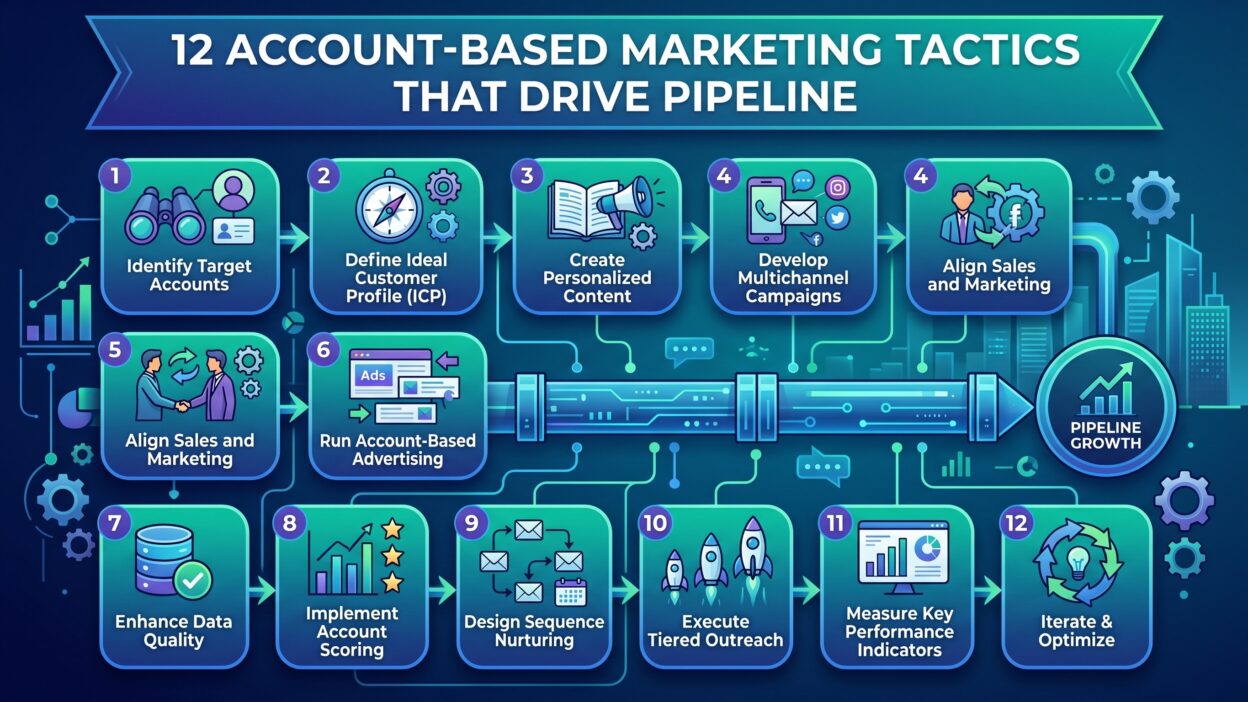
This guide covers 12 account-based marketing tactics that generate real pipeline. Each tactic is practical, proven, and executable by teams of any size. Study every one before you build your next ABM campaign.
What Makes Account-Based Marketing Tactics Different From Traditional Marketing
Traditional marketing optimizes for reach. You want as many people as possible to see your message. You measure success by impressions, clicks, and lead volume. Account-based marketing tactics optimize for relevance instead.
Relevance means your message speaks directly to one account’s situation. It references their industry, their size, their specific challenges, and their goals. A generic message gets ignored. A relevant message starts a conversation.
Traditional marketing treats every lead equally at first. Scoring models sort them later. Account-based marketing tactics start with your best-fit accounts and work backward. You identify who you want to win before you create a single piece of content.
The measurement framework changes too. Traditional marketing counts MQLs. Account-based marketing tactics measure account engagement, pipeline influence, and revenue from target accounts. Those metrics tell a more honest story about real business impact.
Sales and marketing alignment is mandatory in ABM. Both teams agree on the target account list. Both teams coordinate their outreach. Both teams share credit for pipeline. That alignment alone separates ABM from every other marketing approach.
12 Account-Based Marketing Tactics That Actually Drive Pipeline
Tactic 1: Build a Tiered Ideal Customer Profile
Every effective set of account-based marketing tactics starts with a precise ideal customer profile. Your ICP defines the exact company characteristics that predict deal success. Industry, revenue, employee count, technology stack, and growth stage all shape the profile.
Tier your accounts once you define the ICP. Tier one contains your highest-value targets. These accounts get maximum attention, personalized content, and direct sales involvement. Tier two gets lighter personalization. Tier three gets programmatic coverage.
Analyze your existing customers to build the ICP. Find your fastest-closing deals, highest-value contracts, and longest-retained customers. What do those companies share? That answer defines your ideal account profile.
Revisit the ICP every quarter. Markets shift. Your product evolves. New customer segments emerge. Static ICPs lead to stale account lists. Dynamic ICPs keep your account-based marketing tactics sharp and current.
Tactic 2: Use Intent Data to Identify In-Market Accounts
Intent data reveals which companies actively research topics related to your product. Providers like Bombora, G2, and TechTarget track content consumption across thousands of B2B publisher sites. When a company surges on relevant keywords, the data flags them as in-market.
This intelligence transforms your account-based marketing tactics. You stop guessing which accounts are ready to buy. You see the signal and act on it immediately. In-market accounts convert at significantly higher rates than cold outreach targets.
Layer intent data on top of your ICP. An in-market account that matches your ICP is your highest-priority target. Concentrate budget and sales energy on those accounts first. The combination of fit and timing creates the strongest possible entry point.
Set up weekly intent alerts inside your ABM platform. When a tier-one account surges, notify the account owner immediately. Speed matters. The company researching your category is likely researching your competitors at the same time.
Tactic 3: Personalize Content at the Account Level
Generic content does not work in ABM. Account-level personalization is one of the most impactful account-based marketing tactics available. You create content that speaks directly to one company’s situation, challenges, and goals.
Personalization does not require custom content for every account. Develop industry-specific versions of your core assets. A healthcare-focused landing page uses healthcare language, healthcare case studies, and healthcare-specific ROI claims. A manufacturing version does the same for that vertical.
Go deeper for tier-one accounts. Reference the company by name. Mention their recent news, earnings reports, or leadership changes. Show that you studied them. That level of detail signals genuine investment and earns attention from senior buyers.
Personalized microsites work particularly well. You build a dedicated webpage for a target account. It includes their logo, customized messaging, relevant resources, and a direct meeting booking link. The site shows up when the prospect Googles your company name alongside theirs.
Tactic 4: Deploy Account-Based Advertising
Paid advertising becomes far more precise inside account-based marketing tactics. Instead of targeting broad audiences, you target specific companies. IP-based targeting, LinkedIn company targeting, and programmatic DSPs all support account-level ad delivery.
LinkedIn is the strongest channel for B2B account-based advertising. You can target by company name, job title, seniority, and department simultaneously. Your ads reach the exact buying committee members at your target accounts.
Programmatic advertising extends your reach beyond LinkedIn. A B2B DSP delivers your ads across the open web when employees from target accounts browse relevant content. You build brand familiarity across multiple touchpoints every week.
Coordinate your advertising with your sales outreach calendar. When a sales rep is about to send a cold email to a target account, activate advertising against that account for two weeks prior. The prospect sees your brand before the email lands. That familiarity improves reply rates significantly.
Tactic 5: Engage the Full Buying Committee
B2B purchase decisions involve multiple stakeholders. The average enterprise buying committee includes six to ten people. Focusing only on one contact per account is one of the most common ABM mistakes.
Map the buying committee at every target account. Identify the economic buyer, the technical evaluator, the end user champion, and the procurement gatekeeper. Each persona has different priorities and different objections.
Create content that speaks to each role. The CFO wants ROI data and risk reduction. The IT lead wants security specs and integration documentation. The end user wants ease of use and productivity improvement. Account-based marketing tactics require content for every seat at the buying table.
Track engagement across the full committee. When three or more stakeholders at one account engage with your content in the same week, that account shows strong buying signals. Alert your sales team immediately and trigger a multi-threaded outreach sequence.
Tactic 6: Run Account-Specific Executive Events
Executive events are among the highest-impact account-based marketing tactics for tier-one accounts. You invite decision-makers from a small group of target accounts to an exclusive, high-value experience. The environment facilitates genuine relationship building.
Executive dinners work extremely well. Invite six to ten senior leaders from target companies. Keep the guest list tight. Feature a respected industry speaker or a thought-provoking roundtable discussion. Avoid making it a sales pitch.
Virtual executive roundtables expanded the format significantly. Geography no longer limits participation. You host a 90-minute peer discussion for 8 to 12 executives from target accounts. Facilitate the conversation. Let attendees share their challenges openly.
Follow up within 24 hours of every event. Reference specific things each attendee said during the conversation. That personal follow-up transforms a pleasant experience into an active sales conversation. Events without structured follow-up waste the relationship capital you built.
Tactic 7: Develop Direct Mail Campaigns for High-Value Accounts
Direct mail creates physical presence in a digital-saturated world. It stands out because almost nobody sends it anymore. High-quality, thoughtful direct mail to tier-one accounts generates response rates that digital channels rarely match.
The package must feel premium. A generic branded item signals low effort. A custom gift tied to the prospect’s business interests signals real research. One well-chosen item outperforms a box of generic swag every time.
Personalize the message inside the package. Handwrite a short note. Reference something specific about the account. Explain why you sent this particular item. Authenticity turns a physical object into a memorable conversation starter.
Sequence direct mail with digital outreach. Send the package. Wait two days for delivery. Have the sales rep call and reference the package. That call sequence produces significantly better connect rates than cold calling alone. Physical plus digital is a strong account-based marketing tactics combination.
Tactic 8: Create Account-Based Video Outreach
Personalized video cuts through the noise in crowded inboxes. A 60-second video recorded specifically for one prospect delivers a human connection that written emails never match. Tools like Vidyard and Loom make account-level video production fast and scalable.
Record the video with the prospect’s website or LinkedIn profile visible on screen. Open by saying their name and referencing something specific about their company. Keep the video under 90 seconds. Deliver one clear, relevant insight and end with one specific call to action.
Video open rates consistently exceed text email open rates in B2B outreach. Prospects click because they see a thumbnail with their name or company logo. That curiosity drives the first engagement. From there, the quality of your message determines the next step.
Use video at multiple stages of the account journey. Prospecting videos introduce your brand. Mid-funnel videos address specific objections. Post-meeting recap videos summarize next steps. Video fits naturally into account-based marketing tactics at every funnel stage.
Tactic 9: Align Sales and Marketing Around Shared Account Data
Account-based marketing tactics fail when sales and marketing operate in separate data environments. Marketing tracks ad impressions and content downloads. Sales tracks call activity and opportunity stages. Neither team sees the full picture.
Connect your marketing automation platform to your CRM. Every marketing interaction from a target account should appear in the account record that sales reps manage daily. Reps see which contacts opened emails, visited your pricing page, and downloaded your case study.
Hold weekly account reviews between sales and marketing. Review engagement trends for tier-one accounts. Discuss which accounts are heating up and which ones have gone quiet. Adjust campaign intensity based on what the data shows.
Shared goals reinforce alignment. Both teams measure success by pipeline generated from target accounts, not by individual department metrics. When marketing and sales share accountability for revenue, collaboration happens naturally instead of through constant negotiation.
Tactic 10: Build a Customer Reference Program for Target Accounts
Peer validation accelerates deals faster than any other account-based marketing tactics element. When a prospect speaks directly with a customer who faced the same challenge and achieved real results, objections dissolve quickly.
Build a structured reference program. Identify your most successful customers. Segment them by industry, company size, and use case. Match prospects to references who share the most relevant background. A relevant reference is ten times more persuasive than a generic one.
Prepare your references well. Brief them on the prospect’s specific situation. Give them talking points that address the prospect’s known objections. A prepared reference delivers a focused, impactful conversation. An unprepared reference wastes the opportunity.
Create customer case study content from your reference program. Document the story in writing, in video format, and as a data-driven one-pager. Deploy that content across your account-based marketing tactics at multiple touchpoints throughout the sales cycle.
Tactic 11: Use Website Personalization for Target Accounts
Your website shows the same content to every visitor by default. That generic experience wastes the attention of your most valuable accounts. Website personalization fixes this by detecting visitor identity and adjusting content in real time.
Tools like Clearbit, Mutiny, and Demandbase Personalization identify the company behind each website visit. When someone from a target account lands on your homepage, the headline, hero image, and featured case study change automatically to match their industry or company.
Personalized CTAs outperform generic ones significantly. Instead of showing every visitor the same free trial offer, show enterprise visitors a custom demo request form. Show mid-market visitors a relevant case study. Tailored CTAs produce higher conversion rates from target accounts.
Track personalized page performance at the account level. Know which target account contacts visited, which pages they viewed, and how long they spent on each one. That behavioral data feeds back into your account-based marketing tactics and helps sales prioritize outreach.
Tactic 12: Measure ABM Performance With Account-Level Metrics
Standard marketing metrics mislead ABM teams. Click-through rate, cost per click, and MQL volume do not tell you whether your account-based marketing tactics drive real pipeline. Account-level metrics tell the true story.
Track account reach first. What percentage of your target account list saw your ads or received your outreach? Low reach means your campaigns are not penetrating the account list. High reach means your message is getting through.
Measure account engagement next. Which accounts visited your website, opened multiple emails, or attended a webinar? Engagement signals interest. Multiple engagement signals from one account indicate a buying cycle starting.
Monitor pipeline influence most closely. How many active opportunities involve contacts from your target account list? What percentage of new pipeline comes from accounts on your ABM list? Revenue from target accounts is the ultimate measure of every account-based marketing tactic you run.
Common Mistakes That Undermine Account-Based Marketing Tactics
Targeting Too Many Accounts at Once
ABM requires concentration of resources. Teams that try to run true one-to-one account-based marketing tactics across 500 accounts spread themselves too thin. Personalization suffers. Sales engagement drops. Results disappoint.
Start with 25 to 50 tier-one accounts. Give those accounts full attention before expanding. Master the fundamentals at a small scale. Use the results and learning from that group to build a repeatable playbook for broader rollout.
Ignoring Existing Customer Accounts
Most ABM programs focus entirely on new logo acquisition. Existing customers represent an enormous untapped opportunity. Account-based marketing tactics applied to current customers drive expansion revenue, upsell cycles, and renewal retention.
Map your current customer base against your ICP. Identify which customers have room to expand. Build ABM campaigns around product lines they do not yet use. Existing customer ABM often delivers faster ROI than new logo programs because trust is already established.
Skipping the Sales Handoff Process
Marketing can generate strong account engagement signals. Those signals only produce revenue when sales acts on them quickly. A prospect who views your pricing page three times in one week needs a follow-up call within 24 hours, not five days later.
Build clear handoff triggers into your ABM process. Define the engagement threshold that qualifies an account for direct sales outreach. Automate the alert so the right rep receives notification immediately. Speed of follow-up separates ABM programs that generate pipeline from those that generate reports.
Frequently Asked Questions About Account-Based Marketing Tactics
How many accounts should I target with ABM?
The right number depends on your team size, deal size, and sales cycle length. Most ABM practitioners recommend starting with 25 to 50 tier-one accounts for true one-to-one account-based marketing tactics. Tier two can include 100 to 200 accounts with lighter personalization. Tier three supports programmatic coverage for up to 1,000 accounts. Quality of execution matters more than volume of accounts targeted.
What budget do I need to run account-based marketing tactics effectively?
ABM budgets range widely. Small teams run effective programs with $5,000 to $15,000 per month using LinkedIn ads, intent data subscriptions, and personalized outreach. Mid-market teams invest $20,000 to $50,000 per month including executive events, direct mail, and programmatic advertising. Enterprise ABM programs with dedicated technology stacks and large event budgets often exceed $100,000 per month. Start lean, prove ROI, then scale.
How long does it take for account-based marketing tactics to show results?
ABM results follow the natural sales cycle length of your business. Short sales cycles of 30 to 60 days show early pipeline impact within the first quarter. Enterprise sales cycles of 6 to 18 months require 2 to 3 full cycles before drawing reliable conclusions. Early indicators like account engagement rates, meeting bookings from target accounts, and account reach percentages signal whether your account-based marketing tactics are working before pipeline data matures.
Do account-based marketing tactics work for small B2B companies?
Yes. Small companies often see the fastest ABM results because they have clearly defined target markets and lean teams that move quickly. A small B2B company with 10 ideal customers can run highly personalized account-based marketing tactics using basic tools like LinkedIn Sales Navigator, a CRM, and personalized email sequences. The principles scale down effectively. You do not need enterprise technology to practice strong ABM fundamentals.
How do I get sales team buy-in for account-based marketing tactics?
Start by involving sales in building the target account list. When reps choose the accounts they want to pursue, they feel ownership over the program. Share engagement data with reps weekly so they see value in real time. Celebrate early wins publicly. When a rep books a meeting at a target account that marketing warmed up, share that story with the entire revenue team. Tangible proof of impact builds lasting sales enthusiasm for account-based marketing tactics.
What technology do I need to run account-based marketing tactics?
The core ABM technology stack includes a CRM, a marketing automation platform, an intent data provider, and a B2B advertising tool. HubSpot or Salesforce handles CRM. Marketo, HubSpot Marketing Hub, or Pardot handles automation. Bombora or G2 Buyer Intent provides intent signals. LinkedIn Campaign Manager or a B2B DSP handles account-level advertising. As your program matures, add dedicated ABM platforms like Demandbase, 6sense, or RollWorks to unify data and execution in one system.
Conclusion

Account-based marketing tactics work because they match marketing precision to sales reality. Sales already knows which accounts matter most. ABM gives marketing the tools and framework to concentrate resources on those same accounts.
The 12 account-based marketing tactics in this guide cover every stage of the account journey. ICP development and intent data identify the right targets. Personalized content, account-based advertising, and direct mail build awareness and engagement. Executive events, video outreach, and reference programs accelerate deals. Website personalization and committee engagement deepen relationships. Measurement ties every tactic back to pipeline.
You do not need to run all 12 tactics at once. Pick the three or four that fit your current team size and budget. Execute them well. Measure the account-level results. Add more tactics as your program matures and your confidence grows.
The companies winning enterprise deals in 2026 run disciplined, coordinated ABM programs. They study their best accounts deeply. They show up consistently across multiple channels. They align sales and marketing around shared goals.
Start your ABM journey with the account-based marketing tactics in this guide. Focus on precision over volume. Measure what matters. Build momentum one target account at a time. Pipeline follows when the right accounts receive the right attention at exactly the right moment.