Introduction
TL;DR Digital advertising has changed completely. Buyers do their research quietly before they ever talk to a sales rep. By the time a prospect fills out a form, they have already read articles, watched demos, and compared competitors. B2B marketers need to reach these buyers earlier.
A B2B DSP makes that possible. It puts your ads in front of the right business buyers at exactly the right moment. It uses data, automation, and real-time bidding to make every advertising dollar work harder.
Many marketers still confuse a B2B DSP with basic ad tools. They are very different. A B2B DSP is purpose-built for business audiences. It targets by company, job title, industry, and intent signal rather than by age or interest alone.
This complete guide explains everything. You will learn what a B2B DSP is, how it works, why it matters, and how to choose the right one for your business. Read this before you spend another dollar on programmatic advertising.
Table of Contents
What Is a B2B DSP?
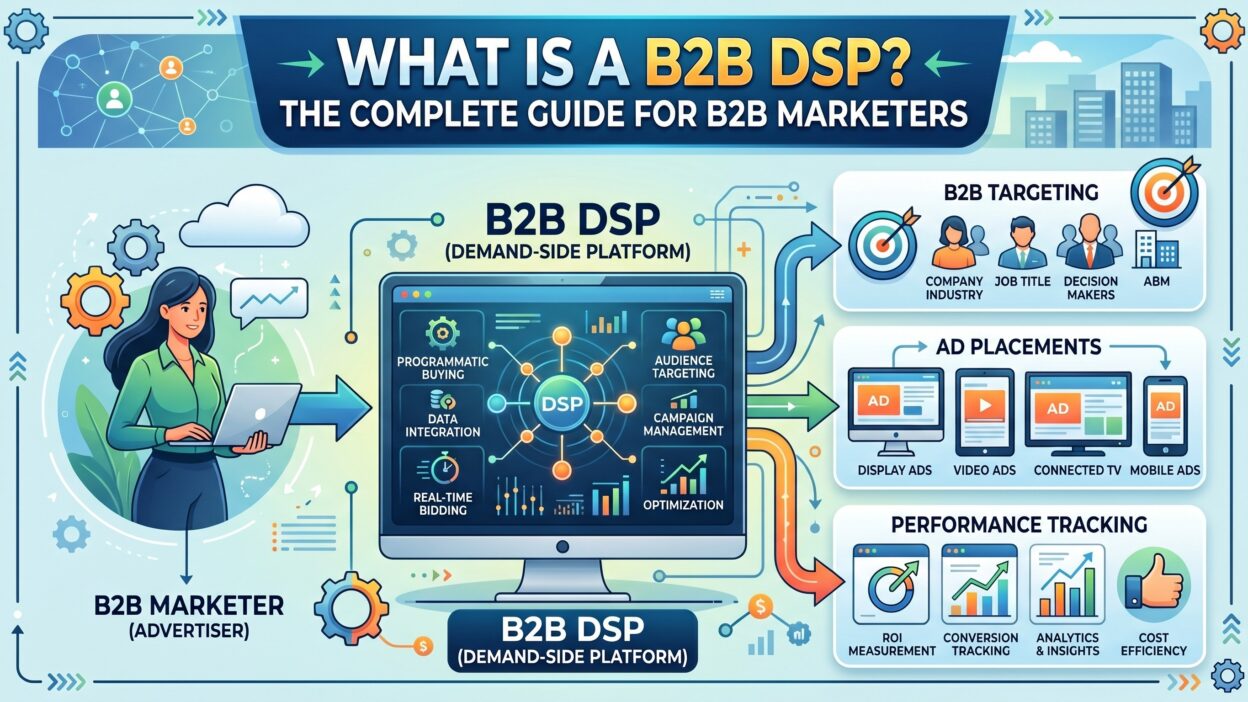
A B2B DSP, or demand-side platform built for business-to-business advertising, is a software system that lets marketers buy digital ad placements automatically. It connects to ad exchanges and data providers through a single interface. Marketers set their audience criteria, budget, and goals. The platform does the rest.
The term demand-side refers to the advertiser side of the equation. On the supply side, publishers sell ad space. A B2B DSP sits on your side of that transaction. It bids on ad impressions in real time on your behalf.
What makes a B2B DSP different from a standard DSP is the data layer. Standard platforms use consumer data like age, location, and interests. A B2B DSP uses firmographic data instead. Firmographics include company size, industry, revenue range, and technology stack.
A B2B DSP also layers in intent data. Intent data shows which companies are actively researching topics related to your solution. When a company surges on keywords related to your product category, a B2B DSP targets that company with your ads immediately.
The result is highly precise advertising. You reach decision-makers at companies that match your ideal customer profile. You do not waste budget on irrelevant audiences who will never buy your product.
How Does a B2B DSP Work?
Real-Time Bidding Explained
Every time a web page loads, an auction happens in milliseconds. A publisher puts an ad impression up for sale. Multiple advertisers bid on that impression through their DSPs. The highest bid wins. The ad appears on the page. This entire process takes less than 200 milliseconds.
A B2B DSP participates in thousands of these auctions every second. It evaluates each impression against your audience criteria. It bids aggressively when the impression matches a target account. It skips impressions that do not meet your standards.
This automation replaces manual ad buying. You no longer negotiate placements individually with publishers. The B2B DSP does it all in real time at massive scale.
The Role of Data in a B2B DSP
Data is the engine that powers every B2B DSP. The platform pulls from multiple data sources to build detailed audience segments. First-party data from your CRM forms the foundation. Account lists, contact records, and website visitor data all feed in.
Third-party data adds depth. B2B data providers like Bombora, Dun and Bradstreet, and TechTarget supply firmographic and intent data. A B2B DSP combines these sources to identify your best possible audience.
Identity resolution connects the dots. A single buyer uses many devices and browsers. A strong B2B DSP recognizes that behavior as one person at one company. You reach the same buyer across desktop, mobile, and connected TV.
Audience Targeting Options Inside a B2B DSP
Account-based targeting is the most popular feature in any B2B DSP. You upload a list of target accounts. The platform matches those accounts to IP addresses, device graphs, and cookie data. Your ads reach people working at those specific companies.
Job title and seniority targeting narrows your reach further. You target CFOs at manufacturing companies with over 500 employees. You exclude junior roles who lack buying authority. Every impression goes to someone who could actually purchase your product.
Intent-based targeting is the most advanced option. A B2B DSP monitors content consumption patterns across the web. When a company shows elevated interest in your category, the platform flags them as in-market. You activate campaigns against these high-intent accounts immediately.
Why B2B Marketers Need a B2B DSP in 2026
The Shift Away From Manual Advertising
Manual ad buying does not scale. Negotiating with individual publishers takes weeks. By the time your campaign launches, the market has moved on. A B2B DSP activates campaigns in hours, not weeks. Speed creates competitive advantage.
Programmatic advertising through a B2B DSP also generates better data. Every impression, click, and conversion links back to a specific audience segment. You know exactly which targeting criteria drive results. That insight sharpens every future campaign.
Reaching Anonymous Buyers Early in the Funnel
Most B2B buyers never fill out a form before making a decision. They research anonymously. They compare options without identifying themselves. Traditional inbound tactics miss these buyers entirely.
A B2B DSP reaches anonymous buyers through intent data and IP-based targeting. You show ads to someone at a target account even when they have never visited your website. You build awareness before the buyer ever enters your funnel.
Early-funnel reach changes the entire sales dynamic. Your brand enters the consideration set before competitors even know the buyer exists. That brand familiarity influences the final purchase decision.
Aligning Advertising With Account-Based Marketing
Account-based marketing, or ABM, requires coordinated outreach across multiple channels. Email, sales development, and events all target the same account list. A B2B DSP adds paid advertising to that coordinated approach.
When a target account sees your ads, opens your emails, and receives a LinkedIn message in the same week, the effect compounds. Repeated impressions build familiarity. Familiarity builds trust. Trust accelerates the sales cycle.
A B2B DSP integrates directly with ABM platforms like Demandbase, 6sense, and RollWorks. Target account lists sync automatically. Campaign activation requires no manual data transfer. ABM and programmatic advertising work as one unified motion.
Top B2B DSP Platforms to Consider in 2026
The Trade Desk — Best for Scale and Transparency
The Trade Desk is not exclusively a B2B DSP, but it powers B2B campaigns at massive scale. Its Koa AI engine optimizes bidding across millions of impressions. Marketers layer in B2B data from third-party providers to build business-focused audiences.
The platform offers unmatched transparency. You see every publisher where your ads run. You control brand safety settings in detail. Reporting shows performance at the impression level. Large enterprise teams with dedicated programmatic resources get the most value here.
Demandbase DSP — Best for Account-Based Advertising
Demandbase built its B2B DSP specifically for account-based advertising. It combines a DSP with an ABM platform inside one system. Target account lists, intent data, and programmatic buying all live in the same interface.
The platform uses its own proprietary B2B data. Account identification covers over 99% of business IP addresses. Intent signals come from a network of B2B publisher sites. Campaigns activate against accounts showing active research behavior.
Demandbase suits marketing teams that run formal ABM programs. If you have a defined target account list and want to surround those accounts with advertising, Demandbase delivers that capability better than almost any other B2B DSP.
6sense Revenue AI — Best for Predictive Intelligence
6sense combines a B2B DSP with a powerful predictive analytics engine. The platform identifies where each target account sits in the buying journey. It predicts which accounts will enter the market before they show obvious intent signals.
Advertising campaigns inside 6sense activate based on predicted buying stage. Accounts early in research receive awareness ads. Accounts close to decision receive more direct response messages. The B2B DSP adjusts automatically as accounts progress through the funnel.
Revenue teams love 6sense because it connects advertising data to sales outreach. When an account reaches a high engagement threshold, 6sense alerts the sales rep. Marketing and sales coordinate their outreach based on the same intelligence.
RollWorks — Best for Mid-Market B2B Teams
RollWorks offers a focused B2B DSP experience at a price point accessible to mid-market teams. It connects with HubSpot and Salesforce natively. Target account lists sync directly from your CRM. Campaign setup takes hours rather than days.
Account-based advertising, retargeting, and LinkedIn integration all work inside the same platform. Attribution reporting shows how advertising influences pipeline. Mid-market B2B marketers get the core ABM advertising capabilities without enterprise complexity.
Xandr (Microsoft) — Best for Data-Rich B2B Campaigns
Xandr, now part of Microsoft, offers a sophisticated B2B DSP with access to Microsoft’s first-party data. LinkedIn professional data enhances audience targeting. Bing search intent signals layer on top of display targeting.
Microsoft’s B2B data sets make Xandr particularly strong for enterprise targeting. You reach senior decision-makers based on their verified professional profiles. The combination of programmatic reach and LinkedIn-quality data is unique in the market.
How to Choose the Right B2B DSP for Your Business
Define Your Audience Before You Evaluate Platforms
Start with your ideal customer profile. Know exactly which industries, company sizes, and job titles you want to reach. Then evaluate whether each B2B DSP can build that audience from its data sources.
Ask each vendor about their data coverage. How many business profiles do they have? How often does their data update? What intent data sources do they use? Data quality determines campaign quality in every B2B DSP.
Evaluate Integration With Your Existing Stack
Your B2B DSP must connect with your CRM and marketing automation tools. Account lists need to sync automatically. Lead data must flow back into your CRM when conversions happen. Manual data transfers create errors and slow down campaign activation.
Check for native integrations with Salesforce, HubSpot, Marketo, and your ABM platform. A B2B DSP with strong integrations saves your team significant time every week. Poor integrations create more work than they eliminate.
Understand Pricing Models
B2B DSP pricing varies significantly. Some platforms charge a percentage of ad spend, typically 15 to 25 percent. Others charge a platform fee plus media costs. Some bundle data costs into the platform fee. Others charge for data separately.
Request full cost transparency before signing. Understand what you pay for the platform, the data, and the media. Compare total cost of ownership across your shortlist. The cheapest platform rarely delivers the best results, but the most expensive one does not automatically win either.
Prioritize Measurement and Attribution
A B2B DSP must prove its impact on revenue. Look for platforms that offer account-level attribution, not just click-based metrics. Know which target accounts saw your ads, engaged with your content, and moved into active pipeline.
Pipeline influence reporting matters more than click-through rate in B2B advertising. A click-through rate of 0.05 percent can still represent millions in influenced pipeline. Choose a B2B DSP that connects advertising impressions to business outcomes.
B2B DSP Best Practices for Maximum ROI
Start With a Focused Account List
Do not try to reach every possible account at once. Start with a focused tier-one account list of your highest-value targets. Concentrate your budget on accounts where winning deals has the biggest revenue impact.
A focused approach delivers faster learning. You see which messaging resonates with specific industries. You learn which creative formats drive engagement at target accounts. Use those insights to expand your campaigns strategically.
Coordinate Ads With Sales Outreach
A B2B DSP works best as part of a coordinated motion. Alert your sales team when target accounts show elevated ad engagement. A sales rep calling a prospect who just saw six ads from your brand has a much warmer conversation.
Set up engagement alerts inside your ABM platform. When an account crosses an engagement threshold, trigger a sales sequence automatically. Advertising warms the account. Sales converts the attention into a meeting.
Test Creative Formats Continuously
Display ads are just the starting point. A modern B2B DSP supports connected TV, digital audio, native ads, and video. Test multiple formats against the same audience. Find out which format drives the most account engagement.
Creative fatigue happens faster in B2B than in consumer advertising. Your target account list is finite. The same person sees your ads repeatedly. Refresh creative assets every four to six weeks to maintain impact.
Frequently Asked Questions About B2B DSP
What is the difference between a B2B DSP and a B2C DSP?
A B2C DSP targets individual consumers using demographic and behavioral data. A B2B DSP targets business buyers using firmographic data, account lists, and intent signals. The data sources, audience targeting logic, and measurement frameworks are completely different. A B2B DSP is built specifically for reaching business decision-makers, not general consumers.
Do I need a large budget to use a B2B DSP?
Minimum budgets vary by platform. Some B2B DSP vendors require $5,000 to $10,000 per month in minimum ad spend. Others work with smaller budgets on self-serve models. RollWorks and some mid-market options are more accessible. Larger budgets do produce better results because they generate more data and reach more impressions across the target account list.
How does a B2B DSP use intent data?
A B2B DSP pulls intent data from content networks that track B2B research behavior. When employees at a company read multiple articles about a specific topic, the platform registers a surge in intent. The B2B DSP flags that company as in-market and activates your ads immediately. You reach active buyers before they raise their hand through a form or sales conversation.
Can a B2B DSP work for small B2B companies?
Yes, but the approach needs adjustment. Small B2B companies often have narrow target account lists. A B2B DSP works well when you define a tight ICP and concentrate budget on a focused list. Spreading a small budget too broadly dilutes impact. Small teams often find self-serve platforms like RollWorks more practical than enterprise options requiring dedicated programmatic specialists.
How do I measure success with a B2B DSP?
Standard digital metrics like click-through rate matter less in B2B advertising. Focus on account-level metrics instead. Track account reach, meaning what percentage of your target account list saw your ads. Measure account engagement, meaning which accounts visited your website after ad exposure. Monitor pipeline influence, meaning how many opportunities involve accounts from your advertising campaigns. Revenue impact is the ultimate measure of any B2B DSP investment.
How long does it take to see results from a B2B DSP?
B2B sales cycles are long. Do not expect immediate pipeline from a B2B DSP campaign. Allow 60 to 90 days before drawing conclusions. Early signals include increases in branded search from target accounts and higher website visit rates from your account list. Pipeline impact shows up after two to three full sales cycles. Set realistic expectations before you launch and hold your measurement window long enough to capture real results.
Read More:-B2B Live Chat: A Guide for Marketing and Sales Teams
Conclusion

A B2B DSP is no longer a luxury for large enterprise teams. It is a core part of any serious B2B marketing strategy in 2026. Buyers research anonymously. Sales cycles are long. Competition for attention is intense. A B2B DSP cuts through all of that.
The right B2B DSP reaches your ideal accounts before your competitors do. It builds brand familiarity during the research phase. It aligns advertising with sales outreach to create a coordinated buying experience.
Demandbase, 6sense, RollWorks, The Trade Desk, and Xandr each offer strong capabilities. Your best choice depends on your team size, budget, existing tech stack, and ABM maturity. Evaluate each option carefully using the criteria in this guide.
Start with a focused account list and a clear ICP. Test creative formats. Align your sales team with your advertising data. Measure account-level outcomes, not just clicks. Give your campaigns 60 to 90 days to show real impact.
The B2B marketers winning today invest early in the right technology. A B2B DSP gives you the reach, precision, and intelligence to compete at the highest level. Make the investment, run the experiments, and let the data guide every future decision.