Introduction
TL:DR Digital advertising keeps getting noisier. Every business competes for the same eyeballs across the same crowded channels. Generic campaigns reach massive audiences that will never buy your product. Budget disappears. Results disappoint. Teams search for a better approach.
Account-based advertising solves this problem at its root. You stop targeting everyone and start targeting the exact companies you want to win. Every ad dollar reaches a real decision-maker at a business that fits your ideal customer profile.
This approach requires a shift in mindset. Traditional advertising optimizes for reach and volume. Account-based advertising optimizes for precision and relevance. The math changes completely when your ads reach only qualified buyers.
This guide explains everything you need to know about account-based advertising. You will learn what it is, how it works, which channels deliver the best results, and how to measure success. Read every section and you will have a clear picture of how to build and run a high-performing account-based advertising program.
Table of Contents
What Is Account-Based Advertising?
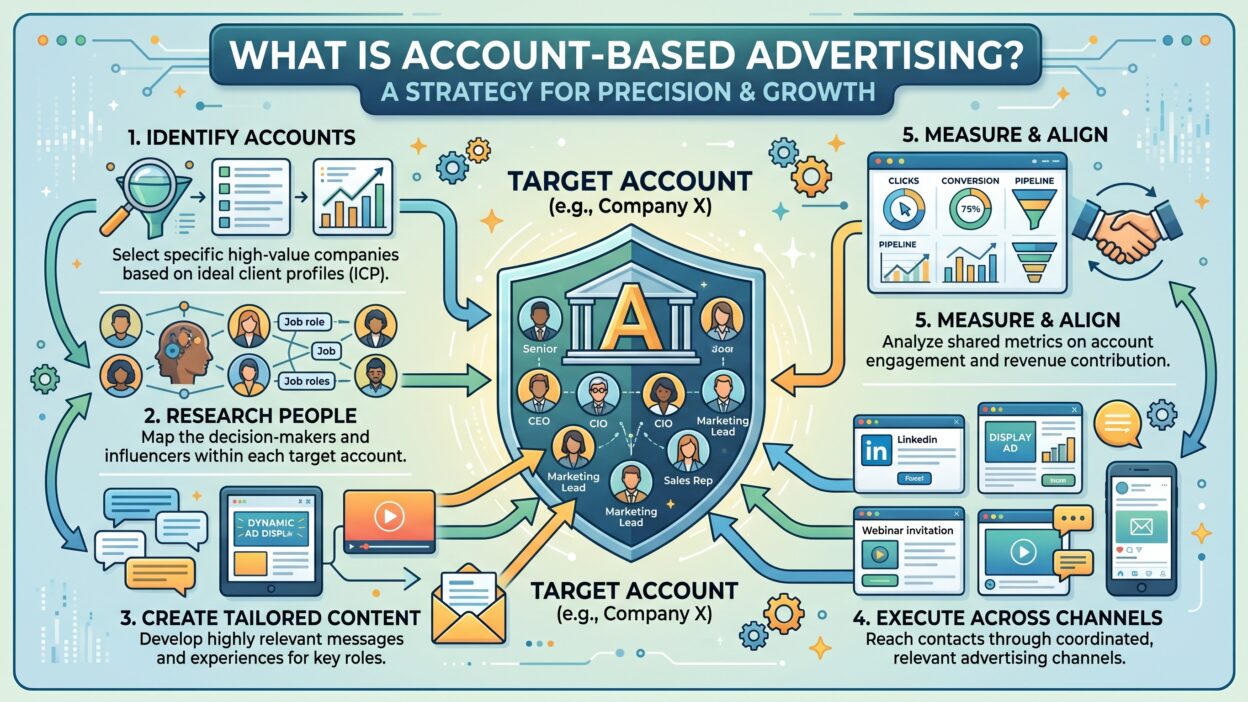
Account-based advertising is a digital advertising strategy that targets specific companies rather than broad demographic audiences. You select a list of target accounts. You deliver paid ads directly to employees at those accounts across multiple digital channels. Every impression serves a business purpose.
The approach stems from account-based marketing principles. ABM focuses all revenue resources on a defined set of high-value accounts. Account-based advertising extends that focus into the paid media layer. Ads become a coordinated weapon inside your broader ABM strategy.
Traditional advertising identifies audiences by characteristics like age, interests, and browsing behavior. Account-based advertising identifies audiences by company. You target the VP of Procurement at a manufacturing company with 1,000 employees. You do not target a generic business professional interested in procurement topics.
The precision of account-based advertising creates a fundamentally different advertising experience. Prospects at your target accounts see your brand consistently across the channels they use every day. That consistent exposure builds familiarity. Familiarity builds trust. Trust creates the conditions for a sales conversation.
Account-based advertising works best as part of a coordinated GTM motion. Sales outreach, email sequences, and event invitations all target the same account list. Advertising surrounds the account from every direction simultaneously. The compound effect of coordinated multi-channel outreach dramatically outperforms any single channel working alone.
How Account-Based Advertising Works
Building the Target Account List
Every account-based advertising program starts with a carefully built target account list. This list defines which companies receive your advertising attention. Quality matters more than quantity. A focused list of 200 ideal-fit accounts outperforms a sprawling list of 2,000 loosely qualified ones.
Build your list using your ideal customer profile as the filter. Industry, company size, annual revenue, technology stack, and geographic location all define which accounts belong on the list. Pull initial candidates from your CRM, from intent data platforms, and from your sales team’s prospecting research.
Tier your list once you compile it. Tier one contains your highest-value targets. These accounts receive maximum ad frequency and the most personalized creative. Tier two accounts receive moderate attention. Tier three accounts receive programmatic coverage with standard creative assets.
Matching Accounts to Digital Identifiers
Account-based advertising platforms convert your company list into targetable digital audiences. They match company names and domains to IP addresses, device graphs, and cookie data. That matching process creates an audience segment that your ads reach across digital channels.
IP-based targeting identifies website visitors by their company’s IP address. When someone from a target account visits a publisher website, the platform recognizes the company and serves your ad. This method works particularly well for reaching employees during business hours.
Device graph matching extends reach beyond IP addresses. Modern workers use multiple devices. A device graph connects a person’s work laptop, personal phone, and home computer into one addressable profile. Your account-based advertising reaches the same buyer regardless of which device they use.
LinkedIn’s professional data provides the most accurate B2B matching available. The platform knows where users work, what their job title is, and what level of seniority they hold. Account-based advertising on LinkedIn targets by company name directly. No guesswork enters the targeting process.
Serving Ads Across Multiple Channels
Effective account-based advertising runs across more than one channel. A prospect who sees your brand on LinkedIn, encounters your display ad on an industry publication, and receives a personalized email in the same week experiences a powerful coordinated signal. Single-channel campaigns miss this multiplication effect.
Programmatic display advertising reaches target accounts across millions of publisher sites. A demand-side platform bids on impressions in real time when a user from a target account visits a qualifying website. Your ad appears on premium industry publications, news sites, and professional content hubs.
Connected TV has become an important account-based advertising channel for enterprise GTM teams. Streaming platforms allow audience targeting based on professional profiles. You reach senior decision-makers at home during evening hours on a channel that commands full attention rather than a small banner competing with page content.
Why Account-Based Advertising Matters for B2B Revenue Teams
Reaching Anonymous Buyers Before They Identify Themselves
Most B2B buyers complete significant research before ever contacting a vendor. They read articles, watch product demos, compare competitors, and build shortlists — all without filling out a single form. Traditional inbound marketing misses this silent majority entirely.
Account-based advertising reaches these anonymous researchers through intent data and IP-based targeting. Your ads appear on the content they consume during their research phase. You build brand presence in the consideration set before the buyer ever raises their hand.
Early brand exposure shapes purchase decisions. Buyers who recognize your brand from repeated ad exposure approach a sales conversation with more familiarity and more trust. Cold outreach to an account that never heard of you faces much higher friction than outreach to an account that saw your ads 15 times over the previous month.
Concentrating Budget on High-Value Opportunities
Account-based advertising eliminates budget waste by design. Every dollar targets a company that matches your ICP. You stop paying to reach small businesses when you sell enterprise software. You stop advertising to individual consumers when you sell B2B services.
The cost efficiency of account-based advertising shows up in pipeline metrics rather than traditional CPM comparisons. Your CPM might appear higher than a broad audience campaign. Your cost per qualified meeting, cost per opportunity, and cost per closed deal tell a more favorable story.
Sales teams close more deals when marketing warms up accounts before outreach. Account-based advertising creates that warmth at scale. The revenue impact per advertising dollar invested exceeds what broad campaigns produce across every B2B organization that measures it properly.
Supporting the Full Buying Committee
Enterprise B2B deals involve multiple decision-makers. The average buying committee includes six to ten stakeholders. Most marketing programs reach only one or two of them. Account-based advertising reaches the entire committee simultaneously.
You create different ads for different roles. The CFO sees ROI and cost reduction messaging. The IT leader sees security and integration messaging. The end user champion sees productivity and ease-of-use messaging. Each stakeholder receives relevant content that speaks to their specific concerns.
When every member of the buying committee sees your brand consistently, consensus forms faster. The deal moves forward without the delays that happen when some stakeholders remain unfamiliar with your solution. Account-based advertising accelerates enterprise sales cycles by building familiarity across the entire decision-making group.
Best Channels for Account-Based Advertising in 2026
LinkedIn — The Foundation of B2B Account-Based Advertising
LinkedIn remains the most powerful channel for account-based advertising in B2B markets. The platform holds verified professional data on over 900 million members. Job titles, company names, seniority levels, and departments are all reliable targeting parameters.
LinkedIn lets you target by company name directly. You upload your target account list and the platform matches it to company pages. Your sponsored content and message ads reach verified employees at those specific companies. The match accuracy is unmatched by any other channel.
LinkedIn Conversation Ads and Message Ads add a direct outreach dimension to account-based advertising. You send personalized messages directly to the LinkedIn inboxes of decision-makers at target accounts. The format feels personal even at scale. Response rates consistently outperform cold email for senior buyers.
Retargeting on LinkedIn adds another layer of precision. When a decision-maker from a target account visits your website, LinkedIn retargeting follows them with relevant ads inside the platform. You reinforce your message at exactly the moment when interest is highest.
Programmatic Display — Broad Reach at Scale
Programmatic display advertising extends your account-based advertising reach far beyond LinkedIn. A B2B demand-side platform delivers your ads across thousands of premium publisher sites wherever target account employees browse online.
Industry publication networks carry particular value in programmatic account-based advertising. When a VP of Engineering from a target account reads a technology industry publication, your display ad appears on that page. The editorial environment lends credibility to your brand message.
Frequency capping is critical in programmatic account-based advertising. Your target account list is finite. The same people see your ads repeatedly. Too many impressions per week creates irritation rather than familiarity. Set frequency caps at 15 to 20 impressions per week per person as a starting point and adjust based on engagement data.
Connected TV — Premium Account-Based Advertising for Enterprise
Connected TV advertising reaches target account employees at home during high-attention evening and weekend viewing. Streaming platforms like Hulu, Peacock, and Paramount Plus support audience targeting based on professional profiles and household income data.
CTV ads command full screen attention. There is no competing content, no banner blindness, no small format fighting for space. A 30-second account-based advertising spot on a streaming platform delivers a brand message in an environment that television advertising historically commanded.
Enterprise GTM teams use CTV to build executive-level brand awareness at target accounts. Reaching C-suite decision-makers outside of business hours, in a relaxed viewing environment, creates brand impressions that differ qualitatively from work-hour display ads. CTV rounds out a multi-channel account-based advertising approach.
Digital Audio — The Emerging Account-Based Advertising Channel
Podcast advertising and streaming audio advertising have matured significantly. Platforms like Spotify and iHeartMedia now support programmatic audience targeting. You reach target account employees through their preferred podcast listening during commutes, workouts, and focus sessions.
Audio ads in account-based advertising work best for brand awareness and thought leadership positioning. A 30-second pre-roll ad on a business podcast heard by a decision-maker from a target company creates a memorable brand impression. The intimacy of audio advertising makes messages land differently than visual formats.
How to Build an Account-Based Advertising Program From Scratch
Align Sales and Marketing on the Target Account List
Account-based advertising fails when marketing targets accounts that sales has no interest in pursuing. Build the target account list collaboratively. Sales brings pipeline knowledge and relationship context. Marketing brings ICP analysis and intent data. The combined input produces a stronger list than either team creates independently.
Hold a monthly account list review meeting. Accounts graduate from the list when deals close or accounts clearly do not fit. New accounts join when intent data or sales research identifies strong opportunities. A dynamic list keeps your account-based advertising focused on current priorities rather than stale targets.
Develop Creative for Each Audience Segment
Generic creative underperforms in account-based advertising. Your ads need to speak to specific industries, specific roles, and specific challenges. Develop at least three creative variants for each major campaign: one for technical buyers, one for business buyers, and one for executive sponsors.
Personalize creative at the account tier level. Tier-one accounts receive custom creative that references their industry, their company size, or their specific business challenges. Tier-two accounts receive industry-personalized creative. Tier-three accounts receive ICP-aligned standard creative. The personalization investment scales proportionally to account value.
Set Up Your Technology Stack
Account-based advertising requires the right technology to execute at scale. Your core stack needs a CRM to manage the account list, a marketing automation platform to coordinate advertising with email and content programs, and a B2B advertising platform or DSP to deliver ads across your chosen channels.
Connect your ABM platform to your CRM so account engagement data flows automatically to sales reps. When a rep sees that a contact from a target account engaged with four ads this week, that context makes their outreach conversation more relevant and more timely.
Activate Campaigns and Monitor Early Signals
Launch your account-based advertising campaigns with a 30-day learning window. Avoid making major changes in the first two weeks. Platforms need time to optimize delivery across your target account list. Early data can mislead if you react too quickly to initial impression counts and click rates.
Monitor account-level engagement rather than individual click metrics during the learning window. Which accounts show increased website visits after ad exposure? Which accounts open emails at higher rates during campaign periods? Those behavioral signals tell you whether your account-based advertising creates real impact at the account level.
Measuring Account-Based Advertising Performance
Account-Level Metrics That Matter
Standard advertising metrics mislead account-based advertising teams. Click-through rate and cost per click measure individual user behavior. Account-based advertising success requires account-level measurement that tracks company engagement trends over time.
Account reach tells you what percentage of your target account list saw your ads during a given period. A reach rate below 40 percent signals that your targeting parameters are too narrow or your budget is insufficient. A reach rate above 70 percent means your message is getting through to the majority of your targets.
Account engagement rate measures how many targeted accounts show active interest signals after ad exposure. Website visits from target account IP addresses, email open rate increases, and content download activity all count as engagement signals. Rising engagement across the account list indicates that your account-based advertising is working.
Pipeline Influence as the Ultimate Success Metric
Pipeline influence is the metric that connects account-based advertising to revenue. Track how many active sales opportunities involve contacts at accounts that received advertising over the previous 90 days. That overlap number shows how advertising contributes to pipeline generation and deal progression.
Multi-touch attribution models give account-based advertising appropriate credit for its role in long sales cycles. A deal that closed after 9 months involved dozens of touchpoints. An attribution model that only credits the last click ignores the brand familiarity that advertising built over months of consistent exposure.
Present pipeline influence data to leadership monthly. Show which target accounts moved from advertising exposure to active opportunity. Show average deal size for accounts that received advertising versus those that did not. Those comparisons build the business case for sustained investment in account-based advertising.
Frequently Asked Questions About Account-Based Advertising
How is account-based advertising different from retargeting?
Retargeting reaches people who already visited your website. It chases existing website visitors across the web after they leave your site. Account-based advertising proactively targets people at specific companies whether or not they have ever visited your website. Account-based advertising creates awareness among buyers who do not yet know your brand. Retargeting reinforces awareness among buyers who already do. Both tactics work well together inside a broader account-based advertising program. Retargeting serves warm accounts. Programmatic account-based advertising reaches cold accounts that match your ICP but have not yet engaged with your brand.
What budget do I need to start account-based advertising?
Minimum viable budgets for account-based advertising vary by channel and account list size. LinkedIn sponsored content campaigns can begin with $3,000 to $5,000 per month and still deliver meaningful reach across a focused account list of 50 to 100 companies. Programmatic display campaigns through a B2B DSP typically require $5,000 to $10,000 per month minimum to generate sufficient impression volume. Combined multi-channel account-based advertising programs at the mid-market level commonly invest $15,000 to $40,000 per month. Enterprise programs targeting thousands of accounts with custom creative invest significantly more. Start at the minimum viable level for your chosen channel, prove ROI through pipeline influence data, and scale investment from there.
How long does it take to see results from account-based advertising?
Account-based advertising results align with your natural sales cycle length. Short sales cycles of 30 to 60 days show early pipeline impact within the first campaign quarter. Enterprise sales cycles of 6 to 18 months require patience before revenue results become visible. Early indicators that your account-based advertising works include increased branded search from target account companies, higher website visit rates from target account IP addresses, and improved email open rates from contacts at accounts receiving ads. Track these leading indicators during the first 60 to 90 days. They signal whether your targeting and creative strategy is engaging the right audience before pipeline data matures.
Can small B2B companies run account-based advertising effectively?
Yes. Small B2B companies with tight ideal customer profiles often run the most effective account-based advertising programs. A focused target account list of 50 to 100 companies requires a fraction of the budget that enterprise programs demand. LinkedIn Sponsored Content with direct company name targeting is accessible to teams with modest monthly budgets. The key advantage for small companies is focus. When you know exactly which 75 companies you want to win this quarter, every advertising dollar serves a clear purpose. Small teams execute account-based advertising well when they resist the temptation to expand their account list beyond what their budget can cover with meaningful frequency.
Do I need an ABM platform to run account-based advertising?
You do not need a dedicated ABM platform to start account-based advertising. LinkedIn Campaign Manager, a B2B DSP, and your existing CRM form a functional starting stack. Upload your target account list to LinkedIn. Build matched audiences. Launch sponsored content campaigns. Connect website visit data back to your CRM. That basic setup runs a meaningful account-based advertising program without enterprise platform costs. Dedicated ABM platforms like Demandbase, 6sense, or RollWorks add value as your program scales. They unify data across channels, automate account list management, and provide account-level attribution reporting that manually stitched tools cannot replicate. Start simple and add platform sophistication when your program outgrows basic tooling.
How do I choose between LinkedIn and programmatic display for account-based advertising?
LinkedIn wins for precision and buying committee targeting. If your primary goal is reaching specific job titles at specific companies with verified professional data, LinkedIn is the right starting channel for account-based advertising. It costs more per impression but delivers unmatched targeting accuracy. Programmatic display wins for reach, frequency, and cost efficiency. It extends your brand presence across hundreds of websites that your target accounts visit daily. The lower CPM allows higher frequency at the same budget. The ideal approach combines both channels. Use LinkedIn for precision targeting of key decision-makers. Use programmatic display to build broad brand familiarity across the full account. The combination creates more touchpoints than either channel delivers alone.
Read More:-10 Best ABM Platforms of 2026
Conclusion

Account-based advertising changes the economics of B2B paid media. You stop chasing volume and start chasing value. Every impression serves a defined business purpose. Every dollar reaches a company you actively want to win.
The approach works because it mirrors how B2B buying actually happens. Buying committees research anonymously for months before engaging a vendor. Account-based advertising meets these buyers during that research phase and builds brand familiarity before sales ever makes contact.
LinkedIn, programmatic display, connected TV, and digital audio all support account-based advertising programs of varying scale. Start with one channel and execute it well. Prove pipeline influence with data. Expand to additional channels as your program matures and your budget grows.
Sales and marketing alignment sits at the heart of every successful account-based advertising program. Both teams must agree on the target account list. Both teams must coordinate their outreach timing. Both teams must share accountability for the pipeline that account-based advertising helps generate.
The B2B brands winning the most competitive markets in 2026 invest in account-based advertising as a core GTM motion. They reach their best-fit accounts early, often, and across multiple channels. They measure success at the account level and connect advertising impact directly to revenue. Start your program today and build the precision advertising capability your revenue team deserves.