Introduction
TL;DR Marketing teams face a real problem in 2026. Data lives in too many places. Campaigns run in silos. Customer journeys break apart at every touchpoint. Marketing orchestration platforms solve all of this.
These platforms connect your tools, data, and teams. They help you deliver the right message to the right person at exactly the right time. Every channel works together. Every campaign feels seamless.
Choosing the right marketing orchestration platform is a serious decision. The wrong choice wastes budget and slows growth. The right choice drives revenue, saves time, and scales your business.
Table of Contents
What Are Marketing Orchestration Platforms?
Marketing orchestration platforms are software systems. They coordinate marketing activities across multiple channels and teams. Email, social media, paid ads, SMS, and web personalization all connect inside one system.
The term ‘orchestration’ comes from music. An orchestra has many instruments. Each instrument plays its own part. A conductor brings them together into one sound. Marketing orchestration platforms work the same way.
Your CRM, marketing automation tool, analytics platform, and ad manager all become one connected system. Data flows freely between them. Customer data updates in real time. Every team sees the same customer picture.
Marketing orchestration platforms differ from basic automation tools. Automation handles one task at a time. Orchestration handles the full customer journey. It tracks behavior, updates segments, and adjusts campaigns without manual effort.
Businesses with complex marketing needs benefit most. Enterprise brands, B2B companies, and fast-scaling startups all find real value. Anyone running campaigns across three or more channels needs an orchestration layer.
Why Your Business Needs Marketing Orchestration Platforms in 2026
The Problem With Disconnected Marketing Tools
Most marketing teams use 10 to 15 different tools. Each tool creates its own data. That data rarely talks to other tools. Campaigns contradict each other. Customers receive duplicate or irrelevant messages.
Disconnected tools kill customer experience. A customer clicks an ad, lands on the wrong page, and receives a generic email the next day. That customer leaves. Your budget goes to waste.
Marketing orchestration platforms fix this by creating a single source of truth. All customer data lives in one place. All teams work from the same playbook. No more confusion, no more gaps.
The Business Case for Orchestration
Companies using marketing orchestration platforms see measurable results. Campaign performance improves when channels work together. Customer lifetime value increases when journeys feel consistent.
Revenue attribution becomes clearer. You know which touchpoints drive conversions. You stop guessing and start making decisions based on clean data. That clarity reduces wasted ad spend.
Team productivity goes up. Marketers spend less time manually copying data between tools. They focus on strategy and creative work. Automation handles the repetitive tasks that slow teams down.
Marketing orchestration platforms also help with compliance. GDPR and CCPA requirements are easier to manage when data sits in one governed system. Consent management becomes part of the workflow.
How to Evaluate Marketing Orchestration Platforms
Key Features to Look For
Not every platform offers the same capabilities. Focus on the features that matter most for your business. Start with cross-channel coordination. Can the platform manage email, SMS, ads, and web in one place?
Check real-time data processing. Some marketing orchestration platforms update customer data in real time. Others process data in batches. Real-time systems react faster and create better experiences.
Evaluate the AI and machine learning capabilities. Predictive segmentation, send-time optimization, and content recommendations all improve performance. Strong AI features separate average platforms from great ones.
Look at the integration ecosystem. Your existing tools need to connect without custom development. Pre-built connectors for Salesforce, HubSpot, Shopify, and Google Ads make implementation faster.
Questions to Ask Every Vendor
How does the platform handle identity resolution? Customers use multiple devices. The system must recognize one customer across different touchpoints.
What does the onboarding process look like? Some marketing orchestration platforms take months to implement. Others get you running in weeks. Ask for a realistic timeline before signing.
How does pricing scale? Some vendors charge by contact volume. Others charge by feature tier or usage. Understand your total cost of ownership before making a commitment.
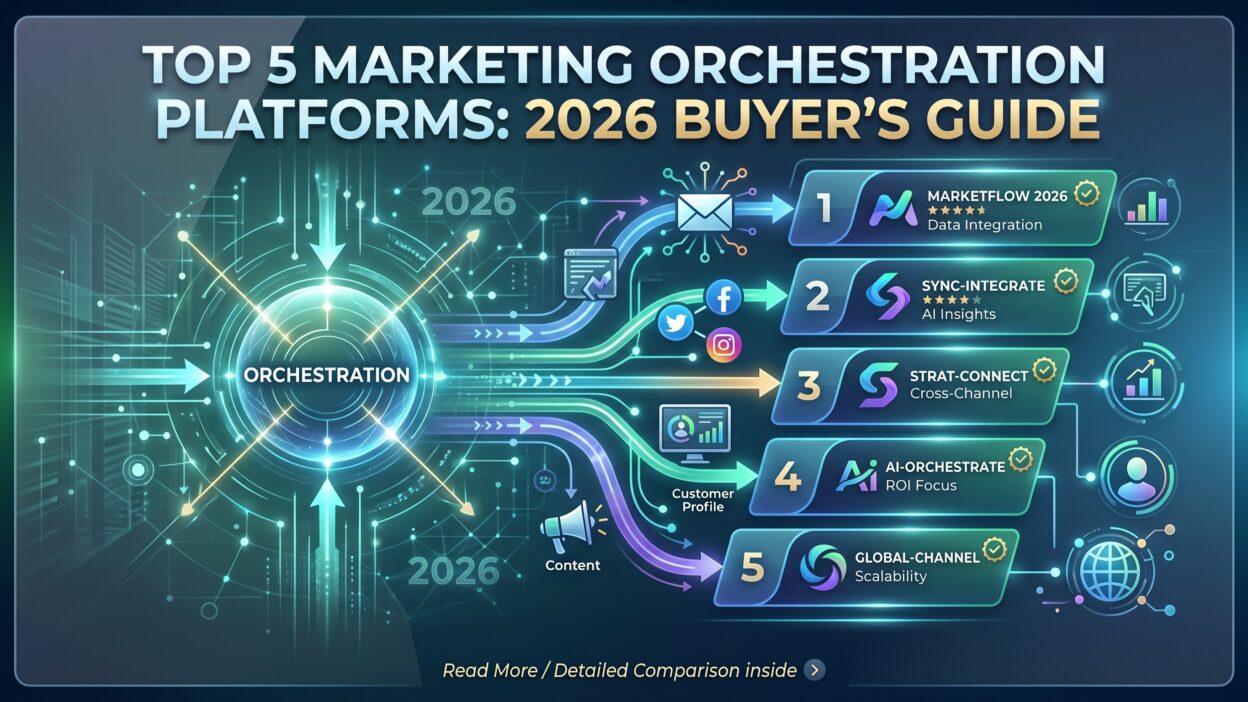
Top 5 Marketing Orchestration Platforms in 2026
1. Salesforce Marketing Cloud — Best for Enterprise Scale
Salesforce Marketing Cloud remains the most powerful marketing orchestration platform for large enterprises. It connects email, mobile, advertising, and web into one unified experience engine.
Journey Builder lets you map every customer touchpoint visually. You drag and drop channels, delays, and decision splits. The interface is intuitive even for complex multi-step journeys.
Salesforce Data Cloud powers real-time customer profiles. Every interaction updates the profile instantly. Sales and marketing teams always see the same customer data. Alignment becomes automatic.
Einstein AI adds predictive intelligence. It scores leads, recommends content, and optimizes send times. Marketers make better decisions faster without needing a data science team.
The Advertising Studio connects your CRM data to paid channels. You can suppress existing customers from acquisition campaigns. You can build lookalike audiences from your best buyers.
Pricing starts high. Enterprise contracts often begin at $50,000 per year. Implementation requires skilled consultants. Smaller teams may struggle to get full value from the platform.
Salesforce Marketing Cloud suits global brands with large budgets and complex needs. If you run campaigns across dozens of markets and channels, it delivers unmatched scale.
2. HubSpot Marketing Hub — Best for Mid-Market Growth
HubSpot Marketing Hub is one of the most accessible marketing orchestration platforms on the market. It combines CRM, email, automation, social media, and reporting in one clean interface.
The platform grew significantly in 2025. AI-powered content creation, better attribution reporting, and enhanced workflow automation all arrived in major updates. HubSpot now competes at a much higher level.
Campaign orchestration works through the Campaigns tool. You attach emails, ads, landing pages, and social posts to one campaign. Performance data rolls up into a single dashboard.
Smart content lets you personalize website pages, emails, and CTAs based on contact properties. A new visitor sees different content than a returning customer. Personalization scales without manual work.
HubSpot integrates with over 1,400 apps. Shopify, Stripe, Slack, Zoom, and Google Ads all connect natively. The ecosystem reduces the need for custom development work.
Pricing is transparent and scales by contact count. Professional plans start around $800 per month. Enterprise plans offer advanced features like custom objects, calculated properties, and predictive scoring.
Mid-market companies see the best results. If your team has 5 to 50 marketers and wants a platform that grows with you, HubSpot Marketing Hub deserves serious consideration.
3. Adobe Marketo Engage — Best for B2B Revenue Teams
Adobe Marketo Engage is a leading marketing orchestration platform for B2B organizations. It excels at account-based marketing, lead management, and revenue attribution.
Engagement programs let you build sophisticated nurture tracks. You can route leads based on score, behavior, or firmographic data. Complex decision trees handle thousands of segments automatically.
Account-based marketing features stand out. You can target entire buying committees, not just individual contacts. Marketo tracks engagement across every decision-maker in a target account.
Revenue attribution reporting shows exactly which campaigns drive pipeline. Multi-touch attribution models credit every interaction. Sales and marketing teams align around the same revenue data.
The Adobe ecosystem adds strength. Marketo connects with Adobe Analytics, Adobe Experience Manager, and Adobe Target. Content, data, and personalization work together without extra integrations.
Marketo Engage pricing starts around $1,000 per month for small databases. Enterprise contracts reach six figures for large B2B teams. The platform requires dedicated marketing operations resources.
B2B companies with complex sales cycles get the most value. If your average deal size is high and your buying committee has multiple stakeholders, Marketo Engage fits your needs perfectly.
4. Braze — Best for Mobile-First and Consumer Brands
Braze is a modern marketing orchestration platform built for real-time customer engagement. It leads in mobile push notifications, in-app messaging, and cross-channel consumer journeys.
Canvas Flow is Braze’s journey builder. It supports branching logic, experiment paths, and winning variant escalation. You can test multiple journey variations and automatically move customers to the best one.
Real-time data streaming sets Braze apart. Customer events trigger messages in milliseconds. A user adds an item to cart and receives a push notification within seconds. Speed matters for consumer brands.
Connected Content lets you pull live data into messages. Product recommendations, live pricing, and inventory status all appear dynamically in emails and push notifications. Every message feels current.
Braze supports over 150 technology integrations. Segment, Amplitude, Snowflake, and major ad platforms all connect natively. Data flows in and out without custom engineering.
Pricing depends on message volume and features. Mid-market contracts typically start around $60,000 per year. Enterprise deals are negotiated based on scale and channel mix.
Consumer apps, retail brands, and media companies love Braze. If mobile is your primary channel and real-time engagement is critical, Braze outperforms most alternatives.
5. Klaviyo — Best for E-Commerce Brands
Klaviyo is the go-to marketing orchestration platform for e-commerce businesses. It connects directly to Shopify, WooCommerce, and BigCommerce. Customer purchase data powers every campaign.
Predictive analytics identify your best customers before they buy again. Klaviyo predicts next order date, lifetime value, and churn risk. You act on these predictions with targeted flows.
Flows are Klaviyo’s automation engine. Welcome series, abandoned cart, browse abandonment, and post-purchase flows all run automatically. Each flow responds to real-time shopping behavior.
Segments update dynamically based on purchase history, browsing behavior, and predicted behavior. A segment of customers predicted to churn receives a win-back campaign automatically.
Email and SMS work together inside the same platform. You coordinate channel timing, suppress contacts who already converted, and test channel combinations. One platform manages both touchpoints.
Pricing scales with contact volume. Small stores start for free. Mid-sized stores with 50,000 contacts pay around $700 per month. The pricing model grows transparently with your business.
D2C brands, subscription boxes, and online retailers see exceptional ROI. If e-commerce drives your revenue and you want a platform built specifically for that model, Klaviyo wins clearly.
Comparison Table: Marketing Orchestration Platforms at a Glance
Salesforce Marketing Cloud: Best for enterprise, strong AI, complex global needs, high cost.
HubSpot Marketing Hub: Best for mid-market, easy to use, strong integrations, transparent pricing.
Adobe Marketo Engage: Best for B2B revenue teams, account-based marketing, complex lead management.
Braze: Best for consumer brands, real-time mobile engagement, fast data processing.
Klaviyo: Best for e-commerce, purchase-driven personalization, email and SMS combined.
Every platform on this list qualifies as a top marketing orchestration platform. Your best choice depends on your business model, team size, and budget. Match the platform to your reality.
How to Implement Marketing Orchestration Platforms Successfully
Start With a Data Audit
Clean data is the foundation of every marketing orchestration platform. Before implementation, audit your existing data. Find duplicates, fill gaps, and standardize formats. Bad data in means bad results out.
Map your customer touchpoints before you build any journeys. Know where customers interact with your brand. List every channel, every form, every purchase point. This map guides your orchestration strategy.
Align Sales and Marketing Teams Early
Marketing orchestration platforms work best when sales and marketing agree on definitions. Agree on what a qualified lead looks like. Agree on handoff points. Agree on how you measure success.
Without alignment, the platform creates confusion at a larger scale. With alignment, it drives revenue that both teams share credit for. Invest time in this work before the technical implementation begins.
Phase Your Rollout
Do not try to orchestrate every channel at once. Start with your highest-volume channel. Get that working well. Then add the next channel. A phased approach reduces risk and builds confidence.
Most successful implementations start with email automation. Email delivers fast ROI and teaches the team how the platform works. Use early wins to build internal support for the full rollout.
Frequently Asked Questions About Marketing Orchestration Platforms
What is the difference between marketing automation and marketing orchestration?
Marketing automation handles individual tasks like sending an email or scoring a lead. Marketing orchestration coordinates entire customer journeys across multiple channels simultaneously. Orchestration includes automation but adds a strategic coordination layer on top.
How long does it take to implement a marketing orchestration platform?
Implementation timelines vary by platform and complexity. Simple setups on HubSpot or Klaviyo can go live in 4 to 8 weeks. Enterprise platforms like Salesforce Marketing Cloud or Marketo often take 3 to 6 months. Data migration and team training add time to every project.
Do small businesses need marketing orchestration platforms?
Small businesses with simple marketing needs may not require a full marketing orchestration platform. A basic email tool may suffice. However, growing businesses that run campaigns on three or more channels often benefit from orchestration sooner than they expect.
What is the average cost of marketing orchestration platforms?
Costs range widely. Klaviyo starts free for small lists. HubSpot Professional costs around $800 per month. Enterprise platforms like Salesforce and Marketo often start at $50,000 per year. Total cost includes software, implementation, and ongoing management.
Can marketing orchestration platforms improve customer retention?
Yes. Marketing orchestration platforms help you identify at-risk customers early. Predictive scores flag customers who show signs of churn. Automated re-engagement campaigns reach these customers before they leave. Better experiences drive higher retention rates across every industry.
Which marketing orchestration platform is easiest to use?
HubSpot Marketing Hub and Klaviyo rank highest for ease of use. Both offer intuitive interfaces, strong onboarding resources, and responsive support. Salesforce Marketing Cloud and Marketo have steeper learning curves but offer more advanced capabilities.
Read More:-Seven Privacy Predictions for 2026
Conclusion

Marketing orchestration platforms are not optional anymore. Every business that runs campaigns across multiple channels needs one. The question is which platform fits your goals, team, and budget.
Salesforce Marketing Cloud leads at the enterprise level. HubSpot Marketing Hub wins for mid-market growth. Adobe Marketo Engage dominates B2B revenue management. Braze excels for mobile consumer brands. Klaviyo is the clear winner for e-commerce.
Take your time with this decision. Map your current tools. Identify your biggest gaps. Request demos from your top two choices. Evaluate the platforms using the criteria in this guide.
The right marketing orchestration platform changes how your entire business operates. Campaigns become smarter. Teams work faster. Customers feel understood at every step. Revenue follows when experience improves.
Start your evaluation today. The brands winning in 2026 are the ones that invested in marketing orchestration platforms early. Do not wait until your competitors get there first.