Introduction
TL:DR Privacy is no longer a compliance checkbox. It is a business strategy, a consumer expectation, and a competitive differentiator all at once. The companies that understand this shift will thrive. The ones that ignore it will face fines, lost trust, and regulatory scrutiny they cannot afford.
Privacy Predictions 2026 matter more than the forecasts of previous years. Artificial intelligence reshapes data collection at scale. New legislation advances across multiple continents. Consumer awareness reaches heights that previous generations of internet users never experienced.
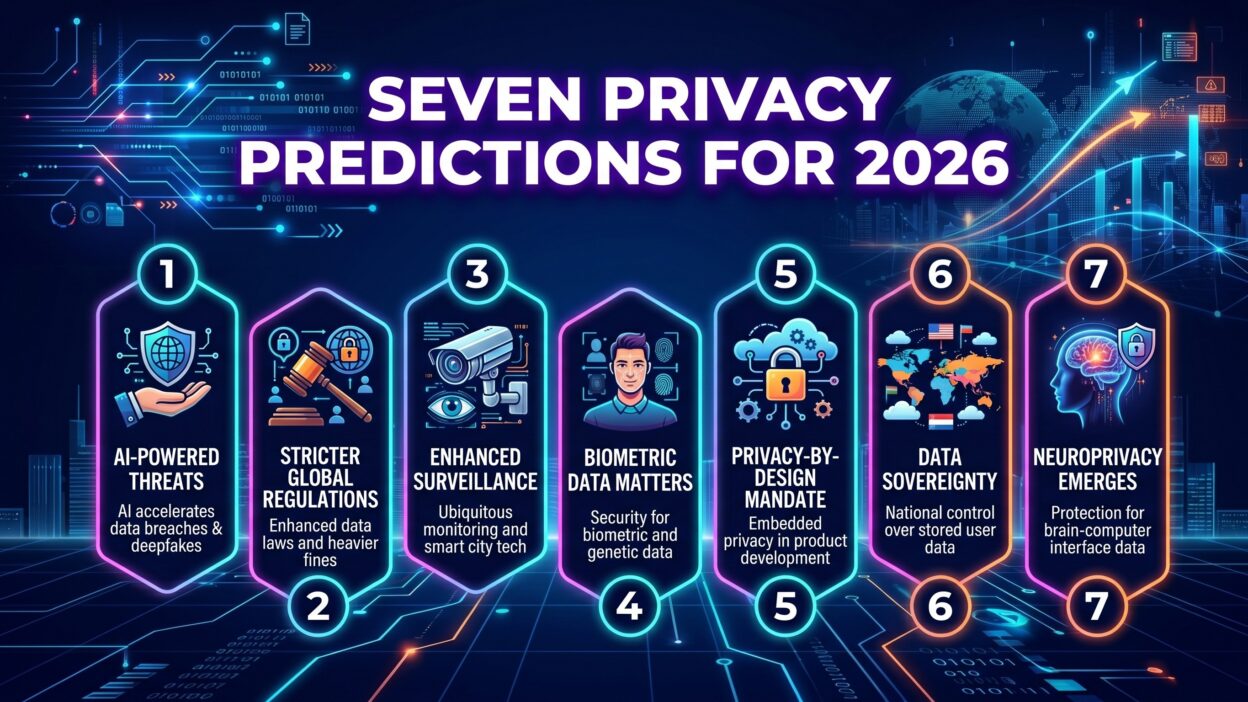
This blog covers seven specific predictions for how the privacy landscape will shift in 2026. Each prediction draws on regulatory trends, technology developments, and business behavior patterns visible right now.
Marketing leaders, legal teams, product managers, and executives all need to understand where privacy is heading. The gap between organizations that prepare and those that react will widen significantly over the next twelve months.
Privacy Predictions 2026 cover everything from AI governance to cookie alternatives, from data broker crackdowns to biometric regulation. Read each section carefully. The implications are broad and the timelines are shorter than most leaders expect.
Table of Contents
Why 2026 Is a Pivotal Year for Data Privacy
Several forces converge in 2026 in ways that make this year distinctly significant. Regulatory frameworks passed between 2018 and 2023 now reach full enforcement maturity. Regulators who spent early years educating businesses now levy serious fines.
AI systems trained on vast personal data sets face their first generation of real legal scrutiny. Courts in Europe, the United States, and Asia issue rulings that define how AI-generated outputs relate to individual privacy rights.
Consumer behavior shifts accelerate the pressure on businesses. Privacy-focused browsers, ad blockers, and opt-out tools reach mainstream adoption. The average internet user in 2026 understands data collection better than ever before.
Privacy Predictions 2026 reflect this convergence. Each prediction connects directly to forces already in motion. None of them require speculation about distant futures. The signals are clear for those paying attention.
Prediction One: AI Data Governance Becomes a Legal Requirement
Artificial intelligence consumes enormous amounts of personal data. Models train on web-scraped content, purchased data sets, user-generated material, and licensed databases. Most of that data includes personal information belonging to real people.
In 2026, regulators will stop treating AI data governance as a voluntary best practice. New legal frameworks will demand that organizations document data sources for every model they deploy. They will require deletion mechanisms for personal data used in training.
What AI Governance Rules Will Look Like
The EU AI Act moves into active enforcement in 2026. Its provisions require high-risk AI systems to maintain detailed data documentation. Companies deploying AI in hiring, credit scoring, healthcare, and law enforcement face the strictest requirements.
Data protection authorities in the UK, Canada, and Brazil mirror many EU requirements in their own guidance. A global baseline for AI data governance begins to take shape. Companies with international operations cannot maintain separate standards by region.
Privacy Predictions 2026 put AI governance at the top of the list because enforcement actions in this area will generate the largest fines and the most public attention. A single high-profile case involving a major AI company will accelerate compliance investment across every sector.
How Companies Should Prepare Now
Organizations need AI data inventories before regulators demand them. Every model in production should document its training data sources, data categories, and retention timelines. That documentation does not exist at most companies today.
Legal teams need to understand the difference between data used for AI training and data used for AI inference. Regulators treat these categories differently. Contracts with data providers need explicit clauses about permissible AI uses.
The cost of retrofitting AI governance onto existing systems far exceeds the cost of building governance in from the start. Companies still in early AI deployment stages have a narrow window to get this right without painful remediation later.
Prediction Two: Third-Party Cookies Reach True Extinction
The deprecation of third-party cookies has been a slow-moving story for years. Google delayed its Chrome timeline multiple times. Advertisers breathed temporary sighs of relief. The deadline kept moving.
Privacy Predictions 2026 mark the year that the advertising industry stops waiting for cookies to disappear and accepts that they are already irrelevant. Browser market share data tells the real story.
The State of Cookieless Advertising
Safari and Firefox blocked third-party cookies years ago. Together they represent a substantial share of global browsing traffic. Advertisers who relied on cross-site tracking already lost access to that audience.
Chrome’s eventual deprecation matters symbolically more than technically at this point. The infrastructure for cookieless advertising has been under construction for years. By 2026, it reaches operational maturity for most major ad platforms.
Privacy Predictions 2026 include a shift in advertiser mindset. Teams stop framing cookieless as a future problem and start treating first-party data as the present reality. The brands that made that shift early will demonstrate measurable performance advantages over those that delayed.
First-Party Data Strategies That Win
Loyalty programs, email subscription lists, and authenticated web experiences represent the primary assets in a cookieless world. Companies that built robust first-party data assets over the past three years will enter 2026 with clear advantages.
Contextual advertising regains respect it lost during the behavioral targeting era. Placing ads based on content context rather than user history delivers results that privacy-first measurement validates consistently.
Clean room technologies enable data collaboration without exposing individual user records. Two companies can match their first-party data sets to find shared audiences without either company seeing the other’s raw data. This approach scales as cookie alternatives mature.
Prediction Three: Biometric Data Regulation Expands Globally
Fingerprints, facial geometry, voiceprints, iris patterns, and gait data all qualify as biometric information. Collection of this data carries higher risk than most other personal information categories because biometric identifiers cannot be changed if compromised.
A stolen password gets reset. A leaked credit card number gets replaced. Stolen facial recognition data remains a liability for the individual’s entire lifetime. Regulators understand this distinction and treat biometric data accordingly.
Where Biometric Laws Stand Today
Illinois led the United States with the Biometric Information Privacy Act, known as BIPA. Several other states followed with their own biometric statutes. Federal biometric legislation advanced further in 2025 than in any prior year.
Privacy Predictions 2026 include significant expansion of biometric regulation outside the United States. Brazil’s LGPD enforcement actions specifically targeting biometric misuse will set important precedents. India’s Digital Personal Data Protection Act will clarify its biometric provisions with binding guidance.
Workplace biometrics face particular scrutiny. Employers who use facial recognition for attendance tracking, fingerprint scanners for time clocks, or voice analysis for performance evaluation will encounter new consent and deletion requirements that many current systems cannot meet.
Industries Facing Immediate Biometric Risk
Retail businesses using facial recognition for loss prevention face class action exposure under BIPA-style statutes in multiple states. The litigation history in Illinois demonstrates how quickly these cases generate massive settlement obligations.
Financial services companies using voice biometrics for customer authentication need to review their consent collection processes immediately. Recording a voice for authentication purposes without explicit biometric-specific consent creates substantial legal risk under 2026 regulatory standards.
Healthcare organizations collecting fingerprints or facial scans for patient identification need both HIPAA compliance and applicable biometric statute compliance. Those two frameworks overlap but do not align perfectly. The gap between them creates compliance complexity that requires expert legal guidance.
Prediction Four: Data Broker Regulation Reaches Critical Mass
Data brokers collect, aggregate, and sell personal information at industrial scale. They operate largely out of sight. Most consumers have no idea that companies holding detailed profiles about their health history, financial behavior, location patterns, and household composition exist and sell that information freely.
Privacy Predictions 2026 forecast a turning point for data broker regulation. The combination of state-level legislation, Federal Trade Commission enforcement priority, and international regulatory pressure creates a compliance environment that even the largest brokers cannot ignore.
State and Federal Data Broker Laws
California, Texas, Oregon, and Montana enacted data broker registration requirements. Vermont pioneered this approach years earlier. The federal DELETE Act, which requires brokers to honor consumer opt-out requests through a centralized mechanism, advances toward implementation.
The FTC demonstrated in 2024 and 2025 that it treats data broker activities as a priority enforcement area. Privacy Predictions 2026 include at least two major FTC enforcement actions against data brokers that generate nine-figure penalties and require structural changes to business models.
Companies that purchase data from brokers face increasing scrutiny for their vendor relationships. Buying data from a broker that collected it improperly creates legal exposure for the purchasing company under some state statutes. Due diligence on data purchases becomes a legal necessity rather than a best practice.
Health Data Brokers Face Separate Treatment
The FTC’s Health Breach Notification Rule and its enforcement against health data brokers specifically signals that medical, fitness, and mental health data receives heightened regulatory attention. Companies selling data derived from health apps, wearables, and telehealth platforms operate in particularly dangerous territory.
Privacy Predictions 2026 include restrictions on the sale of reproductive health location data, mental health app behavioral data, and prescription purchase history. These categories attracted significant legislative attention after the Dobbs decision and that attention translates into enforcement reality in 2026.
Prediction Five: Consent Management Platforms Must Evolve or Fail
Consent management platforms, commonly called CMPs, became standard infrastructure for websites managing cookie consent after GDPR took effect. Most of them were built to satisfy a legal requirement rather than to genuinely respect user preferences.
Dark patterns in consent interfaces drew regulatory attention starting in 2023. Regulators in France, Ireland, and Spain fined organizations for consent interfaces that made rejecting cookies harder than accepting them. Privacy Predictions 2026 mark the year this enforcement reaches full intensity.
What Regulators Demand From Consent Interfaces
Consent must be as easy to withdraw as it is to give. Reject buttons must appear with equal prominence to accept buttons. Pre-ticked boxes do not constitute valid consent. These requirements existed in GDPR text from day one. Enforcement finally matches the legal standard in 2026.
Granular consent choices become mandatory in more jurisdictions. Users must be able to consent to analytics cookies without consenting to advertising cookies. Bundled consent fails regulatory review. CMP vendors that cannot support granular consent lose enterprise customers who cannot afford non-compliance.
Privacy Predictions 2026 include regulatory audits that specifically target consent rate data. Regulators will question organizations whose cookie acceptance rates reach 90 percent or above. Suspiciously high acceptance rates signal manipulative design rather than genuine user preference.
The Next Generation of Consent Technology
Global Privacy Control, a browser-level privacy signal, gains broader legal recognition in 2026. California already requires businesses to honor GPC signals. More states and countries adopt similar mandates. Browsers that support GPC become default tools for privacy-conscious users.
Server-side consent management emerges as a technical approach that separates consent data from client-side scripts. This architecture reduces the latency penalty associated with traditional CMPs and improves the reliability of consent signal transmission to downstream vendors.
Identity-linked consent preferences allow users to carry their consent choices across devices and sessions. A user who opted out on their laptop should not face re-consent prompts on their mobile browser visiting the same site. Cross-device consent synchronization becomes a technical standard that regulations begin to require.
Prediction Six: Employee Privacy Rights Expand Significantly
Employee monitoring accelerated during remote work adoption. Employers deployed screenshot software, keystroke loggers, active window trackers, and productivity scoring systems. Many employees accepted these tools without understanding their scope.
Privacy Predictions 2026 include a significant regulatory and legal response to workplace surveillance overreach. Employee privacy rights that existed primarily on paper in many jurisdictions begin to carry real enforcement weight.
Monitoring Technologies Under Legal Scrutiny
Continuous screenshot software that captures employee screens every few minutes faces legal challenges under European works council rights and emerging US state employee privacy statutes. Employees in New York, California, and Connecticut gain new notification rights about monitoring technologies.
AI-powered productivity scoring systems that evaluate employee performance through keystrokes, mouse movements, and application usage attract regulatory attention in the EU under the AI Act’s provisions on AI systems affecting workers. Employers must notify workers and allow meaningful human review of AI-generated performance assessments.
Mental health monitoring through behavioral analysis tools, including sentiment analysis of communications and productivity pattern monitoring intended to identify stress, faces strong pushback from works councils, unions, and regulatory bodies. Privacy Predictions 2026 include at least one major enforcement action specifically targeting mental health surveillance in workplace contexts.
What Employers Need to Do
Audit all employee monitoring tools currently in use. Document what data each tool collects, how long it retains that data, and who has access to it. Many employers deployed monitoring tools quickly during the pandemic without this documentation.
Review consent and notice mechanisms for each monitoring system. Informing employees that monitoring occurs is a baseline requirement. Informing them specifically about what data gets collected, analyzed, and stored meets the higher standard that 2026 regulations demand.
Evaluate whether monitoring intensity matches legitimate business needs. Regulators apply proportionality tests. Capturing screenshots every two minutes for a customer service representative differs legally from capturing them every two minutes for a knowledge worker whose output cannot be measured by activity metrics.
Prediction Seven: Privacy Becomes a Genuine Brand Differentiator
Privacy has appeared on brand value surveys for years. Consumers consistently say they care about how companies handle their data. Behavioral data told a different story. Consumers said one thing and did another, choosing convenience over privacy at nearly every decision point.
Privacy Predictions 2026 mark a shift in this dynamic. The gap between stated privacy preferences and actual behavior narrows. High-profile data breaches, regulatory news coverage, and privacy-focused product marketing all contribute to changing consumer behavior in measurable ways.
Consumer Privacy Behavior Is Changing
App store privacy labels, introduced by Apple, changed how consumers evaluate apps before downloading. Users who saw that an app collected extensive personal data chose alternatives at rates that surprised developers. That behavior pattern strengthens in 2026.
Browser and search engine market share data shows consistent growth for privacy-focused alternatives. DuckDuckGo, Brave, and similar products attract users who previously considered privacy tools too inconvenient for mainstream use. Mainstream inconvenience threshold drops as these products improve.
Privacy Predictions 2026 include consumer research showing that privacy assurances influence B2B purchasing decisions at significantly higher rates than in prior years. IT buyers and procurement teams add privacy capability assessments to vendor evaluation criteria. This shift gives privacy-forward vendors a genuine sales advantage.
How Brands Win With Privacy as a Value Proposition
Transparency reports, published data practice commitments, and third-party privacy audits all function as trust signals that sophisticated buyers evaluate. Companies that publish these materials create credibility that competitors who stay silent cannot match.
Privacy-by-design product development, where data minimization and user control get built into products from the start, generates marketing advantages alongside compliance benefits. Products that collect only what they need and give users clear control earn positive coverage from privacy-focused publications and advocacy organizations.
Customer-facing privacy dashboards, where users can see exactly what data a company holds about them and request changes or deletions, build loyalty among privacy-conscious segments. These segments grow each year and represent some of the highest-value customer profiles in many industries.
How Businesses Should Prepare for Privacy Predictions 2026
Preparing for Privacy Predictions 2026 requires more than updating privacy policies. The changes ahead demand operational investment, technology upgrades, and organizational alignment that takes months to build.
Build a Privacy Roadmap Now
Organizations without a formal privacy roadmap for 2026 start at a disadvantage. A roadmap identifies which regulations apply, which gaps exist in current practices, and which remediation efforts need to begin immediately.
Privacy counsel, data protection officers, and marketing technology teams all need seats at the planning table. Privacy decisions made without marketing input create friction. Marketing decisions made without privacy counsel create liability. Integration of these functions produces better outcomes than sequential handoffs.
Invest in Privacy Technology Infrastructure
Consent management, data subject rights fulfillment, data mapping, and vendor assessment all require technology support at scale. Manual processes cannot handle the volume and complexity that 2026 regulatory requirements demand.
Privacy technology investment decisions made in early 2026 will shape compliance capacity for the following three years. Organizations that select platforms with strong API capabilities, robust reporting features, and active regulatory update programs protect their investment across multiple regulatory changes.
Train Every Team That Touches Data
Legal and IT teams often receive privacy training. Marketing, sales, product, and customer service teams often do not. Every team that collects, processes, or shares personal data needs role-specific privacy training that connects to their daily responsibilities.
Privacy training programs that focus on real workflow scenarios outperform policy-based training programs. A marketer who understands exactly which data collection practices require consent consent mechanisms and which do not makes better decisions under pressure than one who memorized a policy document.
Frequently Asked Questions About Privacy Predictions 2026
What are the most important privacy changes coming in 2026?
Privacy Predictions 2026 highlight seven major shifts. AI data governance becomes legally mandatory under frameworks like the EU AI Act. Third-party cookies reach true functional extinction across major browsers. Biometric data regulation expands globally with new enforcement mechanisms. Data broker regulation reaches critical mass through federal and state action. Consent management platforms face heightened regulatory scrutiny for dark patterns. Employee privacy rights expand under new monitoring regulations. Consumer privacy behavior shifts enough to make privacy a genuine brand differentiator for forward-thinking companies.
How will AI affect privacy regulations in 2026?
AI drives some of the most significant privacy regulation changes in 2026. The EU AI Act enters active enforcement for high-risk AI systems, requiring detailed data documentation and deletion mechanisms. Data protection authorities globally issue guidance on personal data use in AI training. Companies deploying AI without proper data governance documentation face enforcement actions that generate substantial fines and require costly remediation. Organizations need AI data inventories, clear data sourcing documentation, and legal review of all AI training data contracts before regulators demand them.
What should marketing teams do to prepare for Privacy Predictions 2026?
Marketing teams face several specific preparation priorities. First-party data strategies need to be operational before cookieless advertising becomes unavoidable. Consent management platforms need audits to identify dark patterns that regulators will penalize. Data vendor relationships need due diligence reviews to verify that purchased data meets current legal standards. Marketing analytics infrastructure needs evaluation for privacy-safe measurement alternatives. Training programs need to cover privacy requirements for the specific tools and data sources that marketing teams use daily.
Will there be a federal privacy law in the United States in 2026?
The American Privacy Rights Act advanced further in 2025 than any prior federal privacy bill. Privacy Predictions 2026 suggest that federal legislation remains a live possibility rather than a certainty. Even without a federal law, the combination of FTC enforcement, state legislation in California, Texas, Virginia, Colorado, Connecticut, Oregon, Montana, and other states creates a compliance environment that effectively functions as a national standard for companies operating across multiple states.
How does consumer behavior affect Privacy Predictions 2026?
Consumer behavior changes represent one of the most significant elements of Privacy Predictions 2026. Apple’s privacy features, browser privacy improvements, and growing media coverage of data breaches all contribute to rising consumer privacy awareness. B2B buyers increasingly include privacy capability assessments in vendor evaluations. App download decisions respond to privacy label disclosures. Search engine and browser market share data confirms growth for privacy-focused alternatives. These behavioral shifts create market pressure on businesses that regulatory pressure alone cannot generate.
What industries face the highest privacy risk in 2026?
Healthcare faces elevated risk from biometric regulation, AI governance requirements, and health data broker restrictions simultaneously. Financial services face biometric authentication scrutiny alongside AI governance demands. Retail faces facial recognition liability under BIPA-style statutes and data broker restrictions on purchase history data. Technology companies face the broadest range of regulatory requirements across AI, consent, data broker, and employee monitoring categories. Any organization operating in multiple jurisdictions faces compounded compliance complexity as global regulatory standards continue diverging on specific technical requirements while converging on overall principles.
Read More:-How Younger Generations are Disrupting B2B Buying
Conclusion

Privacy Predictions 2026 paint a clear picture. The regulatory environment grows more demanding. Consumer expectations rise faster than most organizations move. AI creates new data challenges that existing frameworks did not anticipate.
The organizations that treat privacy as infrastructure rather than compliance will enter 2026 ahead of their competitors. They built first-party data assets before cookies disappeared. They documented AI training data before regulators required it. They audited consent interfaces before fines arrived.
Each of the seven predictions in this blog carries actionable implications. AI governance demands documentation and legal review of data sourcing. Cookieless advertising demands first-party data investment. Biometric regulation demands consent and deletion mechanisms. Data broker regulation demands vendor due diligence. Consent management demands dark pattern elimination. Employee monitoring demands transparency and proportionality. Privacy as brand value demands visible commitment and operational follow-through.
Privacy Predictions 2026 are not worst-case scenarios. They reflect trends already in motion. Regulatory frameworks already exist. Consumer behaviors already shift. Technology capabilities already advance. The organizations that read these signals clearly and act on them now will face 2026 with confidence rather than crisis.
The cost of preparation is predictable and manageable. The cost of reactive compliance, when regulators set the timeline and terms, is neither. Every week spent building privacy infrastructure before enforcement arrives is a week that reduces future liability and builds future trust.
Privacy in 2026 rewards those who take it seriously. It punishes those who treat it as someone else’s problem. The predictions are clear. The choices are yours.