Introduction
TL;DR Every marketing technology professional has seen the Martech Supergraphic at least once. It is enormous. It is colorful. It is overwhelming. It maps thousands of marketing software vendors onto a single visual document.
Scott Brinker created it. He has updated it every year since 2011. He built an annual ritual out of tracking an industry that refuses to stop growing. His work became the defining reference point for anyone trying to understand the marketing technology landscape.
The Martech Supergraphic started with 150 vendors. It grew past 11,000 by recent editions. That growth is not just a chart statistic. It reflects a fundamental shift in how businesses operate, compete, and serve customers.
Scott Brinker is more than the graphic’s creator. He is the VP Platform Ecosystem at HubSpot. He runs the Chief Marketing Technologist Blog. He speaks at major conferences. He writes books. He shapes how marketing leaders think about technology adoption and organizational strategy.
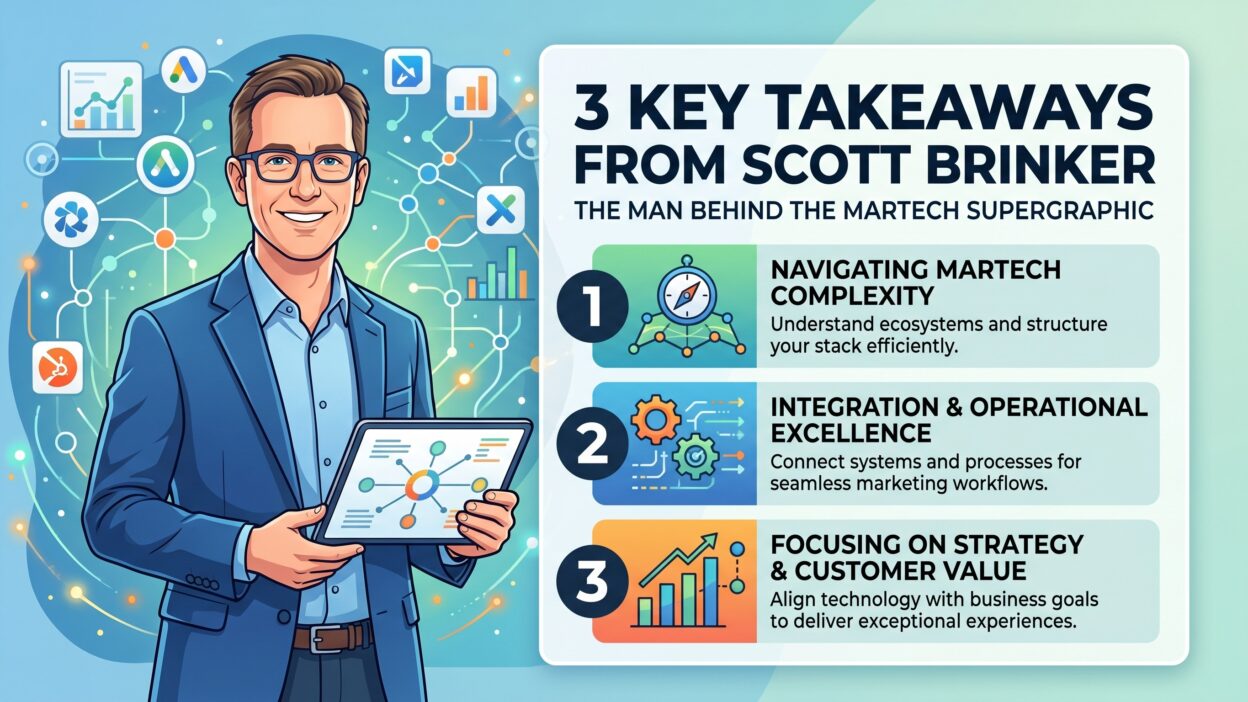
This blog covers three key takeaways from Scott Brinker’s years of research, writing, and speaking. Each takeaway carries direct implications for marketing teams trying to navigate a technology landscape that grows faster than anyone can comfortably track.
Table of Contents
Who Is Scott Brinker and Why Does His Work Matter
Scott Brinker built his reputation by doing something nobody else did consistently. He paid close attention to the marketing software industry as a whole. He counted vendors. He categorized them. He tracked their emergence and their disappearance.
His annual Martech Supergraphic became more than a document. It became evidence. It showed the industry that marketing technology was not a niche concern. It was a massive, sprawling ecosystem with its own economics, politics, and power dynamics.
Brinker’s influence stretched beyond the graphic itself. His writing explored how marketing organizations should structure themselves around technology. He coined the term martech. He explored the concept of the marketing technologist as a distinct professional role.
Leaders at major brands, agencies, and technology companies read his work. CMOs cite the Martech Supergraphic in board presentations. VCs reference it when evaluating software investments. Analysts use it to anchor market size discussions.
Understanding Brinker’s perspective helps marketing leaders make better decisions. His observations are grounded in years of pattern recognition. He sees trends before they become mainstream conversations.
Takeaway One: The Marketing Technology Landscape Will Never Stop Growing
The most common reaction to the Martech Supergraphic is disbelief. People cannot believe the sheer number of tools that exist. They wonder how any of these companies find customers. They assume the market will consolidate soon.
Scott Brinker has heard that consolidation prediction every year since 2012. The consolidation has not arrived. The vendor count keeps rising. The graphic keeps expanding.
Why the Landscape Keeps Expanding
New categories emerge constantly. Social commerce did not exist as a distinct software category a decade ago. Now it does. Creator marketing platforms, AI content tools, and privacy-first analytics suites are all new additions to the Martech Supergraphic.
Buyer fragmentation drives vendor proliferation. Different industries need different tools. An e-commerce brand and a B2B software company share almost no martech requirements. Each builds its own stack. Vendors build products for each specific use case.
Open-source platforms lower the barrier to entry for new software companies. A small team of engineers can build a viable marketing tool faster and cheaper than ever before. More companies enter the market each year than exit it through acquisition or failure.
The Martech Supergraphic reflects this structural reality. It is not a sign of waste or inefficiency. It is a map of genuine market diversity. Every vendor on that graphic serves someone’s real workflow need.
What This Means for Marketing Leaders
Marketing leaders should stop waiting for consolidation. The landscape will not simplify on its own. The number of available tools will keep growing regardless of what any individual company decides.
The Martech Supergraphic teaches a counterintuitive lesson. Abundance creates its own challenge. When thousands of tools exist, the ability to choose well matters more than the ability to adopt quickly.
Stack management becomes a core competency. Marketing teams need someone who understands which tools serve which purposes, how they connect, and when to retire them. That skill set was optional five years ago. It is essential now.
Benchmarking against peers loses relevance in an expanding landscape. The tools a competitor uses today will look different from what they use in eighteen months. Building evaluation frameworks matters more than copying stacks.
The Long Tail of Marketing Software
Brinker identified a pattern in the Martech Supergraphic data that surprises most people. The majority of vendors serve very specific, narrow use cases. These niche tools dominate the graphic by volume.
Most marketing teams will never use the vast majority of listed tools. That is the correct outcome. Specialization drives value at the edges of the market. A highly specific tool for one workflow often outperforms a general platform trying to do everything.
Marketing leaders should feel comfortable ignoring most of the Martech Supergraphic. The relevant section for any given organization is small. The challenge is identifying that relevant section with precision.
Takeaway Two: Technology Adoption Is a People Problem, Not a Software Problem
This is the takeaway that most technology vendors would prefer marketing leaders ignore. Scott Brinker has stated it plainly in writing and on stage. The failure mode for martech investments is almost never the software itself.
The Martech Supergraphic documents vendor existence. It does not document vendor adoption rates. Those two numbers diverge sharply. Many tools appear on the graphic year after year while struggling to retain customers.
The Adoption Gap
Brinker calls the gap between purchased tools and actively used tools a critical challenge for marketing organizations. Research consistently shows that marketing teams use only a fraction of the features they pay for.
A platform with 200 capabilities often sees active use of 20 to 30 of them. The rest sit dormant. Teams pay full license fees for partial functionality. Vendors get blamed for underperformance that adoption failures actually caused.
The Martech Supergraphic grows partly because companies buy replacements for tools they never properly adopted. A new vendor promises better outcomes. The real problem travels with the team to the new platform.
Organizational Structure Shapes Technology Outcomes
Brinker writes extensively about how marketing team structure determines technology effectiveness. A decentralized organization where every regional team buys its own tools creates duplication and integration nightmares.
A highly centralized organization where IT controls all martech decisions moves too slowly for marketing’s pace. Neither extreme works well. The organizations that get the most value from their stacks find a middle path.
Federated governance models give central teams authority over core platforms while allowing local teams to add approved tools for specific needs. That balance keeps the stack coherent while preserving flexibility.
The Martech Supergraphic cannot tell you which governance model fits your organization. That decision requires understanding your team’s capabilities, your business model, and your data strategy. Software selection comes after that foundation exists.
The Marketing Technologist Role
Brinker spent years advocating for the marketing technologist as a formal role inside organizations. This person sits at the intersection of marketing strategy and technical execution.
Marketing technologists evaluate tools against business requirements. They manage integrations. They train colleagues. They communicate with IT. They translate between marketing objectives and technical specifications.
Organizations with a dedicated marketing technologist, or a team built around that skill set, get measurably better returns from their martech investments. The Martech Supergraphic is useful to them. To teams without that expertise, it is mostly noise.
Hiring for this role changed how forward-thinking companies approach their stacks. Technology selection became more disciplined. Adoption rates improved. Renewal decisions became data-driven rather than relationship-driven.
Training as a Competitive Advantage
Brinker has noted that most martech training programs are inadequate. Vendors provide onboarding. Teams attend a few sessions. Active usage drops within weeks of go-live.
Companies that treat martech training as an ongoing program rather than a one-time event see different outcomes. Regular workshops, internal certification programs, and peer learning networks all sustain adoption over time.
The Martech Supergraphic reminds us that alternatives always exist. If a tool is underperforming, another vendor will offer to solve the same problem. Investing in adoption delays replacement cycles and compounds returns on existing investments.
Takeaway Three: Platform Ecosystems Are Reshaping the Entire Stack
The third major insight from Scott Brinker’s work involves how the Martech Supergraphic itself has changed over time. Not just in size. In structure.
Early editions of the graphic showed a relatively flat landscape. Hundreds of vendors competed in similar spaces. No single company dominated the entire map.
Recent editions tell a different story. Platform ecosystems have emerged as organizing structures. A few large platforms sit at the center of most enterprise marketing stacks. Thousands of smaller tools orbit around them.
The Hub and Spoke Model
Salesforce, HubSpot, Adobe, and a handful of other platforms function as ecosystem hubs. They offer robust app marketplaces. They provide APIs that independent software vendors build against.
The Martech Supergraphic now reflects this structure. Many smaller vendors exist primarily as extensions of larger platforms. Their value proposition depends on integration quality with the hub platform.
For marketing leaders, this shifts buying decisions. Evaluating a point solution now requires evaluating its integration with the core platform. A best-in-class tool that connects poorly to the hub platform creates more problems than it solves.
Stack design thinking changed as a result. Teams build around a core platform first. They select complementary tools based on ecosystem compatibility second. Standalone evaluation of individual tools became less relevant.
API Economy and Open Integration
Brinker tracked the rise of the API economy in marketing technology across multiple editions of the Martech Supergraphic. More vendors now compete on integration quality rather than feature depth alone.
Open APIs enable custom connections between tools that vendors never anticipated. Marketing engineers build integrations that make specific workflows possible. Those connections often provide more competitive advantage than any individual tool feature.
Organizations with strong technical marketing capabilities build custom integration layers. They create proprietary workflows on top of standard tools. The result is a stack that competitors cannot easily replicate by purchasing the same software.
AI Is the Next Structural Shift
Brinker has spoken directly about artificial intelligence reshaping the Martech Supergraphic in ways that mirror what APIs did a decade earlier. AI capabilities are embedding themselves across every category.
Email marketing tools now offer AI-generated subject line suggestions. Ad platforms use machine learning for bid optimization. Content management systems provide AI writing assistance. Analytics platforms surface predictive insights automatically.
The Martech Supergraphic will not add an AI category. AI will become a feature layer across existing categories. Tools that do not incorporate AI capabilities will face competitive pressure from those that do.
Marketing leaders should evaluate vendor roadmaps for AI integration. The Martech Supergraphic of five years from now will look radically different not because new categories emerged, but because AI transformed the capabilities within existing ones.
Data as the Connective Tissue
Brinker consistently emphasizes data strategy as the foundation beneath any effective martech stack. The Martech Supergraphic shows tools. Tools are only as valuable as the data flowing through them.
Customer data platforms emerged as a distinct category precisely because data fragmentation became a first-order problem. Each tool in a stack collected data independently. Connecting those data sets required new infrastructure.
Organizations that solved their data architecture challenge before expanding their stack got dramatically better returns. Data strategy is not a technology problem. It is a business decision that technology then executes.
How to Actually Use the Martech Supergraphic as a Strategic Tool
The Martech Supergraphic is most valuable when used as a reference tool rather than a shopping list. Understanding how to extract signal from it saves marketing leaders significant time and prevents poor buying decisions.
Category Awareness, Not Vendor Selection
The primary value of the Martech Supergraphic lies in category discovery. A team dealing with a specific workflow problem can scan the relevant category to understand what types of solutions exist.
Once a category gets identified, deeper vendor research happens through other channels. Review sites, peer recommendations, and trial evaluations provide better buying signals than graphic position.
Tracking Landscape Evolution
Comparing annual editions of the Martech Supergraphic reveals category growth and decline. A category gaining vendors signals an emerging opportunity or problem that the market is actively trying to solve.
A category with fewer vendors each year signals consolidation or commoditization. That pattern helps teams evaluate whether best-of-breed selection still makes sense or whether platform features now cover the same need.
Benchmarking Stack Complexity
The Martech Supergraphic gives marketing leaders context for evaluating their own stack size. An organization using 12 tools in a space where peers average 25 is either very efficient or under-resourced. The graphic helps frame that conversation.
Auditing the internal stack against the Martech Supergraphic categories reveals gaps and redundancies. Two tools serving the same category suggest consolidation opportunity. A critical category with no internal solution suggests a gap worth addressing.
Frequently Asked Questions About the Martech Supergraphic
What is the Martech Supergraphic?
The Martech Supergraphic is an annual visual map of the marketing technology landscape created by Scott Brinker. It catalogs thousands of marketing software vendors organized by category. The graphic started in 2011 with roughly 150 vendors. Recent editions list over 11,000 tools across dozens of categories. Marketing professionals and industry analysts use the Martech Supergraphic as a reference document for understanding the scope and structure of the marketing technology industry.
Who created the Martech Supergraphic?
Scott Brinker created the Martech Supergraphic. He is the VP Platform Ecosystem at HubSpot and the founder of the Chief Marketing Technologist Blog, also known as chiefmartec.com. Brinker has published an updated version of the graphic each year since 2011. His research and writing on marketing technology strategy accompany the graphic and provide context for the vendor counts and category trends it documents.
How many tools appear on the Martech Supergraphic?
The vendor count on the Martech Supergraphic passed 11,000 in recent years. The number changes with each annual edition as new vendors get added and others get removed due to acquisition, closure, or reclassification. The growth rate has slowed compared to the early 2010s but the total count continues rising. Brinker acknowledges that the graphic is not exhaustive. Many smaller or newer vendors do not appear even in the most recent editions.
How should marketing teams use the Martech Supergraphic for planning?
Marketing teams should use the Martech Supergraphic primarily for category discovery rather than vendor shortlisting. When a team identifies a workflow gap, scanning the relevant category in the graphic reveals what types of solutions exist. Deeper vendor evaluation happens through review sites, peer networks, and direct trials. The Martech Supergraphic also helps teams audit existing stacks by comparing internal tools against graphic categories to find gaps and redundancies.
Why does the Martech Supergraphic keep growing?
The Martech Supergraphic grows because new software categories emerge regularly and entry barriers for new software companies remain low. Different industries have distinct tool requirements, so the market segments into many specialized verticals. Brinker has observed that consolidation predictions have not materialized despite years of expectations. Large platforms acquire companies but do not eliminate categories. The total vendor count rises because new entrants consistently outnumber exits.
What is Scott Brinker’s biggest insight from tracking the Martech Supergraphic?
Brinker consistently highlights that technology adoption is a people and process challenge rather than a software challenge. The Martech Supergraphic shows that thousands of tools exist and compete. Despite that abundance, most organizations underutilize the tools they already own. Brinker argues that organizational structure, training programs, and governance models determine martech outcomes more reliably than vendor selection does. His advice directs marketing leaders to invest in human capability alongside software capability.
Read More:-What Google’s Email Changes Really Mean for B2B
Conclusion

Scott Brinker built something rare. He created a piece of work that an entire industry references, debates, and uses to make real business decisions. The Martech Supergraphic is a remarkable artifact not because of its size but because of what it represents.
It represents a commitment to tracking complexity honestly. Brinker did not simplify the landscape to make it more comfortable. He documented it as it actually exists. That honesty made the graphic credible and made Brinker a trusted voice.
The three takeaways from his work carry practical weight. The marketing technology landscape will keep expanding. Technology adoption fails when organizations treat it as a software problem rather than a people problem. Platform ecosystems are restructuring how the entire Martech Supergraphic organizes itself.
Marketing leaders who internalize these lessons make better decisions. They evaluate tools against organizational capability. They invest in adoption alongside purchasing. They build stacks around platform ecosystems rather than assembling disconnected point solutions.
The Martech Supergraphic will grow again next year. It will add new categories and new vendors. The challenge of navigating it will not get easier. The organizations with strong martech governance, skilled marketing technologists, and disciplined adoption programs will get better returns from the landscape regardless of how large it grows.
Scott Brinker’s most durable insight is that the graphic itself is not the answer. It is a mirror. It shows marketing leaders the world they operate in. What they do with that reflection is the actual work.