Introduction
TL;DR Most sales teams guess at their ideal customer. They describe the target as a mid-sized SaaS company with a VP of Sales. That description is too vague to act on. It drives poor targeting, wasted ad spend, and bloated pipelines full of accounts that never close.
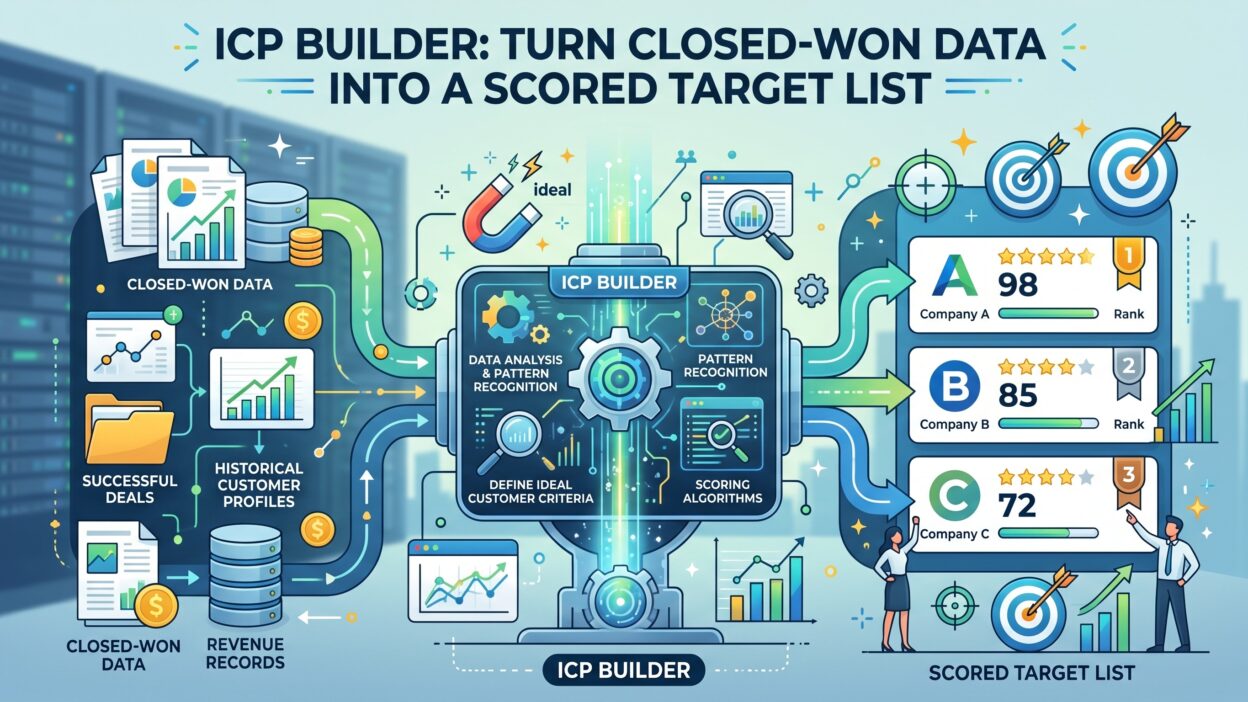
An ICP builder changes that. It replaces gut instinct with data. It takes your closed-won history and turns it into a precise, scored list of accounts worth pursuing. The result is a target list that marketing can act on and sales can trust.
This guide covers the full process. You will learn what an ICP builder is, why closed-won data is the best input, how to build your scoring model, and which tools help you execute at scale. By the end, you will have a clear path to a smarter, revenue-backed ideal customer profile.
Revenue teams that use a structured ICP builder consistently close more deals. They shorten sales cycles. They improve win rates. They waste less budget on accounts that were never going to buy. Building your ICP on real data is one of the highest-ROI moves any revenue team can make.
Table of Contents
What Is an ICP Builder?
An ICP builder is a system or tool that analyzes your best customers and defines the attributes that make them ideal. It examines closed-won deals, extracts patterns, and translates those patterns into a scoring framework. Every new prospect account gets evaluated against that framework.
The output of an ICP builder is not a persona document. It is not a slide deck. It is an actionable scoring model. Accounts that match the most attributes score highest. Sales reps prioritize high-scoring accounts first. Marketing allocates budget toward those same accounts.
A well-built ICP builder connects directly to your CRM. It pulls data from closed-won opportunities. It identifies firmographic traits, technographic signals, behavioral patterns, and timing indicators. It weights each attribute based on its correlation with revenue. The result is a live, data-driven target list.
ICP builders differ from manual ICP exercises. A manual ICP exercise involves a workshop, a whiteboard, and educated guesses from sales and marketing leaders. An ICP builder uses actual deal data. It removes opinion from the equation. The closed-won record is the single most honest signal about who your product actually serves best.
In 2026, ICP builders have become central to revenue operations strategy. The best teams refresh their ICP quarterly using updated closed-won data. They do not set and forget. They treat the ICP as a living model that evolves as the business grows and the market shifts.
Why Closed-Won Data Is the Best Input for an ICP Builder
Every revenue team has access to historical deal data. Most teams underuse it. Closed-won records contain the richest signal available about what a good customer looks like. They capture who bought, at what deal size, in what time frame, and from which segment.
Closed-won data reflects actual purchase decisions. It shows which companies reached a point of enough pain and enough confidence to sign a contract. No other data source captures that level of buying commitment. Web traffic data shows interest. Closed-won data shows conviction.
Using closed-won data in your ICP builder eliminates the problem of aspirational targeting. Sales and marketing leaders often describe their ideal customer as a Fortune 500 company. But the actual closed-won data might show that most revenue comes from 200-to-500-person companies in financial services. The data tells the truth. Opinions tell a story.
Closed-won data also helps identify unexpected segments. Many companies discover high-performing verticals they did not intentionally target. A company focused on SaaS might find that healthcare technology companies close faster and churn less. Without a structured ICP builder analyzing closed-won records, these insights stay hidden.
Time-to-close data adds another dimension. When your ICP builder analyzes how long each closed-won deal took to close, it can identify segments where the sales cycle is shorter. Shorter cycles mean faster revenue. Faster revenue means better cash flow. These timing insights sharpen the scoring model significantly.
Key Attributes to Include in Your ICP Builder
A strong ICP builder examines multiple attribute categories. Each category adds a different layer of precision to the scoring model. Combining these layers produces a more reliable picture of fit than any single data type can provide.
Firmographic Attributes
Firmographic data covers the structural characteristics of a company. Industry vertical, annual revenue, employee count, company age, and headquarters location all belong in this category. These attributes are easy to collect and widely available from enrichment providers.
In your ICP builder, firmographic attributes form the foundation of the scoring model. They define the baseline shape of a good-fit account. An account in the right industry with the right headcount already passes the first filter. Firmographics do not close deals, but they identify whether an account is worth engaging at all.
Technographic Attributes
Technographic data reveals which technologies a company uses. CRM platform, marketing automation stack, ERP system, data warehouse, and security tools are all examples. Technographic signals often correlate strongly with product fit.
A company using Salesforce and Marketo might represent a much stronger fit for a sales intelligence platform than a company using spreadsheets. Your ICP builder should weight technographic matches heavily when the data shows strong correlation with closed-won deals. Tools like BuiltWith, HG Insights, and Clearbit provide this data at scale.
Behavioral and Intent Signals
Behavioral data captures how a company has interacted with your brand before buying. Did they visit the pricing page multiple times? Did a contact download a specific whitepaper? Did the account engage with ads over several months before a sales rep reached out?
Intent signals extend beyond your own website. Third-party intent data providers track which companies research relevant topics across the web. A company actively researching your category is a much warmer target than one with no visible research activity. ICP builder models that incorporate intent data identify in-market accounts earlier in their buying journey.
Organizational and Structural Signals
Company structure affects deal complexity and win probability. A privately held company often moves faster than a publicly traded enterprise. A PE-backed company may have aggressive growth targets that create urgency. A recent merger or acquisition often triggers new technology spending.
These structural signals add nuance to your ICP builder scoring model. They help identify accounts that are not just a good fit in terms of size and industry, but also in the right organizational moment to buy. Timing is as important as fit.
Customer Success Attributes
Closed-won is not the only relevant data source. Customer success data adds another layer of signal. Which customers expanded their contracts? Which customers churned within the first year? Which segments produce the highest lifetime value?
A great ICP builder includes expansion and retention signals, not just initial purchase signals. An account that fits the ICP should be likely to buy, likely to stay, and likely to grow. When customer success data feeds the ICP builder, the scoring model reflects the full revenue lifetime of a customer, not just the initial deal.
How to Build Your ICP Scoring Model Step by Step
Building a scoring model inside your ICP builder requires a structured process. Rushing the setup produces an inaccurate model. Take time with each step. The quality of the output depends on the quality of the input and the rigor of the process.
Pull Your Closed-Won Data
Export your closed-won opportunities from the CRM. Include deal size, close date, industry, company size, deal source, and any segment tags. Pull at least 12 months of data. Two years is better. Larger data sets produce more statistically reliable patterns.
Clean the data before analysis. Remove duplicate entries. Standardize industry labels. Fill in missing fields using enrichment tools. Dirty data produces misleading patterns. Invest time in data preparation before touching the scoring model.
Identify the Top 20 Percent of Deals
Not all closed-won deals are equal. Segment your closed-won data by deal size, time-to-close, and expansion revenue. Identify the top 20 percent of deals. These are your best customers. They closed at the highest value, closed fastest, and expanded most.
Your ICP builder should model this top tier, not the average deal. The goal is to replicate your best outcomes, not your average outcomes. Identifying this top cohort is the most important analytical step in the entire process.
Analyze Common Attributes Across Top Deals
Look for patterns across your best deals. Which industries appear most frequently? What company size range dominates? Which technologies do these accounts use? What titles are most common in the buying committee? Where are these companies located?
Run frequency analysis across every attribute you have. Rank attributes by how strongly they correlate with membership in the top 20 percent cohort. Attributes that appear far more often in top deals than in average deals carry more predictive weight. These become your highest-scoring criteria in the ICP builder model.
Assign Attribute Weights
Assign point values to each attribute based on its predictive strength. An attribute that appears in 80 percent of top deals earns more points than one that appears in 40 percent. Create a scoring rubric with clear point values for each attribute and each attribute value.
Keep the total possible score manageable. A 100-point scale works well. High-fit accounts score 70 and above. Medium-fit accounts score 40 to 69. Low-fit accounts score below 40. This tiering gives sales reps a simple priority signal without overwhelming them with complex formulas.
Apply the Score to Your Target Account List
Run every account in your target list through the ICP builder scoring model. Enrich each account with the attributes your model requires. Assign scores. Sort the list from highest to lowest score. Your sales team now has a prioritized target list grounded in data.
Automate this process wherever possible. Manual scoring does not scale. CRM workflows, enrichment APIs, and scoring tools can apply the model to every new account automatically. Real-time scoring ensures the list stays current as new accounts enter the system.
Validate and Calibrate the Model
Run the model against a hold-out set of closed-won and closed-lost deals. High-scoring accounts should map heavily to closed-won outcomes. Low-scoring accounts should map more heavily to closed-lost or never-engaged outcomes. If the model shows poor separation, revisit the attribute weights.
Calibration is ongoing. Each quarter, pull new closed-won data and re-run the attribute frequency analysis. If new patterns emerge, update the scoring weights accordingly. An ICP builder that gets recalibrated regularly stays accurate. One that never gets reviewed drifts out of alignment with reality.
Best ICP Builder Tools in 2026
Several tools help revenue teams build, score, and activate their ICP. Each has different strengths. The right choice depends on your CRM, data maturity, and team resources.
Clearbit
Clearbit enriches accounts with firmographic, technographic, and employee data in real time. It integrates directly with Salesforce and HubSpot. For teams building an ICP builder on top of CRM data, Clearbit provides the enrichment layer that makes attribute scoring possible. Its Reveal product identifies anonymous website visitors and matches them to company records, giving the scoring model behavioral signals without requiring a form fill.
6sense
6sense combines account identification, intent data, and AI-powered scoring. Its ICP builder capability analyzes closed-won data and scores prospect accounts automatically. The platform identifies accounts showing in-market buying signals and ranks them against the ICP. Sales teams get a live, prioritized target list updated in real time. 6sense suits mid-market and enterprise teams that want a fully integrated ICP builder with intent data built in.
Salesforce Einstein
Salesforce Einstein includes account scoring and lead scoring models that function as a lightweight ICP builder inside the Salesforce ecosystem. Revenue operations teams can train the model on closed-won data. Einstein identifies the attributes most predictive of conversion and scores accounts accordingly. It suits teams that want ICP builder capabilities without adding a new vendor to the stack.
HubSpot Customer Journey Analytics
HubSpot’s reporting and scoring tools allow teams to build a basic ICP builder inside the HubSpot CRM. Custom scoring properties, deal source analysis, and contact scoring workflows can approximate the core ICP builder function. It works best for teams at an earlier stage of data maturity who want to start scoring without a dedicated tool.
Warmly
Warmly identifies website visitors and matches them to accounts in real time. It layers intent signals on top of firmographic data. Teams use Warmly as an ICP builder activation layer. When a high-scoring account visits the website, Warmly triggers a sales alert. This connects the ICP scoring model to live sales execution, reducing the lag between identifying a fit account and engaging them.
Clay
Clay is a flexible data enrichment and workflow automation platform. Revenue operations teams use it to build custom ICP builder workflows. Clay pulls data from dozens of enrichment sources, applies scoring logic, and pushes scored account records into the CRM. It suits teams that want full control over their ICP builder process without relying on a black-box vendor model.
Common Mistakes to Avoid When Using an ICP Builder
Building an ICP is not difficult in concept. Execution is where most teams go wrong. These mistakes are common and avoidable.
Using Too Little Data
Running an ICP builder on fewer than 50 closed-won deals produces unreliable patterns. Small sample sizes amplify noise. One unusually large deal distorts the entire model. Use at least 12 months of closed-won data. Two years produces more reliable attribute correlations. If your data set is small, supplement with customer success data to expand the analysis pool.
Modeling the Average Customer Instead of the Best Customer
Averaging all closed-won deals into one profile dilutes the signal. The goal of an ICP builder is to identify who your best customers are, not who your typical customers are. Model the top 20 percent. Target accounts that match that cohort. Average customers are fine. Best customers drive growth.
Ignoring Churn Data
An account that churns within the first year was not actually an ideal customer. It was a misfit that your sales team convinced to buy. Including churned accounts in your ICP builder analysis without flagging them pollutes the model. Exclude churned accounts from the positive signal set. Use them as negative examples to identify attributes associated with poor fit.
Setting and Forgetting the Model
Market conditions change. Your product evolves. New segments emerge. A static ICP builder model becomes less accurate over time. Refresh the model quarterly. Pull new closed-won data. Re-run the attribute analysis. Update weights where patterns have shifted. A live ICP builder is significantly more valuable than a static one.
Failing to Activate the Score
Building a scoring model and leaving it in a spreadsheet wastes the effort. The ICP builder score must flow into the CRM, the marketing automation platform, and the outbound sequencing tools. Sales reps need the score visible in their workflow. Marketing needs the score driving audience segmentation. Without activation, the model produces no revenue impact.
How Revenue Operations Teams Use an ICP Builder
Revenue operations teams own the ICP builder process in most modern B2B organizations. They sit at the intersection of data, systems, and go-to-market strategy. The ICP builder gives RevOps a concrete deliverable that directly influences pipeline quality.
RevOps uses the ICP builder to define territory design. Territories get shaped around concentrations of high-scoring accounts. Reps work areas where fit accounts are dense. This increases productivity without increasing headcount. Better territory design is one of the most direct ways the ICP builder creates revenue impact.
The ICP builder also informs marketing budget allocation. Channels and campaigns that reach high-scoring accounts get more budget. Channels that reach low-scoring audiences get less. This alignment between ICP score and media spend reduces wasted budget significantly. Marketing ROI improves because targeting is sharper.
Demand generation programs use ICP scores to define audience segments. A LinkedIn campaign targeting accounts in the top ICP tier outperforms one targeting a broad demographic. A webinar invitation list filtered by ICP score produces higher-quality pipeline than a list filtered by job title alone. The ICP builder makes every campaign smarter.
Sales development teams use ICP scores to prioritize outbound sequences. SDRs work the highest-scoring accounts first. Response rates improve because the outreach goes to accounts with genuine fit. Meetings booked increase. Pipeline from SDR activity improves in quality, not just quantity.
Frequently Asked Questions About ICP Builders
What is the difference between an ICP and a buyer persona?
An ICP defines the ideal company. A buyer persona defines the ideal individual within that company. The ICP builder focuses on firmographic, technographic, and behavioral attributes of the account itself. Buyer personas describe the roles, motivations, and challenges of the decision-makers inside that account. Both are useful. The ICP comes first because it defines which companies to target. Personas define how to engage the people inside those companies.
How often should I update my ICP builder model?
Refresh the model at least once per quarter. Pull new closed-won data. Re-run the attribute frequency analysis. Adjust weights for any attributes that have shifted in predictive power. Annual updates are not frequent enough. Markets move quickly. Products evolve. Customer success patterns shift. A quarterly refresh keeps the ICP builder model aligned with current revenue reality.
Can a small team with limited data use an ICP builder?
Yes. Smaller data sets require more caution but not abandonment. Use every available closed-won deal. Supplement with customer success data on which accounts expanded versus churned. Conduct qualitative interviews with your best customers to add signal beyond what the CRM holds. A smaller dataset produces a less statistically robust model, but it still outperforms a model built on gut instinct and workshop opinions.
What CRM fields matter most for an ICP builder?
Industry, company size by employee count and revenue, deal source, deal size, time-to-close, and product or tier purchased are the most universally valuable fields. Technographic fields like primary CRM and marketing automation platform add precision. Custom fields that your team uses to classify accounts by segment or use case are also highly valuable. The richer and cleaner your CRM data, the more precise your ICP builder output will be.
How does an ICP builder differ from a lead scoring model?
An ICP builder scores companies based on fit attributes. A lead scoring model scores individual contacts based on fit and behavior. ICP scores apply at the account level. Lead scores apply at the contact level. Many teams use both. The ICP builder defines which companies belong in the pipeline. The lead scoring model identifies which contacts within those companies are most engaged and most likely to champion the deal.
Can I use an ICP builder for customer success and expansion?
Absolutely. The ICP builder logic applies just as well to expansion targeting as to new business. Run your ICP builder analysis on your highest-expansion and highest-retention accounts. Identify the attributes that predict long-term customer value, not just initial purchase. Use those attributes to score your existing customer base. Customer success teams can prioritize high-ICP accounts for proactive expansion outreach and health monitoring.
How do I convince sales leadership to trust the ICP builder scores?
Show the validation data. Run the ICP builder model against historical closed-won and closed-lost records. Demonstrate that high-scoring accounts correlate with wins and low-scoring accounts correlate with losses. Present the conversion rate difference between high-ICP and low-ICP pipeline. Numbers move sales leaders. A clear correlation between ICP score and win rate is the most persuasive argument available.
Read More:-How the Loss of Trade Shows Changed the Customer Acquisition Funnel
Conclusion

Every revenue team claims to know their ideal customer. Very few can prove it with data. An ICP builder closes that gap. It takes your closed-won history and converts it into a scored, actionable framework that every rep and marketer can use every day.
The process is not complicated. Pull your best deals. Find the patterns. Assign weights. Score your prospect universe. Activate the scores in your CRM and campaigns. Refresh the model every quarter. Repeat.
Teams that invest in a proper ICP builder stop chasing accounts that will never buy. They focus their best reps on accounts with genuine fit. They allocate marketing spend to audiences that convert. Pipeline quality improves. Win rates climb. Sales cycles shorten.
The closed-won record is the most honest data source in your business. It reflects real decisions, real budgets, and real pain. Let that data define your target list. An ICP builder turns historical revenue into forward-looking precision. That precision is the foundation of a sustainable, scalable go-to-market engine.
Start with the data you already have. Build the model with care. Trust the output. The accounts at the top of your ICP-scored list are the accounts most likely to become your next best customers.