Introduction
TL;DR Trade shows were once a cornerstone of B2B marketing. Companies spent millions securing floor space. Sales teams flew across the country. Executives shook hands with prospects every quarter.
Then everything stopped. The pandemic canceled events globally. In-person gatherings disappeared overnight. The customer acquisition funnel felt the impact hard.
Businesses could no longer rely on face-to-face discovery. The traditional methods of generating leads at conventions were gone. Marketing teams had to rethink every step of their strategy.
This shift changed how brands find, attract, and convert customers. The customer acquisition funnel evolved in ways no one fully predicted. Some changes were painful. Others turned out to be improvements.
This blog explores what happened. It examines how the loss of trade shows reshaped the funnel from top to bottom.
Table of Contents
What Trade Shows Actually Did for the Customer Acquisition Funnel
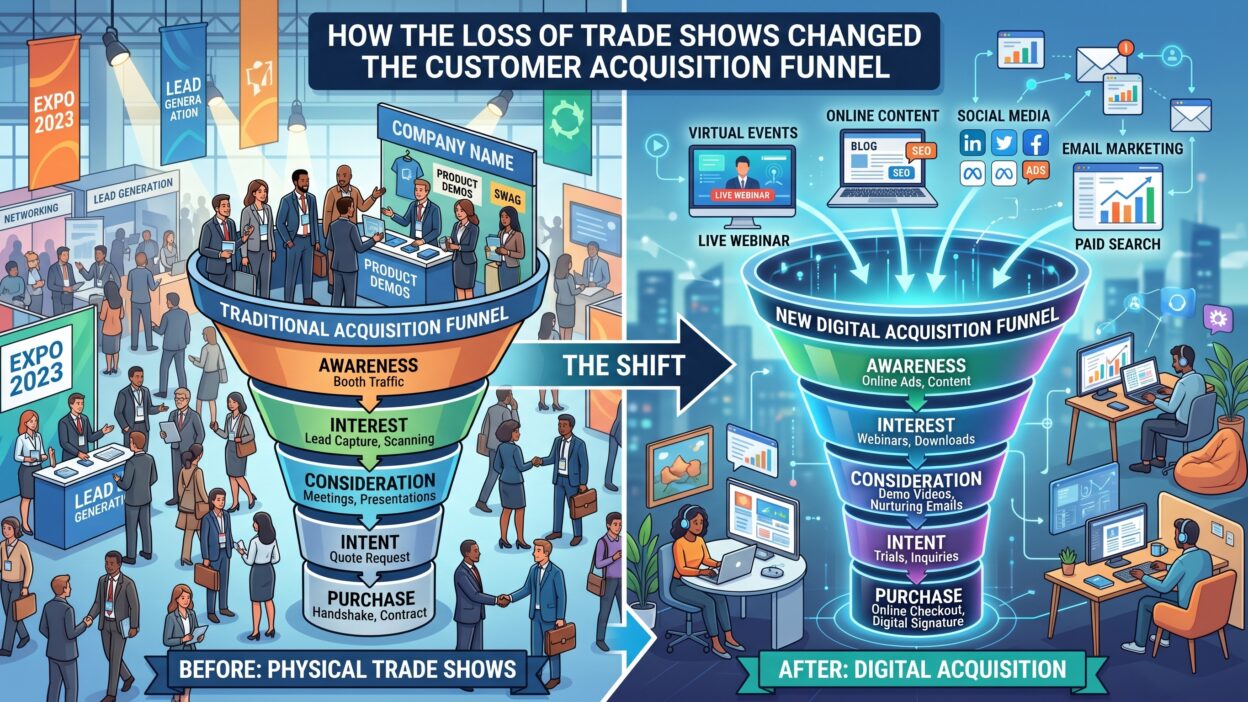
Trade shows served multiple roles in the customer acquisition funnel. They were not just networking events. They functioned as lead generation engines, brand awareness platforms, and sales acceleration tools all at once.
Top-of-Funnel Awareness
At the top of the funnel, trade shows created visibility. Companies showcased new products to thousands of potential buyers in one location. Booth designs attracted attention. Demos drew crowds. Brand recognition grew fast.
A startup could walk out of a major event with 500 qualified leads. An established brand could reinforce dominance in its space. The customer acquisition funnel was fed consistently through these annual gatherings.
Trade shows also gave smaller companies access to enterprise buyers. A well-placed booth opened doors that cold emails never could.
Mid-Funnel Engagement
In the middle of the funnel, trade shows accelerated trust. Buyers met real humans. They saw product demonstrations live. They asked hard questions and got immediate answers.
Sales conversations that might take three months over email could happen in three days at an event. The customer acquisition funnel moved faster because human connection shortened decision timelines.
Panels and breakout sessions also positioned brands as thought leaders. Speaking slots gave companies credibility that no whitepaper could match.
Bottom-of-Funnel Conversions
At the bottom of the funnel, trade shows closed deals. Contracts were signed on the last day of events. Relationships built over morning coffee turned into purchase agreements.
The informal setting made it easier to negotiate. Buyers felt relaxed. Sellers felt confident. The customer acquisition funnel benefited from this high-trust, in-person environment.
The Immediate Impact on the Customer Acquisition Funnel When Events Stopped
When trade shows vanished, companies felt it immediately. The pipeline dried up for many B2B brands. Leads that used to come in quarterly from major events simply stopped.
Lead Volume Dropped Sharply
Marketing teams scrambled to replace trade show leads. For many, those events accounted for 20 to 40 percent of annual lead generation. The customer acquisition funnel experienced a major gap at the top.
Digital campaigns were launched quickly. But they lacked the warm, in-person quality of a trade show lead. Cold outreach filled some gaps. It could not fill all of them.
Sales Cycles Got Longer
Without in-person events, sales cycles stretched out. Buyers could not meet vendors face to face. Trust took longer to build. Decisions moved more slowly.
The customer acquisition funnel widened at every stage. More nurturing was needed. More follow-ups were required. Conversion rates dropped across many industries.
Brand Differentiation Became Harder
At trade shows, companies stood out visually. Booth design, product demos, and personal charisma all communicated brand identity. Online, those signals got harder to convey.
Every brand suddenly competed on the same digital channels. The customer acquisition funnel got crowded. Ads, emails, and webinars all fought for the same attention.
How Digital Channels Filled the Gap in the Customer Acquisition Funnel
Necessity drives innovation. When trade shows disappeared, digital marketing had to grow up fast. Several channels took on new importance in the customer acquisition funnel.
Content Marketing Became a Primary Driver
Companies invested heavily in content. Blog posts, whitepapers, case studies, and video explainers replaced booth conversations. The goal was the same: educate and attract buyers.
SEO became critical. Companies that ranked on Google for industry-relevant searches captured traffic that events used to provide. Content marketing became a key layer of the customer acquisition funnel.
Long-form content did especially well. Buyers at home had time to read. Educational resources built trust even without human interaction.
Webinars Replaced Conference Sessions
Webinars exploded in popularity after 2020. Companies moved their speaking sessions online. Registration pages replaced badge scanners. Email lists replaced business card collections.
The customer acquisition funnel adapted. Webinar registrants became top-of-funnel leads. Attendees who stayed until the end became mid-funnel prospects. Follow-up sequences moved them toward conversion.
Some companies ran weekly webinars. Others hosted virtual summits that lasted several days. These events mimicked the trade show model as closely as possible in a digital format.
LinkedIn Became the New Trade Show Floor
LinkedIn emerged as the go-to replacement for in-person networking. Executives engaged in comment sections. Sales reps built personal brands. Companies published thought leadership content daily.
The customer acquisition funnel on LinkedIn moved through connection requests, direct messages, and content engagement. It was slower than a trade show conversation. It still worked.
LinkedIn Sales Navigator gave reps detailed targeting tools. They could find decision-makers at specific companies, in specific roles, at specific company sizes. That precision replaced the random-but-high-volume nature of trade show leads.
Paid Digital Advertising Scaled Quickly
Google Ads and LinkedIn Ads became bigger priorities. Budgets that once paid for booth space shifted to paid media. The customer acquisition funnel got a new top layer built entirely online.
Retargeting campaigns helped warm up prospects who had visited a company website. Intent-based advertising let brands reach buyers actively researching their category. These tools did not perfectly replace trade shows. They filled the space well enough to survive.
Changes to Buyer Behavior That Reshaped the Customer Acquisition Funnel
The loss of trade shows changed seller behavior. It also changed how buyers made decisions. These shifts permanently altered the shape of the customer acquisition funnel.
Buyers Became More Self-Directed
Without trade show conversations, buyers did more independent research. They read reviews. They watched product demos on YouTube. They compared vendors through third-party platforms like G2 and Capterra.
By the time a buyer contacted a sales rep, they were much further along. The customer acquisition funnel changed shape. More of the journey happened before any human interaction.
This made top-of-funnel content more important than ever. Companies needed to be found early in the research process. If a brand was not visible at that stage, it did not get considered at all.
Trust Signals Shifted Online
At a trade show, trust came from handshakes and live demos. Online, trust comes from different signals. Case studies, testimonials, review site ratings, and recognizable logos on a website all serve this role now.
The customer acquisition funnel needed new trust-building mechanisms. Companies redesigned their websites. They invested in customer success stories. They gathered more reviews and published them prominently.
Social proof became a currency. A brand with 500 G2 reviews outperformed one with none. The trust architecture of the customer acquisition funnel changed completely.
Committees Replaced Champions
Trade shows often meant one salesperson talking to one buyer. That buyer could then sell internally. Without events, the buying committee became more visible.
Multiple stakeholders reviewed vendors digitally. Finance teams, IT leaders, and end users all weighed in. The customer acquisition funnel had to account for multiple decision-makers simultaneously.
Account-based marketing rose in prominence. Teams crafted tailored messages for each member of the buying committee. The funnel widened at the consideration stage to accommodate this complexity.
The Rise of Account-Based Marketing in the New Customer Acquisition Funnel
Account-based marketing, or ABM, became a mainstream strategy after trade shows disappeared. It replaced the spray-and-pray approach of event marketing with precision targeting.
What ABM Means for the Funnel
ABM flips the traditional customer acquisition funnel. Instead of attracting thousands and filtering down, ABM starts with a list of target accounts. Marketing and sales align to convert specific companies.
This approach demanded better data. Companies invested in intent data tools. They tracked which companies were researching their category. They timed their outreach accordingly.
The customer acquisition funnel became smaller in volume but higher in quality. Conversion rates improved. Deal sizes grew. Revenue per customer increased.
Personalization at Scale
ABM required personalized content for each target account. Generic messaging did not work. Buyers expected vendors to know their business challenges before reaching out.
Teams created custom landing pages, personalized email sequences, and targeted ad campaigns. The customer acquisition funnel moved from mass communication to tailored engagement.
This was harder than running a trade show booth. It paid off more reliably. Deals that came through ABM campaigns often closed faster than deals from traditional digital advertising.
Virtual Events: The Temporary Bridge in the Customer Acquisition Funnel
Virtual events tried to replace trade shows. They succeeded partially. Attendance numbers were often impressive. Engagement was harder to replicate.
What Virtual Events Got Right
Virtual events removed geographic barriers. A company in Mumbai could attend a U.S.-based industry summit without a plane ticket. The customer acquisition funnel expanded globally as a result.
On-demand recordings gave virtual events longer shelf lives. A session recorded in January could generate leads through December. Trade shows did not offer that kind of ongoing reach.
Registration data was cleaner than trade show badge scans. Email addresses were verified. Engagement data was available. The customer acquisition funnel got better quality data from virtual events than from physical ones.
What Virtual Events Got Wrong
Engagement dropped sharply in virtual environments. Attendees multitasked. Sessions played in the background. The serendipitous conversations of a trade show floor never happened online.
Networking tools were clunky. Breakout rooms felt awkward. The informal relationship-building that accelerated the customer acquisition funnel at live events did not translate well to video calls.
Event fatigue set in quickly. By mid-2020, buyers were tired of webinars. Open rates for event invitations dropped. Attendance declined. The virtual event model had clear limits.
The Return of In-Person Events and What It Means for the Customer Acquisition Funnel
Trade shows came back. Physical events returned in 2022 and continued growing. But the landscape was not the same. The customer acquisition funnel had been rebuilt during the absence.
A Hybrid Model Emerged
Most major events now run in hybrid formats. Attendees can join in person or virtually. Content gets recorded and distributed after the event ends. The customer acquisition funnel benefits from both formats simultaneously.
Companies attend fewer events but choose them more strategically. The days of attending every industry conference are over. Budget now goes to events with proven ROI.
Digital Habits Remained
Buyers who adopted digital research habits during the pandemic kept them. Trade shows no longer serve as the primary discovery channel. They are part of a broader, digital-first customer acquisition funnel.
A prospect might first discover a company through a Google search. They read a blog post. They watch a product demo video. They download a whitepaper. Then they attend a trade show. Then they buy.
The funnel is longer now. More touchpoints are involved. The role of in-person events changed from primary discovery to late-stage trust acceleration.
FAQs About the Customer Acquisition Funnel After Trade Shows
How has the customer acquisition funnel changed without trade shows?
The customer acquisition funnel shifted from event-driven to digital-first. Lead generation now happens through content marketing, paid advertising, SEO, and LinkedIn. The funnel is longer and involves more touchpoints. Trust is built through digital signals rather than in-person interaction.
What replaced trade shows for B2B lead generation?
Webinars, virtual summits, LinkedIn engagement, content marketing, and ABM campaigns replaced trade show lead generation. No single channel replicated the full value of an event. A combination of these tactics now fills the same role in the customer acquisition funnel.
Are trade shows still relevant for customer acquisition?
Yes. Trade shows remain relevant for late-stage trust building and relationship acceleration. They are less important for initial discovery. Most companies now use trade shows as one part of a larger, digital-first customer acquisition funnel.
What is ABM and how does it relate to the customer acquisition funnel?
ABM, or account-based marketing, targets specific high-value accounts rather than broad audiences. It flips the traditional customer acquisition funnel by starting with a defined list of target companies. ABM improved in importance after trade shows disappeared because it provided the precision that mass-event marketing once delivered.
How should companies optimize their customer acquisition funnel today?
Companies should invest in SEO-driven content for top-of-funnel visibility. They should use webinars and thought leadership for mid-funnel engagement. Personalized ABM campaigns work best for bottom-of-funnel conversion. Trade shows can accelerate trust at the final stages. All channels should feed a unified CRM system for tracking and optimization.
Read More:-Key Privacy Considerations from the Experian Appeal
Conclusion

The loss of trade shows forced an uncomfortable but necessary evolution. The customer acquisition funnel could not stay the same. Companies that adapted quickly came out stronger.
Digital channels proved capable of generating leads at scale. Content marketing, ABM, webinars, and LinkedIn each took on greater importance. The customer acquisition funnel became more measurable, more data-driven, and more complex.
Buyer behavior shifted permanently. More research happens online now. More decisions involve multiple stakeholders. The customer acquisition funnel must account for longer journeys and more touchpoints than ever before.
Trade shows came back. They did not reclaim their old throne. They now play a supporting role in a funnel that digital channels lead. Companies that understand this new balance win more deals.
The brands that suffered most were those that waited for events to return. The brands that thrived were those that rebuilt their customer acquisition funnel from the ground up. That rebuild, though painful, made many of them stronger than they were before the events ever stopped.
If your business still depends heavily on in-person events for pipeline, the time to diversify is now. Build your digital foundation strong. Use trade shows to accelerate. Never rely on them as your primary customer acquisition funnel driver again.