Introduction
TL;DR Sales teams have chased big accounts for decades. Marketing teams chased leads. The two groups rarely met in the middle. Account-Based Marketing changed that pattern.
The idea sounds simple. You pick the companies you want as customers. You build campaigns for those companies. You measure results at the account level. Every team works toward the same list of names.
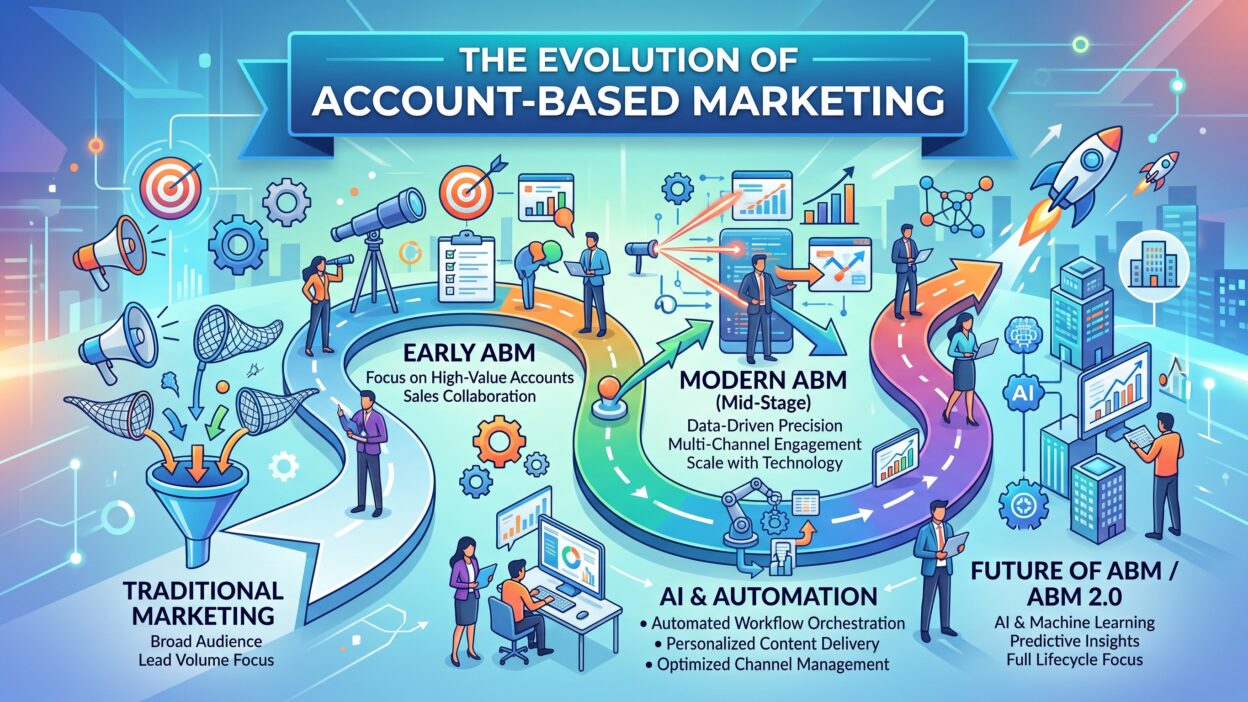
The path to that simple idea took many years. It began with key account managers who studied one client at a time. It grew through early software that tracked company behavior. It exploded when data and automation made personal outreach possible at scale. Today it runs on intent signals, AI tools, and shared revenue goals.
Whether you lead a startup or a global sales team, the history explains the present. Knowing why ABM works helps you run it better.
Table of Contents
What Is Account-Based Marketing?
Account-based marketing is a strategy that treats each target company as a market of one. Traditional marketing casts a wide net. ABM drops the net and picks up a spear. You choose specific accounts. You learn what each account cares about. You deliver messages built for its people.
A simple example shows the difference. A software vendor sells to hospitals. A traditional campaign runs ads for all healthcare buyers. An ABM campaign picks fifty named hospitals. The team studies their goals, their tech stack, and their leaders. Ads, emails, and events speak directly to those fifty hospitals.
Core Ideas Behind ABM
Focus drives everything. Teams spend time and money on accounts with the highest value. They ignore vanity metrics such as raw lead counts.
Relevance comes next. Buyers ignore generic messages. They respond to content that names their problems, their industry, and their goals.
Teamwork holds it together. Sales, marketing, and customer success share the account list. They share the plan. They share the credit for wins.
How ABM Differs From Traditional Lead Generation
Lead generation counts people. A form fill equals a win. The funnel starts wide and narrows over time. Many leads never fit the company’s real customer profile.
ABM flips the funnel. It starts with the accounts you want. It builds awareness inside those accounts. It engages the whole buying committee. It converts the account into a deal and then grows the relationship.
Lead generation asks how many contacts came in this month. ABM asks how many target accounts moved forward this month. The second question ties directly to revenue.
The Roots of ABM Before the Name Existed
Long before marketers used the term, salespeople practiced the idea. Enterprise sellers have always worked named accounts. A rep for a large bank or a big manufacturer spent months learning about one client. The rep met the executives. The rep mapped the org chart. The rep built proposals for a single buyer.
Key account management formalized this habit. Companies assigned senior staff to their biggest clients. Those staff members owned the entire relationship. They coordinated product, service, and finance teams around one customer.
Marketing played a small role in that world. Brochures and trade shows supported the sales rep. Marketing produced materials for broad audiences. Sellers adapted them by hand. Personal effort did the real work.
The model had limits. Personal attention costs money. Only the largest accounts earned it. Mid-size targets got generic treatment. Most companies could not afford a dedicated team for every promising account.
Consumer marketing then took the spotlight in the late twentieth century. Mass media, direct mail, and later the web rewarded volume. Marketers learned to generate demand by the thousands. Funnels, lead scores, and campaign calendars became the standard tools.
B2B marketing borrowed those methods. Teams measured success by lead volume. Sales complained that most leads went nowhere. Marketing complained that sales ignored the good ones. Tension grew on both sides.
That tension planted the seed for change. Leaders saw that big deals came from a small set of companies. They saw that sales already knew which companies mattered. They wondered why marketing did not aim at the same targets. The answer would take a new name and a new set of tools.
The Birth of a Named Strategy in the 2000s
The early 2000s brought a shift. Industry groups in the technology services sector started to describe a new approach. The Information Technology Services Marketing Association, known as ITSMA, gave the practice a name. Researchers and consultants there studied how large service firms won big clients. They saw marketing built around individual accounts. They called it account-based marketing.
The first programs looked like an upgraded version of key account management. Marketers partnered with sellers on a handful of strategic clients. They created custom research, executive briefings, and private events. Each account received a tailored plan.
Results impressed leaders. Deal sizes grew. Sales cycles shortened. Client relationships deepened. Executives noticed that a small number of accounts produced most of the revenue.
Adoption stayed narrow for years. Programs required heavy manual work. A marketer had to research each account by hand. Content creation for one account could take weeks. Only firms with big deal values could justify the cost.
Data was another barrier. Teams struggled to see which people at a company engaged with their content. Web analytics tracked visitors as anonymous sessions. Email tools tracked contacts as isolated records. Nobody could roll those signals up to the company level with ease.
Those barriers shaped the next chapter. The strategy worked. The tools lagged behind the idea. A new group of software vendors saw the gap. They set out to close it.
How Technology Fueled the Growth of Account-Based Marketing
The decade after 2010 changed everything. Cloud software, better data, and marketing automation gave teams new power. The strategy that once required a large staff suddenly fit a much smaller team.
Marketing automation tools arrived first. They tracked email clicks, page visits, and form fills. They scored leads and triggered follow-up. They gave marketers a clear view of individual behavior. Those tools still centered on leads, not accounts.
Vendors then built account-aware features. Software could match a visitor’s IP address to a company name. Teams could see which target accounts visited the pricing page. Dashboards grouped activity by company. A marketer could finally answer a basic question. Which of my target accounts are paying attention?
Advertising technology joined the movement. Platforms let marketers show ads only to people at named companies. A team could upload a list of one hundred accounts and reach staff at those companies across the web. Ads on professional networks added another channel. Personal targeting no longer required a personal budget.
Data providers improved the picture. They supplied firmographic details such as company size, industry, revenue, and location. They added technographic details that showed which software a company used. Teams built target lists from facts instead of guesses.
Customer relationship management systems tied it together. Sales reps saw marketing activity inside their account records. Marketers saw deal progress. Both teams looked at the same data for the first time.
Dedicated vendors appeared during this period. They built ABM platforms that combined account identification, advertising, analytics, and orchestration in one place. Marketing leaders now had a toolkit made for the job.
Technology did not change the core idea. It changed the cost. Personalization at scale became realistic. A small team could run programs for hundreds of accounts. The strategy moved from a luxury for giants to a practical option for growing firms.
ABM Reaches the Mainstream
By the middle of the 2010s, the buzz grew loud. Analyst firms published research on the topic. Conferences added ABM tracks. Job boards listed new roles such as ABM manager and account-based strategist. Surveys showed rising budgets.
Several forces drove that rise. Buyers changed how they shop. They researched vendors online and talked to sales late in the process. Marketing had to reach them earlier and with more precision. Generic content lost power in a world of endless information.
Buying groups also grew larger. Studies from research firms showed that many B2B purchases involved six or more decision makers. A single champion no longer closed a deal. Marketers needed to reach finance, IT, legal, and operations staff at the same company. Lead-based tactics could not map those groups. Account-focused tactics could.
Pressure on marketing ROI increased. Executives demanded proof that marketing drove revenue. Lead counts told a weak story. Account-level metrics told a strong one. Leaders could see pipeline and closed deals for named targets.
Success stories spread. Companies shared results such as larger deals, faster cycles, and better win rates. Peers copied the playbook. Vendors, agencies, and communities grew around the practice.
The label also expanded. Some teams used it as a synonym for any targeted campaign. Others treated it as a full operating model for revenue teams. Debates about definitions filled blogs and podcasts. Serious practitioners agreed on the core: named accounts, coordinated effort, and account-level results.
This period taught a hard lesson. Buying software did not equal running a program. Teams that skipped strategy wasted money. The winners built clear account lists, tight sales alignment, and strong content. Tools supported the plan. They never replaced it.
Modern ABM: Intent Data, AI, and Buying Committees
Today’s programs look very different from the early days. They run on richer data and smarter tools. They treat the buying committee as the true customer.
The Power of Intent Data
Intent data reveals which companies research topics related to your product. Providers track content consumption across the web. They flag accounts that show a surge in interest. A company that reads five articles about data security this week may be shopping for a solution.
Marketers use those signals to time outreach. They prioritize accounts that show interest. They tailor messages to the topics those accounts study. Reps call at the moment a need appears.
First-party intent adds more detail. Your own website, emails, and events show which accounts engage with you. A visit to a pricing page or a return trip to a case study carries weight. Smart teams combine both data types for a full picture.
AI and Personalization at Scale
Artificial intelligence changed the workload. Tools now score accounts based on patterns in past wins. They predict which accounts will convert. They suggest the best channel and message for each one.
Generative tools draft emails, ads, and landing pages tailored to an account. A marketer supplies the context and reviews the result. Personalization that once took days now takes minutes. Human judgment still matters. Editors protect brand voice and catch errors.
Reaching the Whole Buying Committee
Modern programs map every person who influences a deal. The economic buyer cares about cost and risk. The technical evaluator cares about integration and security. The end user cares about daily workflow. Each person needs a different message.
Teams build role-specific content for each stakeholder. They run ads, emails, and outreach across the committee. They watch for engagement from multiple people at one account. Broad engagement signals real momentum. A single active contact may signal only curiosity.
From Marketing Tactic to Revenue Strategy
Many companies now run ABM as a company-wide model. Sales development, account executives, marketing, and customer success plan together. They build joint account plans. They review progress in shared meetings. The approach extends past the first sale into renewal and expansion.
Building Blocks of a Strong ABM Program
Great programs share a few foundations. Skipping one weakens the rest.
Start With an Ideal Customer Profile
The ideal customer profile describes the type of company that gains the most from your product. It includes industry, size, region, technology, and pain points. Build it from your best current customers. Study the accounts with the highest lifetime value and the lowest churn. Look for patterns.
A sharp profile prevents wasted effort. Vague targeting produces vague results.
Select and Tier Your Target Accounts
Turn the profile into a list. Pull candidates from your CRM, data providers, and sales input. Score each account for fit and potential value. Sales must join this step. Reps know which accounts hold real promise.
Sort the list into tiers. Top-tier accounts receive deep, custom work. Mid-tier accounts receive lighter personalization. Lower tiers receive programmatic campaigns. Tiering matches effort to opportunity.
Create Content That Fits the Account
Content carries the message. Research the account before you write. Read its news, earnings calls, and job posts. Learn its goals and struggles. Reference them in your outreach.
Use different formats for different stages. Educational articles build awareness. Comparison guides support evaluation. Case studies from similar companies build trust. Custom assets such as tailored reports or microsites impress top-tier targets.
Choose the Right Channels
Meet buyers where they spend time. Email and direct outreach reach individuals. Paid ads on professional networks and the open web build familiarity. Direct mail cuts through digital noise. Events, both live and virtual, create face time. Social selling lets reps join conversations.
Coordinate channels so each account sees a consistent story. A buyer who sees an ad, gets a note from a rep, and receives a relevant gift builds a stronger impression.
Align Sales and Marketing
Alignment separates strong programs from weak ones. Hold regular meetings. Share account insights. Agree on definitions of engagement and readiness. Set clear handoff rules. Give sales a stake in the plan and marketing a view of the pipeline.
Invest in the Right Tools
A CRM anchors the tech stack. Marketing automation, data enrichment, intent providers, and advertising tools add capability. Many teams also adopt ABM platforms that unify these functions. Start with what you need. Add layers as the program matures.
Three Models: One-to-One, One-to-Few, One-to-Many
Not every account deserves the same investment. Practitioners describe three models that match effort to value.
One-to-One
This model serves your most strategic accounts. A dedicated team builds a custom plan for a single company. The plan may include executive dinners, tailored research, and bespoke content. Each program feels like a private campaign. Costs run high. Deal sizes justify them.
Large enterprise vendors use this model for their flagship clients. A handful of accounts may drive a huge share of revenue.
One-to-Few
This model groups accounts with shared traits. A team might cluster ten to fifty companies in the same industry with a similar challenge. Campaigns speak to the shared problem while adding light account-specific touches. Effort stays manageable. Relevance stays high.
Many teams find this model the best balance. It delivers personalization without a huge headcount.
One-to-Many
This model reaches hundreds or thousands of accounts. Technology does most of the work. Programmatic ads, automated emails, and dynamic web content adapt to firmographic and behavior data. Personalization stays lighter. Reach grows wide.
This model works well for mid-market targets or as a feeder into the other two. High-engaging accounts can move up to a higher tier.
Most mature programs blend all three. They invest heavily where the payoff is large. They automate where volume is high. They move accounts between tiers as signals change.
How to Measure ABM Results
Measurement proves the value of the strategy. Lead-based metrics fit poorly. Account-based metrics fit well.
Start with coverage and reach. How many target accounts have you engaged? How many buying committee members responded? A high count of touched accounts shows your outreach lands.
Engagement comes next. Track visits, content views, event attendance, and meeting acceptances at the account level. Combine them into an engagement score. Rising scores signal growing interest. Flat scores signal a need to change tactics.
Pipeline metrics matter most. Measure how many target accounts created opportunities. Track the value of that pipeline. Compare conversion rates and deal sizes to non-target accounts. Strong programs show higher win rates and larger contracts for targeted companies.
Velocity shows speed. Measure the time from first engagement to closed deal. Coordinated outreach usually shortens the cycle. Faster movement means lower cost and earlier revenue.
Revenue and retention close the loop. Track closed revenue from target accounts. Track renewal and expansion rates. Account-based work often lifts customer lifetime value because it builds relationships across the whole buying group.
Cost metrics prove marketing ROI. Compare the spend on each account tier against the revenue it produced. Calculate return by tier. Shift budget toward the tiers that perform.
Set a baseline before you launch. Record current win rates, cycle length, and deal size for your target list. Compare results after three, six, and twelve months. Give programs enough time. Enterprise deals move slowly, and early results may show up as engagement rather than closed revenue.
Report to leadership in plain language. Show the story of a few named accounts. Numbers convince analysts. Stories convince executives.
Common Challenges and How to Overcome Them
Every program hits obstacles. Knowing them in advance helps.
Poor alignment tops the list. Sales may ignore the target list. Marketing may build campaigns without sales input. Fix this with joint planning sessions and shared goals. Give both teams the same revenue targets.
Bad data undermines everything. Outdated contacts, wrong company matches, and missing fields cause wasted spend. Schedule regular data cleanups. Use trusted enrichment sources. Assign an owner for data quality.
Weak account selection wastes effort. Teams sometimes pick accounts because they sound impressive. Return to your ideal customer profile. Score accounts with real criteria. Review the list every quarter.
Content bottlenecks slow launches. Personalization needs a steady supply of assets. Build modular content that teams can adapt fast. Use templates for common formats. Reserve custom work for top-tier accounts.
Impatience kills programs. Leaders expect results in weeks. Enterprise buying takes months. Set expectations early. Track leading indicators such as engagement and meetings booked while deals mature.
Tool overload confuses teams. Some companies buy every platform on the market. Complexity grows and adoption drops. Start with essentials. Add tools only when a clear gap appears.
Finally, scale strains resources. A program that works for twenty accounts can break at two hundred. Automate repeat tasks. Use tiers. Hire or train specialists as demand grows.
The Future of Account-Based Marketing
The story continues to unfold. Several trends will shape the next chapter.
AI will handle more of the heavy lifting. Tools will research accounts, build target lists, draft content, and recommend next steps. Marketers will spend less time on manual research and more time on strategy and creative ideas. Teams that pair machine speed with human insight will lead.
Privacy rules will reshape data collection. Regulators limit tracking. Browsers restrict cookies. First-party data will grow in value. Companies will earn permission through useful content, communities, and events. Trust will become a competitive edge.
Revenue teams will merge further. Marketing, sales, and customer success will share tools, data, and goals. Account plans will cover the full customer journey from first touch to renewal. The line between marketing and sales will blur.
Buyer expectations will keep rising. People compare every vendor experience to the best digital brands they use. They expect relevance, speed, and respect for their time. Generic outreach will fail faster than ever.
Community and peer influence will gain weight. Buyers trust colleagues and industry peers. Programs will invest in customer advocacy, user groups, and partner networks alongside direct outreach.
Measurement will improve. Better attribution will connect touches across channels and across people in one account. Leaders will see a clearer link between effort and revenue.
The core idea will hold. Pick the right companies. Understand them deeply. Serve them well. Tools will change. That principle will not.
Frequently Asked Questions
What is the main goal of ABM?
The goal is to win and grow high-value accounts. Teams focus resources on the companies most likely to buy and stay. They measure success by account outcomes such as pipeline, revenue, and retention.
Is account-based marketing right for small businesses?
Yes, in many cases. Small teams can run a lean version with a short list of accounts. They can use free or low-cost tools. A focused list of twenty to fifty accounts often beats a broad campaign for a limited budget. Deal size matters. A higher average contract value makes the effort worthwhile.
How is ABM different from inbound marketing?
Inbound marketing attracts anyone who searches for your topic. ABM chooses the audience in advance and reaches out. Many teams combine both. Inbound content feeds account campaigns, and ABM targeting sharpens inbound messages.
How long does it take to see results?
Early engagement signals appear within weeks. Pipeline growth often takes three to six months. Closed revenue can take a year or more in complex B2B sales. Patience and steady tracking pay off.
How many target accounts should I start with?
Start small. Choose ten to fifty accounts for your first program. Learn what works. Expand as your team builds skill and your content library grows.
What tools do I need to begin?
You need a CRM, an email platform, and a way to track account-level activity. Data enrichment and advertising tools add power. Dedicated platforms help when you outgrow simple setups.
Which teams should join the program?
Marketing and sales must both join. Sales development and customer success add value. Executive sponsors help remove roadblocks. Shared ownership drives results.
Can ABM support existing customers?
Yes. Many companies use the approach for upsell and renewal. Existing accounts already trust you. Targeted campaigns can introduce new products and deepen relationships.
Read More:-The Evolution of Account-Based Marketing: From Sales Tactic to Revenue Engine
Conclusion

Account-Based Marketing grew from a simple truth. Big deals come from specific companies. Smart teams pick those companies and serve them with care.
The idea began with key account managers and personal relationships. It received a name in the early 2000s. Technology in the 2010s made it practical for far more teams. Intent data, AI, and shared revenue goals now push it further.
A strong program rests on clear foundations. Define your ideal customer profile. Choose target accounts with sales input. Build content that speaks to the whole buying committee. Pick channels that match your buyers. Measure results at the account level.
Start small if you feel unsure. Choose a short list. Align with sales. Launch one campaign. Learn from the results. Grow from there.
The tools will keep changing. The principle will stay. Buyers reward companies that understand them. Focus on your best accounts, treat each one as a market of one, and let the results speak.