Introduction
TL;DR Account-based marketing looked very different five years ago. Teams built static account lists. Campaigns ran on quarterly cycles. Personalization meant swapping a company name into a generic email. That version of account-based marketing no longer wins deals.
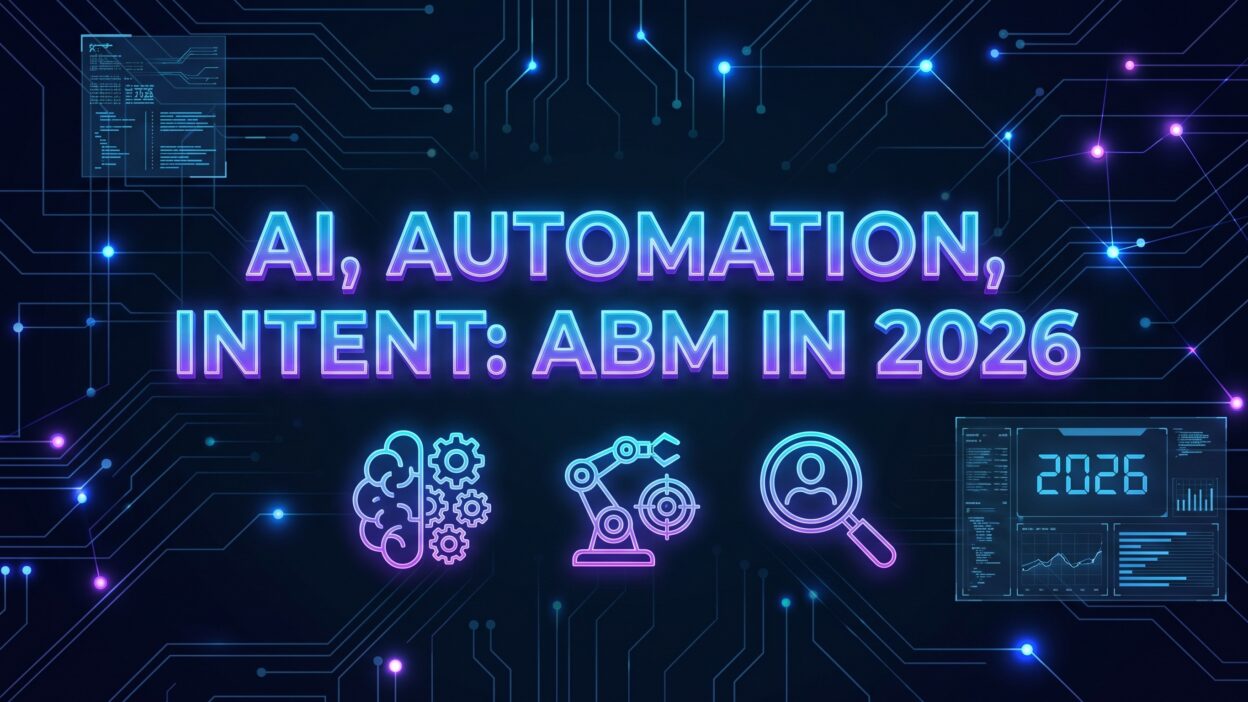
In 2026, the discipline runs on AI, real-time intent signals, and cross-functional automation. The best GTM teams treat account-based marketing as a living system — not a campaign type. This guide breaks down exactly where the practice stands today, what changed, and how forward-thinking B2B companies build programs that actually generate revenue.
Read this guide whether you run a lean two-person demand gen team or lead a full ABM function at an enterprise company. The principles scale. The frameworks apply. The results compound when you execute with precision.
Table of Contents
What Is Account-Based Marketing in 2026?
Account-based marketing is a B2B revenue strategy that focuses all sales and marketing resources on a defined set of high-value target accounts. Instead of casting a wide net and hoping the right buyers show up, account-based marketing flips the model. You identify the exact companies you want as customers. Then you build personalized campaigns and outreach specifically for them.
The original concept of account-based marketing emerged in the early 2000s. It gained serious momentum around 2015 when technology made execution at scale possible. In 2026, the strategy looks fundamentally different again. AI accelerates research and personalization. Intent data surfaces in-market buyers before they raise their hands. Automation orchestrates multi-channel engagement without burning out small teams.
Account-based marketing no longer belongs only to enterprise companies with massive budgets. Mid-market and even growth-stage startups now run effective ABM programs with lean teams and focused account lists. The barrier to entry dropped significantly as tooling matured and best practices spread across the industry.
The core philosophy of account-based marketing never changed. Focus beats spray. Precision beats volume. A highly relevant message to the right company beats a generic message to ten thousand companies. That logic becomes more powerful every year as buyer attention grows more scarce and more valuable.
The Three Tiers of Account-Based Marketing
ABM programs typically operate across three tiers based on the level of personalization and resource investment each account receives. Understanding these tiers helps GTM teams allocate effort and budget with intention rather than guesswork.
Tier one accounts receive the deepest personalization. These are your highest-value named accounts — often fewer than 50 companies. Sales and marketing collaborate directly on custom research, bespoke content, and hyper-personalized outreach for each account. The investment is high. The expected return is proportionally higher.
Tier two covers a broader set of accounts — typically 100 to 500 companies. Personalization at this level is persona-level rather than account-level. Industry-specific messaging, role-relevant content, and targeted ad campaigns serve this group effectively without the resource intensity of tier one.
Tier three applies account-based marketing principles at scale across thousands of accounts. Automation does most of the heavy lifting. Behavioral triggers fire campaigns based on account activity. Personalization happens dynamically through technology rather than human effort. This tier generates volume while maintaining relevance.
How AI Transformed Account-Based Marketing Programs
Artificial intelligence changed every stage of the account-based marketing workflow. The change is not incremental. AI fundamentally altered what small teams can accomplish and how quickly they can act on signals that previously required weeks of manual research.
AI-Powered Account Research and Selection
Building a quality account list used to take days of manual research. Sales reps and marketing analysts combed through LinkedIn, company websites, industry databases, and CRM data to identify accounts that matched the ideal customer profile. AI compressed that timeline to hours or minutes.
Modern AI tools analyze millions of data points to score and rank accounts against your ICP criteria. Firmographic fit, technographic signals, hiring patterns, funding announcements, and digital behavior all feed the scoring model. The output is a ranked account list with clear evidence behind every inclusion.
AI-driven account selection removes opinion from a process that used to rely heavily on gut instinct. Sales leaders no longer argue about which accounts belong on the list. The data makes the case. Account-based marketing programs built on AI-selected lists outperform those built on manually curated ones consistently.
Personalization at Scale Through Generative AI
Personalization was always the promise of account-based marketing. Execution at scale was always the challenge. Generative AI closed that gap decisively in 2025 and 2026. Teams now produce account-specific landing pages, personalized email sequences, and custom ad copy faster than ever before.
AI generates first-draft personalized content by ingesting account research, persona profiles, and messaging frameworks. Human editors refine the output for tone, accuracy, and strategic fit. The combination of AI speed and human judgment produces content that feels genuinely personal without requiring a content team ten times the size.
Dynamic website personalization became a mainstream account-based marketing tactic as AI made it accessible. When a target account visits your website, the homepage headline, case studies, and CTAs all adapt to reflect their industry, use case, and funnel stage. The visitor sees a site built for a company exactly like theirs.
Predictive Analytics and Account Prioritization
Predictive analytics ranks accounts by their likelihood to buy based on historical win data and current behavioral signals. Account-based marketing teams use these predictions to focus outreach on accounts with the highest conversion probability at any given moment.
Machine learning models improve over time as more deal data flows through the system. An ABM program running for 18 months has significantly sharper predictive accuracy than one that launched last month. The system learns what winning accounts look like and weights future predictions accordingly.
Intent Data: The Fuel Behind Modern Account-Based Marketing
Intent data changed account-based marketing more than any other single development in the past three years. It answers the question every sales and marketing team desperately wants answered. Which accounts are actively researching solutions like ours right now?
Without intent data, account-based marketing teams contact accounts on a fixed schedule regardless of whether those accounts show active buying interest. Some outreach lands at the right time by chance. Most lands too early or too late. Intent data replaces chance with precision.
First-Party Intent vs. Third-Party Intent Data
First-party intent data comes from your own digital properties. Website visits, content downloads, webinar attendance, email engagement, and product trial activity all signal buyer interest. This data is highly reliable because it reflects direct interaction with your brand.
Third-party intent data tracks content consumption across the broader web. Platforms like Bombora, G2, and TechTarget monitor which companies research specific topics on publisher sites, review platforms, and industry forums. When a target account spikes on topics related to your product category, your account-based marketing system triggers immediate action.
The most effective account-based marketing programs combine both data types. First-party data tells you about accounts already in your orbit. Third-party data surfaces accounts researching your category before they ever reach your website. Together they create a complete view of in-market demand at any given time.
Activating Intent Signals Across the ABM Workflow
Intent data only creates value when it triggers action. A spike in account research activity should automatically alert the assigned sales rep, add the account to targeted ad campaigns, enroll key contacts in a personalized email sequence, and prioritize the account in the sales activity queue.
This activation requires tight integration between your intent data provider, CRM, marketing automation platform, and ad technology. Account-based marketing teams that invest in these integrations see dramatically faster response times and higher conversion rates from in-market accounts.
Speed matters enormously when responding to intent signals. An account actively researching your category today may sign a contract with a competitor in two weeks. Account-based marketing programs that respond to intent signals within 24 hours consistently outperform those that batch intent data for weekly review.
Automation in Account-Based Marketing: What to Automate and What Not To
Automation made account-based marketing scalable. It also introduced a new failure mode — over-automating outreach until it loses the human quality that makes ABM effective. The art of modern account-based marketing is knowing exactly where automation adds value and where human judgment must take over.
High-Value Automation Use Cases in ABM
Account list monitoring runs best on automation. When a target account hits a funding milestone, makes a key executive hire, or publishes content about a challenge your product solves, an automated alert reaches the right sales rep or marketer immediately. Manual monitoring of hundreds of accounts is impractical. Automated monitoring is effortless.
Ad campaign orchestration across LinkedIn, display networks, and retargeting platforms runs efficiently through automation. Account-based marketing platforms like Demandbase, 6sense, and Terminus manage bid adjustments, audience updates, and budget allocation dynamically based on account engagement scores and intent signals.
Meeting follow-up sequences benefit from automation as well. After a sales call, an automated sequence sends relevant case studies, ROI calculators, or competitor comparison content based on topics discussed during the conversation. This follow-up happens consistently without relying on rep memory or discipline.
Where Human Judgment Must Lead in Account-Based Marketing
Executive outreach at tier-one accounts requires human authenticity. A CEO or VP-level decision-maker recognizes AI-generated outreach immediately. A handcrafted note referencing a specific challenge from a recent earnings call or a shared industry contact creates connection that no automation tool can replicate.
Strategic account planning demands human intelligence. Deciding which accounts to prioritize for the next quarter, which messaging angle to lead with, and which internal champions to cultivate all require judgment, creativity, and relationship intuition. Account-based marketing succeeds when automation handles the repetitive and humans lead the strategic.
Aligning Sales and Marketing Inside an Account-Based Marketing Program
Account-based marketing fails more often from misalignment than from tactical errors. When sales and marketing disagree on account selection, messaging, or outreach timing, the program fragments. Buyers receive inconsistent experiences. Opportunities get dropped between the two teams.
Alignment starts with shared account selection. Marketing cannot unilaterally decide which accounts belong on the ABM list. Sales must co-own that decision. When a sales rep has no input into their target account list, buy-in collapses and follow-through suffers. Involve sales leadership from the first account selection meeting.
Shared metrics eliminate the blame game between sales and marketing. Both teams should track the same pipeline metrics, not separate departmental scorecards. Marketing measures pipeline influenced. Sales measures pipeline closed. Account-based marketing holds both teams accountable for the same revenue outcomes from the same account list.
Building the ABM Pod Model for Execution
The ABM pod model assigns a dedicated marketing resource, sales development rep, and account executive to a defined set of target accounts. The pod operates as a mini-GTM team. They share intelligence, coordinate outreach timing, and hold each other accountable for account engagement progress.
Pod models work because they create ownership without silos. The marketer knows which sales conversations are happening. The AE knows which content the account engaged with. The SDR knows which outreach channels produced responses. Account-based marketing becomes a shared sport rather than a relay race with an uncertain handoff.
Measuring Account-Based Marketing Success: Metrics That Actually Matter
Traditional marketing metrics do not translate well to account-based marketing. Impressions, clicks, and form fills mean very little when your program targets 200 specific companies. ABM demands a different measurement framework built around account engagement and pipeline outcomes.
Account engagement score measures how deeply target accounts interact with your marketing touchpoints. Website visits, content downloads, ad clicks, webinar attendance, and email opens all contribute to the score. Rising engagement scores across your target account list signal a healthy account-based marketing program before pipeline numbers confirm it.
Pipeline coverage from target accounts is the primary financial metric for account-based marketing. It shows how much qualified pipeline comes specifically from the accounts on your ABM list versus inbound or other outbound sources. A strong ABM program should generate a disproportionate share of total pipeline from a focused account set.
ABM-Specific Metrics to Track Every Quarter
Account penetration rate measures what percentage of your target accounts have at least one active opportunity in the CRM. Low penetration means your account-based marketing program generates awareness but not enough conversion to meaningful sales conversations. Investigate which outreach channels and messages produce meetings at the highest rate.
Multi-stakeholder engagement tracks how many contacts within a single account actively interact with your content and campaigns. B2B deals involve an average of six to eight decision-makers. Account-based marketing programs that engage only one contact per account leave the buying committee uninformed and underprepared to champion your solution internally.
Deal velocity inside your ABM account list should exceed your overall average sales cycle. If it does not, your personalization and intent-triggered outreach are not creating the acceleration they should. Investigate where deals stall within the ABM funnel and adjust your nurture content and sales enablement materials accordingly.
Frequently Asked Questions About Account-Based Marketing
What is the difference between account-based marketing and inbound marketing?
Inbound marketing attracts a broad audience through content, SEO, and social media. It generates leads from anyone who discovers your brand. Account-based marketing flips this approach entirely. ABM identifies specific target companies first and then builds personalized campaigns exclusively for those accounts. Inbound casts a wide net. Account-based marketing uses a spear. Most mature B2B programs run both in parallel — inbound feeds the top of the funnel while ABM accelerates revenue from the highest-value opportunities.
How many accounts should an ABM program target?
The right account list size depends on your average deal size, sales team capacity, and available marketing resources. Enterprise programs with high ACV often target 50 to 200 named accounts at the tier-one level. Mid-market ABM programs typically cover 200 to 500 accounts across tiers one and two. Growth-stage companies often start with a focused pilot list of 50 to 100 accounts and expand as they validate the program. A smaller list executed well always outperforms a large list executed poorly in account-based marketing.
What technology does an account-based marketing program need?
A foundational ABM tech stack includes a CRM, a marketing automation platform, a B2B data provider, an intent data platform, and an account-based advertising tool. Popular platforms include 6sense, Demandbase, Terminus, and RollWorks for ABM orchestration. LinkedIn Campaign Manager handles paid social targeting at the account level. Bombora and G2 Buyer Intent provide third-party intent signals. You do not need every tool on day one. Build the stack incrementally based on program maturity and budget availability.
Is account-based marketing suitable for small B2B companies?
Yes. Account-based marketing scales down effectively for small B2B teams. A two-person GTM team can run a focused ABM program targeting 50 accounts with a CRM, LinkedIn ads, and a basic intent data subscription. The investment is modest. The returns from winning even two or three large accounts justify the effort many times over. Start small, prove the model, and scale the program as revenue grows. Account-based marketing is a strategy, not a budget level.
How long does it take for an ABM program to generate results?
Expect early engagement signals within the first 60 days of launching a well-structured account-based marketing program. Meaningful pipeline contributions typically appear between months three and six. Revenue from ABM-sourced deals often closes between months six and twelve depending on your average sales cycle length. Set realistic expectations with leadership from program launch. Account-based marketing compounds over time as relationship depth grows within target accounts and as your data and personalization improve with each campaign cycle.
What makes account-based marketing programs fail?
The most common failure causes are misalignment between sales and marketing, poor account selection, insufficient personalization, and inconsistent execution. Programs that treat account-based marketing as a marketing-only initiative fail because sales disengages. Programs that select accounts based on opinion rather than data target the wrong companies. Programs that send generic content to named accounts waste the ABM label. And programs that run for two months before declaring failure never give the strategy enough time to demonstrate its compounding value.
How does account-based marketing work with customer expansion?
Account-based marketing applies as powerfully to customer expansion as it does to new logo acquisition. Existing customers represent the highest-probability expansion targets in your entire database. ABM programs that map account-specific expansion plays — identifying whitespace opportunities, engaging new buying centers, and personalizing upsell campaigns by department or use case — consistently outperform generic renewal and upsell motions. Customer-focused account-based marketing typically carries a dramatically lower CAC and higher win rate than new business ABM.
Read More:-How to Improve CRM Data Quality
Conclusion

Account-based marketing in 2026 is not a new concept. It is a proven strategy that AI, automation, and intent data made dramatically more powerful and more accessible than ever before. The companies generating the strongest results are the ones that treat ABM as a system, not a campaign.
They select accounts with data. They personalize with AI. They activate intent signals within hours. They align sales and marketing around shared metrics and shared account lists. They measure engagement, pipeline, and velocity — not impressions and clicks.
Account-based marketing rewards focus. The more precisely you define your target accounts, the more relevant your campaigns become. The more relevant your campaigns become, the more your pipeline grows from the accounts that matter most to your business.
Start or improve your account-based marketing program this quarter. Audit your current account list for data quality. Review your intent data coverage. Tighten your sales and marketing alignment around shared goals. The competitive advantage available to teams that execute account-based marketing well grows larger every year. Claim your share of it now.