Introduction
TL;DR ABM did not arrive fully formed. It grew from a simple idea into one of the most sophisticated revenue strategies in modern B2B sales and marketing. That growth happened over two decades of experimentation, failure, tool development, and hard-won insight from thousands of GTM teams across the world.
Today ABM looks nothing like it did in 2003 or even 2015. The strategy matured. The technology caught up. The data got sharper. The teams running ABM programs grew more experienced and more deliberate in how they build and measure their programs.
This guide traces the full arc of ABM from its conceptual roots to where the discipline stands in 2026. Whether you want to understand the history, build a stronger program today, or spot where ABM is heading next, this guide delivers everything you need to think clearly about the strategy and act on it with confidence.
Table of Contents
Where ABM Began: The Origins of Account-Based Thinking
The concept behind ABM predates the acronym by decades. Sales leaders always knew that not every prospect deserves equal attention. Enterprise sales reps naturally focused their effort on a short list of high-value accounts. That focus produced better results than spreading effort across hundreds of smaller opportunities.
The formal articulation of ABM as a strategy came in 2003 when ITSMA — the IT Services Marketing Association — published foundational research on the approach. They called it account-based marketing and defined it as treating individual accounts as markets of one. That framing changed how B2B marketers thought about personalization, resource allocation, and the relationship between sales and marketing.
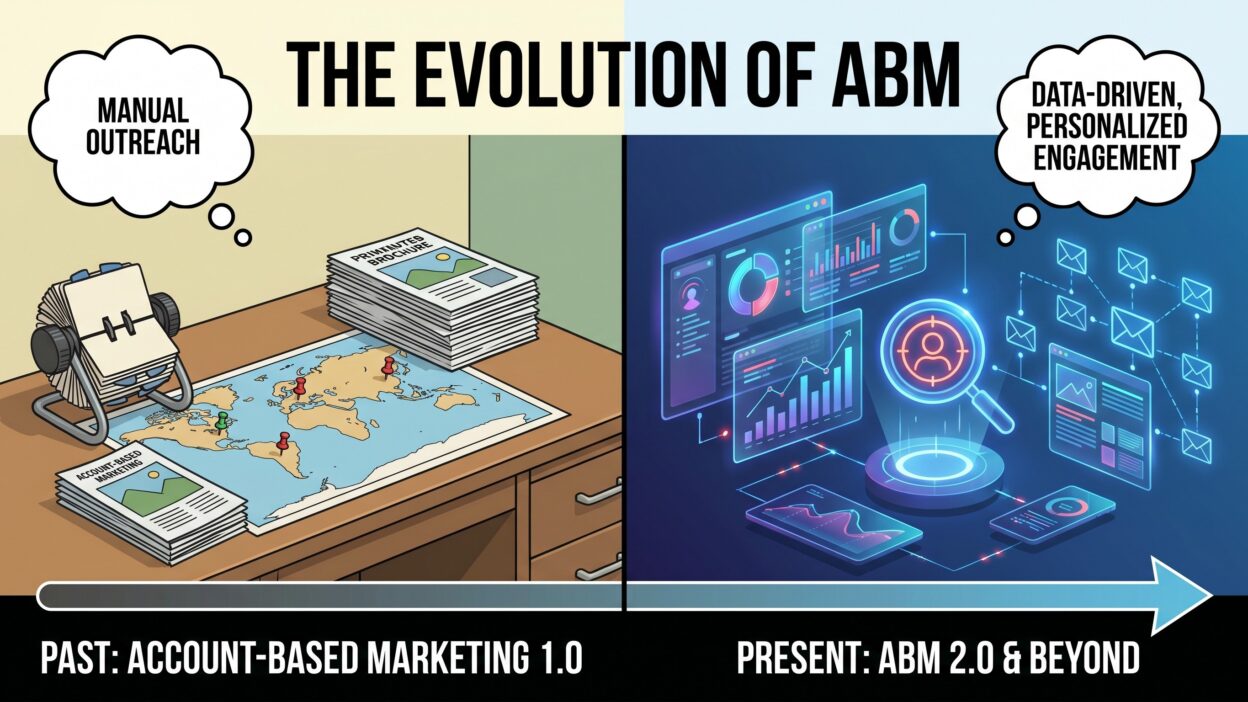
Early ABM operated almost entirely without technology. Marketers conducted manual account research. They crafted custom presentations and printed collateral for individual companies. Sales teams hand-delivered personalized proposals after months of relationship building. The approach worked for very large deals where the investment justified the return. Scaling it beyond a handful of accounts was not realistic.
The core insight from those early ABM programs still holds true today. Focused attention on the right accounts produces better outcomes than broad outreach to the wrong ones. Every advancement in ABM technology and methodology since 2003 built on that original insight without replacing it.
Why Traditional Demand Generation Created the Need for ABM
Traditional demand generation treated every lead equally. Marketing ran campaigns to generate volume. Thousands of leads entered the funnel. Sales picked through them looking for anything worth pursuing. The process was inefficient. Most leads were never real buyers.
ABM challenged that model directly. Instead of generating volume and hoping quality emerged, ABM defined quality upfront. The account list became the filter. Only companies matching the ideal customer profile received marketing attention and sales effort. Quality replaced quantity as the organizing principle of the entire revenue function.
That philosophical shift created conflict in many organizations. Marketing teams measured success by lead volume. ABM programs measured success by account engagement and pipeline from named accounts. The metrics disagreed. That disagreement forced organizations to rethink what success in B2B marketing actually meant.
The First Wave of ABM: Manual Programs and Enterprise Adoption
The first decade of ABM belonged to large enterprise companies with the resources to execute labor-intensive programs. Professional services firms, major technology vendors, and management consulting companies ran the most sophisticated early ABM programs. They had the sales teams, the marketing budgets, and the long sales cycles that made the investment worthwhile.
First-wave ABM relied on human intelligence above all else. Account teams researched target companies through annual reports, industry publications, and analyst briefings. Marketers wrote account-specific white papers and hosted private executive dinners tailored to each company’s strategic priorities. The touch was unmistakably personal. The cost was enormous.
Results from these early ABM programs validated the strategy. Companies running disciplined account-focused programs consistently reported higher win rates, larger average deal sizes, and deeper customer relationships than companies running traditional demand generation. The evidence accumulated. The strategy spread — slowly, because the barrier to entry remained high throughout this period.
Sales and Marketing Tension in Early ABM Programs
First-wave ABM exposed a structural problem in most B2B companies. Sales and marketing did not share goals. Marketing owned lead generation metrics. Sales owned revenue metrics. ABM required both functions to pursue the same accounts with the same messages over an extended time horizon. That collaboration rarely happened naturally.
Organizations that succeeded with early ABM programs solved the alignment problem first. They created shared account lists approved by both marketing and sales leadership. They built joint communication calendars. They held weekly check-ins between account executives and their dedicated marketing counterparts. The program infrastructure forced the collaboration that organizational culture alone could not produce.
ABM programs that launched without solving the alignment problem failed consistently. Marketing created content that sales never used. Sales pursued accounts that marketing never supported. The buyers inside target accounts received conflicting messages from different team members. The program collapsed under the weight of its own disorganization.
The Second Wave of ABM: Technology Enters the Picture
Everything changed for ABM between 2013 and 2019. A new category of marketing technology emerged specifically to enable account-based programs at scale. Companies no longer needed armies of researchers and writers to run ABM. Technology automated the execution. ABM became accessible to mid-market companies for the first time.
Platforms like Demandbase, Terminus, and RollWorks built the infrastructure for digital ABM execution. They enabled B2B companies to serve targeted display advertising to employees of specific named accounts. A marketing team could now reach the buying committee at 500 target companies simultaneously without a single cold call or printed mailer.
CRM platforms matured during this period as well. Salesforce became the dominant system of record for B2B sales organizations. Marketing automation platforms like Marketo and HubSpot connected to CRM data and enabled account-level tracking and reporting. The data that ABM programs needed to function began flowing through integrated technology stacks for the first time.
Intent Data Makes Its First Appearance in ABM
Intent data emerged as a transformative input for ABM programs during the second wave. Companies like Bombora began aggregating content consumption data from publisher networks across the B2B web. For the first time, marketing teams could see which companies actively researched topics related to their product category — before those companies ever contacted a vendor.
ABM programs that incorporated intent data changed how they prioritized outreach. Instead of contacting all 500 accounts on a fixed weekly schedule, teams focused their energy on the 50 accounts showing active research signals. Response rates improved dramatically. Sales reps appreciated receiving accounts already demonstrating buying interest rather than cold names from a static list.
The integration of intent data into ABM workflows raised the quality of every downstream interaction. Personalization improved because teams knew what topics the account was researching. Timing improved because outreach reached accounts during active evaluation windows. ABM programs running intent data consistently outperformed those without it, and the gap widened as teams learned to activate signals more quickly.
The Rise of Account-Based Advertising
Account-based advertising became a defining capability of second-wave ABM programs. Marketers served targeted digital ads to IP addresses and cookie pools associated with named accounts on their target lists. A company’s buying committee saw your brand’s messaging across the web as they researched solutions — without ever visiting your website or filling out a form.
This capability changed the relationship between marketing reach and marketing relevance. ABM teams reached decision-makers at specific companies with specific messages rather than broadcasting to broad demographic categories. Impressions became meaningful because they reached the right people rather than just large numbers of people.
Account-based advertising also changed how ABM teams measured marketing performance. Reach metrics shifted from total impressions to account-level reach and engagement. Share of voice within a target account — the percentage of relevant digital impressions your brand captured — became a valuable ABM metric that volume-based metrics could never provide.
The Third Wave of ABM: AI, Signals, and Full-Funnel Orchestration
The third wave of ABM began around 2019 and accelerated dramatically through 2024 and 2025 as artificial intelligence became embedded in every major GTM platform. ABM entered a new era defined by predictive intelligence, real-time signal activation, and cross-channel orchestration that no previous generation of the strategy could have achieved.
AI transformed how ABM teams select and prioritize accounts. Machine learning models now analyze thousands of firmographic, technographic, and behavioral signals to score accounts against the ideal customer profile. Account selection that once took weeks of manual research takes hours. The output is more accurate because machines process more data than humans can evaluate manually.
Generative AI added a new dimension to ABM personalization. Teams produce account-specific landing pages, custom email sequences, and tailored ad copy faster than ever before. Human editors review and refine AI-generated content for strategic accuracy and brand voice. The combination of machine speed and human judgment produces personalization at a scale that second-wave ABM programs could never reach.
The Convergence of ABM, Revenue Operations, and GTM Intelligence
Third-wave ABM no longer operates as a standalone marketing program. It converged with revenue operations and go-to-market intelligence into a unified approach to B2B revenue generation. Data flows continuously between marketing platforms, CRM systems, sales engagement tools, and intent data providers. Every team member operates from the same account intelligence at all times.
Revenue operations teams now own the ABM data infrastructure in many organizations. They build and maintain the integrations that connect intent signals to CRM alerts, trigger automated campaign enrollment based on account engagement scores, and produce the unified reporting that sales and marketing leadership review together each week.
This convergence elevated ABM from a marketing tactic to a company-wide operating principle. The best B2B companies in 2026 do not run an ABM program inside their marketing department. They operate the entire revenue function as an account-based business — where every customer-facing team member focuses on the same prioritized account list with the same strategic context.
Buyer Committee Engagement: The Most Important ABM Advancement
B2B purchase decisions involve more stakeholders than ever. Research consistently shows that the average enterprise buying committee includes seven to ten individuals across multiple departments and seniority levels. Third-wave ABM programs now orchestrate personalized engagement with every member of that committee simultaneously.
Mapping the buying committee at each target account became a core ABM discipline during this period. Sales reps identify economic buyers, technical evaluators, end users, and procurement contacts within each account. Marketing builds persona-specific content and ad campaigns for each role. Every committee member receives messaging relevant to their specific concerns and priorities.
Multi-threading — the practice of engaging multiple contacts within a single account — dramatically improved ABM win rates. Deals with three or more engaged contacts inside the target account close at significantly higher rates than single-threaded opportunities. Third-wave ABM programs treat buyer committee coverage as a measurable objective, not an afterthought.
How ABM Metrics Evolved Alongside the Strategy
Measurement always lagged behind ABM strategy development. First-wave programs used anecdotal evidence and relationship quality as proxies for success. Second-wave programs introduced account-level engagement metrics. Third-wave ABM now measures the full revenue impact of account-focused programs with a precision that earlier generations could not achieve.
Early ABM practitioners struggled to prove ROI. Traditional marketing attribution models credited lead generation and form fills. ABM produced few form fills because it focused on quality engagement with named accounts rather than volume conversion from anonymous visitors. The metrics mismatch made ABM look ineffective inside organizations still measuring marketing the old way.
Modern ABM measurement frameworks track account engagement scores, account pipeline coverage, multi-stakeholder engagement rates, deal velocity within target accounts, and revenue sourced from the named account list. These metrics tell the complete performance story of an ABM program in a language both marketing and finance understand.
Pipeline Attribution in ABM Programs
Pipeline attribution connects ABM program activity to revenue outcomes. Multi-touch attribution models distribute credit across every marketing touchpoint that influenced a deal. ABM teams use these models to identify which campaigns, channels, and content types produce the most pipeline from target accounts.
Attribution data also guides budget allocation decisions. ABM programs that generate strong attribution data can defend and grow their budgets because leadership sees a clear connection between program investment and revenue results. Programs without attribution data fight budget battles every quarter and rarely win.
Where ABM Is Heading: Predictions for 2027 and Beyond
ABM will continue evolving as AI capabilities expand and buyer behavior shifts. Several developments already visible in 2026 point clearly toward where the strategy is heading over the next two to three years.
Autonomous ABM agents will handle more of the execution layer without human instruction. AI systems will monitor account signals, trigger campaigns, personalize content, schedule follow-up sequences, and alert sales reps to engagement spikes — all without manual intervention from a marketing manager. Human strategists will set the parameters and review outcomes rather than executing individual tasks.
Real-time personalization will extend deeper into every buyer touchpoint. Websites, emails, ads, sales decks, and even product trials will adapt dynamically to account-specific context. A prospect from a financial services firm will see a fundamentally different version of your product experience than a prospect from a healthcare company — automatically, without requiring a separate campaign build for each industry.
The Future of Sales and Marketing Alignment in ABM
The boundary between sales and marketing will continue blurring inside ABM programs. Revenue teams in 2027 will not think in terms of separate departments with separate goals. They will operate as unified account coverage teams where every member contributes to both pipeline creation and revenue conversion.
Shared technology platforms will accelerate this convergence. Single platforms will manage both marketing orchestration and sales engagement for target accounts. Every customer-facing interaction will live in the same system, visible to every team member, and connected to the same account-level success metrics. ABM will become the operating system of the modern B2B revenue function rather than a program that marketing runs alongside everything else.
Frequently Asked Questions About ABMWhat does ABM stand for and what does it mean?
ABM stands for account-based marketing. It is a B2B revenue strategy that focuses all sales and marketing resources on a defined list of high-value target accounts rather than trying to attract a broad, undifferentiated audience. ABM treats each target company as a market of one — with personalized messaging, dedicated campaigns, and coordinated outreach designed specifically for that account’s industry, challenges, and buying committee.
How is ABM different from traditional B2B marketing?
Traditional B2B marketing generates leads at volume and qualifies them after they enter the funnel. ABM defines the ideal accounts upfront and focuses every marketing activity exclusively on those accounts. Traditional marketing casts a wide net. ABM uses precision targeting from the start. The result is fewer total leads but significantly higher lead quality, stronger pipeline conversion rates, and larger average deal sizes from the accounts that matter most to the business.
What are the three tiers of ABM?
Tier one ABM targets a small number of the highest-value named accounts — typically fewer than 50 — with fully customized campaigns, dedicated marketing resources, and deep personalization at the individual account level. Tier two ABM covers a broader set of 100 to 500 accounts with persona-level personalization and industry-specific messaging. Tier three ABM applies ABM principles at scale across thousands of accounts using automation, dynamic content, and behavioral triggers. Most mature ABM programs operate across all three tiers simultaneously with different resource levels assigned to each.
What technology does an ABM program require?
A functional ABM program needs a CRM to manage account and contact data, a marketing automation platform to orchestrate campaigns, a B2B data provider for contact and firmographic enrichment, an intent data platform to surface in-market accounts, and an account-based advertising tool to deliver targeted ads to buying committee members across digital channels. Enterprise ABM programs also use ABM-specific orchestration platforms like 6sense, Demandbase, or Terminus to manage the full workflow in a single system. Start with the essentials and add tools as the program matures.
How do you measure ABM program success?
ABM success metrics differ significantly from traditional marketing metrics. The most important measures include account engagement score, pipeline coverage from target accounts, multi-stakeholder engagement rate, deal velocity inside the named account list, and revenue sourced from ABM-targeted companies. Win rate and average contract value from ABM accounts compared to non-ABM accounts also demonstrate program impact clearly. ABM programs should establish these baselines before launch so leadership can see improvement over time rather than evaluating performance without context.
How long does an ABM program take to show ROI?
Most ABM programs show meaningful engagement signals within 60 to 90 days of launch. Pipeline contributions from ABM activity typically appear within three to six months. Revenue from ABM-sourced deals often closes between months six and twelve depending on the typical sales cycle for your product. ABM compounds in value over time as teams refine their account lists, improve personalization quality, and build relationship depth within target accounts. Leadership should commit to at least a 12-month evaluation window before drawing conclusions about program ROI.
Can small B2B companies run an effective ABM program?
Yes. ABM scales down effectively for small teams and lean budgets. A two-person marketing team can run a focused ABM program targeting 50 accounts using a CRM, LinkedIn advertising, basic intent data, and personalized email outreach. The principles of ABM — focus, precision, and personalization — apply at any company size. Start with a small pilot list, prove the model, and expand as program results justify additional investment. Winning two or three large accounts through a disciplined ABM approach often delivers more revenue than winning ten smaller accounts through broad-based demand generation.
Read More:-How To Segment Audiences: A B2B Marketer’s Guide
Conclusion

ABM traveled a long road from manual, enterprise-only programs in 2003 to the AI-powered, signal-driven, full-funnel discipline it represents in 2026. Every stage of that evolution sharpened the strategy. Every new tool expanded who could use it. Every wave of adoption proved the core idea more definitively.
The teams winning with ABM today are not the ones with the biggest budgets. They are the teams that commit to the discipline — selecting accounts with data, aligning sales and marketing around shared goals, personalizing with genuine relevance, and measuring what actually drives revenue.
ABM is not a campaign. It is not a technology purchase. It is an operating model for B2B revenue generation that rewards focus, consistency, and collaboration between every customer-facing team in the company.
The evolution of ABM is not finished. New capabilities will continue emerging. Buyer behavior will continue shifting. The teams that stay close to the strategy — refining their programs, updating their account lists, and improving their measurement — will capture disproportionate market share as the discipline matures further.
Build your ABM program with intention. Run it with discipline. Measure it with rigor. The results will reflect the quality of the commitment your team brings to it every single quarter.