Introduction
TL;DR Bad data hides in every database. Duplicate customer records pile up. Old addresses sit next to new ones. A single messy spreadsheet can throw off an entire sales forecast. This is exactly why Data Cleansing Platforms matter so much for modern businesses.
Teams used to fix these problems by hand. An analyst would scroll through thousands of rows, deleting duplicates one at a time. This process burned entire days and still missed errors. Data Cleansing Platforms remove this manual grind by scanning, matching, and correcting records automatically.
In this guide, you get a full breakdown of the leading platforms in this space. You learn how they work, what separates a strong tool from a weak one, and how to pick the right fit for your team. We also cover common mistakes and answer real questions people ask about this technology. By the end, you know exactly where to start.
Table of Contents
What Are Data Cleansing Platforms
Data Cleansing Platforms are software tools built to find and fix errors inside a dataset. They scan records for duplicates, missing fields, and formatting mistakes. Once the system flags a problem, it either fixes the issue automatically or sends it to a human for review.
Raw data rarely arrives clean. A customer might type their address three different ways across three different forms. One record might list a phone number with dashes, while another skips the area code entirely. Data Cleansing Platforms standardize these inconsistencies so every record follows the same format.
Duplicate detection sits at the core of most platforms. Two records might describe the same person under slightly different names, like “Bob Smith” and “Robert Smith.” A strong matching engine catches this kind of overlap even when the text does not match exactly. This keeps your customer count accurate and your outreach lists free of repeat contacts.
Validation adds another layer of protection. The system checks emails, phone numbers, and postal codes against known formats. A fake or broken email gets flagged before it ever reaches a marketing campaign. This single step alone saves teams from wasted spend on bounced messages.
Data Cleansing Platforms also handle enrichment in some cases. Beyond fixing what exists, certain tools add missing details like a company name or job title pulled from a trusted source. The end result is a dataset that actually reflects reality, not a patchwork of old entries and typos.
Why Businesses Need Data Cleansing Platforms
Dirty data costs real money. Reports show that poor data quality drains millions of dollars from companies every year through wasted marketing spend and bad decisions. Data Cleansing Platforms attack this problem directly at the source.
Sales teams feel this pain often. A rep calling a disconnected number wastes time that could go toward a real lead. Data Cleansing Platforms remove these dead ends before a rep ever picks up the phone.
Marketing campaigns depend on clean lists too. An email sent to a duplicate contact looks unprofessional and annoys the recipient. Data Cleansing Platforms merge these duplicates so every person receives one message, not three.
Decision making improves with accurate numbers. A sales dashboard built on duplicate records inflates your customer count and skews every forecast that follows. Clean data gives leadership a true picture of where the business actually stands.
Compliance also plays a growing role here. Regulations like GDPR require companies to manage personal data responsibly. Data Cleansing Platforms help teams track, update, and remove records properly, which reduces legal exposure.
Team morale benefits in a quieter way. Analysts stuck cleaning spreadsheets all day feel stuck in repetitive work. Automating this task frees people to focus on real analysis instead of manual cleanup that nobody enjoys doing.
How Data Cleansing Platforms Work
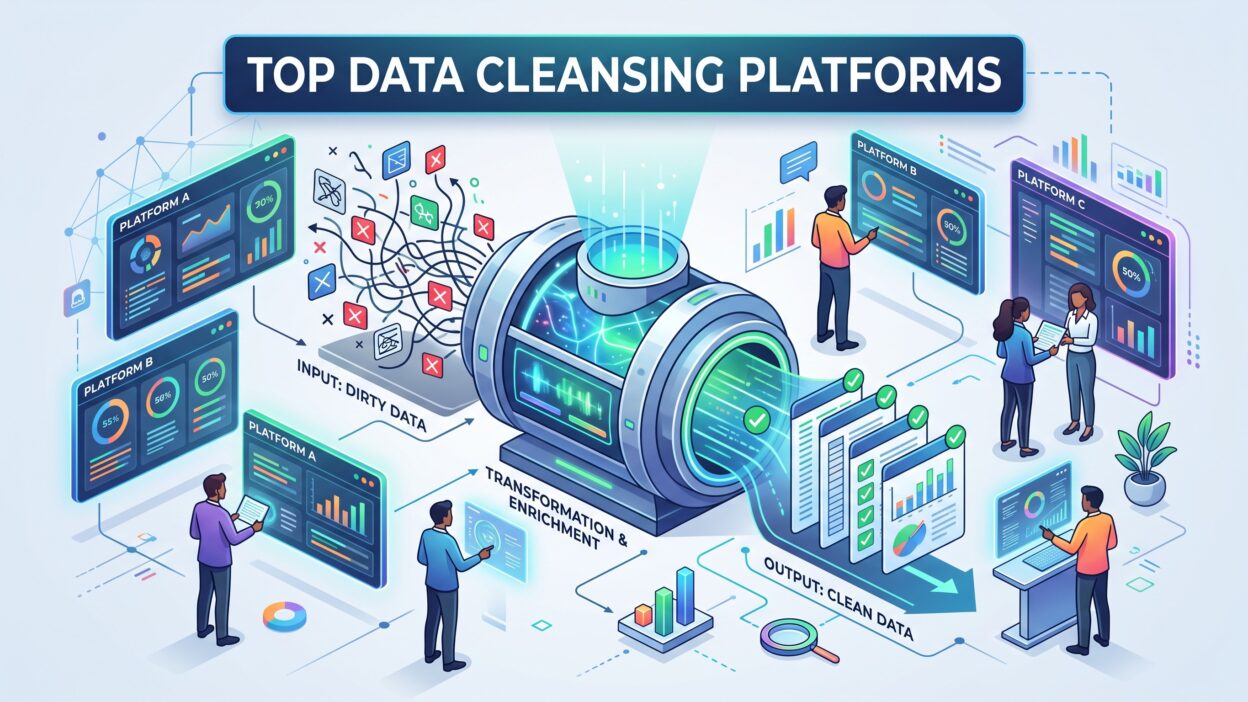
The process behind these tools follows a consistent pattern. Each stage builds on the work done in the last one.
Data Profiling
The platform first scans your dataset to understand its shape. This step counts missing values, spots inconsistent formats, and flags obvious outliers. Profiling gives you a clear picture of how messy your data actually is before any fixing begins.
Standardization
Next, the system applies consistent formatting rules across every field. Phone numbers get a single format. Dates follow one structure instead of five different styles. Addresses match a standard layout used by postal services.
Deduplication
Once formatting is consistent, the platform searches for duplicate records. Matching algorithms compare names, addresses, and other identifiers to catch overlaps that a simple search would miss. The system merges these duplicates into one clean record.
Validation and Enrichment
The final step checks each record against trusted reference data. Emails get verified for deliverability. Addresses get checked against postal databases. Some platforms also enrich records with missing details pulled from external sources.
This four-step flow repeats across every batch of new data entering your system. Data Cleansing Platforms handle millions of records without slowing down, something a manual process could never match at that scale.
Ongoing Monitoring
Clean data does not stay clean forever. New records enter your system daily through forms, imports, and integrations. A strong platform keeps monitoring incoming data continuously, catching errors the moment they appear instead of letting them pile up for months.
Top Data Cleansing Platforms in 2026
Here is a detailed look at the leading tools in this space today. Each platform brings its own strengths to the table.
Trifacta
Trifacta built its reputation on visual data preparation. The interface shows your dataset alongside suggested cleaning steps, which makes the tool approachable for analysts without deep coding skills. Its engine learns from your corrections and suggests similar fixes across the rest of the dataset.
Data teams at larger companies often choose Trifacta for its scale. The platform handles massive datasets across cloud storage systems without a heavy performance hit. Smaller teams sometimes find the learning curve steeper than simpler tools, but the visual workflow pays off once you get comfortable with it.
Talend
Talend combines data cleansing with broader integration features. The platform pulls data from multiple sources, cleans it, and pushes it into a warehouse or application in one connected pipeline. This makes Talend a favorite among teams already managing complex data flows.
Its open source roots keep entry costs lower than some enterprise competitors. Companies scaling up often move to the paid tiers for advanced matching and governance features. Talend suits teams that want cleansing bundled inside a wider data pipeline instead of a standalone tool.
OpenRefine
OpenRefine offers a free, open source option built for smaller cleanup jobs. Analysts use it to explore messy spreadsheets, spot patterns, and apply bulk fixes through a simple interface. The tool runs locally, which appeals to teams cautious about sending data to a cloud platform.
The learning curve stays gentle compared to enterprise software. OpenRefine works best for one-off cleanup projects rather than continuous, automated pipelines. Teams needing ongoing monitoring usually pair it with a more robust platform down the line.
Informatica
Informatica serves large enterprises with complex data governance needs. The platform combines cleansing with broader data quality management, covering everything from profiling to compliance reporting in one suite.
Its depth comes with a steeper price tag and a longer implementation timeline. Companies with dedicated data teams get the most value here, since Informatica rewards careful configuration over quick, out-of-the-box setup. Many Fortune 500 companies rely on Informatica as their core data quality backbone.
Melissa Data
Melissa Data focuses heavily on contact information accuracy. The platform verifies addresses, phone numbers, and emails against authoritative postal and telecom databases. This specialization makes it a strong choice for teams cleaning customer contact lists specifically.
Pricing scales with volume, which suits businesses of many sizes. Melissa Data works well as a focused tool rather than a full data management suite, so many teams pair it with a broader platform for tasks beyond contact verification.
WinPure
WinPure targets small and mid-size businesses looking for an approachable entry point. The platform runs deduplication and standardization through a straightforward desktop or cloud interface. Setup takes far less time than enterprise-grade tools.
Its matching engine handles fuzzy duplicates well, catching names and addresses that look different but describe the same record. WinPure fits teams that want solid results without a lengthy onboarding process or a dedicated data engineering team.
Data Ladder
Data Ladder specializes in matching and merging records across multiple systems. The platform connects to various databases and applies custom matching rules tailored to your industry. Retailers and healthcare companies often choose Data Ladder for its flexible rule engine.
The interface stays accessible for non-technical users while still offering deep customization for advanced needs. Data Ladder positions itself as a middle ground between simple tools and heavyweight enterprise platforms.
Experian Data Quality
Experian brings its data expertise from the credit industry into the world of data cleansing. The platform verifies contact details against a massive reference database built over decades. This depth gives Experian an edge in address and identity verification accuracy.
Enterprise clients value the compliance features built into the platform, especially around regulated industries like finance and insurance. Smaller teams might find the pricing steep compared to lighter alternatives on this list.
IBM InfoSphere QualityStage
IBM’s offering fits within its broader data governance ecosystem. Companies already using IBM tools for data warehousing often add QualityStage for its tight integration with the rest of the stack.
The platform handles massive datasets reliably, which suits large enterprises with strict data quality requirements. Implementation usually needs dedicated technical resources, so smaller businesses rarely choose this route unless they already run on IBM infrastructure.
Ataccama
Ataccama blends data cleansing with governance and cataloging features in one platform. Its AI-driven engine suggests cleaning rules automatically based on patterns it detects across your dataset, cutting down the manual rule-building work common with older tools.
Mid-size and large companies both use Ataccama for its balance of automation and control. The platform suits teams that want strong automation without giving up the ability to fine-tune specific rules when needed.
Data Cleansing Platforms vs Manual Data Management
A manual process feels workable at first. One analyst checks a spreadsheet for obvious duplicates. This works fine for a small customer list under a few thousand records.
Growth breaks this system quickly. A database with hundreds of thousands of records hides errors no human could catch by scrolling through rows. Data Cleansing Platforms solve this exact problem by scanning every record systematically instead of relying on a tired set of human eyes.
Cost comparisons favor automation more than people expect. Hiring extra analysts just to clean spreadsheets adds real payroll expense. A single platform often replaces hours of repetitive manual work at a fraction of that cost.
Consistency also improves with automated tools. A human might apply a cleaning rule differently on a Monday morning versus a Friday afternoon. Software applies the same logic every single time, which keeps results predictable across the entire dataset.
The tradeoff sits in setup time. Manual cleanup needs no software investment upfront. Data Cleansing Platforms require some configuration before running smoothly. Once set up, though, the ongoing time savings and improved accuracy usually justify that early investment within just a few months.
Key Features to Look for in Data Cleansing Platforms
Matching accuracy should top your checklist. A weak matching engine misses obvious duplicates or merges records that should stay separate. Test any platform against your own messy data before committing to a purchase.
Scalability matters just as much. A tool that handles ten thousand records smoothly might choke on ten million. Ask any vendor about performance benchmarks at your actual data volume, not just their marketing claims.
Integration options decide how well a platform fits your existing workflow. Check for native connections to your CRM, data warehouse, or spreadsheet tools. A clunky manual export process defeats the purpose of automation entirely.
Rule customization deserves close attention too. Every industry has unique data quirks. A healthcare company needs different validation rules than a retail business. Strong platforms let you build custom logic instead of forcing a generic, one-size-fits-all approach.
Reporting and visibility round out a solid feature list. You want a clear view of how many records got fixed, merged, or flagged for review. This transparency helps teams trust the automated process instead of wondering what happened behind the scenes.
Benefits of Using Data Cleansing Platforms
Accuracy stands out as the clearest benefit. Automated matching catches duplicates and errors that manual review often misses. Your team works from a dataset that actually reflects reality.
Time savings follow close behind accuracy. Analysts no longer spend entire days scrolling through spreadsheets looking for mistakes. The system handles this work continuously instead of during rare, scheduled cleanup sprints.
Better decisions come from cleaner numbers. A sales report built on duplicate-free data gives leadership an honest view of performance. Forecasts become more reliable once the underlying data stops lying through inflated counts.
Cost control improves as well. Wasted marketing spend on duplicate or invalid contacts adds up fast across large campaigns. Data Cleansing Platforms cut this waste by keeping outreach lists accurate before a single message goes out.
Compliance gets easier to manage too. Many platforms include tools for tracking consent and managing personal data properly. This reduces legal risk for companies operating under strict privacy regulations.
Scalability rounds out the benefit list nicely. A growing company can add new data sources without rebuilding its entire cleaning process from scratch. The system adjusts automatically as your data volume increases over time.
How to Choose the Right Data Cleansing Platform
Start by identifying your biggest data problem. Some teams struggle mainly with duplicates. Others deal with outdated contact information or inconsistent formatting. Knowing your top pain point narrows the field considerably.
Think about your data volume next. A small business with a few thousand records needs a lighter tool than an enterprise managing millions of rows daily. Match the platform’s scale to your actual needs, not your future hopes.
Review your existing tech stack too. Confirm the platform connects with your CRM, spreadsheet tools, or data warehouse. A tool that requires manual exports every time creates extra work nobody wants.
Test the matching engine directly. Upload a sample of your messiest real data during a trial period. Compare the results against what you expect a human reviewer to catch manually.
Consider your team’s technical skill level as well. Some platforms need coding knowledge to configure custom rules. Others offer a simple visual interface built for non-technical users.
Finally, weigh your budget against long-term value. A cheaper tool that misses half your duplicates costs more in wasted outreach than a slightly pricier platform that actually works.
Common Mistakes to Avoid with Data Cleansing Platforms
Many teams wait too long before adopting automation. Manual tracking works fine for a small dataset, but errors compound quietly as records pile up month after month.
Ignoring ongoing monitoring causes real trouble. A one-time cleanup feels satisfying, but new dirty data enters your system every single day through forms and imports. Set up continuous monitoring instead of treating cleansing as a single project.
Skipping a proper trial period backfires often. Every dataset behaves differently, and a platform that works well for one industry might miss patterns specific to yours. Always test with your real data before signing a long contract.
Over-relying on default settings limits results too. Generic matching rules catch obvious duplicates but miss the subtle patterns unique to your business. Spend time customizing rules instead of accepting whatever comes out of the box.
Forgetting to train your team causes friction later. Even the best platform underperforms if nobody understands how to review flagged records properly. Build a short training process alongside your rollout.
FAQs About Data Cleansing Platforms
What makes Data Cleansing Platforms different from a simple spreadsheet formula? A spreadsheet formula checks for exact matches only. Data Cleansing Platforms use fuzzy matching, which catches similar records even when the text does not match perfectly.
Do these platforms replace a human data analyst? No. The software handles repetitive detection and correction work. A human analyst still reviews edge cases and makes judgment calls the system cannot handle alone.
How accurate is duplicate detection in most platforms? Accuracy varies by vendor and dataset quality. Strong platforms catch the vast majority of duplicates, though a small percentage of tricky edge cases usually still need manual review.
Can small businesses afford Data Cleansing Platforms? Yes. Tools like OpenRefine and WinPure offer pricing built for smaller teams. Enterprise platforms like Informatica and IBM QualityStage suit larger operations with bigger budgets.
How long does a typical cleansing project take? Simple projects finish within a few days. Large enterprise datasets with complex rules can take several weeks, especially when custom matching logic needs careful configuration.
Do Data Cleansing Platforms work with cloud data warehouses? Most modern platforms connect directly to popular cloud warehouses. Confirm integration support before choosing a tool if your data already lives in a cloud system.
How often should a team run a cleansing process? Continuous monitoring works best for most businesses. New records enter your system daily, so waiting for a scheduled quarterly cleanup lets errors build up unnecessarily in the meantime.
Read More:-Adobe Experience Platform vs. Oracle: 2026 Comparison
Conclusion

Messy data quietly drains time and money from every department that touches it. Data Cleansing Platforms fix this problem by scanning, matching, and correcting records automatically instead of leaving the work to tired human eyes.
Every tool on this list serves a different type of business. Trifacta and Talend suit teams managing complex pipelines. OpenRefine and WinPure fit smaller teams looking for a simple entry point. Informatica and IBM QualityStage serve large enterprises with strict governance needs.
Pick a platform based on your actual data problems, not just brand recognition. Test the matching engine against your real, messy data before committing to a long contract.
Data Cleansing Platforms are not a passing trend in the data management world. They solve a real, growing problem for any business drowning in duplicate records and inconsistent formatting. Teams that adopt this approach today build a cleaner foundation for every decision they make going forward.