Introduction
TL;DR B2B companies sit on mountains of scattered data. A prospect fills a form on the website. A sales rep logs a call in the CRM. A support ticket lands in a separate help desk tool. None of these systems talk to each other. This is exactly the gap a B2B Customer Data Platform tries to close.
The idea sounds simple on paper. Pull every customer touchpoint into one place. Build a single view of each account. Use that view to guide sales, marketing, and support decisions. The execution gets messier once real systems and real data enter the picture.
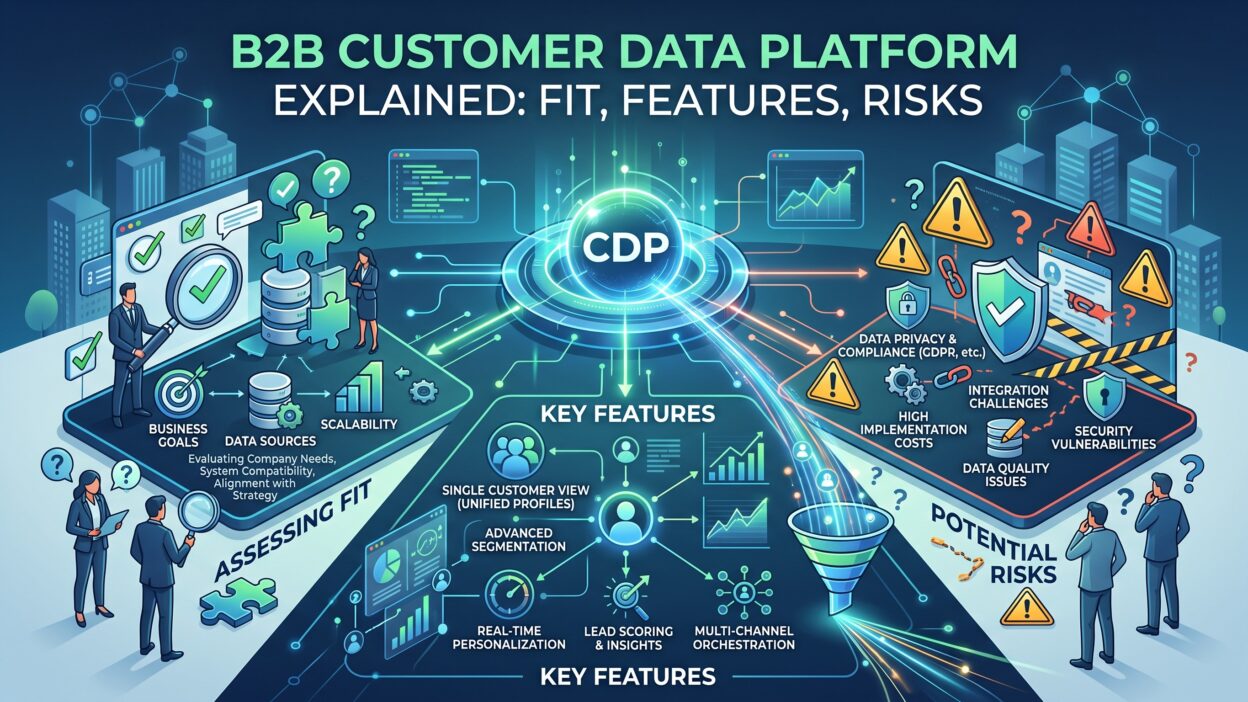
This guide breaks down what a B2B Customer Data Platform actually does, who really needs one, and where the risks hide. You get a clear look at core features, common pitfalls, and the questions worth asking before you sign a contract. By the end, you know whether this technology fits your business right now.
What Is a B2B Customer Data Platform
A B2B Customer Data Platform collects data from every system your company uses and merges it into one unified customer record. This includes your CRM, marketing automation tool, support desk, and even product usage logs if you sell software.
The word “unified” matters here more than people realize. Most companies already have data spread across ten or more tools. A B2B Customer Data Platform does not replace those tools. It sits on top of them, pulling data in and organizing it around each account or contact.
Account-based thinking sets B2B platforms apart from consumer-focused tools. A B2C customer data platform tracks one person and their purchase history. A B2B Customer Data Platform tracks an entire company, along with every individual contact inside that company who interacts with your business.
Identity resolution forms the technical backbone of this process. The system matches a website visitor to a known contact, then links that contact to a company record, then connects that company to every deal, ticket, and email in your history. Get this matching wrong, and the whole platform loses value fast.
Real-time updates separate a modern platform from an old-school data warehouse. A B2B Customer Data Platform refreshes records as new activity happens, not once a month during a batch import. This lets sales and marketing teams react to signals within minutes instead of days.
Why B2B Companies Need a Customer Data Platform
Fragmented data creates real business problems. A sales rep reaches out to a prospect who already told support about a serious complaint last week. Nobody connected those two systems, so the rep walks into an awkward conversation blind.
Marketing teams waste budget without a unified view too. Sending the same campaign to a contact who already converted wastes money and annoys the customer. The right platform flags this overlap before the email goes out.
Sales prioritization improves once account data lives in one place. A rep can see every touchpoint a company had with your business, from a webinar signup to a pricing page visit. This context helps reps focus on accounts showing real buying signals instead of guessing.
Customer retention also benefits from this visibility. A support team spotting a drop in product usage can flag the account before it churns. Without a connected system, this warning sign often gets missed until the renewal conversation falls apart.
Reporting accuracy rounds out the case for adoption. Leadership asking “how many accounts engaged with our new feature” should get one clear answer, not five conflicting numbers from five different tools. A unified system gives every department the same source of truth.
Growing companies feel this pain the most. A five-person startup manages fine with a spreadsheet. A two-hundred-person company selling into enterprise accounts cannot survive on manual tracking alone.
How a B2B Customer Data Platform Works
The mechanics behind this technology follow a repeatable pattern across most vendors.
Data Ingestion
The platform connects to your existing tools through APIs or direct integrations. This includes your CRM, marketing automation software, billing system, and product analytics tool. Data flows in continuously rather than through a one-time import.
Identity Resolution
Once data arrives, the system matches records that describe the same person or company. An email address in your CRM gets linked to a cookie ID from your website and a company domain from your billing system. This matching step decides how accurate your unified view actually becomes.
Profile Building
After matching, the platform builds a single profile for each contact and each account. This profile includes every interaction, from email opens to support tickets to contract renewal dates. Sales and marketing teams pull from this profile instead of checking five separate tools.
Activation
The final step pushes cleaned, unified data back out to the tools your team already uses. A sales rep sees updated account context inside the CRM. A marketing tool triggers a campaign based on a new buying signal. This activation step turns raw data into something teams actually use daily.
This four-step flow runs continuously in the background. A B2B Customer Data Platform processes thousands of events per day without requiring manual intervention from your team.
Governance and Access Control
Data access needs limits, especially with sensitive account information. Strong platforms let admins control who sees what data and how long records stay stored. This step matters more as your company grows and more departments start pulling from the same system.
Key Features of a B2B Customer Data Platform
Unified Account Profiles
The core feature centers on merging scattered data into one account-level view. This profile shows every contact at a company, every deal stage, and every support interaction in a single screen instead of scattered across ten tabs.
Real-Time Data Sync
Data freshness separates a strong platform from a static reporting tool. A B2B Customer Data Platform updates records the moment new activity happens, whether that means a form submission or a product login. Sales teams act on fresh signals instead of stale, week-old data.
Segmentation and Scoring
Most platforms let teams build custom segments based on account behavior. A segment might include every account that visited the pricing page twice this month without booking a demo. Scoring models rank these accounts by likelihood to convert, helping sales focus their time wisely.
Integration Depth
A platform is only as useful as the tools it connects to. Strong integration options cover CRMs like Salesforce and HubSpot, marketing tools, support desks, and data warehouses. Weak integration support forces manual workarounds that undercut the entire point of the platform.
Data Governance Controls
Enterprise buyers care deeply about who can access sensitive account data. Role-based permissions, audit logs, and data retention settings all fall under this category. A B2B Customer Data Platform without strong governance creates compliance headaches down the road.
Predictive Analytics
Some advanced platforms layer machine learning on top of the unified data. These models predict churn risk, upsell opportunity, or deal likelihood based on historical patterns. This feature adds real value once your account volume grows large enough for patterns to emerge clearly.
Top B2B Customer Data Platform Options to Consider
Segment built its name as one of the earliest players in this category, offering strong developer tools and broad integration support. Companies with an engineering team on hand often choose Segment for its flexibility, though that same flexibility means more setup work upfront. Salesforce Data Cloud appeals to companies already deep inside the Salesforce ecosystem, since it connects natively with existing CRM data and requires less custom integration work as a result.
Hightouch and Census take a different approach, focusing on reverse ETL that pushes warehouse data directly into sales and marketing tools. This suits data teams that already maintain a strong warehouse and want activation without duplicating storage across multiple systems. Both platforms appeal to companies with mature data engineering practices already in place.
Tealium and Treasure Data serve larger enterprises with complex data needs across many regions and business units. Both platforms handle high data volume reliably, though implementation usually needs dedicated technical resources and a longer rollout timeline than smaller competitors.
Amperity focuses on identity resolution accuracy, which matters most for companies with messy, duplicate-heavy data across many source systems. Its matching engine handles complex edge cases that simpler tools often miss entirely.
Choosing between these options depends heavily on your existing tech stack and your team’s technical depth. A company already comfortable managing a data warehouse leans toward reverse ETL tools. A company wanting a more guided, out-of-the-box experience often prefers a platform with deeper native integrations instead.
B2B Customer Data Platform vs Traditional CRM
A CRM stores what a sales rep manually enters. Deal stages, contact names, and call notes all live inside this system, built around one rep’s workflow at a time.
A B2B Customer Data Platform works differently. It pulls data automatically from many systems, not just the CRM. Website visits, support tickets, and product usage all flow into the same unified account view without anyone typing a single note.
Coverage gaps show up fast with a CRM-only approach. A rep might never learn that a prospect visited the pricing page five times last week. That signal lives in a separate analytics tool most reps never check. A connected platform surfaces this activity automatically, right inside the tools reps already use.
Scale reveals the real difference between these two approaches. A CRM works fine for tracking a few hundred active deals. Once a company manages thousands of accounts across many products, manual entry cannot keep pace with the volume of real customer activity happening every day.
The two systems work best together, not as replacements for each other. A CRM still manages the sales process itself. A B2B Customer Data Platform enriches that process with the fuller context reps would otherwise never see.
Is a B2B Customer Data Platform the Right Fit for Your Business
Company size plays a big role in this decision. A small business with a few hundred contacts rarely needs this level of infrastructure. A B2B Customer Data Platform earns its cost once your contact and account volume grows into the thousands.
Sales complexity matters just as much. A company with a long, multi-stakeholder sales cycle benefits more than one with a simple, single-touch purchase process. Account-based selling depends on seeing every contact and interaction tied to one company.
Tool sprawl signals readiness too. If your team already juggles five or more disconnected systems, a unified platform starts paying for itself quickly. Companies running lean on just a CRM and one email tool might not see the same return yet.
Technical resources deserve honest evaluation. Some platforms need engineering support for setup and ongoing maintenance. A team without this capacity should lean toward simpler, more guided platforms instead of a fully customizable option.
Budget realities cannot get ignored either. A B2B Customer Data Platform represents a real investment, both in licensing cost and setup time. Companies should weigh this cost against the actual revenue impact of better data, not just the appeal of new technology.
Growth trajectory matters most of all. A company scaling fast toward enterprise accounts benefits from building this foundation early, before data chaos becomes harder to untangle later.
Risks and Challenges of a B2B Customer Data Platform
Implementation complexity ranks as the biggest early risk. Connecting a dozen systems correctly takes real time and expertise. Companies underestimating this effort often end up with a half-finished rollout that delivers less value than promised.
Data quality problems can actually get worse before they improve. Merging messy data from multiple sources sometimes creates new duplicate records instead of fixing old ones. A B2B Customer Data Platform needs proper matching rules configured carefully, or it just moves the mess around instead of cleaning it.
Vendor lock-in poses a long-term risk worth considering upfront. Once your entire data flow depends on one platform, switching vendors later becomes expensive and disruptive. Review contract terms and data portability options before committing to a multi-year deal.
Privacy and compliance risk grows alongside your data volume. Storing detailed account and contact information across regions triggers different regulatory requirements. A platform without strong governance controls can create real legal exposure for your company.
Cost overruns happen more often than vendors advertise. Base pricing rarely covers every integration or advanced feature your team eventually wants. Budget for growth in usage and feature needs, not just the initial quoted price.
Team adoption remains an underrated risk too. A powerful platform delivers nothing if sales and marketing teams keep working from their old habits instead of the new unified view. Change management deserves as much planning as the technical rollout itself.
Overreliance on automation creates a subtler risk. Scoring models and predictive features work well only when built on solid data. A B2B Customer Data Platform trained on incomplete or biased data can send sales teams chasing the wrong accounts entirely.
How to Choose the Right B2B Customer Data Platform
Start with a clear list of your current tools and data sources. This tells you exactly what integration depth you actually need from a vendor before you start comparing options.
Map your specific use case next. A team focused purely on lead scoring needs different features than one focused on churn prediction or account-based marketing. Vague goals lead to a mismatched platform choice later.
Test identity resolution accuracy directly. Ask any vendor to run a sample of your real, messy data during a trial period. Compare the merged results against what your team already knows about these accounts.
Evaluate governance features carefully if you operate in regulated industries. Confirm role-based access controls, audit logging, and data retention policies meet your compliance requirements before signing anything.
Consider your internal technical capacity honestly. Some platforms need dedicated engineering support for ongoing maintenance. Choose a vendor that matches your team’s actual skill level, not an idealized version of your future team.
Weigh total cost against expected impact. A B2B Customer Data Platform should pay for itself through better conversion rates, reduced churn, or faster sales cycles. If you cannot draw a clear line to revenue impact, reconsider the timing of this investment.
Common Mistakes Companies Make with a B2B Customer Data Platform
Many companies rush the implementation timeline. Rolling out a platform in a few weeks without proper data mapping leads to messy, unreliable results that damage trust in the tool early on.
Skipping stakeholder buy-in causes ongoing friction. Sales and marketing teams both need a voice in how the unified profile gets built. A platform designed only by IT often misses the practical details teams actually need daily.
Ignoring data governance from day one creates problems that compound over time. Adding proper access controls after the fact costs far more effort than building them in from the start.
Choosing a platform based on brand name alone backfires often. The most popular vendor is not always the best fit for your specific tech stack or team size. Always test before committing to a long-term contract.
Forgetting to measure results leaves teams unsure if the investment worked. Set clear metrics before launch, like reduced response time or improved lead scoring accuracy, so you can prove the platform’s actual value later.
FAQs About B2B Customer Data Platforms
What is the main difference between a B2B Customer Data Platform and a CRM? A CRM tracks deals and contacts manually entered by sales teams. A B2B Customer Data Platform automatically pulls and merges data from many systems, including your CRM, into one unified account view.
Does a B2B Customer Data Platform replace existing marketing tools? No. The platform sits on top of your existing tools, feeding them cleaner, unified data. Your marketing automation and CRM systems still handle their core functions.
How long does implementation usually take? Simple setups with a few integrations take a few weeks. Complex enterprise rollouts with many data sources can take several months, especially with strict governance requirements.
Is this technology only for large enterprises? Mid-size companies with growing account volume and multiple disconnected tools also benefit. Very small businesses with simple sales processes rarely need this level of infrastructure yet.
What is identity resolution, and why does it matter so much? Identity resolution matches records describing the same person or company across different systems. Poor matching creates duplicate or incomplete profiles, which undermines the entire value of a B2B Customer Data Platform.
Are these platforms secure for sensitive account data? Security depends heavily on the vendor. Look for strong access controls, encryption standards, and compliance certifications before trusting a platform with sensitive customer information.
How much does a B2B Customer Data Platform typically cost? Pricing varies widely based on data volume, integrations, and features. Expect costs to scale with your contact and account count, plus additional fees for advanced governance or predictive features.
Read More:-Unleashing the Power of AI-Generated Emails With Copilot
Conclusion

Scattered data quietly costs businesses real revenue every single day. A B2B Customer Data Platform solves this by pulling every customer touchpoint into one clear, unified view that sales, marketing, and support teams can all trust.
The technology fits some companies better than others. Growing businesses juggling multiple tools and complex sales cycles see the strongest return. Smaller teams with simple processes might find the investment premature right now.
Weigh the risks honestly before committing. Implementation complexity, data quality challenges, and vendor lock-in all deserve careful thought during evaluation. Test any platform against your real data before signing a long-term contract.
A B2B Customer Data Platform is not a magic fix for messy data. It is a serious infrastructure investment that pays off when built thoughtfully around your actual business needs. Companies that approach this decision with clear goals end up with a system that genuinely improves how they understand and serve their customers.