Introduction
TL;DR Most product launches fail — not because the product is bad, but because the launch plan is weak. A go-to-market strategy is the document that prevents that failure. It gives every team a shared direction, a shared story, and a shared definition of success.
This guide answers every important question about a go-to-market strategy. You will learn what it is, why it matters, how to build one, and what mistakes to avoid. B2B companies in 2026 face a crowded, noisy market. The companies that win are the ones with a clear, disciplined go-to-market strategy guiding every move they make.
Table of Contents
What Is a Go-to-Market Strategy?
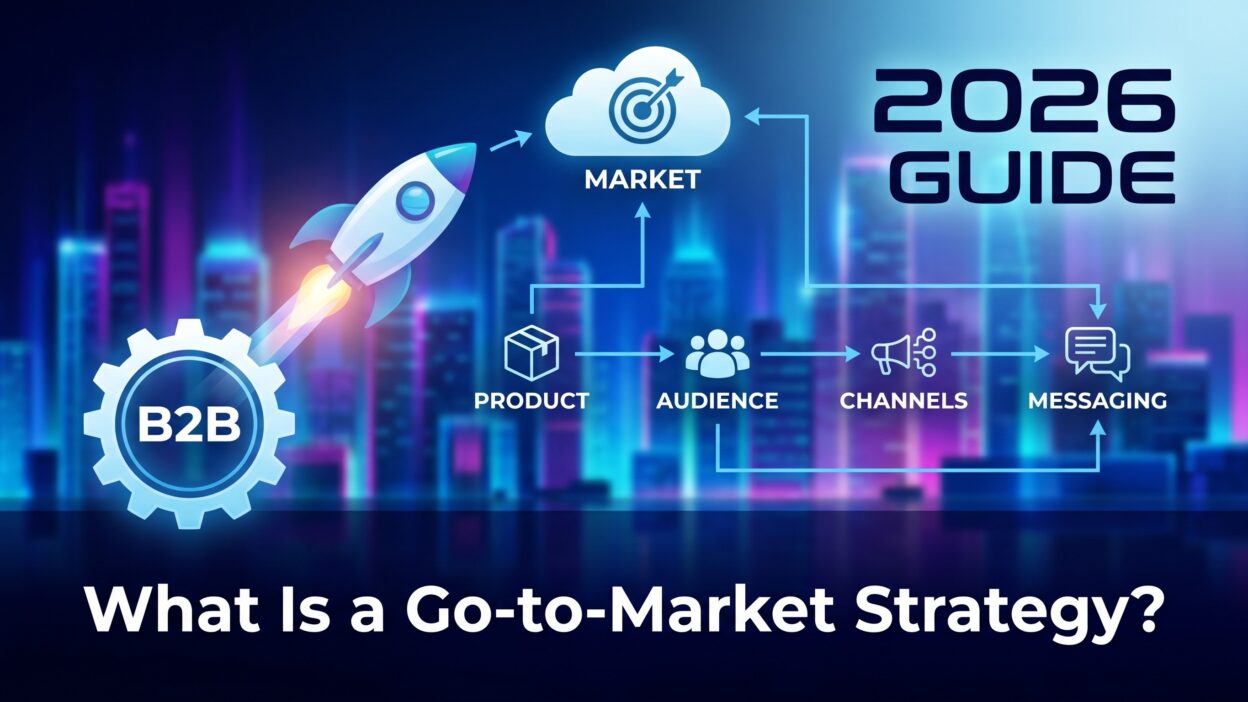
A go-to-market strategy is a step-by-step plan that defines how a company brings a product or service to market. It covers target customers, pricing, channels, messaging, and the sales motion your team uses to close deals. Every element works together toward one goal — sustainable revenue growth.
A go-to-market strategy differs from a marketing plan. A marketing plan focuses on ongoing promotional activities. A go-to-market strategy is specifically built around a product launch or a new market entry. It is time-bound, focused, and cross-functional by design.
Sales, marketing, product, and customer success all contribute to a go-to-market strategy. No single department owns it entirely. When one team operates in isolation, the whole strategy breaks down. Successful execution requires every function pulling in the same direction.
Companies that document and commit to a formal go-to-market strategy launch faster, waste less budget, and convert more customers. The discipline of building the strategy forces alignment before it matters most — at launch.
Go-to-Market Strategy vs. Business Strategy: Key Differences
A business strategy defines where a company wants to go over the long term. A go-to-market strategy defines how a specific product reaches a specific market right now. Business strategy is broad. A go-to-market strategy is precise.
Both strategies must align with each other. A go-to-market strategy built in conflict with the business strategy creates confusion and wasted resources. Sanity-check both documents against each other before launching anything.
Why a Go-to-Market Strategy Is Critical in 2026
The B2B buying environment changed dramatically over the past three years. Buyers complete 70 percent of their research before ever speaking to a salesperson. Attention spans are shorter. Decision committees are larger. A go-to-market strategy built for 2019 will not work today.
Competition intensified across every B2B category. Hundreds of SaaS tools fight for the same buyers. Differentiation is harder to achieve and easier to lose. A go-to-market strategy forces you to define your differentiation clearly before you spend a dollar on acquisition.
Economic pressure also changed how buyers evaluate purchases. CFOs now scrutinize software spend more than ever. Vendors need a stronger value story. A strong go-to-market strategy puts that value story at the center of every customer interaction from day one.
Speed matters more in 2026 as well. First movers in new product categories often capture disproportionate market share. A documented go-to-market strategy compresses launch timelines by eliminating the confusion that slows teams down during critical early weeks.
What Happens Without a Go-to-Market Strategy
Teams without a go-to-market strategy default to guesswork. Sales targets the wrong accounts. Marketing creates content for the wrong personas. Product ships features that do not move the needle with buyers. Every department works hard but in different directions.
Misalignment costs money. It inflates customer acquisition costs. It lengthens sales cycles unnecessarily. It frustrates buyers who receive inconsistent messaging from different team members. A missing go-to-market strategy is an invisible tax your company pays every single day.
The Core Components of a Go-to-Market Strategy
Every strong go-to-market strategy includes the same foundational elements. Miss one and the entire plan develops a weak point that competitors or market forces will eventually expose. Build each component carefully before moving to execution.
Ideal Customer Profile and Target Market Definition
The ideal customer profile is the starting point for any go-to-market strategy. It defines the exact type of company most likely to buy, stay, and grow with your product. Without a sharp ICP, every downstream decision becomes harder and less effective.
Build your ICP from real data. Analyze your best current customers. Look at which accounts generate the highest revenue, lowest churn, and fastest time-to-value. The characteristics these accounts share define your ICP with evidence behind it.
Firmographic attributes include company size, industry, geography, and annual revenue. Technographic attributes include the tools and platforms they already use. Both categories matter for precise targeting inside your go-to-market strategy.
Value Proposition and Messaging
Your value proposition answers the most important buyer question. Why should I choose your product over every alternative available to me? A weak answer loses deals before they start. A sharp answer accelerates every stage of the sales cycle.
A go-to-market strategy needs one clear core message and supporting messages for each persona. The CFO cares about cost reduction and ROI. The VP of Marketing cares about pipeline contribution. The end user cares about ease of use and time savings. Each message addresses a different priority with the same underlying value story.
Test your messaging before launch. Run it by current customers. Share it with prospects in discovery calls. Run copy tests on landing pages. Real-world feedback shapes better messaging than any internal brainstorming session ever will.
Pricing and Packaging
Pricing signals value. A go-to-market strategy that ignores pricing leaves money on the table or prices the company out of its target market. Both outcomes hurt growth. Get pricing right before launch, not after.
Research competitor pricing before setting your own. Understand whether your target market buys on value, on features, or on the lowest price available. Value-based pricing works best for differentiated products. Competitive pricing works best in commoditized categories.
Packaging simplifies the buying decision. Offer two or three clearly differentiated tiers. Name each tier in a way that signals the buyer it was designed for them. Simple packaging accelerates deals. Complex packaging creates confusion and stalls sales cycles.
Sales Motion and Distribution Channels
The sales motion defines how your company sells. Product-led growth lets users try before committing. Sales-led growth uses a human sales team to drive every deal. Hybrid models combine both. Your go-to-market strategy should match the sales motion to your product complexity and average contract value.
Low-ACV products with simple use cases suit product-led and low-touch sales models. High-ACV enterprise products require consultative selling and multi-stakeholder management. Choose the motion that matches reality, not the one that sounds impressive in a board presentation.
Distribution channels determine how buyers find and access your product. Direct sales, channel partners, marketplaces, and self-serve all carry different cost structures and scalability profiles. A smart go-to-market strategy picks channels based on where your ICP already spends time and how they prefer to buy.
How to Build a Go-to-Market Strategy Step by Step
Building a go-to-market strategy feels complex at first. Breaking it into sequential steps makes the work manageable. Follow this process and you will produce a strategy strong enough to guide your entire GTM team.
Conduct Deep Market Research
Start with the market, not the product. Understand who your buyers are, what problems keep them awake at night, and how they currently solve those problems. Primary research through buyer interviews produces the most valuable insights at this stage.
Competitive analysis belongs in your market research phase. Identify every credible competitor. Map their positioning, pricing, and target customer segments. Find the gaps they leave open. Your go-to-market strategy should position your product directly in those gaps.
Market sizing matters for resource allocation. Know the total addressable market, serviceable addressable market, and serviceable obtainable market for your product. These numbers guide realistic revenue forecasts and help leadership set appropriate expectations for launch results.
Define and Validate Your ICP
Take your market research and translate it into a precise ICP. Document firmographic, psychographic, and technographic characteristics. Share the ICP draft with your sales and customer success teams. They speak to buyers daily and will catch anything your research missed.
Validate the ICP with a small pilot campaign before scaling. Run targeted outreach to a segment that matches your ICP criteria. Measure response rates, meeting conversion rates, and deal velocity. Strong validation numbers confirm you built the right ICP. Weak numbers signal the need for refinement.
Develop Positioning and Core Messaging
Use your ICP and competitive research to craft positioning. Positioning defines the specific space your product occupies in the buyer’s mind relative to all available alternatives. It is the strategic foundation. Messaging is how you communicate that positioning in plain language buyers understand.
A go-to-market strategy needs messaging that passes the plain language test. If your target buyer reads your headline and does not immediately understand what you do and why it matters, rewrite it. Clarity converts. Jargon confuses and repels.
Align Teams and Launch
Run a pre-launch alignment session with every team involved in the go-to-market strategy. Sales, marketing, product, support, and leadership should all attend. Walk through the ICP, messaging, pricing, and sales motion together. Address every question before launch day.
Create an internal launch kit. Include messaging guides, talk tracks, FAQ documents, and objection-handling scripts. Sales reps should never have to improvise answers to questions your team already anticipated. Preparation prevents lost deals from poor early execution.
Set launch metrics in advance. Define what success looks like at 30, 60, and 90 days. Track pipeline generated, meetings booked, and conversion rates at each funnel stage. Review progress weekly in the early weeks and adjust your go-to-market strategy based on real performance data.
Go-to-Market Strategy Frameworks Used by Top B2B Companies
Experienced GTM leaders lean on proven frameworks to structure their thinking. These frameworks do not replace original strategy work. They accelerate it by giving your team a shared vocabulary and a proven starting structure.
The Product-Market Fit Framework
Product-market fit is the foundation every go-to-market strategy builds on. It means your product solves a real problem for a real market segment well enough that customers actively recommend it to others. Without product-market fit, even the best go-to-market strategy cannot generate durable growth.
Measure product-market fit with the Sean Ellis test. Survey existing users with one question. How would you feel if you could no longer use this product? If more than 40 percent answer very disappointed, you have product-market fit. Below that threshold, refine the product before scaling your go-to-market strategy.
The Jobs-to-Be-Done Framework
Jobs-to-be-done reframes how you think about your buyer. Instead of asking who your customer is, you ask what job they hire your product to do. This shift changes messaging, positioning, and even product development in powerful ways.
A procurement manager does not buy contract management software. They hire it to eliminate manual contract errors and reduce legal review time. That reframe produces messaging that speaks directly to the outcome the buyer cares about. Every strong go-to-market strategy uses jobs-to-be-done thinking to sharpen its messaging.
The Bowtie Funnel Framework
The bowtie funnel extends the traditional marketing funnel to include post-sale customer expansion. The left side covers awareness through closed-won. The right side covers onboarding, adoption, retention, and expansion. A complete go-to-market strategy addresses both sides.
Most GTM teams over-invest in the left side and neglect the right. Expansion revenue from existing customers carries a dramatically lower CAC than new customer acquisition. Customer success and account management belong inside your go-to-market strategy from the beginning.
Common Go-to-Market Strategy Mistakes B2B Companies Make
Even experienced teams make avoidable mistakes when building a go-to-market strategy. Recognizing these mistakes in advance saves your team from costly missteps during critical launch windows.
Targeting too broad an audience is the most common mistake. Teams fear narrowing their ICP because a smaller addressable market feels riskier. In reality, specific targeting produces higher conversion rates, lower CAC, and stronger word-of-mouth within a defined buyer community.
Launching without sales enablement materials consistently derails early go-to-market execution. Marketing delivers leads that sales cannot convert because reps lack the right talk tracks, competitive battle cards, and objection responses. Build enablement content before launch, not during it.
Neglecting the post-sale experience destroys LTV and generates negative word-of-mouth. A great go-to-market strategy plans the customer onboarding experience with the same rigor applied to acquisition. The sale is the beginning of the relationship, not the end.
Ignoring data from early deals slows strategy improvement unnecessarily. Your first 20 closed deals contain invaluable insights about what messaging worked, which objections appeared most often, and which customer profiles converted fastest. Capture and act on that intelligence immediately within your go-to-market strategy.
Measuring the Performance of Your Go-to-Market Strategy
A go-to-market strategy without metrics is a document, not a management tool. Define your key performance indicators before launch and track them with the same discipline you bring to product development or financial reporting.
Pipeline generated by marketing and sales outreach is the primary leading indicator. It tells you whether your ICP targeting and messaging attract buyers who could realistically purchase. If pipeline is thin, something in the front half of your go-to-market strategy needs adjustment.
Win rate measures how effectively your sales motion converts opportunities into customers. A low win rate signals a positioning problem, a pricing problem, or a mismatch between your ICP and the accounts sales actually pursues. Dig into lost deal reasons with structured win-loss analysis.
Time-to-close measures sales cycle length. Long cycles relative to your ACV signal excessive friction somewhere in the buyer journey. Map every step a buyer takes from first touch to signature. Eliminate steps that add delay without adding value to the decision.
Leading vs. Lagging Indicators for GTM Performance
Leading indicators predict future outcomes. Website traffic, inbound inquiry volume, demo request rates, and email engagement all signal whether your go-to-market strategy generates interest before it generates revenue. Monitor these weekly in early launch phases.
Lagging indicators confirm past performance. Closed revenue, customer acquisition cost, net revenue retention, and payback period all tell you how well your strategy performed historically. Use lagging indicators to validate strategic decisions and allocate future budget. Use leading indicators to course-correct in real time.
Frequently Asked Questions About Go-to-Market Strategy
What are the main types of go-to-market strategy?
The four main types are product-led growth, sales-led growth, marketing-led growth, and channel-led growth. Product-led growth relies on the product itself to drive acquisition and expansion. Sales-led growth uses a human sales team to close every deal. Marketing-led growth generates demand through content, brand, and paid media. Channel-led growth scales through resellers, partners, and distribution networks. Most B2B companies combine elements of two or more types within a single go-to-market strategy.
How long does it take to build a go-to-market strategy?
A focused team can produce a solid first draft in three to four weeks. The research phase takes the longest — typically two weeks of buyer interviews and competitive analysis. Messaging development and team alignment sessions add another week. Expect to iterate on your go-to-market strategy for several months after launch as real-world data surfaces new insights.
Who owns the go-to-market strategy inside a company?
Ownership depends on company structure and stage. Early-stage startups typically assign ownership to the CEO or a VP of Sales and Marketing. Growth-stage companies often create a dedicated GTM or revenue operations function. Regardless of formal ownership, the best go-to-market strategies involve active contribution from sales, marketing, product, and customer success leadership. Collaboration drives better strategies than isolation.
What is the difference between a go-to-market strategy and a product launch plan?
A product launch plan is a subset of a go-to-market strategy. The launch plan covers the specific activities, timeline, and responsibilities for launching a product to market. A go-to-market strategy is broader — it defines the ongoing approach to acquiring and retaining customers beyond the initial launch window. Think of the launch plan as the first chapter of your go-to-market strategy.
Can a go-to-market strategy work for a new market entry?
Yes, and it is especially important for new market entries. Entering an unfamiliar market without a documented go-to-market strategy dramatically increases risk. The strategy forces you to research buyer behavior, competitive dynamics, and pricing norms specific to that new market. Companies that skip this step often discover expensive market realities after committing significant resources.
How often should a go-to-market strategy be updated?
Review your go-to-market strategy at least quarterly. Markets shift. Buyer priorities evolve. Competitive landscapes change faster than ever in 2026. A quarterly review cycle lets your GTM team catch strategic drift early and course-correct before small misalignments become large revenue problems. Major market shifts or product pivots require an immediate full strategy review.
What role does customer success play in a go-to-market strategy?
Customer success plays a critical role in the post-sale half of your go-to-market strategy. Onboarding experience determines whether new customers achieve the value that marketing promised during acquisition. Retention and expansion depend on how consistently customer success teams deliver outcomes. Companies that treat customer success as optional within their go-to-market strategy consistently underperform on net revenue retention and lifetime value.
Read More:-Mastering ABM: How 3 Marketing Teams Built Effective Strategies
Conclusion

A go-to-market strategy is not optional for B2B companies competing in 2026. It is the document that turns a great product into a growing business. It aligns your teams, sharpens your targeting, and gives every customer interaction a consistent foundation.
Start with your ICP. Layer on sharp messaging. Choose the right sales motion and distribution channels. Align every team before launch. Then measure relentlessly and improve continuously. That sequence produces a go-to-market strategy that compounds in effectiveness over time.
The companies that win market share this year built their go-to-market strategy before they needed it. They did not scramble to define their ICP after missing a quarter. They did not rewrite their messaging after losing deals to competitors with a clearer story.
Your go-to-market strategy is the most leveraged document your GTM team can create. Build it with intention. Commit to it with discipline. Refine it with data. The results will reflect the quality of the strategy behind every customer conversation your team has.