Introduction
TL;DR Your CRM holds names and deal stages. It does not hold the full picture. AI agents need real Go-to-Market Intelligence to make smart decisions every day. A name in a spreadsheet tells an agent nothing about timing or intent. This missing context fills that gap directly.
Sales teams feel this shift already. Buyers move fast now. A CRM field updates once a week if you are lucky. AI agents need fresh signals every hour, not stale notes from last quarter. This kind of live intelligence brings freshness into the system.
This blog breaks down what this concept means for AI agents today. It covers the data sources that matter most. It covers common mistakes teams make and the best practices for feeding smarter agents. Every section stays practical. No fluff. Just details you can use this week.
Table of Contents
What Go-to-Market Intelligence Really Means
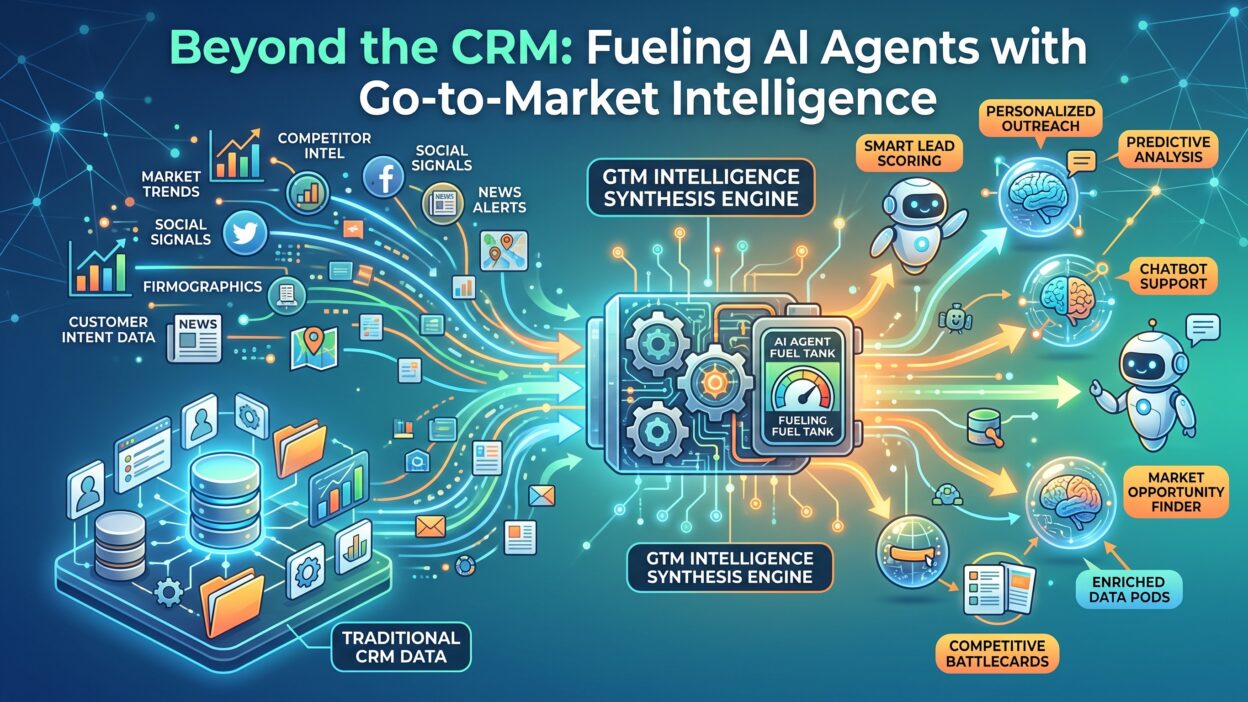
This kind of intelligence is not one dataset sitting in a folder. It is a living layer of signals across sales, marketing, and product teams. This layer tells you who is ready to buy. It tells you who is at risk. It tells you who needs a nudge right now.
A CRM records what already happened. Go-to-Market Intelligence points toward what happens next. That gap matters for AI agents built to act, not just to report numbers on a dashboard.
Signals vs Static Records
Static records list a title, a company name, an email address. Signals show behavior instead. A prospect visiting your pricing page five times in one week is a signal. A champion leaving a company is a signal too. This layer turns these signals into structured data an AI agent can actually read.
Why Timing Beats Data Volume
Teams often chase more data first. Volume alone does not help an agent decide anything useful. Timing does the real work here. A signal from ten minutes ago beats a record from ten months ago every time. A strong intelligence layer values freshness over raw size.
Where the Signals Actually Come From
Signals come from many places at once. Website visits, email opens, product logins, and support tickets all count. Job postings and funding announcements count too. Each source adds one small piece to a larger account picture.
A Simple Example
Picture a mid-size logistics company browsing your integrations page three times in one month. Their engineering team posts two open roles tied to your product category. A support ticket from their account mentions a competitor by name. None of these facts alone means much. Stacked together, they tell a clear story an agent can act on right away.
Why AI Agents Need More Than CRM Data
An AI agent built only on CRM fields acts blind. It sees a contact record and guesses the rest of the story. Guessing wastes time. Guessing also burns trust with buyers who expect relevant outreach.
AI agents need context to act well. They need to know which page a buyer viewed last night. They need to know if a competitor came up on a recent call. Real market and buyer signals supply these details straight into the agent’s decision process.
The Cost of Guessing at Scale
A sales rep with zero context on a call already struggles. An AI agent faces the same risk, but at a much larger scale. Feed it thin data and it makes thin decisions across thousands of accounts overnight. One bad guess costs a single deal. Thousands of bad guesses cost a whole pipeline.
From Reactive Reports to Active Decisions
Old systems reported what happened last month. AI agents built on live buyer signals act inside the moment itself. They rank accounts, draft messages, and flag risks while a human rep still reads their morning email. This shift moves teams from reactive reporting toward active, real-time decisions.
The Building Blocks of Go-to-Market Intelligence
Strong Go-to-Market Intelligence rests on a few core pillars. Each pillar feeds a different part of the buyer picture an AI agent needs.
Firmographic and Technographic Data
Firmographic data covers company size, industry, and revenue range. Technographic data covers the tools a company already runs day to day. Together they tell an agent if a lead fits your ideal customer profile. This pairing forms the foundation layer beneath every strong go-to-market data program.
Intent Data
Intent data tracks research behavior across the open web. A company searching terms tied to your category shows real buying intent. AI agents read these intent spikes and rank accounts by urgency instead of by gut feeling. Intent data adds motion to an otherwise flat, static profile.
Product Usage Signals
For companies selling software, usage data tells the real story every time. A drop in login frequency signals churn risk early. A spike in feature adoption signals expansion potential just as clearly. AI agents trained on these signals catch problems before a human rep even notices them.
Competitive and Market Signals
Buyers rarely evaluate one vendor alone. Mentions of competitor names on sales calls matter a lot. Funding rounds, leadership changes, and layoffs shift buying priorities fast. A connected intelligence feed pulls these outside signals into one place an agent can search.
How AI Agents Use Go-to-Market Intelligence in Sales
Sales agents built on strong buyer and market signals prioritize the right accounts first. They rank leads using intent score, fit score, and engagement history together. A rep opens their queue in the morning and sees the accounts most likely to close that week.
Prioritization That Actually Works
Manual prioritization relies on memory and gut instinct. An AI agent removes that guesswork completely. It scores every account the same way, every single day. Reps stop wasting hours on cold leads that were never going to convert.
A rep managing three hundred accounts cannot track every signal by hand. An agent watching those same accounts never gets tired and never forgets a detail. It checks usage data, intent spikes, and firmographic fit before the rep even logs in for the day.
Context-Aware Outreach
These agents also draft outreach grounded in real, current context. An agent references a recent product launch or a hiring announcement inside an email draft it writes. The message feels researched by a human, not pulled from a generic template.
Catching Risk Before It Becomes a Loss
Deal risk detection improves through this same process. An agent trained on strong signal data flags a stalled deal early, often days before a rep notices anything wrong. It notices a champion went quiet. It notices a competitor got mentioned on the last call. The rep gets an alert while the deal can still be saved.
How AI Agents Use Go-to-Market Intelligence in Marketing
Marketing teams face a flood of leads with mixed quality every quarter. Strong Go-to-Market Intelligence helps AI agents sort real signal from noise fast, without a human sitting there scoring each one by hand.
Lead Scoring That Reflects Reality
An agent scores each lead using firmographic fit and intent data together. High scoring leads move straight into a sales rep’s queue. Low scoring leads enter nurture flows built around the exact topics they researched. This scoring feels accurate because it reflects real behavior, not a static form fill.
Content That Matches the Buyer
Content personalization gets sharper through the same data. An agent picks case studies and landing pages based on industry and buying stage. A healthcare buyer sees healthcare proof points on their next visit. A retail buyer sees retail proof points instead. This same signal data drives the matching without manual segmentation work from your team.
Smarter Campaign Timing
Campaign timing improves as well, once agents can act on live signals. Agents launch outreach the moment intent signals spike, not on a fixed weekly send schedule. This timing shift often lifts response rates more than any subject line rewrite ever could.
How AI Agents Use Go-to-Market Intelligence in Customer Success
Customer success teams juggle renewals, expansions, and churn risk all at once. Rich Go-to-Market Intelligence gives AI agents the signals needed to triage every account properly, without guessing which fires to put out first.
Catching Churn Before It Happens
An agent watches usage trends every single day. A steep drop triggers an alert to the success manager well before the renewal date arrives. This early warning often saves accounts that would otherwise churn quietly, with no complaint filed and no warning given.
Finding Expansion Opportunities
A steady rise in seat usage triggers a different kind of alert instead. The agent flags the account for an expansion conversation. Success managers stop missing upsell windows because nobody was watching the usage graph closely enough.
Reading Sentiment Alongside Behavior
Support ticket sentiment feeds into this same picture too. Agents read ticket tone alongside usage data at the same time. A frustrated tone paired with dropping logins signals real churn risk, not just a minor one-off complaint. A connected signal layer ties these dots together automatically across every account in the portfolio.
Secondary Signals That Sharpen Go-to-Market Intelligence
Beyond the core pillars, a few secondary signals add real sharpness to the picture an agent builds.
Website and Content Engagement
Return visits to a pricing page carry weight. Time spent on a comparison page carries weight too. These small behaviors, tracked over weeks, paint a clearer intent picture than any single form submission ever could.
Event and Webinar Activity
Attendance at a live webinar signals active interest in a topic right now. Repeat attendance across several sessions signals something stronger still. AI agents fold this activity into the same scoring model used for every other signal type.
Social and Community Signals
Comments on a product forum or a public review carry real information. A negative review posted right after a renewal date passes deserves quick attention. A well built signal layer treats these public signals the same way it treats private ones inside your own systems.
Building a Go-to-Market Intelligence Stack
A working stack needs three distinct layers. Each layer plays its own role in feeding AI agents clean, usable data every day.
Data Collection Layer
This layer pulls raw signals from intent providers, product analytics tools, firmographic databases, and support platforms. Raw data alone does not help an agent make a good decision. It needs structure and context wrapped around it first.
Integration and Unification Layer
Raw signals from different tools rarely match formats out of the box. This layer normalizes company names, removes duplicate records, and links every signal back to one clean account profile. Clean unification here decides how useful your intelligence layer becomes further downstream.
AI Orchestration Layer
This layer sits closest to the agent itself. It scores accounts, ranks priorities, and triggers actions like outreach or internal alerts. A well built orchestration layer turns raw signal data into decisions an agent can execute without a human reviewing every single step.
Industry Use Cases Worth Studying
Different industries lean on different signals, though the same principles apply everywhere.
SaaS and Software Companies
A software company lives and dies by product usage patterns. Login frequency, feature adoption, and seat expansion tell most of the story here. An agent watching these metrics catches both churn risk and expansion potential weeks before a quarterly business review even gets scheduled.
E-commerce and Retail Brands
Retail brands care less about seat counts and more about purchase cadence. Repeat visits without a purchase signal hesitation. Cart abandonment tied to a specific product line signals a pricing or messaging problem worth fixing. Agents in this space often blend browsing behavior with loyalty program data to build a fuller picture of each shopper.
Financial Services and Insurance
Financial firms move slower and face heavier compliance rules on every interaction. Signals here often center on life events: a new job, a home purchase, a growing family. Agents trained to spot these events help advisors reach out at the exact right moment, without crossing any regulatory line.
Manufacturing and Industrial Companies
Long sales cycles define this space more than any other. Buying committees involve five or six stakeholders on a typical deal. Agents track engagement across every stakeholder separately, flagging deals where only one person stays active while the rest of the committee goes quiet.
Measuring the Impact on Your Revenue Engine
None of this matters if a team cannot measure real results. A few core metrics show whether the investment actually pays off.
Pipeline Velocity
Track how fast deals move from first touch to closed won. Teams running AI agents on strong signal data typically see deals move through each stage faster, since reps spend less time chasing accounts that were never going to convert.
Lead Response Time
Measure how quickly a sales rep reaches out after a lead shows real intent. Faster response times correlate closely with higher win rates across nearly every industry studied. Agents that trigger instant alerts shrink this window from days down to minutes.
Churn Rate and Net Revenue Retention
Success teams should watch churn rate and net revenue retention side by side every month. A rising retention number, paired with fewer surprise cancellations, signals that early warning signals are actually reaching the right people in time.
Agent Adoption Among Reps
A tool nobody trusts gets ignored fast, no matter how smart it looks on paper. Track how often reps actually act on an agent’s recommendation versus ignoring it. Low adoption usually points to noisy signals or too many false alerts, not a lack of interest from the team itself.
Common Mistakes Teams Make
Many teams collect data without a clear use case in mind. They pull in ten different data sources and never connect any of them to real agent decisions. Data sitting unused adds cost without adding real value anywhere.
Other teams chase every signal type available on the market. Not every signal matters for every business model. A small B2B software company does not need retail foot traffic data sitting in its stack. Picking relevant signals matters far more than collecting every signal that exists.
Some teams skip the unification step entirely, hoping tools will just work together. Their AI agents see the same account listed three different ways across three separate tools. This confusion leads to duplicate outreach and missed context on real deals. Go-to-Market Intelligence only works when the underlying data stays clean and properly unified.
A few teams also treat this as a one-time project instead of an ongoing habit. They build the stack once and stop maintaining it. Signals decay fast without regular upkeep, and stale intelligence misleads an agent just as badly as no intelligence at all.
Best Practices for Feeding AI Agents Better Data
Start small on purpose. Pick two or three signal types that map directly to your actual sales motion. Test how agents use these signals before adding a single new source to the mix.
Refresh data often, on a schedule you actually track. Stale signals mislead an agent just as much as missing signals do. Set refresh cycles measured in hours, not weeks, wherever the source allows it.
Give every agent a feedback loop. Track which flagged accounts actually convert or actually churn over time. Feed these real outcomes back into the scoring model itself. This loop sharpens the value of your Go-to-Market Intelligence month over month.
Keep humans in the loop for high stakes decisions. Let agents surface signals and clear recommendations. Let humans make the final call on major account moves and big renewals. This balance builds trust in the system across sales, marketing, and success teams alike.
Document your signal sources clearly for the whole team. New hires should understand where each signal comes from and why it matters. This documentation keeps your Go-to-Market Intelligence program consistent as your team grows.
Frequently Asked Questions
What is the difference between CRM data and Go-to-Market Intelligence? CRM data records static facts like names and deal stages. Go-to-Market Intelligence adds live signals like intent, usage, and market events. One tells you the past. The other points toward what happens next.
Do small businesses need Go-to-Market Intelligence? Yes, even at a smaller scale. A small team cannot manually track every signal across hundreds of accounts by hand. AI agents fed with even basic Go-to-Market Intelligence still save real time on daily prioritization.
Which data sources matter most for Go-to-Market Intelligence? Intent data and product usage data tend to offer the strongest signal for most B2B companies. Firmographic data sets the baseline fit score. Competitive signals add sharper context around timing and urgency.
How do AI agents use Go-to-Market Intelligence for churn prevention? Agents watch usage drops and support sentiment together, side by side. A combined negative trend triggers an early alert to the success team right away. This early warning often saves accounts that would otherwise renew silently at risk.
Can Go-to-Market Intelligence replace human sales reps? No, it sharpens what reps and agents both already see. Humans still build relationships and close the actual deals. Go-to-Market Intelligence just removes the guesswork from where reps spend their time each day.
How long does it take to build a working Go-to-Market Intelligence program? Most teams see early value within a few weeks of connecting their first two data sources. A fuller program, with unification and orchestration layers running smoothly, often takes a couple of quarters to mature properly.
Read More:-Salesforce Sync: What, Why & How?
Conclusion

CRM data alone cannot power smart AI agents anymore. Buyers move too fast for static records to keep up with them. Go-to-Market Intelligence gives agents the live signals they need to act with real judgment.
Sales teams close more deals when agents flag the right accounts early. Marketing teams waste less budget when agents score leads using real context instead of guesswork. Success teams save more renewals when agents catch churn signals before it is too late to act.
Building this system takes real, sustained work. Clean data collection, careful unification, and strong orchestration all matter here. Teams that invest in this foundation build AI agents that reason from evidence, not from guesswork. Go-to-Market Intelligence is not a passing buzzword. It is the fuel that makes AI agents genuinely useful across the entire revenue engine.