Introduction
TL;DR Most marketing teams chase volume. They generate thousands of leads, hand them to sales, and hope for the best. The conversion rates are low. The sales team is frustrated. The marketing team defends its numbers. Nobody wins.
Account-based marketing flips this entirely. Instead of fishing with a net, you fish with a spear. You pick your targets deliberately. You build campaigns around specific companies and specific people. You go deep instead of wide.
ABM strategies have moved from experimental to essential in B2B marketing. Companies across industries report shorter sales cycles, higher deal values, and stronger alignment between marketing and sales when they commit to ABM.
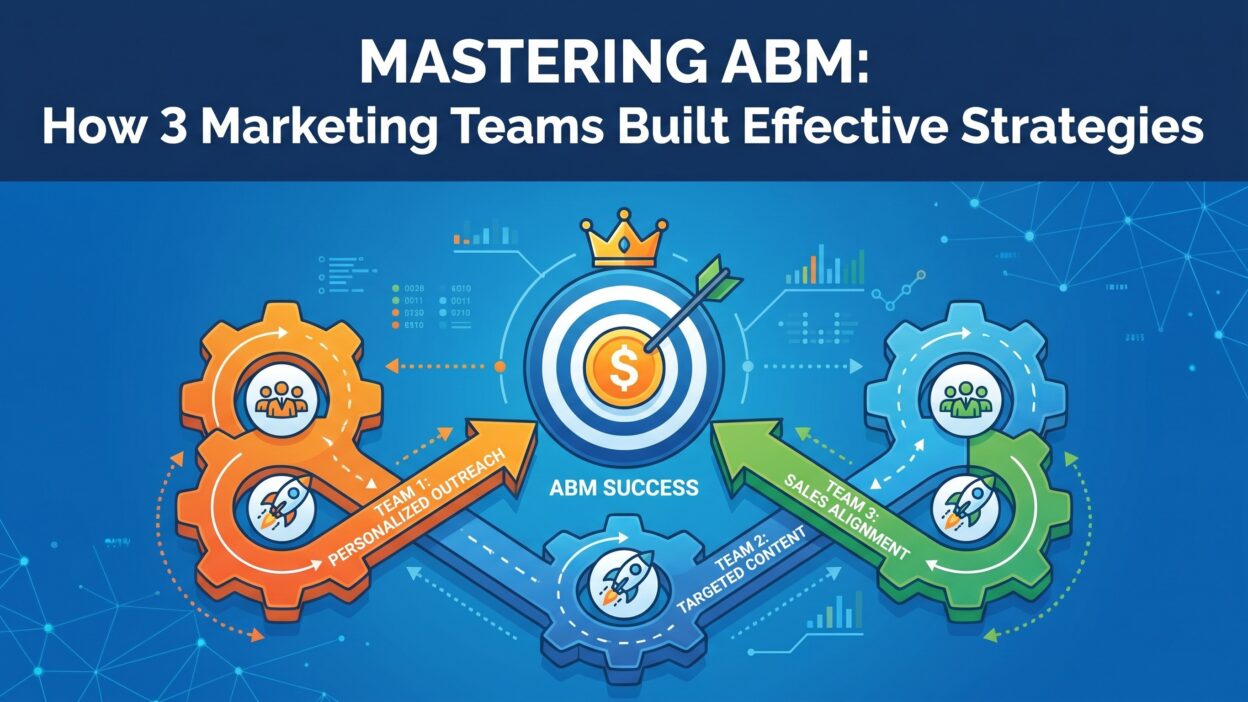
This guide tells the story of three real marketing teams — in SaaS, financial services, and manufacturing — that built ABM strategies from the ground up. Each team faced different challenges. Each found a different path. All three delivered measurable results.
Read this if you are building an ABM program for the first time. Read this if you have tried ABM and struggled to make it work. The stories here carry practical lessons you can apply to your own market and team right away.
Table of Contents
What ABM Strategies Actually Look Like in Practice
Account-based marketing sounds simple in theory. Focus on the right accounts. Personalize your outreach. Align sales and marketing around shared targets. Close bigger deals.
In practice, ABM strategies require significant coordination. You need a clear target account list. You need intent data to know who is ready to buy. You need content mapped to each buying stage. You need sales reps who actually follow up on the accounts marketing engages.
ABM strategies come in three main forms. One-to-one ABM targets a very small number of accounts — sometimes fewer than ten — with fully customized campaigns built around each specific company. One-to-few ABM targets clusters of similar accounts with tailored messaging for each cluster. One-to-many ABM uses technology to personalize at scale across hundreds or thousands of target accounts.
Most B2B companies start with one-to-few ABM. It offers a balance of personalization and scale. You can run meaningful campaigns without the resource intensity of true one-to-one ABM.
What Makes ABM Strategies Different From Traditional Demand Generation
Traditional demand gen optimizes for lead volume. ABM strategies optimize for account engagement and pipeline quality. The metrics look completely different.
In demand gen, you celebrate a high MQL count. In ABM, you celebrate when a target account reaches a specific engagement threshold. You track account pipeline coverage, not just individual lead conversion.
The organizational mindset shift is significant. Marketing stops asking how many leads it generated. It starts asking how many target accounts are showing buying signals. That shift in framing changes everything about how campaigns are planned and measured.
Case Study 1 — A SaaS Company That Rebuilt ABM From Scratch
A mid-market SaaS company selling project management software had a problem. Their demand generation machine produced thousands of MQLs every month. But the average deal size was shrinking. The sales team complained that leads were too small and too unqualified. Marketing and sales were in constant conflict.
The CMO made a call. She pulled the team off broad demand generation and committed entirely to ABM strategies built around enterprise accounts. It was a risky move. The pipeline took a hit in the first ninety days. But the results twelve months later were transformative.
Building the Target Account List
The team started by defining their Ideal Customer Profile at the enterprise level. Companies with 500 to 5,000 employees. Project management budgets above $200,000 annually. Industries with distributed teams — professional services, technology, and construction.
They pulled firmographic data from ZoomInfo and cross-referenced it with their existing customer base. They identified 200 accounts that matched the ICP perfectly. They ranked them by intent signal strength using 6sense data. The top 50 accounts became their Tier 1 ABM targets.
Creating Account-Specific Content
The content team built customized landing pages for each Tier 1 account. Each page referenced the company by name, used their industry’s language, and cited relevant case studies from similar customers.
They created industry-specific battle cards for sales reps. Each card included talking points relevant to the target account’s specific challenges, their tech stack, and their known competitors.
Sales reps stopped sending generic pitch decks. Every outreach email referenced something specific about the target account — a recent earnings report, a product launch, a leadership change. That level of personalization required research, but the reply rates justified every hour of effort.
Measuring What Mattered
The team stopped reporting on MQL volume entirely. They built a new dashboard that tracked account engagement score, pipeline coverage by account tier, and meeting conversion rate for Tier 1 accounts.
Twelve months into the ABM strategy shift, average deal size grew by 67 percent. Pipeline coverage for Tier 1 accounts reached 4x quota. Sales cycle length dropped by three weeks on average. The conflict between marketing and sales disappeared because both teams now chased the same accounts with the same goals.
This SaaS team proved that well-built ABM strategies can transform not just pipeline quality but the entire relationship between sales and marketing. The lesson: commit fully or do not start.
Case Study 2 — A Financial Services Firm That Used Intent Data to Drive ABM
A B2B financial services company selling treasury management software faced a different challenge. Their target accounts were large enterprises — Fortune 1000 companies with complex buying committees and 18-month decision cycles.
Their previous ABM strategies relied on relationship-based selling. Senior reps cultivated contacts over years. The approach worked but did not scale. They needed a way to identify which accounts were actively researching treasury solutions right now — not just which accounts had the right profile.
Layering Intent Data Into ABM Strategies
The team integrated Bombora’s intent data into their CRM. They set up intent topics relevant to their solution — treasury automation, cash flow management, ERP integration, and financial compliance software.
Every week, the intent platform surfaced accounts showing a spike in research activity on these topics. The marketing team cross-referenced these intent signals with their Ideal Customer Profile. Accounts that matched both criteria moved into their active ABM campaign queue.
This approach changed everything. Instead of guessing which accounts to pursue, the team had a data-driven signal telling them which accounts were already in buying mode. The timing of outreach shifted from arbitrary to deliberate.
Building the Multi-Channel Campaign Sequence
When an account entered the active campaign queue, the ABM strategy kicked into a structured sequence. LinkedIn ads started serving personalized content to known contacts at the target account. Customized direct mail packages went to the top five stakeholders. A senior business development rep made a warm call referencing the company’s recent financial news.
The team created a content hub specific to treasury management challenges at enterprise scale. Each piece of content addressed a stage of the buying journey. Awareness content covered the cost of manual treasury processes. Consideration content compared automation approaches. Decision content included ROI calculators and implementation timelines.
Every touchpoint connected back to the same account-specific messaging. The prospect experienced a coherent narrative across every channel they encountered — not a series of disconnected ads and cold calls.
The Results of Intent-Driven ABM
Over an 18-month period, the financial services firm ran intent-driven ABM strategies across 150 target accounts. Seventy-three percent of those accounts entered a qualified sales conversation. Thirty-one percent converted to closed-won revenue within the measurement period.
Average deal value increased by 44 percent compared to deals sourced through traditional outbound methods. The sales team reported higher quality conversations because prospects had already consumed relevant content before the first call.
Intent data did not replace relationship selling. It made relationship selling smarter. Reps knew when to reach out, what the prospect was researching, and which stakeholders were most active. That intelligence made every conversation more relevant.
Case Study 3 — A Manufacturing Company That Built ABM With a Small Team
Not every company runs ABM with a large marketing team and enterprise-level budget. A mid-sized industrial equipment manufacturer built effective ABM strategies with a team of three marketers and a modest technology stack.
Their challenge was focus. They sold highly specialized equipment to a narrow set of industries — automotive assembly, aerospace components, and heavy machinery. Their total addressable market was small. Every account mattered.
Starting With What They Already Knew
The team did not start with expensive ABM software. They started with their existing customer base. They interviewed their top ten customers. They mapped every buying stakeholder at each account. They documented the specific pain points that drove each purchase decision.
From those interviews, they built a detailed ICP and a list of 80 target accounts that matched it closely. They ranked accounts by revenue potential and relationship warmth. Accounts where they had an existing contact went into Tier 1. Accounts where they had no relationship but strong fit went into Tier 2.
Using Events as the Core of the ABM Strategy
Trade shows and industry conferences were central to their ABM strategies. Before each event, the team identified which target accounts would attend. They scheduled dinners, facility tours, and private product demonstrations with decision-makers from Tier 1 accounts.
Pre-event outreach was highly personalized. Each invitation referenced the specific equipment challenge the target company faced. It described what they would see at the demonstration and why it was relevant to their production line specifically.
Post-event follow-up continued the account-specific narrative. The rep sent a summary of what the prospect saw, answered the specific questions raised during the visit, and proposed a clear next step tailored to the account’s timeline.
Results Built on Relationships, Not Technology
Without a single ABM-specific software platform, the manufacturing team delivered strong results. Over two years, they closed deals with 34 of their 80 target accounts. Average deal size was $420,000. Total pipeline generated from the ABM program exceeded $18 million.
The lesson from this team is powerful. ABM strategies do not require massive budgets or sophisticated technology to work. They require focus, deep customer understanding, and the discipline to treat every target account as a unique opportunity.
The manufacturing team proved that a small, focused effort guided by smart ABM strategies outperforms a large, unfocused demand generation machine every time in a narrow market.
The Building Blocks Every ABM Strategy Needs
Three different companies. Three different markets. Three different team sizes. But their ABM strategies shared the same core building blocks. These elements appear in every successful ABM program regardless of industry or budget.
A Well-Defined Ideal Customer Profile
Every strong ABM strategy starts with a precise ICP. Not a vague description of your target market. A specific, data-backed profile that defines company size, industry, revenue range, technology stack, buying committee structure, and the pain points that drive purchase decisions.
Your ICP should exclude as many accounts as it includes. The tighter the definition, the more focused your effort. A loose ICP produces a large target list that dilutes attention and reduces personalization quality.
A Tiered Target Account List
Not all target accounts deserve equal investment. Tier your account list based on revenue potential and strategic importance. Tier 1 accounts get fully customized campaigns with direct sales involvement. Tier 2 accounts get cluster-level personalization. Tier 3 accounts get programmatic personalization at scale.
Review and update your target account list quarterly. Companies grow, shrink, merge, and change strategy. Your target account list should reflect current market reality, not a snapshot from twelve months ago.
Sales and Marketing Alignment
ABM strategies fail without tight sales and marketing alignment. Both teams must agree on which accounts are in scope, who owns which touchpoints, and how engagement signals get communicated between teams.
Build a shared ABM playbook that both teams sign off on. Define what marketing delivers for each account tier. Define what sales does with the accounts marketing warms up. Agree on the handoff criteria. Review performance together in a weekly or bi-weekly ABM sync.
Personalized Content at Every Stage
Generic content does not work in ABM. Every piece of content should address the specific challenges of the account tier or individual account it targets. Industry-specific landing pages, custom case studies, and account-specific ROI calculators all outperform generic whitepapers.
Map your content to the buying journey. Awareness content builds familiarity. Consideration content addresses specific objections. Decision content reduces risk and accelerates commitment. Your ABM strategies need content across all three stages for every account tier.
Technology That Powers Modern ABM Strategies
The right technology amplifies your ABM strategies. The wrong technology creates complexity without results. Choose tools that match your team size, budget, and maturity level.
ABM Platforms
Demandbase, 6sense, and Terminus are the leading ABM platforms in 2026. Each one combines intent data, account identification, ad targeting, and campaign orchestration in a single platform. They integrate with Salesforce, HubSpot, and major marketing automation tools.
These platforms help you identify which accounts are in-market, serve personalized ads to buying committee members, and measure account engagement across every channel. For teams running ABM at scale, they are transformative. For teams just starting out, they may be more than you need initially.
Intent Data Providers
Bombora and G2 Buyer Intent provide third-party intent signals that show which companies are actively researching topics relevant to your solution. This data helps you prioritize outreach and time campaigns for maximum relevance.
Intent data is most powerful when layered on top of a strong ICP. An account showing intent signals that also matches your ICP is a high-priority target. An account showing intent that does not match your ICP is a distraction.
Personalization Tools
Mutiny and Intellimize personalize your website for known target accounts. When a visitor from a Tier 1 account lands on your homepage, they see content tailored to their industry and company. This level of personalization significantly improves engagement and conversion rates.
CRM and Sales Engagement
Your CRM is the backbone of your ABM strategy. Account data, engagement history, contact mapping, and pipeline tracking all live there. Sales engagement platforms like Outreach and Salesloft help reps execute multi-touch sequences at scale while maintaining the personalization ABM strategies demand.
Measuring the Success of ABM Strategies
ABM metrics look different from traditional marketing metrics. Volume-based metrics like MQL count and website traffic become less relevant. Account-level engagement and pipeline metrics take center stage.
Track account engagement score. This composite metric measures how many contacts at a target account have engaged with your content, ads, events, and sales outreach. A rising engagement score signals a warming account. A flat score signals that your campaign needs adjustment.
Measure pipeline sourced and influenced by ABM strategies. Sourced pipeline is revenue where ABM was the first touch. Influenced pipeline is revenue where ABM contributed at some point in the buying journey. Both matter. Report both to leadership.
Track win rate by account tier. Tier 1 accounts should show a meaningfully higher win rate than non-targeted accounts if your ABM strategies are working. A flat win rate across tiers signals a personalization problem.
Measure average deal size for ABM-sourced opportunities versus non-ABM sources. ABM typically drives larger deals because it targets accounts with the right profile and engages the full buying committee. If deal sizes are equal, you may be targeting accounts that are too small.
Common Mistakes in ABM and How to Avoid Them
ABM looks straightforward until you try to execute it. Teams run into the same set of mistakes repeatedly. Knowing them in advance prevents months of wasted effort.
The biggest mistake is targeting too many accounts. ABM strategies work because of focus and personalization. A target list of 500 accounts with a team of five marketers produces shallow engagement across the board. Start with 25 to 50 accounts. Do the work deeply. Expand when the model proves itself.
The second common mistake is skipping the ICP work. Teams jump straight to campaign execution without defining who they are targeting or why. The result is a list of accounts that feel right but perform poorly. Invest the time in ICP definition before touching a single campaign.
The third mistake is running ABM as a marketing-only initiative. ABM strategies succeed when sales owns their role in the process. If reps are not following up on marketing-warmed accounts within a defined window, the entire system breaks down. Sales participation is non-negotiable.
The fourth mistake is measuring ABM with demand generation metrics. When you judge ABM by MQL volume, it always looks like a failure. Build an ABM-specific measurement framework before the program launches so everyone agrees on what success looks like.
Frequently Asked Questions About ABM Strategies
What are ABM strategies and how do they work?
ABM strategies are account-based marketing approaches where sales and marketing teams align around a defined set of high-value target accounts. Instead of generating broad demand, they create personalized campaigns for specific companies and buying committee members. The goal is to build deep engagement with the right accounts and convert them into large, long-term customers.
How long does it take to see results from ABM strategies?
Most ABM programs take six to twelve months before delivering clear pipeline results. The first few months involve building the target account list, aligning sales and marketing, creating personalized content, and launching initial campaigns. Deal cycles in ABM target accounts are often longer than average, so patience and consistent execution matter enormously.
How many accounts should I target with ABM?
Start with 25 to 50 accounts for your first ABM program. This number allows meaningful personalization without overwhelming your team. As your ABM strategies mature and you build the right technology stack, you can expand your target account list. Quality of engagement always matters more than the number of accounts in scope.
Do I need expensive software to run ABM strategies?
No. The manufacturing case study in this guide shows that strong ABM strategies deliver results with a basic CRM and strong customer understanding. Intent data platforms and ABM software accelerate results at scale. But discipline, focus, and personalization matter more than technology budget when you are starting out.
How is ABM different from account-based selling?
ABM strategies are marketing-led programs that identify, engage, and warm target accounts through content, advertising, and events. Account-based selling is the sales execution that follows. In a well-run ABM program, both functions work together. Marketing builds awareness and engagement. Sales converts that engagement into revenue through personalized outreach and relationship development.
What role does content play in ABM strategies?
Content is central to every ABM strategy. Personalized content drives account engagement. Industry-specific landing pages outperform generic ones. Custom case studies from similar companies reduce buyer risk. Account-specific ROI tools accelerate decision-making. Map your content to the buying journey and to each account tier for maximum impact.
Read More:-Modern Marketing Skills: What Every Marketer Needs to Succeed Today
Conclusion

Three companies. Three markets. Three team sizes. Three different paths to the same destination. Each one built ABM strategies that delivered measurable revenue results by committing to focus, personalization, and sales-marketing alignment.
The SaaS team rebuilt their entire go-to-market around enterprise ABM and grew average deal size by 67 percent. The financial services firm used intent data to identify accounts in buying mode and converted 31 percent of their target list to closed revenue. The manufacturing team proved that small, focused ABM strategies outperform large, unfocused demand generation in narrow markets.
The lessons cut across every case. Define your ICP precisely. Build a tiered target account list. Create content that speaks directly to each account’s world. Align sales and marketing around shared goals. Measure engagement and pipeline — not lead volume.
ABM strategies are not a campaign type. They are a go-to-market philosophy. They reflect a belief that the right accounts, deeply engaged, produce better revenue outcomes than a sea of barely qualified leads.
Start small. Pick 25 accounts. Do the work with genuine personalization and real sales coordination. Measure what happens. The results will make the case for scaling your ABM strategies better than any guide ever could.