Introduction
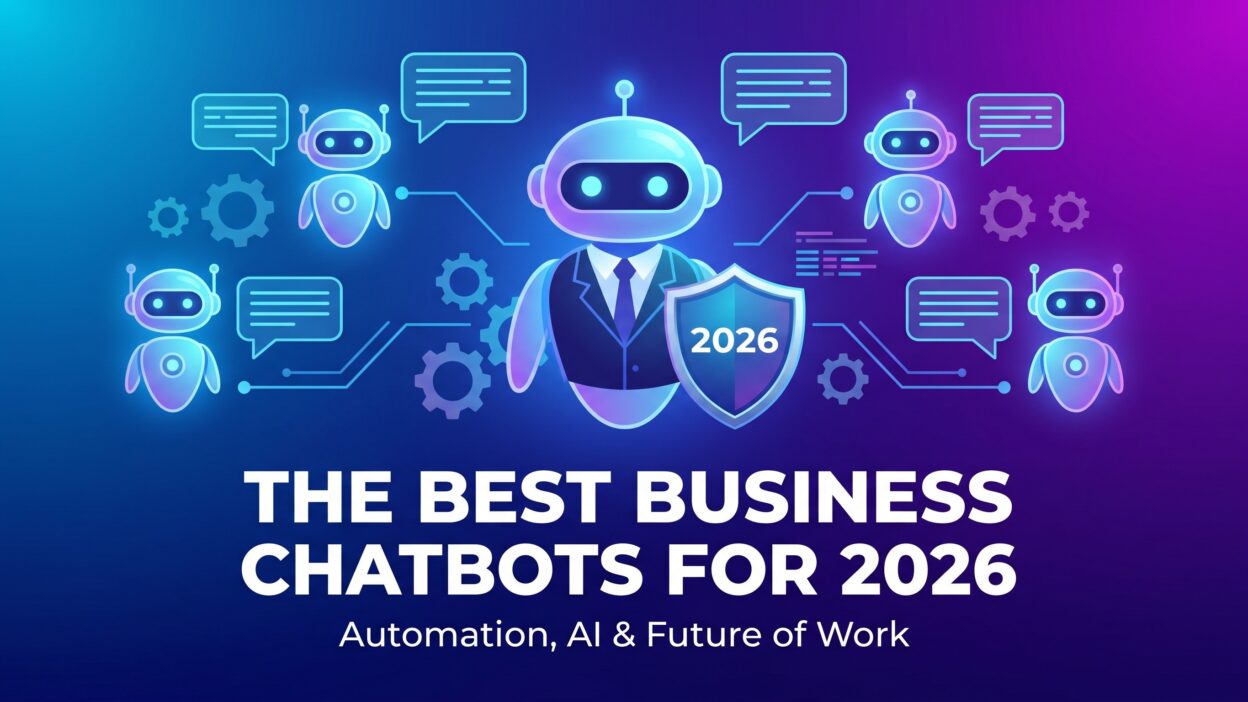
TL;DR Every business wants faster responses, lower costs, and happier customers. Chatbots deliver all three. In 2026, the best business chatbots do far more than answer simple FAQs.
They qualify leads. They book meetings. They resolve support tickets. They personalize product recommendations. They work around the clock without a break.
The market for business chatbots has exploded. Hundreds of platforms now compete for your attention. Choosing the wrong one wastes time and budget. Choosing the right one transforms your customer experience and internal operations.
This guide covers everything you need. It explains what makes the best business chatbots worth the investment. It reviews the top platforms for 2026. It breaks down use cases across industries. It also answers the questions most buyers ask before making a decision.
Whether you run a small e-commerce brand or a global enterprise, this guide will help you find the right chatbot solution for your goals.
Table of Contents
Why Chatbots Have Become Essential for Business in 2026
Customer expectations have shifted dramatically. People want instant answers. They do not want to wait on hold for twenty minutes. They do not want to send an email and hear back three days later.
The best business chatbots solve this problem at scale. They respond in seconds. They handle thousands of conversations simultaneously. They never call in sick.
In 2026, AI-powered chatbots have matured significantly. Natural language processing is sharper. Context retention across conversations has improved. Integration with CRMs, payment systems, and ticketing platforms is seamless.
Businesses that deploy chatbots see measurable results. Studies show chatbots can reduce customer service costs by up to 30 percent. They can handle up to 80 percent of routine queries without human intervention. Response times drop from hours to seconds.
The shift is not just about cost savings. It is about competitive advantage. Companies using the best business chatbots provide a faster, more consistent experience than competitors who rely solely on human agents.
The Role of AI in Modern Business Chatbots
Earlier chatbots followed rigid decision trees. If a customer said something unexpected, the bot broke. Modern AI chatbots understand intent. They handle varied phrasing. They adapt to context.
Large language models have changed the game completely. Bots now hold nuanced conversations. They detect sentiment. They escalate to a human when the situation demands it.
AI is no longer a differentiator in chatbot platforms. It is the baseline. The best business chatbots of 2026 go beyond basic AI to offer deep customization, omnichannel deployment, and enterprise-grade security.
What to Look for When Choosing the Best Business Chatbots
Not all chatbots are created equal. Some excel at customer support. Others are built for lead generation. A few do both well. Knowing what to look for saves you from a costly mistake.
Natural Language Understanding
The quality of NLU determines how well the chatbot understands your customers. A weak NLU engine misinterprets questions and frustrates users. Strong NLU handles slang, typos, and complex sentence structures with accuracy.
Test any chatbot platform’s NLU before you commit. Feed it real questions from your customer support logs. See how it performs on your actual use case, not a demo script.
Integration Capabilities
A chatbot that cannot talk to your existing tools creates more work, not less. The best business chatbots connect natively with Salesforce, HubSpot, Zendesk, Shopify, and other major platforms.
Check the integration library before signing any contract. If you use a niche CRM or a custom-built system, confirm that an API connection is possible. Disconnected tools kill productivity.
Omnichannel Deployment
Your customers are everywhere. They reach out via your website, WhatsApp, Facebook Messenger, Instagram, SMS, and email. The best business chatbots deploy across all these channels from one dashboard.
Omnichannel capability means a customer can start a conversation on your website and continue it on WhatsApp without losing context. That kind of continuity builds trust.
Analytics and Reporting
You cannot improve what you do not measure. Look for platforms with robust dashboards. Track conversation volume, resolution rate, escalation rate, CSAT scores, and bot accuracy over time.
The best business chatbots give you actionable data. They show you where conversations drop off. They highlight gaps in your bot’s knowledge base. They surface patterns in customer complaints.
Ease of Building and Updating
Your chatbot needs constant maintenance. New products launch. Policies change. Regulations evolve. Choose a platform your team can update without a developer on call every time.
No-code and low-code builders are now standard in the best chatbot platforms. Look for drag-and-drop flow builders, intent training tools, and easy content management systems.
The Best Business Chatbots of 2026: Platform-by-Platform Breakdown
The chatbot market has consolidated around a core group of leading platforms. Each one has strengths in specific areas. Here is what each one does well in 2026.
Intercom Fin
Intercom Fin is one of the strongest AI-powered support chatbots available today. It uses large language models to resolve customer queries with high accuracy. It pulls answers directly from your help center, knowledge base, and internal documents.
Fin handles complex, multi-step questions without breaking character. It escalates gracefully when it cannot help. It integrates tightly with the broader Intercom platform, making handoff to human agents seamless.
Businesses in SaaS, fintech, and e-commerce rate Intercom Fin highly. It ranks among the best business chatbots for companies that prioritize fast, accurate customer support at scale.
Drift (now part of Salesloft)
Drift built its reputation on conversational marketing. It excels at pipeline generation. The bot engages website visitors, qualifies them based on firmographic data, and books meetings directly with the right sales rep.
In 2026, Drift’s integration with Salesloft deepens its sales intelligence capabilities. It pulls buyer intent signals and routes hot leads instantly. For B2B companies focused on revenue, Drift earns its place among the best business chatbots on the market.
Tidio
Tidio appeals to small and mid-sized businesses. It offers a generous free plan and an intuitive builder. The AI layer, powered by Lyro, handles customer service conversations with solid accuracy.
Tidio connects with Shopify, WooCommerce, and major email platforms out of the box. It is a popular choice for e-commerce brands that want chatbot functionality without enterprise-level pricing. Tidio ranks among the best business chatbots for growing teams with limited budgets.
Zendesk AI
Zendesk has evolved its chatbot from a basic rule-based tool into a powerful AI agent. The platform now uses generative AI to understand intent, draft responses, and resolve tickets autonomously.
Zendesk AI works best for companies already using the Zendesk suite. The deep integration with ticketing, CRM, and reporting makes it a cohesive customer service hub. For enterprise support teams, it stands among the best business chatbots available.
Salesforce Agentforce
Salesforce launched Agentforce as its flagship AI agent platform. It goes beyond a traditional chatbot. Agentforce can take autonomous actions — updating records, sending emails, scheduling calls — without human input.
For Salesforce-heavy organizations, Agentforce offers unmatched depth. It pulls from CRM data, product catalogs, and service histories to give highly personalized responses. Enterprise teams consistently name it among the best business chatbots for complex workflows.
HubSpot Chatbot Builder
HubSpot’s chatbot builder sits inside its CRM, which makes it powerful for inbound marketing and sales teams. Bots qualify leads, enroll contacts in workflows, and hand off to reps at the right moment.
HubSpot’s chatbot is not the most advanced AI platform. But it is deeply integrated with the HubSpot ecosystem. For companies running their entire go-to-market on HubSpot, this tool belongs on the list of best business chatbots for 2026.
Botpress
Botpress is an open-source chatbot platform with enterprise-grade capabilities. Developers love it for its flexibility. It supports complex logic, multi-language deployment, and custom AI model integration.
For technical teams that want full control over their bot’s behavior, Botpress offers something proprietary platforms cannot match. It earns its spot among the best business chatbots for companies with in-house development resources.
Best Business Chatbots by Use Case
Different problems need different chatbot solutions. The best business chatbots for customer support may not be the best for sales automation. Match the platform to your primary goal.
Customer Support Automation
Support teams use chatbots to deflect repetitive tickets. Password resets, order status checks, return requests, and billing questions are all candidates for automation.
The best business chatbots for support resolve these queries without a human. They pull real-time data from your backend systems. They provide accurate answers in seconds. Resolution rates climb. Support costs drop.
Look for platforms with strong knowledge base integration. The bot needs to learn from your documentation, not just a predefined script. Intercom Fin and Zendesk AI lead this category in 2026.
Lead Generation and Qualification
Sales chatbots engage website visitors at the right moment. They ask qualifying questions. They score leads based on company size, budget, and intent. They route hot prospects to the right rep instantly.
Speed matters enormously in lead response. Research shows that responding within five minutes of a website inquiry increases conversion rates dramatically. A chatbot responds in zero minutes. That is a significant advantage.
Drift and HubSpot Chatbot Builder excel in this category. Both connect deeply with CRM data and sales workflows.
E-commerce and Retail
Retail chatbots help shoppers find products, track orders, process returns, and get personalized recommendations. They reduce cart abandonment by engaging hesitant shoppers in real time.
The best business chatbots for e-commerce understand product catalogs. They pull inventory data. They apply discount codes. They handle post-purchase queries without a human agent.
Tidio and Salesforce Agentforce work well in retail environments. Both offer strong product recommendation capabilities and e-commerce platform integrations.
HR and Internal Operations
Chatbots are not only customer-facing. Internal HR bots answer employee questions about benefits, leave policies, and onboarding steps. They route IT requests. They handle expense submissions.
Internal bots free up HR teams from repetitive admin tasks. Employees get instant answers at any hour. Companies with large distributed workforces benefit most from this use case.
Industry-Specific Applications of Business Chatbots
The best business chatbots adapt to the specific demands of each industry. A bot built for a healthcare provider looks very different from one built for a fintech company.
Healthcare
Healthcare chatbots handle appointment scheduling, symptom checking, medication reminders, and insurance queries. They operate within strict compliance frameworks like HIPAA.
Patient-facing bots reduce administrative burden on clinic staff. They direct patients to the right care pathway. They collect pre-appointment information before the patient arrives.
The best business chatbots for healthcare balance conversational warmth with clinical accuracy. They know when to recommend a doctor rather than attempt a diagnosis.
Financial Services
Banks and insurance companies use chatbots to handle account inquiries, fraud alerts, loan applications, and claims processing. Security is non-negotiable in this sector.
The best business chatbots for financial services support multi-factor authentication, encrypted data handling, and audit logging. They comply with regulations like GDPR and PCI-DSS.
Customers in financial services value accuracy above all else. A bot that gives wrong information about a balance or a policy term creates serious liability. Top platforms in this sector invest heavily in AI accuracy and compliance tooling.
Travel and Hospitality
Travel chatbots handle bookings, itinerary changes, flight status checks, and hotel upgrade requests. They operate across multiple languages for global audiences.
In peak travel seasons, customer service volume spikes dramatically. The best business chatbots absorb that volume without adding headcount. They handle rebooking for cancelled flights at 3am without a human in sight.
Education
Educational institutions use chatbots for student enrollment, course queries, financial aid information, and campus FAQs. They operate on school websites, learning management systems, and messaging platforms.
Students want fast answers about tuition deadlines, class schedules, and campus events. A well-trained chatbot handles all of it. It frees up admissions teams to focus on complex student needs.
How to Implement a Business Chatbot Successfully
Buying a chatbot platform is the easy part. Implementing it well is where most companies struggle. A poorly built chatbot damages your brand. A well-built one becomes a business asset.
Start With a Narrow Use Case
Do not try to automate everything at once. Start with your highest-volume, most repetitive query type. Build the bot to handle that one thing exceptionally well.
Launch, measure, and improve. Once that use case runs smoothly, expand the bot’s scope. This approach reduces risk and delivers faster ROI.
Train Your Bot With Real Data
Feed your chatbot real customer conversations from day one. Pull data from your support ticket history, live chat transcripts, and email logs. Real data produces better intent models than sample scripts.
Review conversations weekly at launch. Identify where the bot misunderstands or fails to answer. Retrain the model with corrections. Continuous training is what separates a great bot from a mediocre one.
Design for Escalation, Not Just Automation
Every chatbot needs a clean escalation path. When a conversation gets too complex, the bot must hand off to a human without friction. The customer should not have to repeat themselves.
A seamless handoff preserves customer trust. It shows that automation serves the customer, not just the business. The best business chatbots make escalation invisible and effortless.
Communicate That It Is a Bot
Customers deserve to know they are talking to a bot. Transparency builds trust. Bots that pretend to be human create backlash when discovered. Start every conversation with a clear introduction.
Measuring the ROI of Business Chatbots
Every investment needs a return. Chatbots are no different. Measuring ROI correctly helps you justify the spend and identify opportunities to improve.
Track cost per conversation. Divide your total chatbot cost — platform fee, implementation, and ongoing maintenance — by the number of conversations handled. Compare this to the cost of a human-handled conversation. The gap is usually significant.
Measure deflection rate. This is the percentage of conversations the bot resolves without human intervention. A deflection rate above 60 percent is a strong result. The best business chatbots push this above 80 percent for routine query types.
Monitor customer satisfaction scores separately for bot-handled and human-handled conversations. In well-implemented deployments, bot CSAT scores rival or exceed human scores for straightforward queries.
Track revenue impact for sales chatbots. Measure meetings booked, leads qualified, and pipeline generated. Assign a value to each. Compare against the cost of the bot. The math usually favors automation decisively.
Report these metrics monthly. Share them with leadership. Use them to make the case for expanding the bot’s scope and capabilities over time.
Common Mistakes to Avoid With Business Chatbots
Most chatbot failures share the same root causes. Knowing the common pitfalls saves you time, money, and frustrated customers.
Do not launch before testing thoroughly. A bot with gaps in its knowledge base goes live and immediately disappoints customers. Test every conversation flow. Bring in real users for beta testing before a public launch.
Do not ignore the data after launch. Chatbot performance degrades over time if nobody maintains it. Product changes, new policies, and shifting customer language all create gaps. Schedule regular review sessions.
Do not automate conversations that need a human touch. Complaints about serious product failures, legal disputes, and emotionally charged situations should go to a human immediately. Automating these creates PR disasters.
Do not choose a platform based on price alone. The cheapest chatbot often lacks the NLU quality, integration depth, or scalability your business needs. Total cost of ownership matters more than the monthly subscription fee.
Do not treat chatbot implementation as a one-time project. The best business chatbots receive continuous investment in training, content updates, and feature expansion. Treat it like a product, not a tool you set and forget.
Chatbot Trends Shaping Business in 2026
The chatbot industry moves fast. Staying current on key trends helps you choose platforms that will still be relevant in two or three years.
Agentic AI is the biggest trend of 2026. Chatbots no longer just converse — they act. They browse the web, update databases, send emails, and trigger workflows without human prompting. Salesforce Agentforce leads this wave, but most major platforms are building agentic capabilities.
Voice-enabled chatbots are gaining traction. Customers use voice on smart speakers, phone IVR systems, and in-car interfaces. The best business chatbots of 2026 offer voice as a channel alongside text.
Personalization has reached a new level. Bots now adapt their tone, language, and content based on the individual customer’s history, location, and behavior. This kind of personalization was impossible two years ago.
Multimodal interactions are emerging. Customers can send images, videos, and documents to chatbots. The bot analyzes the content and responds intelligently. A customer can photograph a broken product and start a warranty claim in the same conversation.
Frequently Asked Questions About Business Chatbots
What are the best business chatbots for small businesses?
Tidio, HubSpot Chatbot Builder, and Intercom Fin work well for small businesses. Tidio offers a strong free tier. HubSpot integrates deeply with its CRM at no extra cost for basic users. Intercom Fin suits small SaaS teams with a lean support operation.
How much do business chatbots cost in 2026?
Pricing varies widely. Basic plans start at $0 to $50 per month for small teams. Mid-market platforms charge $200 to $1,000 per month. Enterprise solutions like Salesforce Agentforce require custom pricing. Costs scale with conversation volume, AI capabilities, and integration depth.
Can chatbots replace human customer service agents?
Chatbots cannot replace human agents entirely. They handle routine, high-volume queries well. Complex complaints, emotional conversations, and nuanced negotiations still need a human. The best business chatbots augment human agents — they do not replace them.
How long does it take to implement a business chatbot?
A basic chatbot can go live in one to two weeks with a no-code platform. A fully custom enterprise chatbot with deep integrations and multi-language support takes three to six months. Ongoing training and optimization never stop.
What industries benefit most from business chatbots?
E-commerce, financial services, healthcare, SaaS, and travel benefit most from chatbot automation. These industries share high query volume, repetitive request types, and 24/7 customer expectations. The best business chatbots are purpose-built for these environments.
How do I know if my chatbot is performing well?
Track deflection rate, resolution rate, CSAT scores, and conversation drop-off points. A well-performing chatbot resolves over 60 percent of queries autonomously. Customer satisfaction should match or exceed the benchmark for human-handled conversations. Review these metrics monthly.
Read More:-What Is a MarTech Stack? How B2B Teams Build for Revenue
Conclusion

The chatbot landscape in 2026 is richer, smarter, and more capable than ever before. AI has matured. Integrations have deepened. Agentic capabilities have arrived. Businesses that invest in the right platform now will pull ahead of competitors who wait.
The best business chatbots are not just answering machines. They qualify leads. They close support tickets. They personalize shopping experiences. They help HR teams serve employees at scale. They take autonomous actions that used to require a full team.
Choosing the right chatbot starts with your specific use case. Define the problem you want to solve. Match the platform to that problem. Start small, measure everything, and expand from there.
Platforms like Intercom Fin, Drift, Zendesk AI, and Salesforce Agentforce lead the 2026 market for good reasons. They invest in AI quality, integration depth, and enterprise security. They improve constantly.
Your customers will not wait. Your competitors will not wait. The best business chatbots give you the speed, scale, and consistency to meet both challenges head-on.
Start your chatbot journey today. Choose a platform that fits your budget and goals. Build something your customers will actually appreciate. The results will follow.