Introduction
TL;DR B2B marketing has changed completely. Ten years ago, a team ran campaigns on instinct and spreadsheets. Today, data drives every decision. Technology runs every process. Speed determines who wins.
A MarTech Stack sits at the center of all of it.
Every B2B marketing team needs one. But most teams either overbuild or underutilize theirs. They collect tools. They pay subscriptions. They end up with a bloated system that slows people down instead of speeding them up.
A well-built MarTech Stack does the opposite. It connects your data. It automates repetitive work. It gives your team clear visibility into what drives revenue. It makes every campaign smarter and every dollar more accountable.
This blog covers everything you need to know. You will learn what a MarTech Stack is and why it matters. You will see which categories of tools belong inside it. You will understand how B2B teams build stacks that actually generate revenue.
Whether you are starting from scratch or rebuilding a messy system, this guide gives you a clear path forward.
Table of Contents
What Is a MarTech Stack?
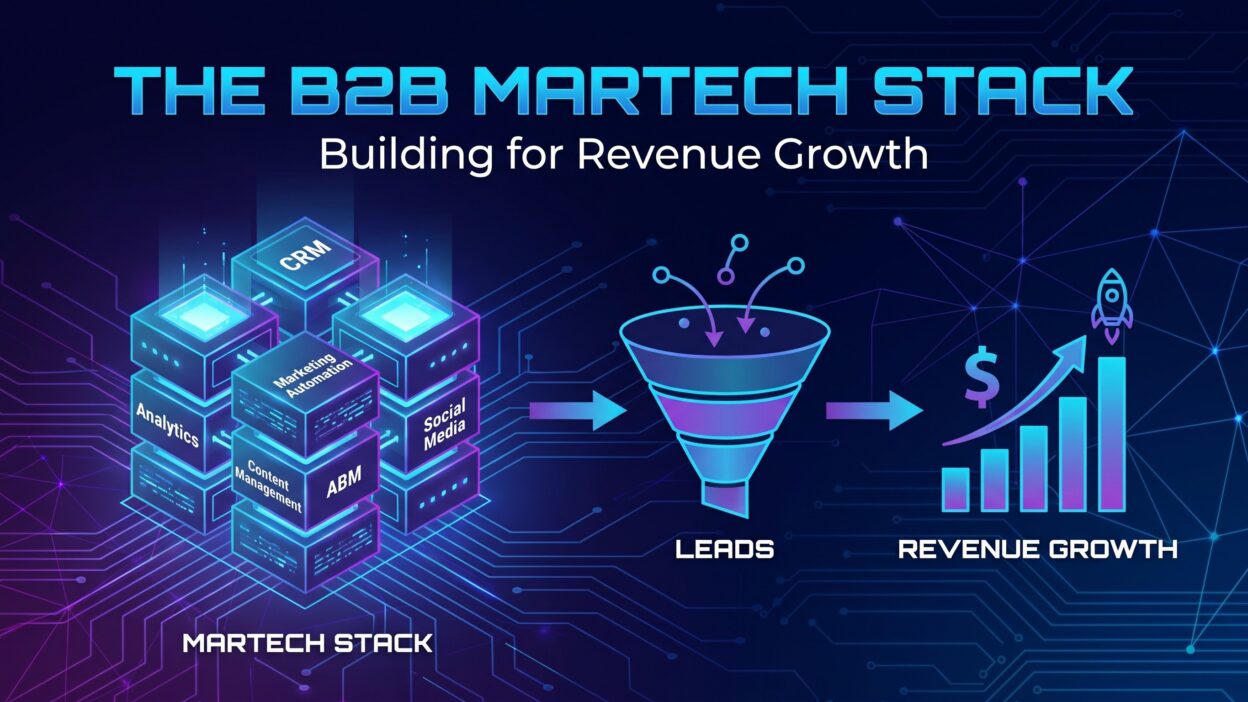
A MarTech Stack is a collection of marketing technology tools. These tools work together to plan, execute, measure, and optimize marketing activity. The word “stack” refers to how these tools layer on top of each other. Each layer serves a specific purpose. Each layer feeds data into the next.
The term comes from combining “marketing” and “technology.” Scott Brinker, who tracks the marketing technology landscape, identified over 11,000 marketing tools in 2023. That number keeps growing. The challenge is not finding tools. The challenge is choosing the right ones and making them work together.
A MarTech Stack is not just software. It reflects your marketing strategy. It reflects how your team thinks about customers, data, and revenue. A team focused on content marketing builds a different stack than a team running paid acquisition at scale.
For B2B teams specifically, the MarTech Stack plays a critical role. B2B buying cycles are long. Multiple stakeholders are involved. Deals can take months or years to close. The stack must support that complexity. It must track prospects across every touchpoint. It must give sales and marketing a shared view of the pipeline.
A good MarTech Stack removes friction. It replaces manual tasks with automation. It surfaces insights that would take days to find manually. It creates a single source of truth for every campaign, contact, and conversion.
A poorly built stack does the opposite. It creates data silos. It forces teams to work in disconnected tools. It produces contradictory reports. It slows everyone down.
Getting the MarTech Stack right is one of the most important investments a B2B marketing team can make.
Why B2B Teams Need a Strong MarTech Stack
B2B marketing is uniquely complex. A consumer purchase might take minutes. A B2B deal might take a year. Multiple buyers sit at the table. Each one has different concerns. Each one needs different information at different stages.
A strong MarTech Stack manages all of that complexity systematically. It does not rely on individual memory or manual tracking. It captures every interaction. It routes leads correctly. It measures what actually works.
Revenue Accountability Has Become Non-Negotiable
CFOs and CEOs now hold marketing to the same standards as sales. Marketing must show pipeline contribution. It must show cost per lead, cost per opportunity, and cost per acquisition. Without the right technology in place, these numbers are impossible to report accurately.
A mature MarTech Stack connects marketing activity to revenue outcomes. It shows which campaigns sourced which deals. It shows which channels produce the highest lifetime value customers. That visibility protects marketing budgets and justifies headcount.
Sales and Marketing Alignment Requires Shared Technology
When sales and marketing share no common tools, they share no common truth. Sales says leads are bad. Marketing says sales does not follow up. Both sides are frustrated. Neither side has clean data to prove their point.
A connected MarTech Stack solves this. It gives both teams a shared CRM. It shows how leads move through the funnel. It tracks which content influenced deals. It creates accountability on both sides.
Personalization at Scale Is Impossible Without It
B2B buyers expect relevant experiences. They do not want generic emails. They do not want content that ignores their industry or use case. But personalization at scale requires data. It requires automation. It requires a MarTech Stack that can segment audiences, trigger relevant messages, and adapt content dynamically.
No human team can do this manually across thousands of contacts. Technology handles the execution. Humans handle the strategy.
Without a capable MarTech Stack, B2B teams lose deals they should win. They spend budget on channels that produce no results. They fail to convert interest into pipeline.
The Core Layers of a B2B MarTech Stack
Every B2B MarTech Stack contains several core layers. Each layer handles a distinct function. Together, they create a connected marketing engine.
Data and Analytics Layer
Data is the foundation. Everything else depends on it. This layer collects, stores, and processes information about your customers, campaigns, and website behavior.
Key tools in this layer include Customer Data Platforms (CDPs), web analytics tools like Google Analytics 4, and data warehouses like Snowflake or BigQuery. Business intelligence tools like Looker or Tableau sit here too.
This layer answers critical questions. Who is visiting your website? Where do they come from? What content do they consume? Which pages do they view before requesting a demo?
Without a strong data layer, your MarTech Stack makes decisions in the dark.
CRM and Customer Data Management
The CRM is the spine of the B2B MarTech Stack. It stores contact and account data. It tracks every interaction. It connects marketing activity to sales outcomes.
Salesforce dominates the enterprise space. HubSpot CRM is strong for mid-market teams. Pipedrive and Zoho work well for smaller operations.
The CRM must stay clean. Duplicate records, outdated data, and missing fields corrupt every report and workflow that depends on it. Data hygiene is not glamorous work. It is essential work.
Marketing Automation
Marketing automation handles the execution of campaigns at scale. It sends emails. It scores leads. It triggers workflows based on behavior. It nurtures prospects across long sales cycles.
Platforms like Marketo, HubSpot Marketing Hub, Pardot, and ActiveCampaign dominate this space. The right choice depends on team size, complexity, and budget.
Automation turns your MarTech Stack from a passive database into an active revenue engine. It ensures no lead falls through the cracks. It ensures every prospect gets relevant communication at the right time.
Content Management and Experience
B2B buyers consume a lot of content before they talk to sales. Whitepapers, case studies, blog posts, webinars, and comparison guides all influence decisions.
A CMS like WordPress, Contentful, or Webflow hosts and publishes that content. Personalization tools like Mutiny or Optimizely adapt the website experience based on visitor characteristics. A/B testing tools help optimize landing pages and CTAs.
This layer ensures your content works harder. It does not just exist. It converts.
Paid Advertising and Demand Generation
Demand generation drives awareness and inbound leads. This layer includes platforms for LinkedIn Ads, Google Ads, and programmatic display. Tools like LinkedIn Campaign Manager, Google Ads, and demand-side platforms sit here.
Attribution tools connect ad spend to pipeline and revenue. Without attribution, you cannot know which campaigns deserve more budget.
Intent data platforms like Bombora or G2 Buyer Intent feed this layer with signals. They show which accounts are actively researching your category. That intelligence makes ad targeting far more precise.
Sales Enablement and Engagement
The handoff between marketing and sales is critical. This layer supports it. Tools like Outreach, Salesloft, and Seismic help sales teams act on marketing-qualified leads quickly and effectively.
Sales engagement platforms track email opens, call activity, and meeting bookings. They feed data back into the CRM. This closes the loop between marketing campaigns and actual sales conversations.
Reporting and Revenue Intelligence
The final layer ties everything together. Revenue intelligence platforms like Gong, Clari, or Chorus analyze sales conversations and pipeline health. BI tools aggregate data from every other layer.
This layer answers the ultimate question. Is the MarTech Stack actually producing revenue?
How B2B Teams Build a MarTech Stack for Revenue
Building a MarTech Stack is not a shopping exercise. It is a strategic decision. Teams that start with tools end up with a mess. Teams that start with goals end up with a machine.
Start With Strategy, Not Software
Define your revenue goals first. Know your ideal customer profile. Map your buyer journey. Identify where leads currently get lost. Find where your team wastes the most time.
Those gaps tell you which tools you actually need. Every tool in your MarTech Stack should solve a specific, identified problem. If it does not, it does not belong.
Build Around Your CRM
The CRM is the hub. Every other tool should connect to it. Data from your website, email campaigns, paid ads, and sales calls should flow into your CRM. Reports should pull from it. Workflows should trigger based on it.
A MarTech Stack without a strong CRM at the center fragments your data. That fragmentation destroys your ability to measure anything accurately.
Prioritize Integration Over Features
The most feature-rich tool is worthless if it does not connect to your other systems. Before adding any tool to your MarTech Stack, ask one question. Does it integrate natively with the tools you already use?
Native integrations beat workarounds every time. Workarounds break. They require maintenance. They create data gaps.
Add Complexity Gradually
Start lean. Use five well-chosen tools and use them well. That beats twenty tools used poorly. Add new platforms only when your current stack has clear limits.
Complexity compounds. Every new tool adds training, maintenance, and integration overhead. A bloated MarTech Stack slows teams down. It creates confusion. It drains budget.
Involve Sales in the Build
B2B marketing stacks must serve sales too. Involve sales leadership early. Get their input on what data they need. Show them how the stack helps them prioritize outreach and close deals faster.
A MarTech Stack that serves only marketing and ignores sales creates friction. That friction kills the revenue potential of the entire investment.
Assign Ownership
Every tool needs an owner. Someone must manage each platform. Someone must ensure data quality, oversee integrations, and lead training. Without ownership, tools deteriorate. Data gets messy. Workflows break silently.
Common MarTech Stack Mistakes B2B Teams Make
Even experienced teams make costly mistakes when building or scaling their MarTech Stack. These patterns show up repeatedly across companies of all sizes.
Buying Before Understanding
Many teams buy tools because a competitor uses them or because a vendor promised results. They skip the strategy step. They add platforms without defining success criteria. Six months later, the tool sits unused.
The fix is simple. Define the problem first. Evaluate tools against that specific problem. Buy only when the fit is clear.
Ignoring Data Quality
A MarTech Stack is only as good as the data inside it. Bad data produces bad segments, bad reports, and bad decisions. Teams often invest in powerful platforms and then fill them with duplicate records, missing fields, and outdated information.
Data governance must be part of the stack strategy from day one. Set standards. Enforce them. Audit regularly.
Underinvesting in Training
Teams buy tools and skip training. Agents use ten percent of the platform’s capability. The remaining ninety percent sits idle. That is wasted money and wasted potential.
Plan for training at launch and on an ongoing basis. Platforms evolve. Features change. Teams grow. Continuous enablement keeps your MarTech Stack performing at full capacity.
Over-Automating Too Fast
Automation is powerful. It is also dangerous when applied too early. Automating a broken process just creates broken outcomes at scale.
Map the process manually first. Validate it works. Then automate. This sequencing keeps your MarTech Stack from amplifying problems instead of solving them.
Measuring the ROI of Your MarTech Stack
Every dollar spent on your MarTech Stack must justify itself. This requires clear measurement frameworks and consistent reporting.
Define Stack-Level Metrics
At the macro level, measure the contribution your stack makes to pipeline and revenue. Track marketing-sourced pipeline, marketing-influenced revenue, cost per marketing-qualified lead, and campaign ROI across channels.
These metrics connect technology investment to business outcomes. They make the case for your budget. They surface which parts of your stack deliver and which do not.
Measure Tool-Level Performance
At the micro level, measure each tool individually. Track usage rates, integration health, and the specific outcomes each tool is responsible for. If a tool cannot show clear impact, it is a candidate for removal.
Run Quarterly Stack Audits
Technology changes fast. Vendor pricing changes. New platforms emerge. Old ones stagnate. A quarterly audit keeps your MarTech Stack current and cost-efficient.
Review usage data. Talk to your team. Check integration reliability. Evaluate whether each tool still serves its original purpose. Remove what no longer earns its place.
FAQs About the MarTech Stack
What is a MarTech Stack in simple terms?
A MarTech Stack is the set of technology tools a marketing team uses to plan, run, and measure campaigns. It typically includes a CRM, marketing automation platform, analytics tools, content tools, and ad platforms. All tools work together to support marketing goals.
How many tools should a B2B MarTech Stack include?
There is no fixed number. Early-stage startups might run effectively on five to seven tools. Large enterprise teams may use thirty or more. The right number is the fewest tools that cover your core needs without creating unnecessary complexity.
What is the most important tool in a MarTech Stack?
The CRM is the most critical piece. It stores customer data and connects every other tool. Without a strong CRM at the center, the rest of the MarTech Stack cannot function cohesively.
How much does building a MarTech Stack cost?
Costs vary widely. A lean stack for a small team might run five hundred to two thousand dollars per month. An enterprise MarTech Stack with advanced automation, intelligence, and multiple integrations can exceed fifty thousand dollars per month. Budget should align with team size, complexity, and revenue goals.
What is the difference between a MarTech Stack and a SalesTech Stack?
A MarTech Stack focuses on marketing activity — demand generation, content, campaigns, and analytics. A SalesTech Stack focuses on sales activity — prospecting, outreach, pipeline management, and forecasting. In high-performing B2B organizations, the two stacks share a CRM and exchange data constantly.
How do I know if my MarTech Stack needs an overhaul?
Signs include data discrepancies between tools, low team adoption, high tool costs with unclear ROI, inability to attribute pipeline to specific campaigns, and frequent integration failures. If your team works around the stack instead of through it, an overhaul is overdue.
Is a MarTech Stack only for large companies?
No. Small B2B teams benefit just as much. Even a simple MarTech Stack with a CRM, email automation, and analytics can dramatically improve performance. The key is choosing tools that match your current scale and can grow with you.
The Future of the MarTech Stack
The MarTech Stack continues to evolve rapidly. Several forces are reshaping what modern stacks look like.
AI is the biggest shift. Generative AI now powers content creation, email personalization, chat, and predictive analytics. Platforms like HubSpot, Salesforce, and Marketo have embedded AI features across their core functionality. Teams that adopt these capabilities gain significant speed and scale advantages.
Consolidation is another trend. Vendors are acquiring smaller tools and bundling them into larger suites. This reduces integration complexity. It also reduces choice. Marketing leaders must evaluate whether best-of-breed or all-in-one approaches fit their team better.
Privacy regulations continue to reshape data strategies. Third-party cookies are disappearing. First-party data becomes more valuable. The MarTech Stack must support robust first-party data collection, consent management, and identity resolution.
Composable architecture is gaining traction at the enterprise level. Instead of rigid platforms, teams assemble modular stacks from best-in-class components. A data warehouse sits at the center. Every other tool connects to it.
The MarTech Stack of tomorrow will be smarter, more connected, and more privacy-aware than today’s. Teams that build with flexibility and data quality in mind will adapt fastest.
Read More:-Webinar Lead Generation: Expert Tips That Get Real Results
Conclusion

A MarTech Stack is not a luxury. It is a requirement for any B2B marketing team that wants to compete and grow.
The best stacks start with strategy. They center on clean data. They connect sales and marketing. They automate intelligently. They measure relentlessly. They evolve continuously.
No stack is perfect on day one. Building one is an ongoing process. The goal is not perfection. The goal is progress. Each improvement makes your team faster, your campaigns smarter, and your revenue more predictable.
Start with what you need right now. Build around your CRM. Add tools purposefully. Train your team properly. Measure every investment. Remove what does not earn its place.
The MarTech Stack reflects how seriously your organization takes marketing as a revenue function. A well-built stack sends a clear signal. It says marketing is strategic, accountable, and built for growth.
Your competitors are investing in their stacks. Your buyers expect personalized, relevant experiences at every touchpoint. Your leadership team expects marketing to show pipeline.
The right MarTech Stack makes all of that possible.
Build it intentionally. Use it fully. Improve it constantly.