Introduction
TL;DR Every B2B company sits on a mountain of decisions. Which market to enter next. Which competitor to watch closely. Which customer segment deserves more budget. Market intelligence data answers these questions with facts instead of guesses. It gives sales, marketing, and product teams a clear picture of the market around them.
This guide breaks down market intelligence data in plain language. You will learn what it means, why it matters, and how real teams put it to work every day.
Table of Contents
What Is Market Intelligence Data?
Market intelligence data is information collected about a market, its customers, its competitors, and its trends. Companies gather this data from surveys, public records, industry reports, and digital tools. The goal stays simple: understand the market better than your rivals do.
This data covers many angles. It shows customer behavior patterns. It reveals pricing trends across an industry. It tracks competitor moves in real time. Market intelligence data turns scattered facts into a single, usable picture.
Many people confuse market intelligence data with market research. Market research usually answers one specific question at a time. Market intelligence data works differently. It builds an ongoing, living picture of the market. Teams update it constantly and use it for many decisions, not just one project.
B2B companies rely on market intelligence data because their sales cycles run long. A single wrong assumption can cost months of pipeline work. Good data removes that risk early.
Why Market Intelligence Data Matters for B2B Teams
B2B buying decisions involve multiple people, longer timelines, and higher stakes than typical consumer purchases. A single deal might involve five decision makers and a six month sales cycle. Market intelligence data helps teams navigate this complexity with confidence.
Sales teams use this data to know who to call and when. Marketing teams use it to shape messages that match real buyer needs. Product teams use it to build features the market actually wants. Executives use it to plan expansion into new regions or verticals.
Without market intelligence data, teams often chase gut feelings. Gut feelings work sometimes. They fail often too. Data-backed decisions reduce that failure rate significantly.
Speed also matters here. Markets shift fast today. A competitor launches a new pricing model overnight. A customer segment suddenly grows twice as fast as expected. Market intelligence data catches these shifts early, giving teams time to react instead of scramble.
Types of Market Intelligence Data
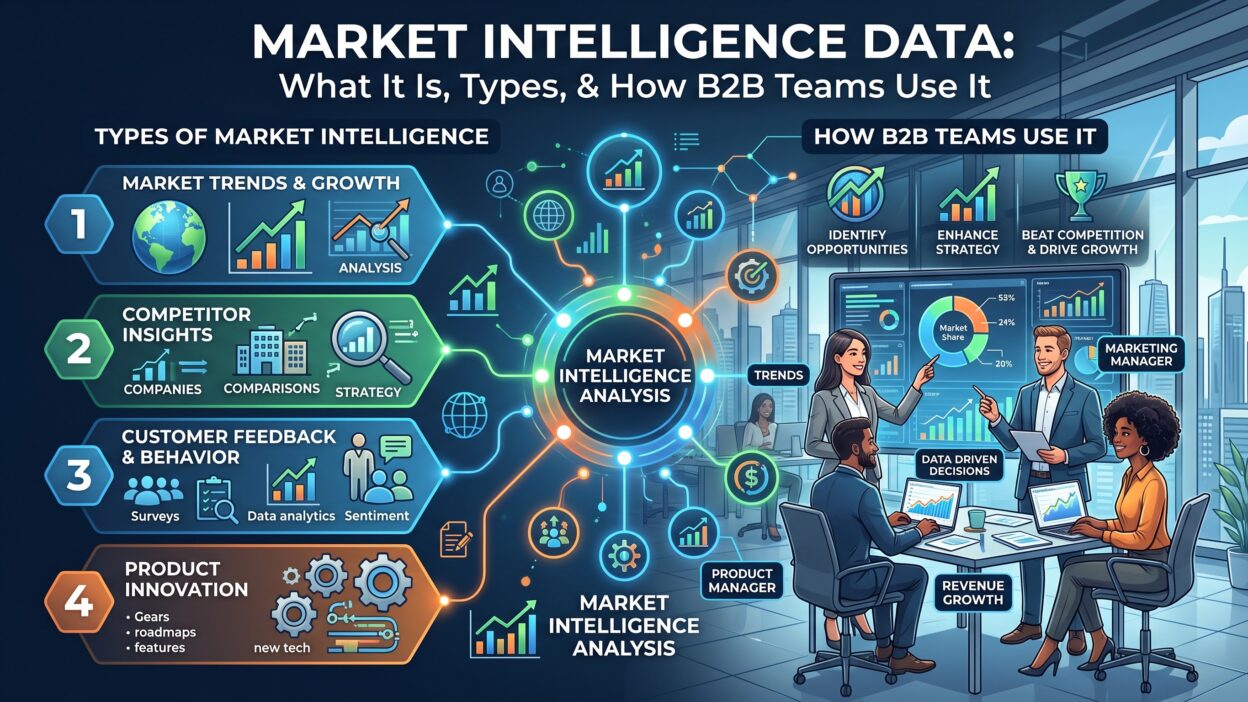
Market intelligence data comes in several distinct forms. Each type answers a different business question. Smart teams combine multiple types to build a complete market view.
Competitive Intelligence Data
Competitive intelligence data tracks what rival companies do. This includes their pricing, product launches, marketing campaigns, and hiring patterns. Sales teams use this data to position their product against alternatives during a deal.
A sales rep armed with competitive intelligence data can answer tough prospect questions instantly. They know the competitor’s weak points. They know where their own product wins. This confidence often closes deals faster.
Product teams also study competitive intelligence data closely. A new feature from a rival signals where the market direction moves next. Teams can respond quickly instead of falling behind.
Customer Intelligence Data
Customer intelligence data centers on buyer behavior, preferences, and pain points. This type of market intelligence data comes from surveys, support tickets, usage analytics, and sales call notes.
Marketing teams use customer intelligence data to write copy that speaks directly to real problems. Product teams use it to prioritize which features to build next. Customer success teams use it to spot accounts at risk of churning.
This data type often reveals surprising patterns. A feature nobody expected to matter turns out to drive the most renewals. A customer segment considered small turns out to hold the highest lifetime value. Customer intelligence data uncovers these hidden truths.
Market Trend Data
Market trend data tracks the bigger picture. Industry growth rates, emerging technologies, regulatory changes, and shifting buyer expectations all fall under this category. This form of market intelligence data helps leadership teams plan years ahead, not just months.
A company entering a new market segment needs trend data first. It shows whether the segment grows or shrinks. It shows which regions adopt new technology fastest. Without this data, expansion plans become expensive guesses.
Product Intelligence Data
Product intelligence data focuses on how buyers use and evaluate products within a category. It includes feature comparisons, adoption rates, and integration preferences across the market.
Product managers depend on this data heavily. It tells them which features competitors already offer. It tells them which integrations customers demand most. Market intelligence data of this type shapes product roadmaps directly.
Pricing Intelligence Data
Pricing intelligence data tracks how competitors price their products across different tiers and regions. B2B pricing often stays hidden behind sales calls and custom quotes, so this data type requires more effort to gather.
Revenue teams use pricing intelligence data to set competitive rates without leaving money on the table. A company that prices too low loses revenue. A company that prices too high loses deals. Accurate data finds the right balance.
Firmographic and Technographic Data
Firmographic data describes company attributes like size, industry, revenue, and location. Technographic data describes the software and tools a company already uses. Together, these datasets help sales teams target the right accounts.
A sales team targeting mid-market SaaS companies using a specific CRM platform can filter their entire prospect list using this data. This precision saves enormous time and improves close rates.
How B2B Teams Collect Market Intelligence Data
Collecting market intelligence data takes a mix of tools and manual research. Most companies combine several methods rather than relying on just one source.
Surveys and Direct Customer Feedback
Direct surveys remain one of the most reliable sources. Customers tell you exactly what they think, want, and struggle with. Teams run these surveys through email, in-app prompts, or phone interviews.
The key here stays simple: ask short, focused questions. Long surveys get ignored. Short surveys get completed and provide clean, usable market intelligence data.
Web Scraping and Public Data Sources
Public websites, government filings, and industry publications hold enormous amounts of useful data. Teams use scraping tools or manual research to pull pricing pages, job postings, and press releases from competitors.
This method requires care around legal boundaries and data accuracy. Reliable teams verify scraped data against multiple sources before trusting it fully.
Sales and Support Team Insights
Sales reps talk to prospects daily. Support agents talk to customers daily. Both groups collect valuable market intelligence data simply through conversation. Smart companies build systems to capture these insights instead of losing them in scattered notes.
A CRM note about a lost deal often reveals more about competitor weaknesses than any formal report. Capturing this data consistently turns everyday conversations into a strategic asset.
Third Party Data Providers
Many companies buy market intelligence data from specialized vendors. These providers track firmographic details, technographic signals, and industry benchmarks at scale. This approach saves time for teams that lack resources to gather everything manually.
Choosing the right vendor matters. Data accuracy varies widely across providers, so teams should test samples before committing to a long contract.
How B2B Teams Use Market Intelligence Data
Collecting data means nothing without action. Here is how different teams put market intelligence data to real use.
Sales Teams and Account Targeting
Sales teams use market intelligence data to build target account lists. They filter prospects by industry, company size, and technology stack. This focus means reps spend time on accounts likely to convert instead of cold, random outreach.
During active deals, reps pull competitive intelligence data to handle objections. They know exactly why their product wins against a specific rival. This preparation shortens sales cycles and increases win rates.
Marketing Teams and Campaign Strategy
Marketing teams rely on customer intelligence data to craft messages that resonate. They know which pain points matter most to each buyer segment. Campaigns built on real data outperform campaigns built on assumptions almost every time.
Market trend data also shapes content calendars. Marketing teams create content around topics the industry already discusses widely. This alignment brings organic traffic and positions the brand as a market leader.
Product Teams and Roadmap Planning
Product teams use market intelligence data to decide what to build next. Feature requests from customers combine with competitive intelligence data to form a clear roadmap. Teams avoid building features nobody wants and avoid missing features everyone expects.
This data also helps product teams price new features correctly. Pricing intelligence data shows what the market already pays for similar capabilities.
Executive Teams and Strategic Planning
Leadership teams use market intelligence data for the biggest decisions a company makes. Should the company enter a new region? Should it acquire a competitor? Should it pivot its core product? These decisions carry huge financial risk, and data reduces that risk substantially.
Board meetings increasingly include market intelligence data as standard reporting. Investors expect data backed reasoning behind every major strategic move.
Tools That Power Market Intelligence Data
Several categories of software help teams manage market intelligence data efficiently. CRM platforms store customer and prospect information in one place. Competitive intelligence platforms track rival pricing, features, and marketing moves automatically. Survey tools collect direct customer feedback at scale.
Analytics platforms turn raw usage data into readable patterns. Data enrichment tools add firmographic and technographic details to existing contact records. Together, these tools remove the manual burden of collecting market intelligence data by hand.
Smaller teams often start with spreadsheets and a few free tools. Larger teams invest in dedicated platforms built specifically for market intelligence data collection and analysis. Both approaches work as long as the data stays accurate and current.
Real World Examples of Market Intelligence Data in Action
Abstract explanations only go so far. Real examples show how market intelligence data changes outcomes for actual companies.
A mid-size SaaS company once struggled with a stalled expansion plan. Leadership guessed which region to target next. The guess turned out wrong, and the launch burned through budget with little return. The next year, the same company built a proper market intelligence data process. They studied growth rates, competitor presence, and buyer readiness across three candidate regions. The data pointed to a smaller, less obvious market that competitors had ignored. The second launch succeeded within months.
A B2B manufacturing firm faced a similar situation with pricing. Sales reps constantly lost deals to a rival offering steep discounts. Nobody understood the rival’s actual pricing structure until the team gathered pricing intelligence data through public quotes and customer conversations. The data revealed the rival discounted only on the smallest deal sizes. Larger deals stayed priced high. Armed with this insight, the sales team adjusted their pitch for bigger accounts and stopped losing those deals.
A fintech startup used customer intelligence data to rescue a struggling product line. Usage data showed most customers ignored a flagship feature the company had promoted heavily. Support tickets revealed a smaller, less advertised feature solved a bigger pain point. The product team shifted marketing focus, and adoption of that smaller feature tripled within a quarter.
These stories share one pattern. Teams stopped guessing. They gathered market intelligence data first, then acted on what the data showed instead of what they assumed.
Measuring the Return on Market Intelligence Data
Investing time and money into market intelligence data only makes sense if it produces measurable results. Smart teams track specific outcomes tied directly to their data efforts.
Sales teams measure win rate changes after adopting competitive intelligence data in their pitches. A rising win rate against a specific competitor signals the data works. Shortened sales cycles offer another clear signal, since reps waste less time chasing accounts that never fit the target profile.
Marketing teams track campaign performance tied to customer intelligence data. Messages built around real pain points usually generate higher click rates and lower cost per lead. Comparing campaigns built with data against older campaigns built on assumptions often reveals a stark difference.
Product teams measure feature adoption rates after using market intelligence data to guide the roadmap. A new feature built on solid customer insight typically sees faster adoption than features built on internal opinion alone.
Executives track broader business metrics like revenue growth in new markets and customer retention rates. These numbers take longer to shift, but they show whether strategic decisions guided by market intelligence data actually paid off.
Teams that skip measurement often lose faith in their data process over time. Tracking clear metrics keeps everyone confident that the effort behind gathering market intelligence data delivers real value.
Building a Market Intelligence Data Framework From Scratch
Companies without any existing process often feel overwhelmed at the idea of starting. The task feels large, but a simple framework breaks it into manageable steps.
Start by identifying the single biggest decision your team faces right now. Maybe it involves choosing a target market. Maybe it involves setting next year’s pricing. Whatever the decision, let it guide which type of market intelligence data you gather first.
Next, pick one or two collection methods instead of trying everything at once. A short customer survey combined with basic competitor research covers a surprising amount of ground for a first attempt. Avoid the trap of buying expensive tools before proving the process works with simple, low cost methods.
Assign someone clear ownership over this early effort. Progress stalls quickly when everyone assumes someone else will keep the data updated. A single owner, even part time, keeps momentum going.
Once the first round of market intelligence data produces a useful decision, expand the process. Add a new data type. Bring in another team. Build a simple shared document or dashboard so insights reach everyone who needs them.
This gradual approach beats trying to build a perfect system on day one. Perfect systems often collapse under their own complexity. Simple systems that actually get used win over time.
Challenges Teams Face With Market Intelligence Data
Gathering market intelligence data sounds simple in theory. Reality gets messier. Data quickly becomes outdated in fast moving markets. A pricing page from six months ago no longer reflects current rates. Teams need refresh schedules to keep data useful.
Data accuracy also poses constant challenges. Public sources sometimes contain errors or outdated information. Teams that skip verification steps risk building strategy on shaky ground.
Too much data creates its own problem. Teams drown in reports, spreadsheets, and dashboards without a clear system for turning data into decisions. The best teams build simple processes that filter noise and highlight what matters most.
Budget constraints limit smaller companies from accessing premium data sources. These teams often combine free tools with manual research to fill gaps. The strategy works, though it requires more time and effort compared to paid platforms.
Best Practices for Using Market Intelligence Data Effectively
Successful teams follow a few consistent habits. They set a clear goal before collecting any data. Random data collection wastes time and produces clutter instead of insight.
They assign ownership. One person or team stays responsible for keeping market intelligence data fresh and accurate. Without ownership, data decays quickly and nobody notices until it causes a bad decision.
They share data across departments. Sales insights help marketing. Marketing insights help product. Product insights help executives. Market intelligence data becomes far more valuable when teams stop hoarding it in silos.
They review data regularly. Markets shift, and stale data misleads decision makers. A quarterly review cycle keeps the picture current without overwhelming teams with constant updates.
They combine multiple data types. Relying only on competitive data misses customer needs. Relying only on customer data misses market trends. A balanced mix produces the clearest strategic picture.
The Future of Market Intelligence Data in B2B
Artificial intelligence now plays a growing role in gathering and analyzing market intelligence data. Machine learning models scan thousands of data points and spot patterns humans might miss. This speeds up research dramatically and frees teams to focus on strategy instead of manual collection.
Real time data also grows more common. Instead of quarterly reports, teams increasingly access live dashboards that update the moment new information arrives. This shift means faster reactions to market changes and fewer missed opportunities.
Privacy regulations continue to shape how companies collect data too. Teams must balance thorough market intelligence data collection with compliance requirements across different regions. Companies that build ethical, transparent data practices will earn more trust from customers and partners alike.
Frequently Asked Questions
What is market intelligence data used for?
Companies use market intelligence data to understand customers, track competitors, and spot industry trends. Sales teams use it to target the right accounts. Marketing teams use it to craft better campaigns. Product teams use it to build features the market actually wants.
How is market intelligence data different from business intelligence?
Business intelligence focuses on internal company performance like revenue and operations. Market intelligence data focuses outward, covering competitors, customers, and industry trends. Both types work together to guide smart decisions.
What sources provide the best market intelligence data?
Strong sources include direct customer surveys, public competitor websites, industry reports, and third party data vendors. Combining multiple sources produces the most accurate and complete picture.
How often should teams update their market intelligence data?
Most teams review core data quarterly, though fast moving markets may need monthly updates. Pricing and competitor data especially need frequent refreshes since these details change often.
Can small businesses afford market intelligence data tools?
Yes. Many free and low cost tools exist for smaller teams. Spreadsheets, free survey tools, and manual competitor research all provide useful market intelligence data without a large budget.
What industries rely most on market intelligence data?
SaaS, financial services, healthcare technology, and manufacturing all rely heavily on market intelligence data. Any industry with long sales cycles and complex buyer journeys benefits from this data significantly.
Read More:-Is it Time to Add Chatbots to Your Demand Generation Engine?
Conclusion

Market intelligence data gives B2B teams a real advantage in crowded, competitive markets. It replaces guesswork with facts drawn from customers, competitors, and industry trends. Sales teams close deals faster. Marketing teams create sharper campaigns. Product teams build features buyers actually want. Executives make bigger decisions with far less risk.
Building a strong market intelligence data practice takes effort. It requires the right tools, clear ownership, and consistent review cycles. Teams that invest in this practice early gain a lasting edge over competitors who still rely on gut instinct alone.
Start small if needed. Pick one data type, one tool, and one clear goal. Growth follows once the habit sticks. Market intelligence data rewards teams that stay consistent, curious, and willing to act on what the numbers reveal.