Introduction
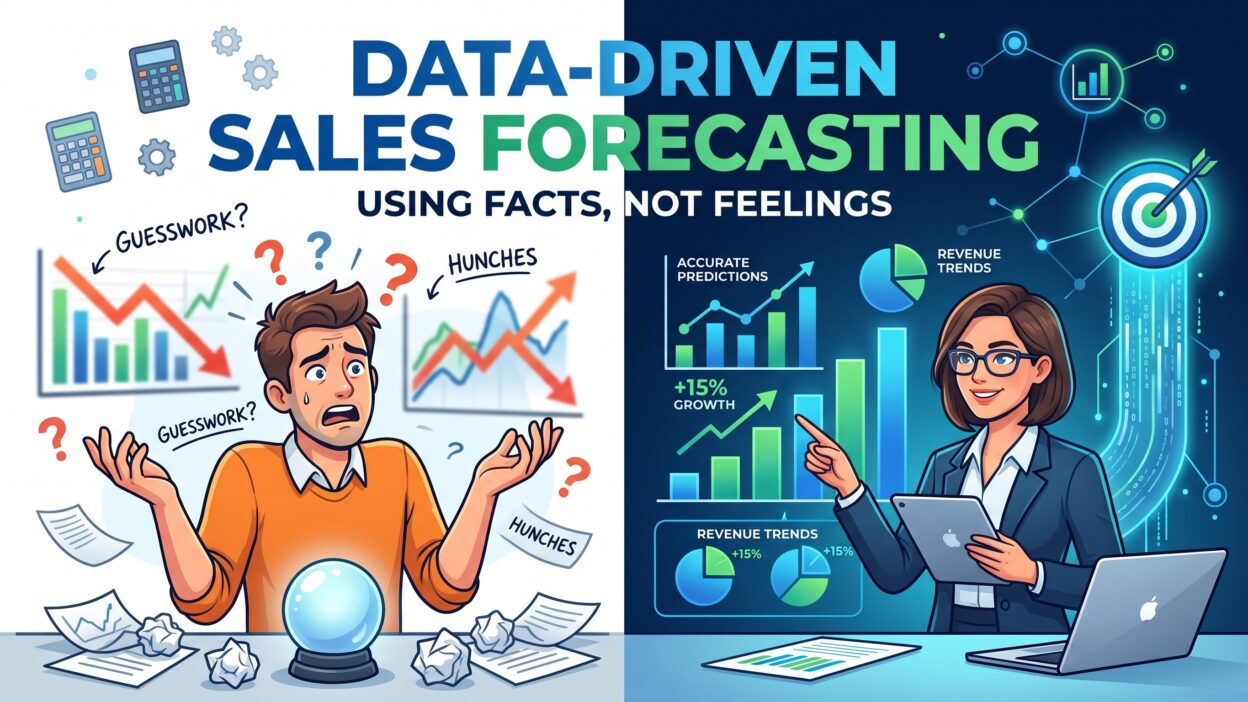
TL;DR Sales leaders guess wrong more often than they admit. A gut feeling says this quarter looks strong, then the numbers come in short. Data-driven sales forecasting fixes this problem by replacing hunches with actual evidence. This guide walks through what data-driven sales forecasting means, why it beats intuition, and how sales teams build it into daily operations.
Table of Contents
What Is Data-Driven Sales Forecasting?
Data-driven sales forecasting means predicting future revenue using historical numbers, pipeline data, and measurable buyer behavior instead of personal opinion. A rep’s confidence about a deal matters far less than the actual signals that deal shows in the data.
This approach pulls from CRM records, past close rates, deal velocity, and engagement metrics. Every prediction ties back to something measurable. Data-driven sales forecasting removes the guesswork that turns quarterly planning into a stressful guessing game.
Traditional forecasting often relied on sales reps rating their own deals as likely or unlikely to close. This method sounds reasonable until you notice how often personal bias creeps in. A rep desperate to hit quota rates deals more optimistically than the data supports. Data-driven sales forecasting removes this bias by grounding every prediction in facts.
Why Sales Teams Need Data-Driven Sales Forecasting
Revenue planning affects hiring decisions, budget allocation, and investor confidence. A forecast built on feelings puts all of this at risk. Data-driven sales forecasting gives leadership a foundation they can actually trust when making these bigger decisions.
Accuracy improves dramatically once teams switch away from gut based predictions. Studies on sales performance consistently show forecasts built on real data outperform forecasts built on rep intuition alone. This accuracy gap grows even wider during uncertain economic periods when intuition becomes even less reliable.
Sales managers gain a clearer view into where deals actually stand in the pipeline. Instead of trusting a rep’s optimistic gut check, data-driven sales forecasting shows exactly how long a deal has sat in each stage and how that compares to deals that closed successfully in the past.
Board members and investors expect data-driven sales forecasting today rather than vague confidence statements from a sales leader. Companies raising capital or reporting to a board need numbers backed by evidence, not a feeling that things look good this quarter.
Core Components of Data-Driven Sales Forecasting
Historical Sales Data
Past performance forms the backbone of any solid forecast. Data-driven sales forecasting starts by studying win rates, average deal size, and sales cycle length from previous quarters. These historical patterns reveal what realistic performance actually looks like for your specific business.
Teams should segment this historical data by product line, region, and customer size. A single blended average hides important differences between fast closing small deals and slow moving enterprise contracts.
Pipeline Velocity Metrics
Pipeline velocity measures how quickly deals move through each stage of your sales process. Data-driven sales forecasting tracks this velocity closely, since a slowing pipeline often signals trouble before it shows up in closed revenue numbers.
Comparing current velocity against historical averages helps predict whether this quarter will land ahead of or behind target. A deal sitting twice as long in negotiation compared to past successful deals raises a clear warning sign.
Deal Stage Probability Scoring
Every stage in a sales pipeline carries a different statistical likelihood of closing. Data-driven sales forecasting assigns a probability percentage to each stage based on actual historical conversion rates, not arbitrary guesses. A deal in early discovery might carry a fifteen percent chance of closing, while a deal in final contract review might carry an eighty percent chance.
This scoring system removes the guesswork reps introduce when manually rating their own deals. The math comes from real patterns across hundreds or thousands of past deals instead of one person’s optimism.
Buyer Engagement Signals
Modern data-driven sales forecasting also factors in engagement data like email opens, meeting attendance, and website activity from the prospect’s team. A deal where the buyer stops responding to emails shows weaker signals than a deal where multiple stakeholders actively engage with proposals and demos.
These engagement signals often predict outcomes more accurately than a rep’s subjective read on how the relationship feels. Cold, quiet accounts rarely close regardless of how confident a rep feels about the relationship.
How to Build a Data-Driven Sales Forecasting Model
Clean Your CRM Data
Data-driven sales forecasting only works with clean, accurate input data. Messy CRM records full of outdated stages, missing close dates, or duplicate entries produce unreliable forecasts no matter how sophisticated the model behind them looks.
Start by auditing your CRM for these common problems. Assign clear ownership over data hygiene so reps update records consistently rather than letting information decay between deal reviews.
Define Your Sales Stages Clearly
Every stage in your pipeline needs a clear, objective definition. A stage labeled “proposal sent” should mean exactly that, not sometimes proposal sent and sometimes just discussed. Data-driven sales forecasting breaks down when stage definitions stay vague or inconsistent across the team.
Document these definitions clearly and train every rep on the same standard. Consistency here directly improves the accuracy of any forecast built from this data later.
Calculate Historical Conversion Rates
Pull data from closed deals over the past several quarters to calculate how often deals convert from each stage to a closed win. This historical conversion rate becomes the mathematical foundation for your data-driven sales forecasting model going forward.
Recalculate these rates regularly, since market conditions and buyer behavior shift over time. A conversion rate calculated three years ago might no longer reflect current reality.
Apply Weighted Pipeline Calculations
Multiply the value of each open deal by its stage specific probability to get a weighted pipeline number. Adding these weighted values together across the entire pipeline produces a realistic forecast instead of simply adding up total pipeline value at face value.
This weighted approach forms the mathematical core of most data-driven sales forecasting systems used by modern sales organizations today.
Step Five: Layer in Predictive Analytics
Advanced teams add predictive analytics on top of basic weighted calculations. Machine learning models study patterns across thousands of past deals, identifying subtle signals that correlate with closing, like specific engagement patterns or deal characteristics that humans might miss entirely.
This layer takes data-driven sales forecasting beyond simple math into genuine predictive intelligence, though it requires enough historical data to train these models accurately first.
Tools That Power Data-Driven Sales Forecasting
CRM platforms serve as the primary data source for most forecasting efforts, storing deal stages, close dates, and historical outcomes in one central system. Sales forecasting software layers on top of this CRM data, applying statistical models and generating visual reports for leadership review.
Business intelligence tools help teams build custom dashboards that track forecast accuracy over time, comparing predicted numbers against actual closed revenue each quarter. Predictive analytics platforms bring machine learning capabilities specifically built for data-driven sales forecasting, analyzing patterns too complex for manual spreadsheet calculations.
Smaller teams often start with spreadsheet based models using historical conversion rates before investing in dedicated software. This approach works fine early on, though it requires discipline to keep data clean and calculations updated consistently.
Common Mistakes That Undermine Data-Driven Sales Forecasting
Relying on Rep Optimism Bias
Even in a supposedly data-driven sales forecasting process, teams sometimes let reps override the math with personal gut feelings. A rep insisting a deal will close despite weak engagement signals introduces exactly the bias this whole approach tries to eliminate. Trust the data over individual optimism.
Ignoring Deal Aging
A deal sitting in the same stage for months carries different risk than a fresh deal that just entered that stage yesterday. Basic weighted pipeline models sometimes miss this nuance. Strong data-driven sales forecasting factors in how long a deal has stalled, adjusting probability downward the longer a deal sits without movement.
Using Outdated Conversion Rates
Market conditions shift, and conversion rates calculated years ago stop reflecting current buyer behavior. Teams that never update their historical baseline numbers end up with forecasts that look precise but predict poorly. Refreshing these calculations every quarter keeps data-driven sales forecasting accurate and relevant.
Treating Every Deal Segment the Same
A large enterprise deal behaves completely differently than a small transactional sale. Blending all deal types into one forecasting model hides important patterns. Segmenting data-driven sales forecasting by deal size, industry, or region produces far more accurate and actionable predictions.
Skipping Regular Forecast Reviews
Building a strong model once and never revisiting it wastes the entire effort. Sales conditions change constantly, and a data-driven sales forecasting model needs regular review meetings where actual results get compared against predictions. This feedback loop reveals where the model needs adjustment over time.
Measuring Forecast Accuracy
Tracking accuracy keeps any data-driven sales forecasting effort honest. Comparing predicted quarterly revenue against actual closed revenue reveals how well the model performs in practice. A forecast consistently off by large margins signals a need for recalibration somewhere in the underlying assumptions.
Teams should track this accuracy at both the aggregate level and the individual rep level. A single rep whose deals consistently close far below predicted probability might need coaching, or their pipeline data might need closer scrutiny for accuracy issues.
Root cause analysis matters just as much as tracking the accuracy number itself. When a forecast misses significantly, teams should dig into why. Maybe a major deal fell through unexpectedly. Maybe stage definitions stayed inconsistent across reps. Understanding these root causes improves the next forecasting cycle.
Data-Driven Sales Forecasting Across Sales Team Roles
Sales Representatives
Individual reps benefit from data-driven sales forecasting by understanding exactly which deals in their pipeline need the most attention. Instead of guessing which prospect to prioritize, reps see clear probability scores that highlight where their time produces the best return.
Sales Managers
Managers use data-driven sales forecasting to spot coaching opportunities across their team. A rep whose deals consistently underperform their predicted probability might need help with negotiation skills or deal qualification. The data highlights these patterns clearly instead of relying on subjective performance reviews alone.
Revenue Operations Teams
RevOps teams own the infrastructure behind data-driven sales forecasting, maintaining clean CRM data, building reporting dashboards, and refining probability models over time. This role sits at the center of making sure the entire forecasting system stays accurate and trustworthy for the whole organization.
Executive Leadership
Executives rely on data-driven sales forecasting for board reporting, budget planning, and strategic decisions about hiring and expansion. A forecast backed by real evidence gives leadership the confidence to make bigger bets, knowing the underlying numbers reflect actual pipeline health rather than optimistic guessing.
The Future of Data-Driven Sales Forecasting
Artificial intelligence continues reshaping how companies approach data-driven sales forecasting. Machine learning models now analyze far more variables than a human forecaster ever could manually, spotting subtle patterns across email tone, meeting frequency, and even competitor mentions during sales calls.
Real time forecasting also grows more common, replacing static quarterly reports with live dashboards that update the moment new pipeline data arrives. This shift lets sales leaders react to changing conditions immediately instead of waiting for the next formal review cycle.
Integration across departments continues expanding too. Data-driven sales forecasting increasingly pulls in marketing engagement data, customer success signals, and even macroeconomic indicators to build a fuller picture of what drives revenue outcomes. Companies that adopt these broader data sources early will likely see forecasting accuracy improve well beyond traditional CRM based models alone.
Real World Impact of Data-Driven Sales Forecasting
A mid-size software company once ran forecasting purely through weekly manager check-ins, asking reps to rate deals as likely or unlikely. Quarterly numbers missed target by wide margins consistently, sometimes off by thirty percent in either direction. After building a proper data-driven sales forecasting model using historical conversion rates and engagement signals, their forecast accuracy improved dramatically within two quarters. Leadership finally trusted the number going into board meetings instead of padding expectations out of caution.
A manufacturing distributor faced a different challenge. Their sales cycle stretched across many months, making it hard to know which deals genuinely stood a chance of closing this quarter versus next year. Data-driven sales forecasting helped them separate near term pipeline from long term opportunities using stage specific probability scoring. This clarity let finance plan cash flow far more accurately than the vague estimates they relied on previously.
A financial services firm used data-driven sales forecasting to catch a warning sign early. Engagement data showed a major renewal account had gone quiet for three weeks, despite the rep rating the deal as highly likely to close. Leadership intervened early, uncovering a budget freeze at the client’s company before it turned into a lost deal at the last minute. The data caught what the rep’s optimism had missed entirely.
These examples show a consistent pattern. Companies that build data-driven sales forecasting on real evidence catch problems earlier and plan with far more confidence than those relying purely on rep instinct.
Data-Driven Sales Forecasting Across Industries
Software and Technology Sales
Technology companies often deal with shorter sales cycles and high deal volume, making data-driven sales forecasting especially valuable for spotting trends quickly. Engagement metrics like product trial usage and demo attendance add powerful signals beyond basic CRM stage data in this industry.
Manufacturing and Industrial Sales
Manufacturing sales cycles often stretch much longer, sometimes spanning a year or more for large equipment purchases. Data-driven sales forecasting in this space relies heavily on tracking deal aging and stage duration, since a stalled deal in this industry often signals real trouble rather than normal slow movement.
Financial Services
Financial services companies face strict regulatory environments alongside complex, relationship driven sales processes. Data-driven sales forecasting here benefits from combining traditional pipeline metrics with account level relationship signals, since a single large client often represents a significant portion of total forecasted revenue.
Healthcare and Life Sciences
Healthcare sales often involve lengthy procurement processes and multiple stakeholders across different departments. Data-driven sales forecasting in this sector needs to account for these extended, multi-stakeholder cycles, often requiring more granular stage definitions than industries with simpler buying processes.
Comparing Manual Forecasting to Data-Driven Sales Forecasting
Manual forecasting relies on subjective rep input, gathered through spreadsheets or verbal check-ins during pipeline review meetings. This method feels fast and simple at first, but accuracy suffers as pipeline size grows and personal bias compounds across dozens of reps rating their own deals differently.
Data-driven sales forecasting removes this inconsistency by applying the same objective probability scoring to every deal regardless of who owns it. Two reps with identical deals at the same stage receive the same probability score, removing the variance that comes from one rep feeling more confident than another purely due to personality.
Speed also favors data-driven sales forecasting once the system exists. Manual forecasting requires time consuming meetings where managers pull individual rep opinions together into one report. A properly built data-driven sales forecasting system generates this same report instantly, freeing up meeting time for actual coaching and deal strategy instead of number gathering.
The transition from manual to data-driven sales forecasting takes real upfront investment in clean data and clear processes. Companies that push through this initial effort consistently report stronger long term forecasting accuracy compared to those that stick with informal, opinion based methods indefinitely.
Frequently Asked Questions
What is data-driven sales forecasting?
Data-driven sales forecasting predicts future revenue using historical numbers, pipeline data, and measurable buyer behavior instead of personal opinion. It relies on evidence like conversion rates and deal velocity rather than a sales rep’s gut feeling about a deal.
How accurate is data-driven sales forecasting compared to traditional methods?
Data-driven sales forecasting typically outperforms traditional intuition based methods, especially during uncertain market conditions. Removing personal bias from the equation produces more consistent and reliable predictions over time.
What data do I need to start data-driven sales forecasting?
You need clean CRM records showing deal stages, close dates, deal values, and historical outcomes. Engagement data like email opens and meeting attendance adds further accuracy once the basic historical foundation exists.
How often should teams update their forecasting model?
Most teams review and recalibrate their data-driven sales forecasting model every quarter. Faster moving markets or rapidly changing buyer behavior might require more frequent updates to stay accurate.
Can small sales teams use data-driven sales forecasting effectively?
Yes. Small teams can start with simple spreadsheet based models using historical conversion rates before investing in dedicated forecasting software. The core principles work at any team size, though larger datasets generally produce more statistically reliable results.
Does data-driven sales forecasting eliminate the need for human judgment?
No. Human judgment still matters for context the data might miss, like a sudden leadership change at a prospect company. Data-driven sales forecasting works best as a strong foundation that human insight then refines, not a complete replacement for experienced judgment.
Read More:-What Is a Demand Generation Manager? Role, Skills, and Salary
Conclusion

Data-driven sales forecasting turns revenue planning from a stressful guessing game into a reliable, evidence based process. Clean CRM data, clear stage definitions, and historical conversion rates form the foundation that makes accurate predictions possible.
Teams that commit to this approach see real benefits across every level of the organization. Reps prioritize the right deals. Managers spot coaching opportunities early. Executives make bigger strategic decisions with genuine confidence instead of crossed fingers.
Building strong data-driven sales forecasting takes real effort and ongoing discipline. Clean data, consistent stage definitions, and regular model reviews all require attention over time. The payoff shows up in forecasts that actually match reality, quarter after quarter, letting your entire team plan with facts instead of hoping feelings turn out right.