Introduction
TL;DR Most B2B marketers track metrics. Few track the right ones. B2B advertising KPIs separate teams that grow pipeline from those that just burn budget. Getting this right is not optional anymore. Revenue accountability sits at the heart of every modern marketing team.
This blog breaks down the exact B2B advertising KPIs you need to watch. It shows you how to connect each metric to real revenue outcomes. You will walk away with a clear framework for smarter campaign decisions.
Table of Contents
Why B2B Advertising KPIs Are Different from B2C Metrics
B2B buying cycles are long. A single deal can take six to eighteen months. That changes everything about how you measure success. B2C brands can optimize for same-day conversions. B2B brands cannot do the same.
Multiple stakeholders approve every purchase. Marketing must influence each one. A click or a visit rarely tells the whole story. B2B advertising KPIs must reflect the complexity of this process. Surface-level metrics mislead more than they guide.
Revenue impact is the only honest scoreboard for B2B campaigns. Every metric you track should point back to pipeline growth or closed revenue. If it does not, question whether you need it at all.
The Problem With Vanity Metrics in B2B Advertising
Impressions look impressive in a deck. They rarely close deals. Clicks feel like progress until the pipeline shows nothing moved. Vanity metrics give marketers comfort without giving executives confidence. B2B advertising KPIs that lack revenue linkage are glorified distractions.
Sales teams judge marketing by one thing — quality of leads. A thousand clicks from irrelevant audiences do nothing for quota attainment. Reframe your thinking. Ask what each metric tells you about future revenue. That question separates signal from noise fast.
Core B2B Advertising KPIs You Must Track in Every Campaign
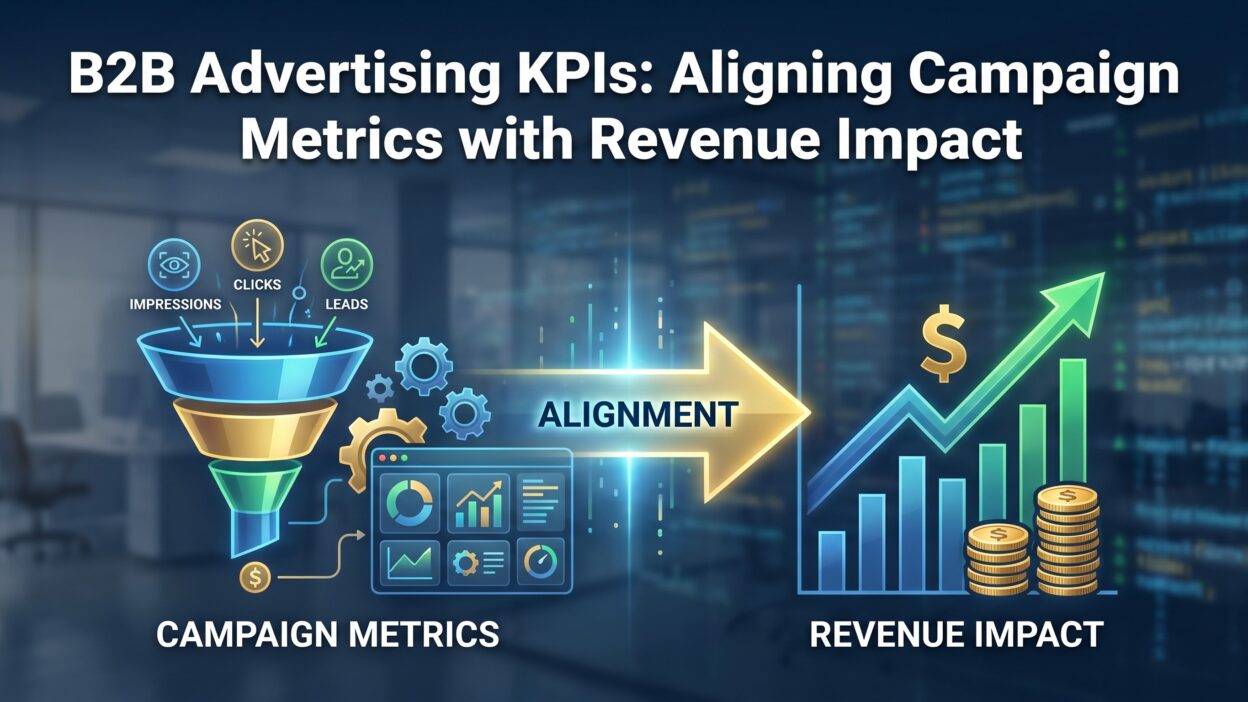
Strong B2B advertising KPIs fall into three stages. Awareness metrics tell you who sees your brand. Engagement metrics show who interacts meaningfully. Conversion metrics reveal who takes action toward a sale. Each stage needs its own set of measurements.
Awareness-Stage KPIs: Measuring Reach Among the Right Audience
Awareness without targeting is expensive noise. The goal is not reach. The goal is reach within your ideal customer profile. Measure share of voice in your target accounts. Track brand recall lift through post-exposure surveys. Monitor ad frequency among named accounts, not random internet users.
Account-based reach percentage matters here. This tells you what portion of your target account list actually saw your ads. If that number is low, your targeting needs work regardless of your total impression count. B2B advertising KPIs at awareness stage must be account-centric by design.
Branded search volume is another honest awareness signal. When prospects research your category, they should start thinking of your name. Rising branded search lift after campaign launches tells you awareness is sticking.
Engagement-Stage KPIs: Finding Signals of Genuine Interest
Engagement tells you who is paying attention. Not all engagement is equal. A two-second scroll past a banner means nothing. A decision-maker spending seven minutes on your pricing page means a lot. Weight your engagement metrics by quality, not just volume.
Time on site from ad traffic is a strong engagement signal. Content consumption depth matters too. Did the visitor read one page or five? Did they visit the case studies section? These behavioral signals indicate intent. They feed directly into your revenue forecast.
Video completion rate deserves attention in B2B advertising. A prospect who watches 80 percent of a product demo has shown genuine interest. Track this metric at the account level. It feeds your sales team with warm conversation starters.
Content download rates from gated assets signal readiness to engage. Whitepapers, ROI calculators, and benchmark reports attract serious buyers. Monitor these downloads against company size and industry. That data sharpens your B2B advertising KPIs over time.
Conversion-Stage KPIs: From Click to Commercial Outcome
Conversion metrics sit closest to revenue. They demand the most scrutiny. Marketing qualified lead volume is a starting point. Lead quality score matters far more. A hundred low-quality MQLs disappoint sales. Ten high-quality MQLs generate pipeline.
Cost per MQL reveals campaign efficiency. A LinkedIn campaign generating MQLs at $200 beats a display campaign generating them at $800, all else being equal. Know your cost per MQL by channel. Optimize toward the channels with lower cost and higher quality.
MQL-to-SQL conversion rate is the handoff metric. It shows how many marketing leads earn sales qualification. A low rate signals a targeting or messaging problem. Fix it at the campaign level, not the sales level. B2B advertising KPIs improve when marketing and sales define qualification criteria together.
Pipeline sourced by marketing is the most honest conversion metric. It shows the dollar value of opportunities marketing-driven campaigns directly influenced. Track this number every quarter. It makes the case for budget expansion faster than any vanity report.
Revenue-Impact KPIs: Connecting Ad Spend to Business Outcomes
Revenue-impact metrics close the loop between advertising spend and business growth. These are the numbers your CFO cares about. Treat them as your north star. Let every tactical metric serve these higher-level outcomes.
Return on Ad Spend (ROAS): The Foundation of Budget Justification
ROAS tells you how much revenue each dollar of ad spend drives. In B2B, this calculation spans months because of long sales cycles. Use attributed pipeline value rather than closed revenue alone in early-stage measurement. This gives a more accurate picture of current campaign performance.
Blend ROAS across short and long attribution windows. A 30-day ROAS misses deals that closed after a six-month cycle. A 12-month ROAS captures the full revenue picture. Smart B2B advertising KPIs frameworks always account for this attribution lag.
Customer Acquisition Cost (CAC): Measuring Efficiency at Scale
CAC measures the total cost of acquiring one new customer. Divide total marketing and sales spend by the number of new customers won. A rising CAC signals inefficiency somewhere in the funnel. A falling CAC signals you found a repeatable growth engine.
Break CAC down by channel and campaign type. Some campaigns look expensive on cost-per-click but deliver customers at low CAC because their leads close faster. Others look cheap on CPL but inflate CAC through poor lead quality. B2B advertising KPIs at the CAC level reveal which channels truly earn their budget.
Pipeline Velocity: How Fast Deals Move Through Your Funnel
Pipeline velocity measures how quickly revenue flows through your sales process. It combines deal count, average deal size, win rate, and sales cycle length. Marketing-sourced opportunities often move at a different speed than outbound ones. Track this difference deliberately.
A high-velocity pipeline means cash flows in faster. Advertising campaigns that target in-market accounts at the right time accelerate velocity. Content that addresses late-stage objections reduces friction. These inputs directly improve the velocity metric. Strong B2B advertising KPIs always include velocity as a health check.
LTV to CAC Ratio: The Ultimate Efficiency Benchmark
The LTV to CAC ratio compares the lifetime value of a customer against the cost of acquiring them. A ratio of 3:1 is a healthy baseline for most B2B SaaS and services companies. Below 1:1 means you lose money on each customer. Above 5:1 often means you are under-investing in growth.
This ratio connects ad spend decisions to long-term business sustainability. B2B advertising KPIs that feed into LTV calculations include upsell conversion rates, retention rates, and expansion revenue from ad-acquired accounts. Track this number annually. Use it to set smart channel budget allocations.
Channel-Specific B2B Advertising KPIs: What to Measure Where
Different channels serve different purposes. Each needs its own KPI framework. Applying the same metrics across every platform creates misleading comparisons. Know what each channel is built to do and measure it accordingly.
LinkedIn Advertising KPIs: Precision Targeting in a Professional Context
LinkedIn excels at reaching specific job titles, industries, and company sizes. Your core LinkedIn B2B advertising KPIs should include lead form fill rate, cost per lead by audience segment, and account penetration rate. Track how many of your target accounts engage with sponsored content.
Conversation ad reply rate is a distinctive LinkedIn metric. It shows genuine interest from named professionals. Message open rate above 50 percent signals strong relevance. Below 30 percent means your targeting or offer needs rethinking. Document Ads should be measured on download-to-request-demo conversion rate.
Google Ads KPIs for B2B: Capturing Demand at the Moment of Intent
Google Ads capture buyers actively searching for solutions. Your intent signals here are strongest. Key B2B advertising KPIs for Google include impression share on branded terms, quality score by campaign, and conversion rate by keyword intent tier.
Segment your keywords by funnel stage. Awareness keywords like ‘what is account-based marketing’ need different success metrics than purchase keywords like ‘B2B ABM software pricing’. Cost per qualified lead by keyword cluster gives the clearest efficiency signal. Set target CPL benchmarks for each tier before launch.
Display and Programmatic KPIs: Account-Level Impact Over Raw Volume
Display and programmatic advertising in B2B works best for retargeting and account-based advertising. Measure account lift: did web visits from your target account list increase after campaigns launched? Track view-through conversion rate with a long attribution window. B2B advertising KPIs for programmatic must reflect the longer decision journey.
Frequency capping compliance keeps your brand from fatiguing key accounts. Monitor average frequency per account per week. More than ten exposures in a short window without a response signal a mismatched audience or a weak offer. Reduce waste and protect brand perception simultaneously.
Building a B2B Advertising KPI Dashboard That Drives Decisions
A dashboard that no one acts on is wallpaper. Build yours around decisions, not data dumps. Every metric on the screen should have an owner and a threshold that triggers action. Less is more when it comes to executive reporting.
Weekly vs Monthly KPIs: Choosing the Right Review Cadence
Weekly dashboards focus on campaign health. Check spend pacing, click-through rate trends, and lead volume. These metrics change fast enough to require frequent review. Monthly dashboards focus on revenue impact. Review pipeline sourced, MQL-to-SQL conversion rate, and CAC. These metrics need time to reflect real trends.
Quarterly reviews analyze ROI and LTV:CAC ratio. These require full attribution cycles to be meaningful. Mixing weekly and quarterly metrics in the same review creates confusion. Separate your cadences and keep stakeholders focused on the right time horizon. Good B2B advertising KPIs governance means matching metrics to review frequency.
Aligning Marketing and Sales Around Shared Revenue Metrics
Misalignment kills pipeline. Marketing celebrates MQL volume. Sales complains about lead quality. The fix is a shared definition of pipeline and revenue contribution. Build a single dashboard that both teams own. Include MQL volume, SQL conversion rate, pipeline sourced, and win rate by marketing channel.
Monthly smarketing reviews using these metrics change team culture fast. Both teams see the same numbers. Disagreements shift from blame to problem-solving. Revenue grows when this alignment happens. B2B advertising KPIs work best when sales and marketing share accountability for outcomes.
Secondary Keywords That Strengthen Your B2B Advertising Strategy
Understanding related concepts sharpens your measurement strategy. Key secondary areas include B2B campaign performance metrics, demand generation KPIs, account-based marketing measurement, B2B lead generation benchmarks, and marketing attribution models. Each area feeds directly into how you define and report B2B advertising KPIs across your organization.
Marketing attribution deserves special attention. Single-touch attribution oversimplifies multi-channel B2B journeys. Multi-touch attribution distributes credit across every touchpoint. Data-driven attribution uses machine learning to assign dynamic credit weights. Choose the model that matches your sales cycle complexity and data maturity.
B2B lead generation benchmarks give your KPIs context. A 2 percent landing page conversion rate means nothing without knowing the industry average. Research benchmarks for your vertical. Compare your B2B advertising KPIs against peers quarterly. Knowing where you stand versus competitors sharpens your budget priorities.
FAQs: B2B Advertising KPIs Answered
What are the most important B2B advertising KPIs for a demand gen team?
Pipeline sourced by marketing, MQL-to-SQL conversion rate, and cost per MQL are the three most important starting points. They connect daily campaign activity to revenue outcomes. Add ROAS and CAC as your team matures its attribution model. These six B2B advertising KPIs give a complete picture of demand generation health.
How do I measure B2B advertising ROI with long sales cycles?
Use pipeline attribution as a proxy for ROI during long sales cycles. Assign revenue credit when campaigns influence opportunities, not just when deals close. Set attribution windows that match your average cycle length. A six-month cycle needs at least a six-month attribution window to measure campaign ROI honestly.
Which KPIs should I show my CFO?
Show your CFO ROAS, CAC, LTV:CAC ratio, and marketing-sourced pipeline. These speak the language of business growth. Avoid showing impression counts or click-through rates to financial stakeholders. They want to know what advertising spend returned in revenue terms. Keep B2B advertising KPIs presentations short and revenue-focused.
How often should B2B advertising KPIs be reviewed?
Review campaign health metrics weekly. Review pipeline and conversion metrics monthly. Review ROI and CAC quarterly. Annual reviews should evaluate full-cycle LTV:CAC ratios. Each cadence serves a different purpose. Weekly reviews prevent waste. Quarterly reviews shape strategy. Annual reviews guide budget planning for the year ahead.
What tools help track B2B advertising KPIs effectively?
CRM platforms like Salesforce and HubSpot provide pipeline attribution data. Marketing automation tools track MQL progression and lead scoring. BI tools like Tableau and Looker consolidate metrics across channels. LinkedIn Campaign Manager, Google Ads, and DSPs provide channel-level data. Connect all sources into a unified dashboard for honest B2B advertising KPIs reporting.
Read More:-What Is a Go-to-Market Strategy? 2026 B2B Guide
Conclusion

Tracking B2B advertising KPIs is not about filling dashboards. It is about earning organizational trust through revenue accountability. Every metric should answer a real business question. Every number should guide a real decision.
Start with pipeline sourced and CAC. Add MQL-to-SQL conversion rate and ROAS next. Build toward LTV:CAC ratio as your data matures. Align these B2B advertising KPIs with your sales team at every stage. The result is a marketing function that commands respect and earns budget.
B2B advertising is complex. The buying journey is long. Multiple stakeholders complicate attribution. None of this excuses poor measurement. Modern tools give marketers everything they need to connect ad spend to revenue impact. Use them. Own your numbers. Make your B2B advertising KPIs the most powerful asset in your next budget conversation.