Introduction
TL;DR A high Net Promoter Score means customers love your brand enough to recommend it. A low one means they tolerate you at best. Most companies measure NPS faithfully. Far fewer know how to improve NPS in ways that actually move revenue.
NPS is not just a customer satisfaction metric. It is a predictor of growth. Companies with scores above 50 grow faster, retain customers longer, and spend less acquiring new ones. The gap between tracking NPS and acting on it is where most organizations lose money.
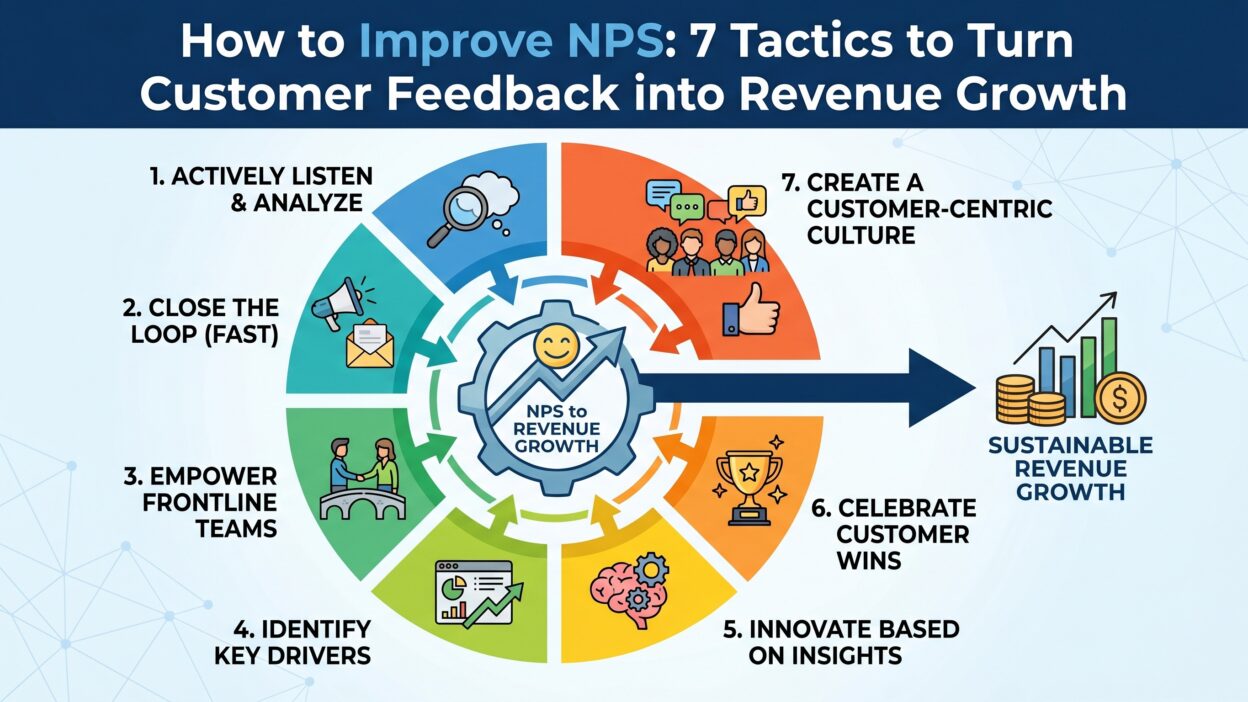
This blog lays out seven practical tactics for how to improve NPS. Each tactic connects directly to revenue outcomes. Apply them in sequence or in parallel. Either approach builds a customer experience that turns passive buyers into active advocates.
Table of Contents
Understanding NPS Before You Try to Improve It
Net Promoter Score measures customer loyalty on an eleven-point scale. Customers who score you nine or ten are Promoters. Scores of seven or eight classify as Passives. Scores of zero through six are Detractors. Your NPS equals the percentage of Promoters minus the percentage of Detractors.
A score above zero means you have more Promoters than Detractors. A score above 50 is considered excellent. Scores above 70 belong to world-class customer experience companies. Most B2B SaaS companies average between 30 and 50. Knowing your baseline matters before you plan how to improve NPS.
NPS data becomes powerful when segmented. An overall score of 40 can hide a segment of enterprise customers scoring you at 20 and SMB customers scoring you at 65. Segment by customer size, industry, tenure, and product tier. The segments with the lowest scores reveal exactly where to focus improvement efforts first.
The Revenue Connection Most NPS Programs Miss
NPS correlates with three revenue levers. Promoters renew contracts at higher rates. Promoters expand into additional products or seats. Promoters refer new customers without a referral incentive. Each of these behaviors directly reduces customer acquisition cost and increases lifetime value.
Detractors do the opposite. They churn faster. They rarely expand. They share negative experiences with peers, increasing your cost to acquire similar accounts. A one-point improvement in NPS generates measurable revenue impact when your customer base is large enough. Learning how to improve NPS is therefore a direct revenue strategy, not a soft satisfaction exercise.
Relational vs Transactional NPS: Choosing the Right Measurement Approach
Relational NPS measures overall loyalty at scheduled intervals — quarterly or annually. It gives a broad picture of how customers feel about your brand over time. Transactional NPS fires after specific interactions — support resolutions, onboarding completions, or feature launches. It tells you exactly which moments create or destroy loyalty.
Both types serve different improvement goals. Relational NPS tracks long-term sentiment trends. Transactional NPS isolates the precise touchpoints that drag your score down. Understanding how to improve NPS requires using both. Relational data sets strategy. Transactional data drives execution.
Tactic 1: Close the Feedback Loop Within 48 Hours
Most companies collect NPS responses and analyze them in monthly reports. By the time action follows, the customer who gave a score of four has already started evaluating competitors. Speed of follow-up is one of the most underestimated tactics for how to improve NPS quickly.
Detractors who receive a personal follow-up within 48 hours reverse their sentiment at significantly higher rates than those who receive no response. A simple acknowledgment and a plan to resolve the core complaint changes the emotional experience. The customer feels heard. That feeling alone shifts loyalty before any structural fix happens.
Building a Loop-Closing Workflow That Scales Across Your Customer Base
A loop-closing workflow starts with routing. Detractor responses go immediately to the customer success manager responsible for that account. The CSM receives the verbatim feedback and the customer’s tenure, product tier, and contract value in the same alert. This context makes the follow-up call informed and targeted, not generic.
Passive responses often get ignored in NPS programs. Do not ignore them. Passives sit one bad experience away from becoming Detractors. A check-in call to a Passive who scored you a seven reveals latent frustration before it compounds. Catching this friction early is a core part of how to improve NPS at the margin.
Promoter follow-up generates a different kind of value. Thank them specifically. Invite them to a customer advisory board, a case study conversation, or a peer referral program. Promoters who feel recognized give more referrals. They deepen their relationship with your brand. Recognizing Promoters is how to improve NPS through momentum, not just damage control.
Tactic 2: Fix the Root Causes Behind Your Most Common Detractor Themes
Individual follow-ups rescue individual accounts. Fixing root causes rescues your score at scale. Text analytics on NPS verbatims reveal the patterns hiding inside your feedback data. Cluster similar complaints into themes. Rank them by frequency and by the average score of accounts mentioning each theme.
The themes that appear most often among your lowest-scoring accounts are your highest-priority product, service, or process failures. Address them with cross-functional urgency. A support experience issue needs a customer success and operations fix. A product reliability issue needs engineering prioritization. Understanding how to improve NPS means holding the right internal teams accountable for the right problems.
Using Verbatim Analysis to Prioritize the Right Fixes First
Verbatim analysis requires structure to be actionable. Categorize feedback into experience dimensions — product quality, support responsiveness, onboarding effectiveness, pricing clarity, and account management quality. Tag each response with a dimension. Count responses by dimension per month. Plot dimension scores over time.
The dimension with the most negative tags and the lowest average score from enterprise accounts deserves immediate leadership attention. A product quality issue mentioned by twenty enterprise Detractors represents far more revenue risk than fifty SMB Detractors complaining about price. Weight your prioritization by account revenue, not just complaint volume.
Share verbatim themes with product, engineering, and operations in a monthly NPS review. Do not summarize for them. Show them direct customer quotes. Hearing a customer say ‘I almost left last month because of this’ lands differently than a statistic. Emotional reality drives faster organizational action on root cause fixes.
Tactic 3: Redesign Onboarding to Create Early Promoters
Onboarding is the highest-leverage moment in the customer lifecycle for NPS improvement. Customers form lasting impressions in the first 90 days. A smooth, value-delivering onboarding experience sets the emotional foundation for loyalty. A confusing, unsupported one creates a Detractor before the relationship truly begins.
Transactional NPS surveys sent at onboarding completion reveal exactly how new customers feel at this critical stage. If your 90-day NPS trails your 12-month NPS significantly, your onboarding experience creates early friction. Fixing this friction is one of the fastest ways to learn how to improve NPS at a structural level.
Time-to-Value: The Onboarding Metric That Predicts NPS Outcomes
Time-to-value measures how quickly a new customer achieves their first meaningful outcome with your product. The faster they reach this moment, the higher their early NPS score. Customers who see tangible results in week one feel confident in their purchase. Customers still struggling in week six feel buyer’s remorse.
Map your onboarding journey against the specific value milestone each customer segment targets. A marketing team values their first campaign live. A sales team values their first pipeline report. Design your onboarding sequence to remove every obstacle between signup and that specific first value moment. Reducing time-to-value by 30 percent consistently lifts 90-day NPS scores.
Proactive check-ins during onboarding prevent silent churn and silent dissatisfaction. A customer who struggles but never says so will give you a six in their first survey. A customer who struggled but received a proactive support call will give you a nine. Onboarding is where learning how to improve NPS becomes a human conversation, not just a process design exercise.
Tactic 4: Elevate Customer Success Quality Across Every Tier
Customer success is the most direct organizational driver of NPS. The quality of your CSM relationships determines whether customers feel supported or ignored. Customers with engaged, proactive CSMs score higher on NPS surveys. Customers with reactive or absent CSM coverage score lower every time.
Measure NPS by CSM and by account portfolio. If one CSM’s book averages 58 and another’s averages 22, the gap is not entirely about the accounts. It reflects different engagement models, communication quality, and proactive value delivery. Identifying this variance is essential for understanding how to improve NPS across your entire customer base.
Proactive vs Reactive Customer Success: The NPS Difference Is Significant
Reactive customer success waits for customers to raise issues before engaging. Proactive customer success monitors health signals and reaches out before problems surface. Customers who receive proactive outreach score NPS 15 to 25 points higher on average than those who only hear from their CSM when something breaks.
Health score dashboards make proactive outreach systematic. When product usage drops below a threshold, an alert fires to the CSM. When a key stakeholder stops logging in, the account receives immediate attention. These interventions prevent passive dissatisfaction from becoming active Detractor sentiment.
Business reviews also drive NPS improvement. A quarterly review that demonstrates ROI in the customer’s language reinforces the value of your product. Customers who see measurable impact report higher loyalty. They remember the value during renewal conversations. Structured business reviews are a direct tactic for how to improve NPS among strategic accounts.
Tactic 5: Improve Support Speed and First-Contact Resolution Rate
Support interactions are the highest-risk NPS moments in the customer lifecycle. A customer who contacts support is already experiencing friction. How quickly and completely you resolve that friction determines whether they become a Promoter or a Detractor from that single interaction.
First-contact resolution rate is the support metric most tightly correlated with NPS improvement. When customers resolve their issue in a single interaction, their satisfaction jumps. When they cycle through two, three, or four contacts for the same problem, their loyalty erodes with each follow-up. Improving FCR is a high-leverage tactic for how to improve NPS at scale.
Self-Service Infrastructure That Reduces Friction and Lifts NPS
Many customers prefer self-service over speaking with a support agent. A comprehensive knowledge base, in-app help content, and video tutorials resolve issues before they become support tickets. Fewer support contacts mean fewer friction moments. Fewer friction moments mean fewer Detractors. Building self-service infrastructure is a structural answer to how to improve NPS without adding headcount.
Search analytics on your help center reveal the most common unsolved questions. Articles searched frequently but rated unhelpful need immediate rewriting. Topics searched with no results need new content created. Treating your knowledge base as a living product rather than a static archive directly reduces customer frustration.
In-app contextual help removes the step of leaving the product to find answers. When guidance appears exactly where customers encounter confusion, resolution happens in seconds. Customers associate that seamless experience with your product quality. This positive association lifts NPS scores among power users who interact with your product daily.
Tactic 6: Build a Voice-of-Customer Program That Feeds Every Department
NPS data collected by customer success and never shared with product, sales, or marketing creates an organizational blind spot. A Voice-of-Customer program routes customer insights to every department that influences the customer experience. This systematic sharing turns NPS from a customer success metric into a company-wide improvement engine.
Product teams need to hear which features frustrate customers most. Sales teams need to know which promises marketing makes that the product does not yet deliver. Marketing teams need to know which customer outcomes Promoters cite most frequently so they can amplify those messages. Each team’s awareness of NPS feedback accelerates their contribution to how to improve NPS organization-wide.
Connecting VoC Data to Product Roadmap Decisions That Lift NPS
Product roadmap decisions made without customer feedback create features customers did not need and miss fixes customers desperately wanted. NPS verbatims give product teams direct evidence of what customers value most. Features that multiple Promoters cite as reasons for their high score deserve roadmap protection. Friction points that Detractors repeatedly mention deserve urgent engineering attention.
Quarterly NPS readouts to the product team create accountability. Product leaders who see their features named in Detractor feedback feel direct responsibility for improvement. This accountability loop between customer sentiment and product direction is a structural answer to how to improve NPS through cross-functional ownership.
Using Promoter Insights to Strengthen Marketing Messaging and Drive Referrals
Promoters tell you why they love your product in their own words. Those words belong in your marketing. A Promoter who says ‘This tool cut our reporting time from two days to two hours’ gives you a headline. A Promoter who says ‘The support team feels like an extension of our own staff’ gives you a differentiator.
Mining Promoter verbatims for marketing language makes your messaging more authentic and more resonant. Prospects trust language that sounds like real customers rather than polished marketing copy. Using Promoter-sourced language in ads, emails, and website copy improves conversion rates. Better conversion means lower CAC, which compounds the revenue benefit of learning how to improve NPS.
Tactic 7: Launch a Formal Promoter Referral Program to Monetize Advocacy
Promoters are your most valuable marketing asset. They believe in your product. They have credibility with their peers. They give referrals willingly when you make it easy. A formal referral program captures this latent advocacy and converts it into measurable pipeline. This is the revenue harvest that makes learning how to improve NPS financially tangible.
Referred customers close at higher rates, pay higher initial contract values, and churn at lower rates than customers from paid acquisition channels. A Promoter’s endorsement carries social proof that a hundred targeted ads cannot replicate. Formalizing this process with a structured program captures referrals that currently happen informally or not at all.
Designing a Referral Program That Promoters Actually Use and Share
Referral programs fail when they create more friction than motivation. A Promoter willing to refer a colleague should complete the referral in under two minutes. A long form, a confusing portal, or an unclear incentive kills the conversion at the moment of highest motivation. Design for simplicity above everything else.
Incentives should match your Promoter’s values. B2B buyers often prefer professional recognition over cash. An exclusive peer community membership, early feature access, or a speaking opportunity at your user conference motivates them more than a gift card. Survey your Promoters before designing incentives. Let their preferences drive the program design.
Trigger referral program invitations at the peak of the Promoter’s enthusiasm. Immediately after a positive NPS response or a successful business review is the optimal moment. The customer’s positive emotion is highest. Their motivation to advocate is strongest. Timing the ask correctly doubles referral program participation rates.
Secondary Strategies That Reinforce NPS Improvement Across the Business
NPS improvement does not happen in isolation. Several adjacent strategies reinforce the seven tactics above. Customer health scoring gives early warning signals before NPS dips. Churn prediction models identify accounts at risk of Detractor sentiment before a survey even fires. Customer journey mapping reveals the structural friction points that depress scores at specific lifecycle stages.
Employee experience also influences NPS outcomes. Customer-facing teams who feel supported and empowered deliver better service experiences. Organizations with high employee NPS consistently outperform on customer NPS. Investing in team culture, training, and tools for CSMs and support staff creates a direct positive effect on customer loyalty scores.
Competitive benchmarking gives NPS goals context. A score of 42 feels adequate until you discover the category leader scores 68. Knowing competitor NPS benchmarks sharpens improvement targets and justifies the investment required to close the gap. How to improve NPS becomes a more urgent conversation when leadership sees where you rank in your market.
Net Revenue Retention ties NPS improvement to financial outcomes in a language executives respect. Companies that track NPS alongside NRR make the fastest progress because both metrics reinforce the same behaviors — reducing churn, expanding accounts, and earning referrals. Building this dual reporting structure gives NPS improvement the organizational priority it deserves.
FAQs: How to Improve NPS Answered for Customer Success and Marketing Leaders
How long does it take to improve NPS scores noticeably?
Most organizations see measurable NPS improvement within two to three quarters of consistent execution across the seven tactics. Quick wins from loop-closing and Detractor recovery show up in four to six weeks. Structural improvements from onboarding redesign and product fixes take two to three quarters to reflect in survey scores. How to improve NPS quickly requires both immediate relationship recovery and long-term structural repair.
What is a good NPS score for a B2B SaaS company?
A B2B SaaS NPS above 30 is considered average. Scores between 40 and 60 are good. Scores above 60 are excellent and indicate a strong customer advocacy culture. World-class companies like Zoom, Slack, and Salesforce have historically maintained scores in the 60 to 75 range. Use your industry vertical benchmark as the primary comparison point rather than cross-industry averages.
How often should you survey customers for NPS?
Relational NPS surveys work best on a quarterly cadence for most B2B companies. Surveying too frequently fatigues customers and reduces response rates. Annual surveys miss important sentiment shifts. Transactional NPS should fire within 24 hours of key lifecycle events — support resolution, onboarding completion, and contract renewal. Combining both cadences gives the most complete picture for how to improve NPS systematically.
What NPS response rate should you aim for?
B2B NPS surveys typically achieve response rates between 15 and 40 percent depending on relationship quality, survey design, and channel. Email surveys average 20 to 25 percent. In-app surveys average 30 to 40 percent among active users. Response rates below 15 percent produce statistically unreliable scores. Improve response rates through personalized survey invitations, mobile-friendly formats, and CSM-triggered sends rather than automated mass email blasts.
How do you turn NPS data into a product roadmap priority?
Start by categorizing NPS verbatims into product-related themes. Count how many Detractors cite each theme. Weight each count by the average contract value of those accounts. Present the top three product themes to your product leader with direct customer quotes attached. This process connects NPS feedback to revenue-weighted roadmap decisions. It gives product teams clear evidence of what to fix first when deciding how to improve NPS through product investment.
Can NPS improvement reduce customer churn?
Yes, NPS improvement and churn reduction share almost identical root causes. Both require faster issue resolution, proactive customer success, better onboarding experiences, and product improvements that match customer expectations. Companies that prioritize how to improve NPS consistently report 10 to 20 percent churn reductions within 12 months. The tactical overlap means that fixing the drivers of low NPS fixes the drivers of churn simultaneously.
Read More:-The Evolution of ABM
Conclusion

Most companies measure NPS. Few use it well. The gap between tracking a number and acting on it represents millions of dollars in unrealized revenue from retained customers, expanded accounts, and referrals that never happened because nobody closed the loop in time.
The seven tactics in this blog build a connected system. Loop closing recovers individual accounts. Root cause analysis prevents recurring damage. Onboarding redesign creates early loyalty. Customer success elevation sustains it. Support improvement eliminates the friction that creates Detractors. Voice-of-customer programs spread NPS accountability across every department. Referral programs harvest the advocacy your Promoters are already willing to give.
Knowing how to improve NPS means understanding that no single tactic is enough on its own. An organization that closes loops but ignores root causes rescues accounts one at a time while creating new Detractors at the same rate. An organization that redesigns onboarding but neglects ongoing customer success creates great first impressions and poor retention. All seven tactics must run in parallel to produce compounding NPS growth.
Start with a segment analysis of your current NPS data. Identify your lowest-scoring customer segment. Pick the two or three tactics most relevant to that segment’s specific pain points. Execute with urgency, measure impact within 90 days, and add more tactics as the team builds confidence. This incremental approach builds organizational muscle around customer experience improvement.
The companies with the highest NPS scores did not get there by accident. They built systems, held teams accountable, and treated customer feedback as the most valuable business intelligence available. Follow the same path. Make how to improve NPS a strategic priority that every revenue-facing team owns. The score will follow the effort.