Introduction
TL;DR Every marketer faces this question at some point. Should you focus on creating awareness or capturing contacts? The answer lies in understanding Demand Generation vs Lead Generation clearly.
Both strategies drive revenue. Both require investment. Yet they work in very different ways and serve different goals.
This guide breaks down each approach with clarity. You will understand how they differ, where they overlap, and how to use both together. Whether you run a startup or an enterprise marketing team, this guide gives you practical direction.
Table of Contents
What Is Demand Generation?
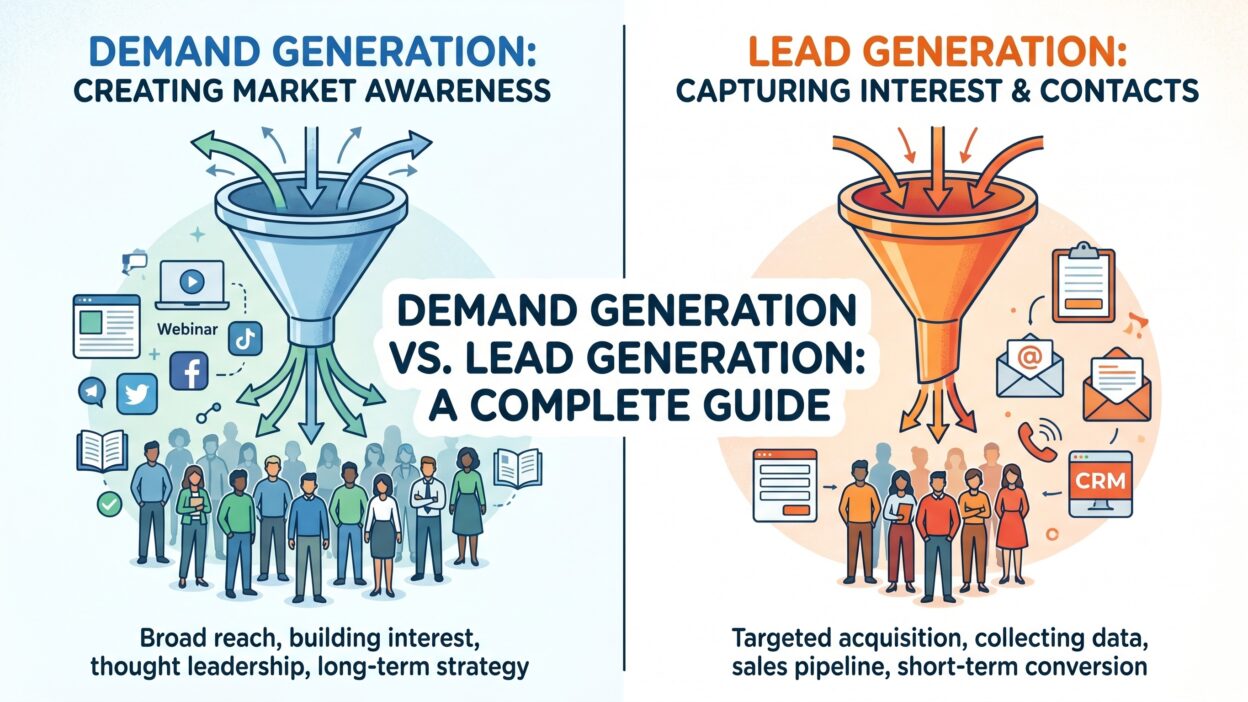
Demand Generation is a marketing strategy focused on building awareness and interest. It creates desire for your product or service before a prospect is ready to buy.
The goal of Demand Generation is not to capture a lead immediately. The goal is to make your brand the obvious choice when a buyer is ready. It plants seeds early and nurtures long-term buying intent.
Demand Generation covers a wide range of activities. Content marketing, social media, podcasts, webinars, and brand campaigns all fall under this umbrella. Each activity builds familiarity and trust over time.
Think of Demand Generation as the effort to grow your total addressable market. You educate people who may not yet know they have a problem. You position your brand as the trusted authority in your space.
B2B marketers rely heavily on Demand Generation. Enterprise buying cycles are long. Decision-makers consume a lot of content before they speak to a salesperson. A strong Demand Generation engine ensures your brand stays top of mind throughout that journey.
Demand Generation requires patience. Results are not always immediate. However, the long-term compounding effect on pipeline and revenue is significant.
What Is Lead Generation?
Lead Generation is the process of capturing contact information from potential buyers. It converts anonymous interest into identifiable prospects that sales teams can pursue.
Lead Generation focuses on the bottom of the marketing funnel. It targets people who have already shown some level of interest. A person who downloads a whitepaper, fills out a demo request form, or signs up for a free trial is a lead.
The mechanics of Lead Generation are direct. Marketers offer something of value in exchange for contact details. This could be a report, a tool, a consultation, or a discount.
Lead Generation produces measurable outputs. Number of leads generated, cost per lead, and lead-to-opportunity conversion rate are all trackable metrics. These numbers give marketing teams clear performance data.
Sales teams depend on Lead Generation to fill their pipeline. Without a steady flow of leads, sales representatives cannot meet their targets. Marketing and sales alignment is essential for Lead Generation to work effectively.
Lead Generation often uses gated content. A prospect fills out a form to access a resource. That action creates a data record that marketing automation systems can track and nurture.
Paid advertising, landing pages, email campaigns, and events are core Lead Generation tools. Each tactic aims at one outcome — getting a qualified contact into the CRM.
Demand Generation vs Lead Generation — The Core Differences
Understanding Demand Generation vs Lead Generation starts with recognising their fundamental differences. They serve different stages of the buyer journey and operate with different timelines, metrics, and tactics.
Purpose and Goal
Demand Generation builds awareness, trust, and market appetite. It operates at the top and middle of the funnel. Lead Generation captures intent and converts interest into actionable contacts. It operates primarily at the bottom of the funnel.
In Demand Generation vs Lead Generation, the former is about reach and the latter is about conversion. Both matter, but they answer different questions. Demand Generation answers: “Do people know we exist and why we matter?” Lead Generation answers: “Can we turn that interest into a sales conversation?”
Metrics and Measurement
Demand Generation metrics include brand awareness, website traffic, content engagement, social reach, and share of voice. These are often harder to attribute directly to revenue in the short term.
Lead Generation metrics are more direct. Cost per lead, lead volume, form conversion rates, and marketing qualified lead (MQL) counts are typical KPIs. Sales teams also track lead-to-opportunity and opportunity-to-close rates.
In the Demand Generation vs Lead Generation debate, measurement is a critical point of difference. Demand Generation requires more sophisticated attribution models. Lead Generation ties more easily to revenue in short reporting cycles.
Content and Tactics
Demand Generation uses ungated, freely accessible content. Blog posts, YouTube videos, social media content, podcasts, and free tools all create awareness without asking for anything in return.
Lead Generation relies on gated content and direct response mechanisms. Ebooks, templates, demo requests, webinar registrations, and free trials ask for contact information.
This distinction in Demand Generation vs Lead Generation is important. Some organisations gate everything and wonder why their content fails to build authority. Others never capture leads and struggle to show marketing ROI.
Audience Targeting
Demand Generation casts a wider net. It targets anyone who might benefit from your product or who influences buying decisions. It builds familiarity across an entire market segment.
Lead Generation targets more precisely. It focuses on individuals who match your ideal customer profile and have shown explicit interest. Targeting criteria include job title, company size, industry, and recent behaviour.
Why Both Strategies Matter Together
The real insight in Demand Generation vs Lead Generation is that you need both. These strategies are not competing approaches. They are complementary stages of a complete revenue marketing engine.
A brand that only runs Demand Generation builds awareness but struggles to convert it. A brand that only runs Lead Generation burns out its existing demand and sees cost per lead rise over time.
The most effective marketing organisations integrate both. They use Demand Generation to grow their market and build a pipeline of future buyers. They use Lead Generation to capture the buyers who are ready now.
Think of it as a river analogy. Demand Generation fills the river upstream. Lead Generation captures the water flowing downstream. Without upstream effort, the downstream dries up. Without downstream capture, the water flows past unused.
High-performing B2B companies invest in content that educates the market broadly. They then deploy lead capture mechanisms to identify the subset of that audience ready to engage with sales. This integrated approach drives both short-term pipeline and long-term market growth.
The Buyer Journey and How Each Strategy Fits
Awareness Stage
At the awareness stage, a potential buyer recognises they have a challenge. They search for information and consume content. They are not ready to speak with sales.
Demand Generation owns this stage. Educational blog posts, social content, thought leadership, and video content all serve awareness-stage buyers. The goal is to be helpful, not to sell.
Marketers who push Lead Generation too early at the awareness stage lose prospects. Asking someone who just discovered your brand to fill out a form creates friction. Patience here pays dividends later.
Consideration Stage
At the consideration stage, buyers compare options. They evaluate vendors and explore solutions in depth. This is where Demand Generation and Lead Generation begin to overlap.
Webinars, comparison guides, case studies, and detailed content serve this stage well. Some of this content can be gated because the buyer now has enough interest to share their contact details.
This middle-ground is often the most productive area in Demand Generation vs Lead Generation strategy. A buyer in the consideration stage is warm. Gentle lead capture here produces higher quality leads than aggressive bottom-funnel tactics.
Decision Stage
At the decision stage, a buyer is close to purchasing. They evaluate specific vendors, review pricing, and seek validation. Lead Generation tactics are most effective here.
Free trials, demo requests, consultations, and pricing page visits signal high purchase intent. Marketing teams should prioritise these signals and pass them to sales immediately.
Common Mistakes Marketers Make in Demand Generation vs Lead Generation
Many marketing teams make predictable errors when managing these two strategies. Understanding these mistakes helps you avoid them.
Over-gating content is the most common error. Brands that put every piece of content behind a form starve their own Demand Generation engine. They slow distribution, reduce organic reach, and frustrate potential buyers. Free content builds trust faster than gated content.
Measuring Demand Generation with Lead Generation metrics creates false conclusions. When a company evaluates a brand awareness campaign using cost per lead, it always looks like a failure. Demand Generation requires different measurement frameworks. Use reach, engagement rate, pipeline influence, and brand lift instead.
Neglecting nurture sequences after Lead Generation is another costly mistake. Capturing a lead and doing nothing with it wastes budget. Marketing automation must move leads through a structured nurture journey until they are sales-ready.
Running both strategies in silos prevents integration. When the demand team and the lead team do not communicate, campaigns conflict and messaging becomes inconsistent. Integrated planning produces far better results.
Focusing only on volume in Lead Generation destroys sales efficiency. More leads are not always better leads. High-volume, low-quality lead generation frustrates sales teams and wastes their time. Quality always outperforms quantity over a full-year cycle.
Building a Demand Generation Strategy
A strong Demand Generation strategy starts with audience clarity. Know exactly who you are trying to reach. Understand their problems, questions, and information consumption habits.
Content is the engine of Demand Generation. Create content that genuinely helps your audience. Answer the questions they are already asking. Publish consistently across the channels where your audience spends time.
SEO is a foundational Demand Generation channel. Ranking for the terms your audience searches builds a steady stream of organic awareness. Each blog post, guide, or video that ranks compounds over time.
Social media amplifies Demand Generation content. LinkedIn is the primary platform for B2B Demand Generation. Executives, practitioners, and decision-makers engage with educational and insightful content there daily.
Podcasts and video content expand Demand Generation reach. Audio and video formats reach buyers who prefer consuming content outside of text. A well-produced podcast positions your brand as a category authority.
Community building accelerates Demand Generation. Brands that create or sponsor communities relevant to their audience generate enormous goodwill and sustained attention. Slack groups, forums, and live events all build market presence.
Paid social can boost Demand Generation too. Ungated content promoted through paid channels extends reach to new audiences. The goal is exposure, not immediate conversion.
Building a Lead Generation Strategy
A successful Lead Generation strategy starts with a clear understanding of your ideal customer profile. Know who you want to capture. Build your targeting criteria before you build your campaigns.
Landing pages are the backbone of Lead Generation. A focused landing page with a single call to action converts better than a cluttered page with multiple options. Test headlines, copy, and form length consistently.
Lead magnets drive form submissions. The value of the offer must justify the friction of giving up contact details. A generic ebook performs poorly. A specific, actionable resource that solves a real problem converts well.
Paid search is a powerful Lead Generation channel. People searching for your solution type are already aware of the problem. Capturing them at this intent-rich moment produces high-quality leads. Google Ads and Bing Ads both serve this function.
Email marketing drives Lead Generation from existing audiences. Sending targeted campaigns to subscribers with a specific, high-value offer produces measurable lead capture. Segmentation improves results significantly.
Retargeting campaigns support Lead Generation efficiently. People who visited your website showed interest but did not convert. Retargeting keeps your brand in front of them and encourages return visits and form completions.
Events and webinars generate leads directly. Registration data gives you contact information and demonstrated interest. Follow-up sequences after events convert attendees into opportunities.
Aligning Sales and Marketing Around Both Strategies
Sales and marketing alignment is critical in the Demand Generation vs Lead Generation model. When these teams operate in isolation, revenue suffers.
Marketing must define what a qualified lead looks like. Sales must agree on that definition. A shared understanding of the MQL prevents finger-pointing when conversion rates disappoint.
Service Level Agreements (SLAs) between sales and marketing formalise the relationship. Marketing commits to a volume of qualified leads. Sales commits to follow up within a defined time period. SLAs create accountability on both sides.
Regular pipeline reviews improve alignment. When marketing attends sales team meetings, they hear first-hand feedback on lead quality. This insight shapes better Demand Generation and Lead Generation decisions.
CRM data is the shared language of both teams. Marketing uses CRM insights to understand which content and campaigns influence pipeline. Sales uses CRM to track lead activity and prioritise outreach.
Revenue attribution models help both teams see contribution clearly. First-touch attribution credits Demand Generation activities that first brought a prospect to the brand. Last-touch attribution credits Lead Generation activities that converted them. Multi-touch models show the full picture.
Technology Stack for Demand Generation and Lead Generation
The right tools make both strategies more effective and measurable.
Marketing automation platforms like HubSpot, Marketo, and Pardot manage lead capture, nurture sequences, and lead scoring. They connect Demand Generation activity to Lead Generation outcomes.
CRM systems like Salesforce and HubSpot CRM store lead and contact data. They provide the pipeline visibility that both marketing and sales teams need.
Content management systems (CMS) power Demand Generation content. WordPress, Webflow, and similar platforms host blog content, landing pages, and resource libraries.
SEO tools like Ahrefs, SEMrush, and Moz support keyword research and content planning for Demand Generation. They also identify opportunities to rank for intent-rich queries that support Lead Generation.
Analytics platforms like Google Analytics 4 and Mixpanel track content performance and user behaviour. They provide the data needed to understand what drives awareness and what drives conversion.
Advertising platforms including Google Ads, Meta Ads, and LinkedIn Campaign Manager support both strategies. Paid reach builds demand. Paid capture generates leads. Clear campaign objectives keep each strategy on track.
Heatmap and conversion rate optimisation tools like Hotjar and Optimizely improve Lead Generation landing pages. Small improvements to form design or page layout can significantly increase conversion rates.
Measuring Success Across Both Strategies
Measurement is where many companies struggle with Demand Generation vs Lead Generation. The metrics look very different and require different timeframes to evaluate.
For Demand Generation, track organic traffic growth month over month. Monitor branded search volume as a proxy for awareness. Measure content engagement including time on page, scroll depth, and social shares. Track pipeline influenced by Demand Generation activities using UTM parameters and CRM attribution.
For Lead Generation, track lead volume by channel. Measure cost per lead and cost per marketing qualified lead. Monitor lead-to-opportunity conversion rates. Track the average time from lead creation to sales qualified status.
For integrated reporting, build a funnel view that connects both strategies. Start with market reach at the top and move through engagement, lead capture, pipeline, and closed revenue. This full-funnel view shows how Demand Generation feeds Lead Generation and how Lead Generation feeds revenue.
Executive teams want revenue impact. Build reports that connect marketing activity to pipeline contribution. Show how Demand Generation expands pipeline over time and how Lead Generation accelerates deals in the near term.
Related Concepts
Inbound Marketing and Its Relationship to Both Strategies
Inbound marketing is closely related to Demand Generation vs Lead Generation. Inbound methodology uses content and SEO to attract buyers organically. It incorporates both awareness-building and lead capture within a single framework.
HubSpot popularised the inbound model. The attract, engage, and delight stages map closely to Demand Generation at the attract phase and Lead Generation at the engage phase.
Account-Based Marketing (ABM) and Demand Generation
ABM focuses marketing efforts on specific target accounts rather than broad audiences. It is a focused form of both Demand Generation and Lead Generation simultaneously.
In an ABM model, Demand Generation creates awareness among stakeholders within target accounts. Lead Generation then captures intent signals from those same accounts. The combination drives highly targeted pipeline.
Content Marketing as a Bridge
Content marketing serves both strategies. Ungated content drives Demand Generation. Gated content drives Lead Generation. A smart content strategy uses the same topic cluster to serve both purposes.
A company might publish a free blog post on a topic to drive Demand Generation. It then offers a deeper downloadable guide on the same topic to drive Lead Generation. This strategy maximises the value of every content investment.
FAQs on Demand Generation vs Lead Generation
What is the main difference between Demand Generation and Lead Generation?
Demand Generation builds awareness and market interest. Lead Generation captures that interest as identifiable contacts. In Demand Generation vs Lead Generation, the former creates the market and the latter harvests it.
Which strategy should a startup prioritise first?
Startups with limited budgets often prioritise Lead Generation for immediate pipeline. However, ignoring Demand Generation entirely means leads become more expensive over time as awareness stays low. A minimal Demand Generation investment alongside Lead Generation is always recommended.
Can Demand Generation directly produce leads?
Yes. A blog post that ranks well and includes a relevant call to action produces leads passively. Demand Generation content that earns trust naturally drives some visitors to request demos or sign up for trials. The two strategies are not mutually exclusive.
How do you measure Demand Generation ROI?
Demand Generation ROI is best measured through pipeline influence. Track how many deals had interaction with your Demand Generation content. Also track branded search growth, organic traffic trends, and audience engagement over time.
What is the ideal budget split between Demand Generation and Lead Generation?
There is no single answer. Many experts suggest a 60/40 split favouring Demand Generation in the long term. Short-term revenue pressure often pushes teams toward heavier Lead Generation investment. The right balance depends on your pipeline health, growth stage, and sales cycle length.
Is email marketing Demand Generation or Lead Generation?
Email marketing serves both purposes. Newsletters and educational emails to existing subscribers build demand. Targeted email campaigns with a specific offer and call to action generate leads. The tactic is the same; the goal determines the category.
How do SaaS companies typically approach Demand Generation vs Lead Generation?
SaaS companies often lead with free trials or freemium products for Lead Generation. They build Demand Generation through content, community, and thought leadership. Product-led growth companies blur the line further by using the product itself as both a demand and lead generation tool.
Read More:-How to Improve NPS: 7 Tactics to Turn Customer Feedback into Revenue Growth
Conclusion

Demand Generation vs Lead Generation is not a debate about which strategy wins. It is a recognition that both strategies play essential roles in a complete marketing programme.
Demand Generation builds the market. It earns trust, creates awareness, and develops the pipeline of future buyers. Without it, Lead Generation becomes an expensive and diminishing activity over time.
Lead Generation converts that market. It captures ready buyers, fills the CRM, and gives sales teams the contacts they need to close deals. Without it, Demand Generation creates awareness with no commercial outcome.
The best marketing teams understand this distinction clearly. They invest in Demand Generation consistently. They deploy Lead Generation strategically. They align both strategies to the buyer journey and measure each with appropriate metrics.
The marketers who grow the fastest are not those who pick one strategy over the other. They are the ones who build both engines simultaneously and integrate them into a single, coherent revenue marketing machine.
Start by auditing your current strategy. Identify where the gaps are. Build the missing engine, integrate both approaches, and watch your pipeline grow with greater predictability and strength.