Introduction
TL;DR Every June, something predictable happens across corporate America and beyond. Brand logos turn rainbow. Social media feeds fill with colourful posts. Press releases announce partnerships with LGBTQ+ organisations. Some of these efforts earn genuine applause. Others earn something far less flattering — the word “rainbow-washing.”
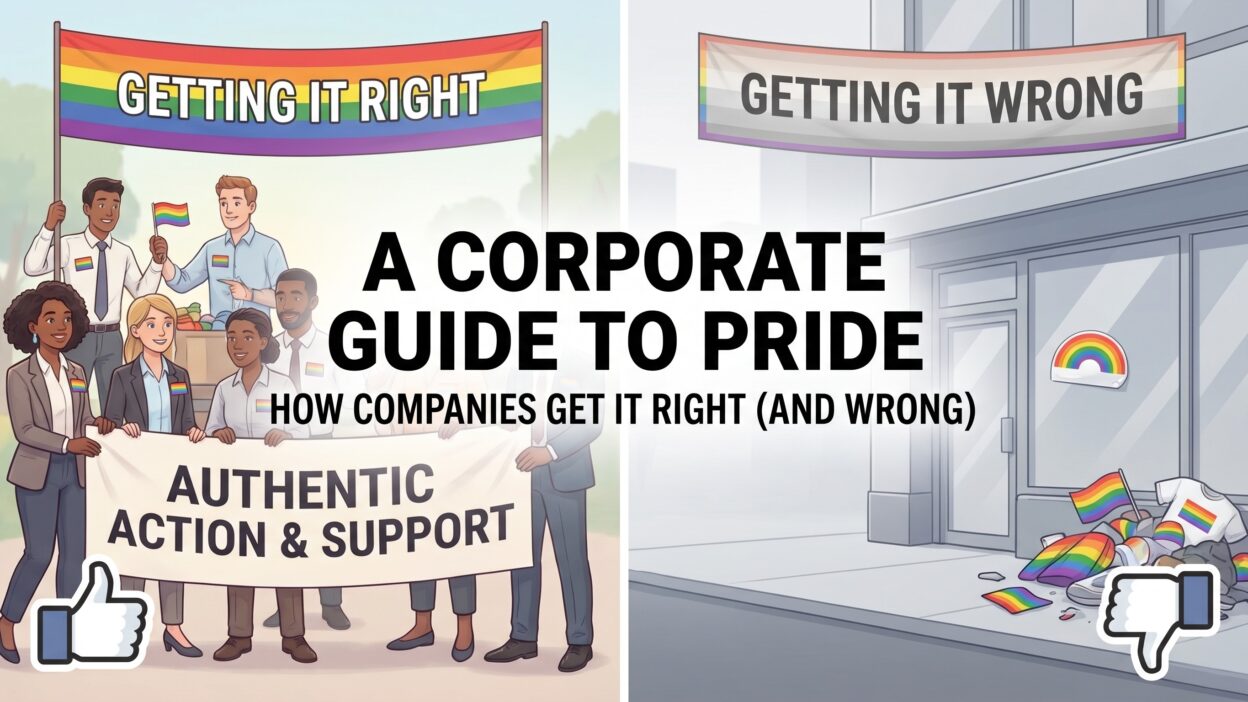
This Corporate Guide to Pride exists to help businesses do better. It separates meaningful commitment from shallow performance. It gives leaders, marketers, HR teams, and communications professionals a clear framework for engaging with Pride Month in a way that is honest, impactful, and lasting.
Getting Pride right matters more than ever. Employees, customers, and communities expect companies to stand for something real. A misaligned Pride campaign does not just fall flat — it actively damages trust, reputation, and employee morale.
This guide covers what great corporate Pride engagement looks like, what common mistakes reveal about a company’s true values, and how to build a year-round approach that earns respect rather than criticism.
Table of Contents
Why Corporate Engagement With Pride Matters
Pride Month commemorates the Stonewall Uprising of 1969. It celebrates LGBTQ+ identity, resilience, and the ongoing fight for equal rights. It is not a marketing season. It is a cultural and human rights moment.
When companies engage thoughtfully with Pride, they signal something important. They tell LGBTQ+ employees they are safe, respected, and valued. They tell customers with LGBTQ+ identities or allies that the brand shares their values. They contribute to a broader culture of inclusion that benefits everyone.
The business case is clear and substantial. McKinsey research consistently shows that diverse and inclusive companies outperform their peers financially. Deloitte surveys show that LGBTQ+ employees who feel included are significantly more productive, more loyal, and more likely to recommend their employer.
Consumer data reinforces the point. A majority of consumers, including those outside the LGBTQ+ community, prefer to buy from brands that demonstrate genuine commitment to equality. Brand loyalty and purchase intent both increase when consumers perceive authentic corporate values.
A Corporate Guide to Pride must begin with this understanding. Engagement with Pride is not just a branding decision. It is a signal about who a company is, what it stands for, and whether its stated values are reflected in real behaviour.
The Difference Between Authentic Engagement and Rainbow-Washing
Rainbow-washing is the practice of displaying Pride symbols and imagery without substantive commitment to LGBTQ+ equality. It is performative. It is transactional. It prioritises optics over impact.
Every Corporate Guide to Pride must address rainbow-washing directly because it is the most common and most damaging mistake companies make during June.
The signs of rainbow-washing are usually obvious to anyone paying attention. A company changes its logo to a rainbow version in June and reverts in July. The same company donates to politicians who vote against LGBTQ+ rights. Its internal policies offer no protections for LGBTQ+ employees. Its leadership team has no visible LGBTQ+ representation.
These contradictions do not go unnoticed. LGBTQ+ employees, consumers, and advocacy organisations track corporate behaviour year-round. When a company’s June communications contradict its year-round actions, the backlash can be swift and damaging.
Authentic engagement looks fundamentally different. It is grounded in internal policy, not just external communication. It starts from within the organisation and reflects genuine cultural commitment. A company that practices authentic Pride engagement does not need to decide what to post in June — the activities and commitments exist already.
The distinction matters enormously. Authenticity builds trust over years. Rainbow-washing destroys trust in a single social media thread. Every Corporate Guide to Pride must help companies choose the former and avoid the latter.
What Great Corporate Pride Engagement Looks Like
Internal Policies That Protect LGBTQ+ Employees
The foundation of any Corporate Guide to Pride is internal policy. Before a company says anything publicly about Pride, it must examine what it does internally for LGBTQ+ employees.
Non-discrimination policies must explicitly include sexual orientation and gender identity. This is a baseline expectation, not a differentiator. Companies without explicit LGBTQ+ non-discrimination protections have no credibility engaging publicly with Pride.
Healthcare benefits must be inclusive. This means covering gender-affirming care, mental health services relevant to LGBTQ+ individuals, and fertility options for same-sex couples. Inclusive benefits are a concrete demonstration of commitment that words cannot replace.
Parental leave policies must apply equally to same-sex couples and adoptive parents. Many companies still have parental leave structures that inadvertently exclude LGBTQ+ families. Reviewing and correcting these structures sends a powerful message to employees.
Anti-harassment training must address homophobia and transphobia explicitly. General workplace respect training is insufficient. LGBTQ+-specific content ensures employees understand the real experiences of their colleagues.
Bathroom and facility access must be safe and inclusive for transgender and non-binary employees. This is a practical, daily reality for trans employees that companies must address with clear policy and physical action.
Visible LGBTQ+ Leadership and Representation
A Corporate Guide to Pride must address representation honestly. If a company’s leadership is entirely non-LGBTQ+, its Pride engagement will always lack credibility.
Visible LGBTQ+ executives and leaders matter. They demonstrate that the company is a place where LGBTQ+ people can thrive and advance. They provide role models for LGBTQ+ employees at every level. They bring lived experience to decisions that affect LGBTQ+ employees and communities.
Companies should examine their hiring and promotion processes for barriers that disproportionately affect LGBTQ+ candidates. Bias in recruitment, mentorship gaps, and networking disadvantages can exclude LGBTQ+ talent from leadership pipelines without anyone intending them to.
Representation also extends to marketing and communications. Are LGBTQ+ people depicted in your advertising year-round, or only in June? Are same-sex couples and transgender individuals visible in your brand imagery? Do your campaigns reflect the full diversity of your customer base?
LGBTQ+ Employee Resource Groups
Employee Resource Groups (ERGs) are one of the most impactful structures a company can invest in as part of its Corporate Guide to Pride approach. An LGBTQ+ ERG gives employees a community, a voice, and a formal channel for influencing company policy.
Effective ERGs have executive sponsorship from senior leaders. They have dedicated budget for programming, events, and community engagement. They have a formal reporting structure that connects their recommendations to leadership decisions.
ERGs should not be entirely funded by member dues or volunteer time. This places an unfair burden on LGBTQ+ employees to manage inclusion work on top of their regular responsibilities. The company must resource ERGs properly to demonstrate genuine commitment.
The best ERGs do more than organise Pride events in June. They advise HR on policy development. They review communications for inclusive language. They connect with external LGBTQ+ organisations. They mentor LGBTQ+ employees across the company. This year-round activity is what separates meaningful ERGs from performative ones.
Partnerships With Genuine LGBTQ+ Organisations
Corporate philanthropy and partnerships are a critical component of any Corporate Guide to Pride. However, partnerships must be chosen with care and aligned with the company’s full behaviour.
Donating to LGBTQ+ organisations while simultaneously funding politicians who oppose LGBTQ+ rights is not a partnership — it is contradiction. Companies that do this face legitimate and severe criticism.
Strong partnerships are long-term and financially meaningful. A one-time donation during Pride Month is easily forgotten. A multi-year commitment that funds specific programmes, supports advocacy, or enables community services is far more impactful.
Look for organisations that do grassroots work and direct service delivery. The Trevor Project, PFLAG, GLSEN, Lambda Legal, and local LGBTQ+ community centres are examples of organisations with direct, measurable impact on LGBTQ+ lives.
Involve LGBTQ+ employees in selecting and evaluating partner organisations. They will identify the most credible and impactful options and ensure the partnership reflects real community needs rather than brand optics.
The Most Common Corporate Pride Mistakes
Changing the Logo and Nothing Else
This is the most widely mocked form of corporate Pride engagement. A rainbow logo in June signals exactly nothing without corresponding internal action. It has become a symbol of corporate insincerity rather than corporate inclusion.
Every Corporate Guide to Pride should flag this trap explicitly. A rainbow logo is not a policy. It is not a benefit. It is not a donation. It is a graphic design choice that costs nothing and changes nothing. Employees and consumers know this. Deploying it as the primary Pride gesture invites ridicule and distrust.
If a company changes its logo for Pride, that visual action must be the smallest part of a much larger and more substantive commitment. On its own, it is meaningless at best and damaging at worst.
Pride Campaigns That Disappear on July 1st
A Corporate Guide to Pride must address the calendar problem head-on. LGBTQ+ rights and identities do not switch off in July. Employees with LGBTQ+ identities experience their workplaces 365 days a year. Customers with LGBTQ+ identities engage with brands year-round.
Companies that celebrate Pride loudly in June and go silent immediately afterwards send an unmistakable message. Their commitment is seasonal. Their support is marketing. Their values are conditional.
Genuine corporate Pride engagement does not disappear when June ends. Inclusive hiring continues in July. Anti-discrimination policies apply in September. LGBTQ+ ERG programming happens in November. Partnerships fund community organisations in February. Year-round consistency is what transforms a Pride campaign into a Pride commitment.
Ignoring the T in LGBTQ+
Many corporate Pride programmes focus heavily on LGB identities and significantly underserve the transgender and non-binary community. This is a serious and common gap that any responsible Corporate Guide to Pride must address.
Transgender employees face specific, acute challenges in workplaces. These include bathroom access, dead-naming, misgendering, healthcare coverage for gender-affirming care, and legal name change support in HR systems.
Generic LGBTQ+ commitments do not automatically address these challenges. Companies must explicitly examine how their policies, benefits, and culture affect transgender and non-binary employees specifically.
Communications during Pride should reflect the full breadth of LGBTQ+ identity. Transgender visibility, non-binary inclusion, and bisexual representation all deserve explicit acknowledgment, not just the rainbow umbrella.
Marketing to LGBTQ+ Consumers Without Internal Commitment
Some companies see Pride as a revenue opportunity. They launch limited-edition rainbow products, target LGBTQ+ consumers with ads, and donate a percentage of sales to LGBTQ+ causes. Meanwhile, their internal culture remains hostile or indifferent to LGBTQ+ employees.
This approach is ethically indefensible. It extracts commercial value from LGBTQ+ identity while refusing to protect LGBTQ+ people within the company itself.
LGBTQ+ consumers are sophisticated and well-connected. Word travels fast within LGBTQ+ communities when a brand’s external marketing contradicts its internal reality. The reputational damage from this discovery is severe and lasting.
How to Build a Year-Round Corporate Pride Strategy
A truly effective Corporate Guide to Pride is not a June playbook. It is a year-round strategic framework that embeds LGBTQ+ inclusion into every function of the business.
Start with an honest internal audit. Assess current HR policies, benefits, ERG infrastructure, leadership representation, training programmes, and partner relationships. Identify the gaps between stated values and actual practice. Be honest about what needs improvement.
Set specific, measurable goals for LGBTQ+ inclusion. Vague commitments like “we value diversity” produce no accountability and no improvement. Measurable goals like “by next year, 100% of managers will complete LGBTQ+ inclusive leadership training” create accountability.
Report publicly on progress. Many companies publish annual diversity, equity, and inclusion reports. The strongest reports include specific LGBTQ+ data, policy updates, ERG activity, and partnership outcomes. Transparency builds credibility. It also creates internal pressure to deliver on commitments.
Involve LGBTQ+ employees in designing and evaluating inclusion programmes. The people with lived experience should shape the policies and programmes that affect them. Designing inclusion from above, without the input of those being included, produces programmes that miss the mark.
Train leaders first. Inclusive culture starts at the top. Managers who do not understand LGBTQ+ issues will undermine even the strongest formal policies. Leadership training on creating psychologically safe environments for LGBTQ+ employees must precede broader staff training.
Engage the community beyond the workplace. Sponsor local Pride events. Support LGBTQ+ youth organisations. Provide pro bono services to LGBTQ+ nonprofits. Corporate engagement with the wider LGBTQ+ community demonstrates commitment that extends beyond the employee base.
Communication Strategy for Corporate Pride
Internal Communications First
A Corporate Guide to Pride must prioritise internal communications before external ones. LGBTQ+ employees should hear about company Pride commitments from their employer before they see them on social media.
Internal communications during Pride should acknowledge the significance of the month. They should highlight specific company actions — new policies, new partnerships, ERG events, and leadership commitments. They should signal that the company’s commitment is substantive and ongoing.
Leaders who speak directly and personally about their commitment to LGBTQ+ inclusion carry significant influence. A CEO who shares a genuine, personal message about why inclusion matters creates far more cultural impact than a corporate press release.
External Communications and Social Media
External Pride communications must be grounded in substance. Every claim made publicly must be supported by corresponding internal action. Claims without substance invite investigation and criticism.
Avoid generic, interchangeable Pride messaging. Statements like “we support the LGBTQ+ community” tell nobody anything meaningful. Specific communications that reference actual policies, actual partnerships, and actual programmes build credibility.
Social media content should feature real employees, real partners, and real stories. Authentic storytelling outperforms stock photography and generic rainbow graphics. When LGBTQ+ employees and allies choose to share their experiences, amplify those voices with their permission and support.
Be prepared for criticism. Even well-intentioned companies receive critical feedback during Pride. Respond to criticism with honesty and openness. Do not delete critical comments. Do not become defensive. Acknowledge gaps, describe what the company is doing to address them, and invite ongoing dialogue.
Measuring the Impact of Corporate Pride Engagement
Every Corporate Guide to Pride should include a measurement framework. Without data, companies cannot know whether their efforts are making a difference.
Employee sentiment surveys specifically addressing LGBTQ+ inclusion provide essential feedback. Ask LGBTQ+ employees whether they feel safe, respected, and included. Ask whether they see themselves represented in leadership. Ask whether company policies meet their needs. Track these scores over time and respond to negative findings with action.
External reputation metrics matter too. Monitor media coverage of company Pride activity. Track social media sentiment during Pride Month. Monitor LGBTQ+ community publication reviews and advocacy organisation assessments. Tools like Glassdoor and LinkedIn provide further signals of how the company’s culture is perceived externally.
Track ERG participation, programme attendance, and policy uptake. Growing ERG membership signals improving psychological safety. Increasing uptake of inclusive benefits signals that employees trust and use company resources. These operational metrics complement sentiment data to give a fuller picture.
Benchmark against the Corporate Equality Index. The Human Rights Campaign’s Corporate Equality Index scores companies across a range of LGBTQ+ workplace policies and practices. A strong CEI score reflects genuine commitment. A weak score identifies specific areas for improvement. Many companies use CEI benchmarks to structure their LGBTQ+ inclusion roadmaps.
Diversity, Equity, and Inclusion Strategy
LGBTQ+ inclusion is one component of a broader Diversity, Equity, and Inclusion (DEI) strategy. A Corporate Guide to Pride should exist within, not separate from, a company’s overall DEI framework.
Strong DEI strategies address multiple dimensions of identity including race, gender, disability, age, and sexual orientation simultaneously. Intersectionality — the way multiple identities interact to create unique experiences — should inform DEI programme design at every level.
Rainbow Capitalism and Its Critics
Rainbow capitalism refers to the commercialisation of LGBTQ+ identity for profit without genuine commitment to LGBTQ+ rights. Critics within the LGBTQ+ community have raised valid concerns about corporate Pride engagement that prioritises brand visibility over community wellbeing.
A credible Corporate Guide to Pride must acknowledge this critique honestly. Companies that engage with Pride must do so in a way that serves the community, not just the brand. The distinction between corporate support that advances rights and corporate visibility that extracts value is a critical one.
FAQs About Corporate Pride Engagement
What is rainbow-washing and how do I avoid it?
Rainbow-washing means displaying Pride symbols without substantive LGBTQ+ commitments behind them. Avoid it by ensuring every public Pride communication reflects real internal policy, practice, and investment. If your company cannot point to specific LGBTQ+ inclusive policies, benefits, and partnerships, do not lead with a rainbow logo.
Should our company take a public stance on LGBTQ+ legislation?
This is a decision that requires genuine conviction and internal alignment. Companies that speak publicly on LGBTQ+ legislation must be prepared for polarised reactions. The credibility of any public stance depends entirely on the company’s internal LGBTQ+ record. A company with strong LGBTQ+ inclusive policies speaks from a position of integrity. A company without them does not.
How do we engage with Pride if we have LGBTQ+ employees who do not want public attention?
Not all LGBTQ+ employees want their employer to speak on their behalf. Consult your LGBTQ+ ERG and conduct employee surveys before designing public Pride communications. Design programmes that celebrate and protect without exposing those who prefer privacy. Individual choice must always be respected.
What is the Corporate Equality Index?
The Corporate Equality Index is an annual benchmarking tool published by the Human Rights Campaign Foundation. It assesses companies across a range of LGBTQ+ workplace policies including non-discrimination protections, inclusive benefits, ERG support, and public commitment to LGBTQ+ equality. A perfect score of 100 reflects exemplary practice. Many companies use the CEI as a roadmap for improving their LGBTQ+ inclusion programmes.
How do we support transgender employees specifically?
Start with explicit transgender-inclusive non-discrimination policies. Ensure healthcare benefits cover gender-affirming care. Create gender-neutral bathroom access. Train managers on correct pronoun usage and dead-naming avoidance. Update HR systems to accommodate name and pronoun changes without requiring legal name change. Consult with transgender employees directly about their needs and priorities.
Is it appropriate to sell Pride merchandise?
Selling Pride merchandise is appropriate only when it is accompanied by genuine internal commitment and meaningful charitable contribution. If a company sells Pride products and donates a portion of proceeds to LGBTQ+ causes, that contribution must be transparent and substantial. Selling rainbow products while maintaining policies or partnerships that harm LGBTQ+ people is exploitative and will damage the brand.
How do we handle backlash for supporting Pride?
Backlash for supporting Pride is a real phenomenon that some companies face. The appropriate response is calm, consistent restatement of company values. Companies that cave to anti-LGBTQ+ pressure campaigns damage their credibility with LGBTQ+ employees, consumers, and allies far more than any boycott threat. Stand by genuine commitments with clear, confident communication.
Read More:-B2B Marketing Strategy: A Data-Driven Guide for GTM Teams
Conclusion

A Corporate Guide to Pride is ultimately a guide to integrity. The companies that get Pride right are not the ones with the most elaborate June campaigns. They are the ones whose June communications reflect a year-round reality of inclusion, protection, and genuine respect for LGBTQ+ people.
The mistakes are avoidable. Rainbow logos without policy. June campaigns without July commitment. LGB focus without transgender inclusion. Consumer marketing without internal protection. Every one of these errors reveals a gap between brand voice and organisational values.
The path forward is clear. Build the internal foundation first. Create policies that protect. Invest in benefits that include. Fund ERGs that give LGBTQ+ employees voice and community. Partner with organisations that do real work in LGBTQ+ communities. Train leaders who model inclusion every day.
Every Corporate Guide to Pride should remind companies of one fundamental truth. LGBTQ+ employees do not need rainbows in June. They need safety, respect, fair pay, inclusive benefits, and career advancement opportunities every single day of the year.
When companies deliver on those fundamentals consistently, their Pride communications become credible expressions of who they actually are. When they do not, their Pride campaigns become evidence of who they are not.
Choose authenticity. Build the internal culture that earns the right to celebrate publicly. Engage with Pride as an ongoing commitment rather than an annual campaign. That is how companies get it right — and it is the only way that matters.