Introduction
Every revenue team wants more pipeline. Every CMO wants marketing to prove its contribution to closed deals. The answer to both demands starts with one foundational concept — the B2B Marketing Funnel.
Understanding the B2B Marketing Funnel is not optional for modern marketers. It defines how buyers move from strangers to customers. It reveals where deals stall, where budget gets wasted, and where the biggest growth opportunities hide.
This guide approaches the B2B Marketing Funnel through a data-driven lens. You will learn what each stage demands, how to measure performance at every layer, and how to convert pipeline with consistency and precision. Whether you are building your first funnel or optimising an existing one, this guide gives you the framework and the tactics to execute with confidence.
Table of Contents
What Is the B2B Marketing Funnel?
The B2B Marketing Funnel is a framework that maps the journey a business buyer takes from initial awareness to a closed deal. It represents the progression of prospects as they move through stages of awareness, consideration, evaluation, and purchase.
The term “funnel” reflects a simple truth. A large number of potential buyers enter at the top. A smaller, qualified subset reaches the bottom and converts into customers. The funnel narrows at every stage as unqualified or disengaged prospects fall away.
Unlike the B2C buying journey, the B2B Marketing Funnel involves multiple decision-makers, longer evaluation periods, and more complex criteria. An enterprise software deal might involve a procurement team, an IT director, a CFO, and several end-users. Each stakeholder has different priorities and consumes different content.
The B2B Marketing Funnel also reflects a shared responsibility between marketing and sales. Marketing owns the top of the funnel. Sales owns the bottom. Both share accountability for the middle, where deals are most likely to stall.
Understanding this framework in depth allows revenue teams to allocate budget correctly, set realistic targets, and identify bottlenecks before they damage pipeline. A company that manages its B2B Marketing Funnel with data makes better decisions at every stage.
The Stages of the B2B Marketing Funnel
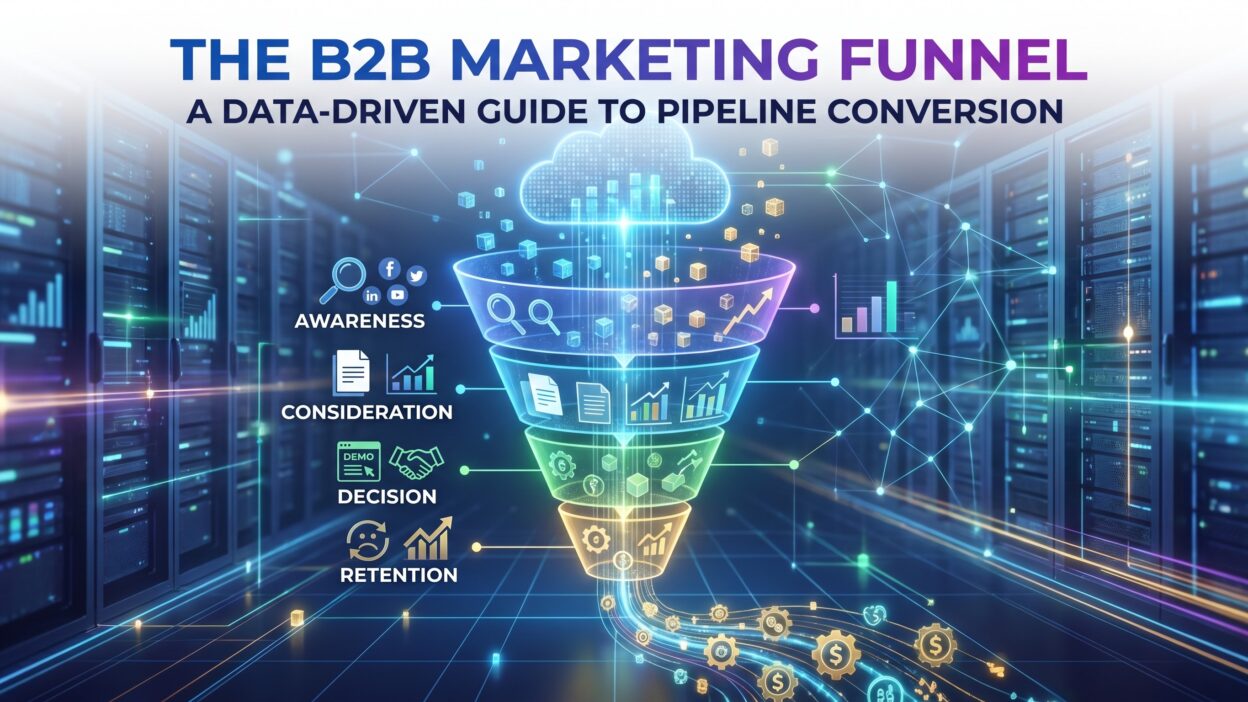
The B2B Marketing Funnel divides into three broad zones. Each zone has distinct buyer needs, marketing tactics, and performance metrics.
Top of Funnel — Awareness and Discovery
The top of the B2B Marketing Funnel is about reach and relevance. At this stage, potential buyers become aware that a problem exists and that solutions are available. They are not yet evaluating vendors. They are seeking information and education.
Marketing at this stage focuses on visibility. SEO-driven content, social media presence, thought leadership, paid social advertising, and PR activity all drive awareness. The goal is to place your brand in front of the right audience at the moment they begin searching for answers.
Content at the top of funnel must deliver genuine value without selling. Educational blog posts, original research reports, data-driven insights, and expert commentary perform well here. Buyers at this stage reward brands that inform rather than pitch.
Key performance metrics at the top of the B2B Marketing Funnel include organic traffic volume, content engagement rates, social reach, branded search impressions, and top-of-funnel lead volume. These metrics reflect how effectively your brand attracts attention in a competitive market.
The volume of prospects entering the top of the funnel directly influences everything downstream. A weak top of funnel means a starved pipeline further down. Investing in top-of-funnel activity is not a vanity exercise — it is a pipeline necessity.
Middle of Funnel — Consideration and Engagement
The middle of the B2B Marketing Funnel is where intent deepens. Buyers in this stage know they have a problem and actively compare solutions. They read case studies, attend webinars, download detailed guides, and request peer reviews.
This stage is where marketing and sales alignment becomes critical. Marketing must deliver content that addresses evaluation criteria. Sales must follow up with relevant, timely outreach that builds on the content a prospect has consumed.
Lead nurturing is the primary activity in the middle of the B2B Marketing Funnel. Marketing automation sequences guide prospects through personalised content journeys based on their behaviour and interests. Each interaction advances the relationship and builds confidence in your solution.
Account-Based Marketing (ABM) is highly effective at the middle of funnel. Identifying high-value target accounts and deploying personalised content and outreach to multiple stakeholders within those accounts accelerates consideration and shortens evaluation timelines.
Mid-funnel metrics include marketing qualified lead (MQL) volume, email engagement rates, content download rates, webinar attendance, lead-to-MQL conversion rate, and sales accepted lead (SAL) rate. These metrics reveal how effectively marketing converts awareness into genuine consideration.
Bottom of Funnel — Evaluation and Conversion
The bottom of the B2B Marketing Funnel is where intent becomes action. Buyers in this stage evaluate specific vendors, negotiate commercial terms, and seek validation before committing.
Marketing plays a supporting role at this stage. Sales conversations dominate. However, marketing content remains influential. ROI calculators, competitive comparison guides, detailed implementation case studies, and analyst reports all support final-stage evaluation.
Free trials, product demos, and proof-of-concept engagements are the most powerful conversion tools at the bottom of the B2B Marketing Funnel. They reduce perceived risk and give buyers the evidence they need to justify a decision internally.
Sales enablement materials must be sharp and accessible here. A well-prepared sales team with strong content assets closes deals faster. When marketing equips sales with the right tools, conversion rates at the bottom of funnel improve measurably.
Bottom-of-funnel metrics include SQL-to-opportunity conversion rate, opportunity win rate, average deal size, average sales cycle length, and pipeline-to-revenue ratio. These metrics tell the revenue story that finance and executive teams care about most.
How Data Transforms B2B Marketing Funnel Performance
Data is the difference between a funnel that guesses and a funnel that performs. A data-driven approach to the B2B Marketing Funnel gives marketing and sales teams clear visibility into what works, what does not, and where to focus improvement efforts.
Funnel Conversion Rate Benchmarks
Understanding industry benchmarks contextualises your own funnel performance. Average visitor-to-lead conversion rates in B2B sit between one and three percent for most websites. Average lead-to-MQL conversion rates range from twenty to thirty percent depending on the industry and lead source.
MQL-to-SQL conversion rates average between twenty and thirty percent in well-aligned organisations. SQL-to-opportunity rates typically range from forty to sixty percent. Opportunity win rates in B2B average between twenty and thirty percent, though this varies significantly by deal size and segment.
These benchmarks give your team a reference point. Rates significantly below benchmark identify priority areas for optimisation. Rates above benchmark reveal competitive strengths worth doubling down on.
Attribution Modelling Across the Funnel
Attribution is one of the most complex and important elements of managing the B2B Marketing Funnel with data. Attribution models determine which marketing activities receive credit for driving revenue.
First-touch attribution credits the campaign or channel that first brought a prospect into the funnel. This model rewards demand generation activities and top-of-funnel investment.
Last-touch attribution credits the final interaction before a deal closes. This model rewards bottom-of-funnel conversion activities and sales-driven engagement.
Multi-touch attribution distributes credit across all interactions throughout the funnel journey. This model gives the most complete picture of how different activities contribute to revenue. It requires more sophisticated tooling but delivers the most accurate insights.
Revenue teams managing the B2B Marketing Funnel at scale should invest in multi-touch attribution. Understanding how content, events, paid channels, and direct sales efforts collectively contribute to a closed deal informs smarter budget allocation.
Pipeline Velocity and What It Tells You
Pipeline velocity measures how quickly deals move through your B2B Marketing Funnel. It is calculated using four variables: number of opportunities, average deal value, win rate, and average sales cycle length.
A high pipeline velocity means deals progress quickly and revenue accrues efficiently. A low pipeline velocity reveals bottlenecks — stages where deals stall and sales cycles extend unnecessarily.
Marketing directly influences pipeline velocity at the top and middle of funnel. Better-qualified leads from marketing reduce the time sales spends on unviable opportunities. Stronger nurture content accelerates the consideration stage and shortens time to evaluation.
Sales influences velocity at the bottom of funnel through faster follow-up, sharper qualification, and more effective objection handling. Improving velocity at every stage compounds into significantly better revenue outcomes over a full year.
Top-of-Funnel Tactics That Fill B2B Pipeline
Filling the top of the B2B Marketing Funnel requires a consistent, multi-channel approach. Relying on a single traffic source creates fragility. Diversified top-of-funnel investment creates resilience and growth.
SEO-driven content marketing is the highest-ROI long-term channel for top-of-funnel growth. Every blog post or guide that ranks for a relevant search query generates compounding organic traffic. Unlike paid advertising, organic content continues to deliver value long after the initial investment.
Intent data platforms like Bombora and G2 Buyer Intent identify companies actively researching solutions in your category. This intelligence allows marketing to target prospects at the exact moment they enter the top of the B2B Marketing Funnel. Timing outreach to intent signals dramatically improves engagement rates.
LinkedIn organic content and paid social advertising reach decision-makers where they spend professional time. LinkedIn’s targeting capabilities allow precise audience segmentation by job title, company size, industry, and seniority. Both organic thought leadership and paid promotion drive measurable top-of-funnel volume.
Original research and data reports are exceptionally powerful top-of-funnel assets. A well-distributed research report earns media coverage, backlinks, and social sharing. It also positions your brand as a credible authority before a prospect has ever heard of your product.
Podcast sponsorships and guest appearances reach niche B2B audiences with high trust. A podcast listener who hears your brand discussed by a trusted host enters the B2B Marketing Funnel already warm and predisposed to engage.
Mid-Funnel Strategies That Accelerate Consideration
The middle of the B2B Marketing Funnel is where most pipeline is won or lost. Prospects are engaged but not yet committed. The right content and outreach at this stage accelerates decisions. The wrong approach causes disengagement.
Customer case studies are the single most influential mid-funnel content type in B2B. A relevant case study showing measurable results for a company similar to the prospect’s own removes doubt and builds confidence. The more specific the case study, the more persuasive it becomes.
Webinars and virtual events engage mid-funnel prospects with interactive, educational content. Registration creates a lead capture moment. The event itself deepens engagement. Post-event follow-up sequences continue the conversation and move attendees toward sales conversations.
Personalised email nurture sequences keep prospects moving through the B2B Marketing Funnel between sales touchpoints. Each email in the sequence should deliver value specific to the prospect’s role, industry, or stated challenge. Generic nurture emails perform poorly. Highly segmented sequences convert at significantly higher rates.
Sales and marketing co-selling is a powerful mid-funnel tactic. When marketing creates a targeted content play for a specific prospect or account, and sales delivers it with a personalised message, the combined effect outperforms either approach alone. ABM programmes operationalise this co-selling model at scale.
Competitor comparison content addresses the head-to-head evaluation that mid-funnel buyers conduct. An honest, well-structured comparison page that acknowledges your product’s strengths and limitations builds trust. Buyers who find this content on your own site are more likely to trust your brand than those who find competitor-written comparisons elsewhere.
Bottom-of-Funnel Conversion Tactics That Close Deals
Converting pipeline into revenue requires precise bottom-of-funnel execution. The B2B Marketing Funnel delivers leads and opportunities to sales. Sales must close them. Marketing must support that process with the right tools and content.
Demo experiences must be tailored and relevant. A generic product walkthrough rarely converts serious buyers. A demo that maps directly to the prospect’s specific use case, challenges, and desired outcomes persuades with far greater effectiveness. Marketing must equip sales with persona-specific demo scripts and supporting materials.
ROI and business case calculators help champions within a prospect’s organisation secure internal approval. Many B2B deals die not because the buyer is unconvinced but because they cannot justify the investment to their CFO or procurement team. A compelling ROI calculator removes that internal barrier.
Reference customers and peer validation accelerate final decisions. Connecting a prospect with a happy customer in a similar industry or role is one of the most effective bottom-of-funnel tactics available. Peer validation reduces risk perception and increases purchase confidence.
Contract and commercial flexibility often determines which vendor wins a competitive deal. Marketing and sales teams that understand common procurement objections and prepare responses in advance close deals faster. Offering flexible payment terms, phased implementation, or pilot programmes reduces the risk buyers associate with a large commitment.
Aligning Marketing and Sales Across the B2B Marketing Funnel
Misalignment between marketing and sales is the most common and costly failure in B2B funnel management. When these teams operate separately, qualified leads get ignored, messaging becomes inconsistent, and pipeline suffers.
A shared definition of lead stages is the foundation of alignment. Marketing and sales must agree on what constitutes an MQL, an SQL, and a sales-ready opportunity. Without a shared definition, both teams measure different things and report conflicting results.
Service Level Agreements (SLAs) formalise the commitment each team makes to the other. Marketing commits to delivering a volume of qualified leads that meet agreed criteria. Sales commits to following up on those leads within an agreed timeframe. SLAs create accountability and eliminate the blame culture that damages revenue team performance.
Regular pipeline reviews that include both marketing and sales leadership create shared ownership of funnel performance. When marketing leaders attend sales team reviews, they hear first-hand which leads convert and which do not. This insight directly improves the quality of future top-of-funnel and mid-funnel activity.
Revenue operations functions increasingly manage the B2B Marketing Funnel as a unified system. RevOps teams build the processes, data infrastructure, and reporting that connect marketing and sales activity to revenue outcomes. Organisations with strong RevOps capabilities consistently outperform those without them.
Technology Stack That Powers the B2B Marketing Funnel
The right technology stack makes the B2B Marketing Funnel measurable, scalable, and optimisable. No single tool manages the entire funnel. A connected stack of complementary platforms delivers the visibility and automation that modern revenue teams need.
Marketing automation platforms like HubSpot, Marketo, and Pardot manage lead capture, nurture sequences, lead scoring, and MQL handoff to sales. They are the operational backbone of mid-funnel management and provide the data infrastructure that attribution modelling depends on.
CRM platforms like Salesforce and HubSpot CRM store opportunity data, sales activity, and pipeline metrics. They give marketing and sales a shared view of every account and contact across the B2B Marketing Funnel. A CRM that is well-maintained and consistently used is the most valuable data asset a revenue team owns.
SEO and content tools like Ahrefs, SEMrush, and Clearscope support top-of-funnel content planning and optimisation. They identify high-value keyword opportunities, monitor organic performance, and guide content strategy with search demand data.
ABM platforms like Demandbase, 6sense, and Terminus combine intent data, advertising, and personalisation capabilities into a unified account-based marketing engine. These platforms accelerate mid-funnel engagement for high-value target accounts.
Analytics and attribution platforms like Google Analytics 4, Bizible, and Rockerbox connect marketing activity to pipeline and revenue. They provide the multi-touch attribution visibility that revenue teams need to allocate budget and report impact confidently.
Conversation intelligence tools like Gong and Chorus analyse sales calls and identify which messages and objections correlate with won and lost deals. These insights feed back into content strategy and messaging improvements that strengthen the entire B2B Marketing Funnel.
Common B2B Marketing Funnel Mistakes and How to Fix Them
Even experienced marketing teams make recurring mistakes in funnel management. Identifying and correcting these mistakes delivers meaningful performance gains quickly.
Treating all leads equally wastes sales capacity on low-probability prospects. Lead scoring models prioritise the contacts most likely to convert. A prospect who visited your pricing page three times, downloaded a case study, and attended a webinar scores higher than someone who downloaded a single resource six months ago. Invest in a scoring model that reflects true purchase intent signals.
Ignoring middle-of-funnel drop-off allows warm prospects to go cold. Many marketing programmes focus heavily on lead generation and neglect what happens to leads after capture. A prospect who downloads a whitepaper and never hears from the brand again is a wasted opportunity. Build nurture programmes that systematically re-engage every lead over time.
Failing to create bottom-of-funnel content leaves sales without support at the most critical stage. Most content budgets concentrate on awareness content. Bottom-of-funnel content — ROI tools, comparison guides, implementation case studies — receives far less investment despite its direct influence on deal conversion.
Not closing the feedback loop between sales and marketing perpetuates lead quality problems indefinitely. Marketing needs to know which leads converted and why. Sales needs to understand what content influenced a buyer before the first meeting. Regular feedback loops between teams continuously improve funnel quality.
Related Concepts
Pipeline Generation vs Pipeline Conversion
Pipeline generation refers to creating new opportunities in the B2B Marketing Funnel. Pipeline conversion refers to closing those opportunities into revenue. Both are essential. Many organisations over-invest in generation and under-invest in conversion tactics that shorten sales cycles and improve win rates.
Inbound vs Outbound in the B2B Marketing Funnel
Inbound marketing attracts buyers to your brand through valuable content and SEO. Outbound marketing proactively reaches prospects through email, cold calling, paid advertising, and direct mail. The highest-performing B2B Marketing Funnel strategies combine both approaches. Inbound builds scalable, compounding pipeline. Outbound accelerates entry into high-value target accounts.
Funnel vs Flywheel Models
The traditional funnel model ends at customer acquisition. The flywheel model extends the framework to include customer success and expansion as growth inputs. Happy customers who renew and expand generate referrals and case studies that feed the top of the B2B Marketing Funnel with new prospects. In SaaS and subscription businesses, the flywheel model more accurately represents how revenue actually grows.
FAQs About the B2B Marketing Funnel
What is the difference between a B2B and B2C marketing funnel?
The B2B Marketing Funnel involves longer buying cycles, multiple decision-makers, higher average deal values, and more complex evaluation criteria. B2C funnels move faster with single decision-makers and lower-stakes purchases. Content strategy, nurture sequences, and conversion tactics differ significantly between the two models.
How long does a typical B2B marketing funnel take?
Average B2B sales cycles range from one to six months for SMB deals and six to eighteen months for enterprise deals. Funnel length depends on deal complexity, number of stakeholders, and the maturity of your brand in the market. Strong Demand Generation activity shortens funnel length by building pre-funnel familiarity.
How do I measure B2B marketing funnel effectiveness?
Measure conversion rates at every stage transition. Track lead-to-MQL, MQL-to-SQL, SQL-to-opportunity, and opportunity-to-close rates. Monitor pipeline velocity to identify where deals stall. Use multi-touch attribution to connect marketing activities to revenue. Report on both leading indicators and revenue outcomes to get a complete picture.
What is lead scoring and why does it matter?
Lead scoring assigns numerical values to prospect behaviours and attributes. High-value actions like requesting a demo, visiting the pricing page, or attending a webinar increase a prospect’s score. When a prospect crosses a threshold score, they qualify as an MQL and route to sales. Lead scoring ensures sales focuses on the highest-probability opportunities in the B2B Marketing Funnel.
How do I fix a leaking B2B marketing funnel?
Start with data. Identify the stage with the lowest conversion rate. Analyse the content, messaging, and process at that stage. Interview sales representatives to understand common objections and disqualification reasons. Build targeted improvements for the specific leak point before addressing other stages. Fixing the biggest leak first produces the fastest pipeline improvement.
What role does content play in the B2B marketing funnel?
Content drives every stage of the B2B Marketing Funnel. Awareness content attracts prospects at the top. Educational and comparative content nurtures consideration in the middle. Proof-based and commercial content supports conversion at the bottom. A content strategy mapped to funnel stages ensures every piece of content serves a clear revenue purpose.
How important is marketing and sales alignment to funnel performance?
Marketing and sales alignment is one of the most significant performance drivers in the B2B Marketing Funnel. Research consistently shows that aligned organisations achieve higher revenue growth, better win rates, and lower customer acquisition costs. Misaligned organisations report lower lead quality, wasted marketing budget, and frustrated sales teams. Alignment is not optional — it is a revenue imperative.
Read More:-The Complete Guide to Marketing Automation
Conclusion

The B2B Marketing Funnel is more than a conceptual model. It is the operating framework that determines how a company attracts, engages, and converts buyers into revenue.
A data-driven approach to the B2B Marketing Funnel removes guesswork from every decision. It reveals where budget produces the greatest return, where pipeline leaks occur, and where modest improvements deliver outsized results.
The most successful revenue teams treat the B2B Marketing Funnel as a shared responsibility. Marketing fills the top, nurtures the middle, and supports the bottom with content that converts. Sales qualifies, advances, and closes with speed and precision. RevOps connects the data, process, and technology that makes the whole system visible and improvable.
Start with an honest audit of your current funnel. Map your conversion rates at every stage. Compare them against benchmarks. Identify your single biggest bottleneck. Fix that before addressing anything else.
Build content strategies that serve every funnel stage. Invest in mid-funnel nurture. Equip your sales team with the bottom-of-funnel tools they need to close. Connect your technology stack so that every interaction is trackable and attributable to revenue.
The B2B Marketing Funnel rewards patience, precision, and consistent optimisation. Companies that commit to managing it with data and discipline build sustainable, predictable revenue engines that outperform competitors year after year.