Introduction
TL;DR Account-based marketing works when the right technology powers it. Without the right tools, ABM becomes a manual, inconsistent, and exhausting effort. With the right ABM tech stack, it becomes a scalable revenue engine that sales and marketing run together.
Most B2B marketers know ABM matters. Fewer know exactly which tools make it work. The market holds hundreds of vendors claiming ABM capabilities. Choosing the wrong ones wastes budget, creates data silos, and frustrates both teams.
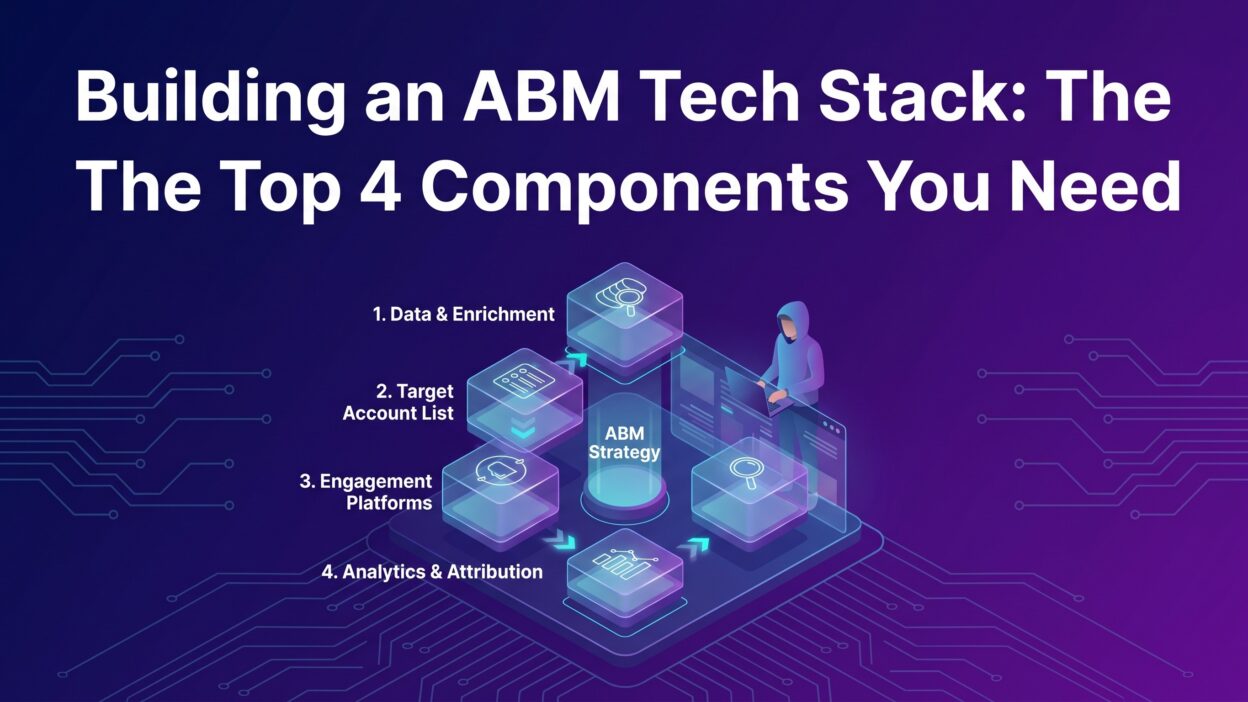
This blog breaks down the four core components every ABM tech stack needs. Each component serves a distinct purpose. Together, they create a connected system that identifies, engages, converts, and retains high-value accounts at scale.
Table of Contents
What Is an ABM Tech Stack and Why Does It Matter?
An ABM tech stack is the collection of software tools that power account-based marketing from identification through close. Each tool handles a specific function. Together they form a connected system that helps marketing and sales teams focus on the accounts most likely to generate revenue.
ABM without technology is possible. It is also slow, hard to scale, and nearly impossible to measure accurately. Manual account research takes weeks. Manual personalization at scale is unrealistic. Manual attribution across a long B2B sales cycle is guesswork. A proper ABM tech stack solves all three problems.
The right ABM tech stack also creates alignment by design. When marketing and sales access the same account data through connected tools, they stop working from different information. Shared data produces shared strategy. Shared strategy produces pipeline.
How ABM Tech Stacks Differ From Traditional Marketing Stacks
Traditional marketing stacks optimize for volume. They capture as many leads as possible and pass them to sales. An ABM tech stack flips this logic. It starts with a defined set of target accounts. Every tool in the stack serves that specific list, not a broad anonymous audience.
Traditional stacks measure success by lead count. ABM tech stacks measure success by account engagement, pipeline influence, and deal velocity within named accounts. The reporting structure is fundamentally different. The technology must support account-level attribution, not just contact-level conversion tracking.
Integration requirements are also more demanding. An ABM tech stack must connect advertising, CRM, intent data, and analytics into a single account view. A traditional stack can tolerate some tool isolation. ABM cannot. Every gap in data flow creates a blind spot in account intelligence.
The Cost of Getting Your ABM Tech Stack Wrong
A poorly assembled ABM tech stack does more damage than no ABM at all. Teams buy tools that do not connect. Data lives in separate systems. Account intelligence stays incomplete. Marketing runs campaigns that sales cannot see. Sales makes calls without knowing which accounts marketing already warmed up.
Wasted budget compounds the problem. ABM tools are not cheap. A $50,000 annual investment in a platform nobody uses correctly is a pure loss. Evaluating tools against specific ABM use cases before purchasing saves enormous sums. The four-component framework in this blog gives you a structured buying lens.
Component 1: Account Intelligence and Data Platform
Account intelligence is the foundation of every effective ABM tech stack. You cannot target accounts well without knowing which ones to prioritize. You cannot personalize outreach without understanding each account’s context, needs, and buying signals. Data is what makes ABM smart instead of just selective.
Ideal Customer Profile Development: Finding the Accounts Worth Targeting
Every ABM program starts with an ideal customer profile. An ICP defines the firmographic, technographic, and behavioral characteristics of accounts most likely to buy and stay. Building an accurate ICP requires data — specifically, data about your best existing customers and your highest-value lost deals.
ICP development tools analyze your CRM data to identify patterns in your top accounts. They surface common industry verticals, company size ranges, technology usage, and growth signals. This analysis gives your ABM tech stack a targeting foundation that reflects real revenue patterns instead of assumptions.
Vendors like Clearbit, ZoomInfo, and 6sense provide ICP modeling as part of their broader data platforms. They enrich your existing account records and score new accounts against your ICP automatically. This continuous scoring keeps your target account list current as market conditions change.
Intent Data Integration: Knowing When Accounts Are Ready to Buy
Intent data tells you which accounts research topics related to your solution right now. It captures behavioral signals from third-party content consumption, review site visits, and search activity. Intent data is one of the most powerful inputs an ABM tech stack can use to prioritize outreach timing.
An account showing high intent around your category is in an active buying cycle. Reaching them at this moment multiplies the impact of every sales and marketing touchpoint. Reaching them six months before they start researching wastes resources. Intent data solves the timing problem that kills many ABM programs.
Bombora dominates the third-party intent data space. G2 buyer intent data captures in-market signals from product review visits. First-party intent from your own website completes the picture. A well-integrated ABM tech stack combines all three intent signal types into a single account score that sales and marketing share.
Firmographic and Technographic Enrichment: Targeting With Precision
Firmographic data includes company size, revenue, industry, location, and growth rate. Technographic data reveals which software tools an account currently uses. Both data types inform account selection and personalization within your ABM tech stack.
Technographic data is especially valuable for technology companies. Knowing that a target account uses Salesforce, Marketo, and AWS tells you which integrations to lead with in your messaging. It tells you which competitors they already use. It shapes the entire conversation before the first call happens.
Data enrichment should run continuously, not just at account setup. Companies change their technology stacks. They grow into new verticals. They hire new leadership with different priorities. An ABM tech stack that refreshes enrichment data quarterly keeps account intelligence current and personalization relevant.
Component 2: Account-Based Advertising and Engagement Platform
Account intelligence tells you who to target. Advertising platforms help you reach them. Account-based advertising is the paid media layer of your ABM tech stack. It delivers personalized content to specific companies across digital channels — without requiring a contact list from sales.
Programmatic Account-Based Advertising: Reaching the Full Buying Committee
B2B purchases involve an average of six to ten stakeholders. Sales rarely knows all of them by name. Programmatic account-based advertising reaches the entire buying committee within a target account, including the stakeholders who never fill out a form or take a sales call.
Platforms like Demandbase, Terminus, and RollWorks enable account-level ad targeting across display, social, and connected TV. They match your target account list to digital identifiers and serve ads to anyone browsing from those company IP ranges or matching firmographic profiles. This reach saturates the buying committee with your message before sales engages.
Frequency management is critical in this layer of your ABM tech stack. Serving ten ads per day to a single account creates fatigue and brand damage. Most platforms offer account-level frequency capping. Use it. A well-paced advertising sequence builds familiarity without generating annoyance.
LinkedIn Advertising in Your ABM Tech Stack: Precision at a Professional Level
LinkedIn offers the most precise B2B audience targeting available in paid social. Its account targeting feature lets you upload a company list and serve ads exclusively to employees of those organizations. Combined with job title and seniority filters, it reaches specific members of the buying committee at named accounts.
LinkedIn Matched Audiences connect your CRM contact lists to LinkedIn profiles for personalized retargeting. A decision-maker who visited your pricing page sees a relevant case study ad in their LinkedIn feed within hours. This continuity of message across channels is what makes an ABM tech stack feel seamless to the buyer.
LinkedIn conversation ads create direct one-to-one engagement at scale. They feel personal even when automated. For enterprise ABM programs targeting fifty to two hundred accounts, conversation ads open dialogue that cold outreach cannot match. Include LinkedIn as a native channel within your ABM tech stack advertising strategy.
Personalization at Scale: Making Every Account Feel Like the Only Account
Personalization separates ABM from standard demand generation. A generic display ad feels like noise. An ad featuring the target account’s industry, use case, and relevant customer story feels like insight. Technology makes this personalization scalable inside a well-built ABM tech stack.
Dynamic creative optimization tools swap ad copy, imagery, and CTAs based on the account’s firmographic profile. A financial services account sees compliance messaging. A healthcare account sees HIPAA-relevant content. The underlying campaign is the same. The experience each account receives feels custom-built.
Landing page personalization extends this continuity beyond the ad click. Tools like Mutiny and Intellimize serve different homepage and landing page content based on the visiting company’s identity. An enterprise visitor sees enterprise social proof. A mid-market visitor sees mid-market pricing context. Personalization at this level dramatically improves conversion rates from ABM campaigns.
Component 3: CRM and Marketing Automation as the Operational Core
The CRM and marketing automation layer is the operational heart of every ABM tech stack. It stores account and contact records. It sequences outreach. It tracks engagement. It passes qualified accounts to sales at the right time. Without a well-configured CRM, the rest of the stack cannot function as a connected system.
CRM Configuration for ABM: Shifting From Contact-Centric to Account-Centric
Most CRMs default to contact-centric data models. ABM requires account-centric thinking. Reconfiguring your CRM for ABM means building account hierarchies, tracking account-level engagement scores, and reporting on pipeline by account segment rather than by individual lead.
Salesforce and HubSpot both support ABM data models with the right configuration. Custom fields capture account tier, ICP score, and intent signal strength. Account-level activity timelines give sales reps a complete picture of every touchpoint marketing generated before their first call. This context transforms cold outreach into warm, informed conversations.
Account ownership rules inside the CRM prevent territory conflicts. When every rep knows exactly which accounts belong to their book of business, duplication stops. Sales management gains clean visibility into account coverage across the entire target account list. A CRM configured for ABM delivers this clarity automatically.
Marketing Automation for ABM: Nurturing Accounts Through Long Sales Cycles
B2B sales cycles stretch from three months to over a year for enterprise deals. Marketing automation keeps target accounts engaged throughout this entire window. It delivers relevant content at the right stage, prevents leads from going cold, and triggers sales alerts when account behavior signals buying intent.
Account-based nurture sequences differ from traditional email drips. They deliver content mapped to account tier, industry, and buying stage rather than a generic contact-level sequence. Marketo, Pardot, and HubSpot all support account-level program logic when configured correctly inside an ABM tech stack.
Sales alert automation adds immediate commercial value. When a target account hits a specific engagement threshold — three visits to the pricing page, two content downloads, and an intent data spike — the automation fires a real-time alert to the account owner. Sales calls at the peak of buyer interest instead of guessing timing from intuition alone.
Account Scoring Models: Telling Sales Which Accounts Deserve Attention Now
Account scoring combines ICP fit data with engagement signals and intent data into a single prioritization score. Sales reps with 150 accounts in their territory need a system that tells them where to spend time today. A strong scoring model inside your ABM tech stack provides exactly this guidance.
Scoring models should weight signals differently based on their proximity to purchase intent. A direct request for a demo outweighs a content download. A pricing page visit outweighs a blog read. Calibrate your scoring model against historical win data. Accounts that look like your past closed-won deals should score highest.
Review scoring models quarterly. Markets shift. Buying signals evolve. A model calibrated in January may misrank accounts by June if it does not update with new behavioral data. The best ABM tech stack implementations treat scoring as a living system, not a set-and-forget configuration.
Component 4: Analytics and Attribution Platform
An ABM tech stack without strong analytics is a machine running without a dashboard. You cannot optimize what you cannot measure. You cannot justify budget without proving revenue impact. Analytics and attribution complete the four-component framework by closing the loop between activity and outcomes.
Account-Level Reporting: Measuring What ABM Actually Produces
Standard marketing reports count contacts, leads, and clicks. ABM reports count accounts engaged, accounts progressed through funnel stages, and pipeline generated from target account segments. This shift in reporting unit changes everything about how success looks.
Account progression reports show how many of your tier-one accounts moved from awareness to consideration to active opportunity this quarter. This movement metric tells you whether your ABM tech stack is working faster than any lead count can. A hundred new leads from non-target accounts adds less value than twenty tier-one accounts advancing through pipeline.
Coverage reports reveal gaps in your account engagement strategy. Which target accounts have not seen a single ad impression this quarter? Which accounts have no open contact records in the CRM? These gaps represent missed revenue opportunities. Good analytics surfaces them before they become missed quarters.
Multi-Touch Attribution: Crediting Every Touchpoint That Moved the Deal
ABM involves many touchpoints across many channels over many months. A single-touch attribution model misses most of this influence. First-touch credits only the original awareness moment. Last-touch credits only the final conversion event. Neither tells the full story of what your ABM tech stack produced.
Multi-touch attribution distributes credit across every meaningful interaction. The display ad that created awareness receives credit. The webinar that accelerated consideration receives credit. The case study that resolved a late-stage objection receives credit. This full-picture view helps CMOs allocate budget toward the touchpoints that actually move deals forward.
Platforms like Bizible, LeanData, and Dreamdata specialize in multi-touch revenue attribution for B2B. They integrate directly with CRM and marketing automation to pull the complete account journey. Every dollar of closed revenue traces back to the marketing activities that influenced it. This traceability makes budget conversations with the CFO far more productive.
Pipeline Velocity and Deal Influence: The Revenue Metrics That Matter Most
Pipeline velocity measures how fast revenue moves through your funnel. ABM programs at their best accelerate this velocity by warming accounts before sales engages. Measure the difference in average sales cycle length between accounts that went through your ABM program and accounts that did not. That difference quantifies the value of your ABM tech stack.
Deal influence metrics capture the percentage of closed-won revenue that had at least one meaningful marketing touchpoint. This metric addresses the classic sales objection that marketing does not help close deals. When marketing can show that 70 percent of last quarter’s revenue touched an ABM-driven campaign, the conversation changes.
Win rate by account tier gives strategic clarity. If your tier-one accounts win at 40 percent and tier-two accounts win at 20 percent, your ICP definition works. If tier-two accounts outperform tier-one, your tiering criteria needs revision. Analytics embedded in your ABM tech stack makes this analysis automatic and ongoing.
Supporting Strategies That Strengthen Your ABM Tech Stack
Four components form the core ABM tech stack. Several supporting strategies amplify its impact. Account-based sales enablement ensures your sales team uses the intelligence your stack generates. Revenue operations governance ensures data flows cleanly between every tool. ABM orchestration platforms like 6sense or Demandbase bring multiple stack layers into a single interface.
Sales enablement within ABM means giving reps account-specific talk tracks, personalized one-pagers, and real-time engagement alerts in one place. Platforms like Highspot and Seismic connect to your CRM and surface the right content for each account automatically. This removes friction from the handoff between marketing intelligence and sales execution.
Revenue operations governance keeps your ABM tech stack healthy over time. Assign data ownership for each system. Define integration SLAs so every tool refreshes at a consistent cadence. Audit data quality quarterly. A stack built on stale or disconnected data degrades in performance without anyone noticing until pipeline slows down.
ABM maturity models give you a roadmap for stack expansion. Start with a foundational stack covering the four core components. Add sophistication as your team builds confidence with account-level measurement and reporting. Rushing to a full enterprise ABM tech stack before the team understands the fundamentals wastes money and creates organizational resistance.
FAQs: ABM Tech Stack Questions Answered
What is the minimum ABM tech stack a small B2B team needs?
A small team can run effective ABM with four tools: a data enrichment platform for ICP and intent signals, LinkedIn Campaign Manager for account-based advertising, HubSpot or Salesforce as the CRM and automation core, and a basic BI tool for account-level reporting. This lean ABM tech stack covers all four components without enterprise-level complexity or cost.
How much does an ABM tech stack cost?
Costs vary widely based on company size, target account volume, and tool sophistication. A foundational ABM tech stack for a mid-market company typically runs between $50,000 and $150,000 per year across all components. Enterprise stacks with full intent data, dedicated ABM platforms, and advanced attribution can exceed $500,000 annually. Prioritize the data and CRM layers first. Advertising and analytics tools add value once the foundation is solid.
How long does it take to build and activate an ABM tech stack?
A lean ABM tech stack can activate in six to eight weeks with a focused implementation team. The ICP and target account list work takes two to three weeks. CRM configuration and integration setup takes another three to four weeks. Campaign launches and reporting dashboards follow. Larger enterprise stacks with custom integrations and complex data workflows can take four to six months to fully implement.
Which ABM platforms are best for enterprise companies?
6sense, Demandbase, and Terminus lead the enterprise ABM platform market. Each combines intent data, account-based advertising, and analytics in a single interface. They integrate deeply with Salesforce and major marketing automation platforms. The best choice depends on your existing stack, team size, and whether you prioritize intent data depth, advertising reach, or analytics sophistication in your ABM tech stack.
How do I measure ABM tech stack ROI?
Measure ROI through three lenses. First, compare pipeline generated from target accounts before and after ABM implementation. Second, measure average sales cycle length for ABM-touched deals versus non-ABM deals. Third, calculate customer acquisition cost for accounts that engaged your ABM program versus those that did not. These three comparisons build a credible ROI case for your ABM tech stack investment.
Can ABM tech stacks work for startups with small sales teams?
Yes. ABM is especially powerful for startups because it focuses limited resources on the highest-probability accounts. A startup with two sales reps and a small marketing team cannot run broad demand generation efficiently. A focused ABM tech stack concentrating energy on twenty to fifty target accounts dramatically improves conversion rates without requiring a large team. Start lean and expand as the model proves out.
Read More:-AI, Automation, Intent: The State of Account-Based Marketing in 2026
Conclusion

Building an effective ABM tech stack requires clarity on what each tool must accomplish. The four components outlined in this blog — account intelligence, account-based advertising, CRM and automation, and analytics and attribution — each serve a distinct and necessary role. A gap in any one of them weakens the entire system.
Do not buy tools because competitors use them or vendors pitch them well. Evaluate every addition to your ABM tech stack against a specific use case. Does it improve account targeting accuracy? Does it accelerate buying committee engagement? Does it sharpen revenue attribution? If it cannot answer yes to at least one of these, it does not belong in your stack.
Integration is the invisible force that makes or breaks your ABM tech stack. Data must flow between every component without manual intervention. A disconnected stack creates more confusion than clarity. Prioritize native integrations and clean data architecture from day one. Fixing integration problems after launch costs more in time and trust than getting them right upfront.
Start with the data layer. An ICP built on real customer patterns and intent signals that reflect true buying behavior give every downstream tool a stronger input. Advertising without good data wastes money. Automation without good data nurtures the wrong accounts. Attribution without good data produces misleading conclusions. Data quality is the multiplier across your entire ABM tech stack.
The companies growing fastest in B2B right now treat their ABM tech stack as a strategic asset, not a vendor collection. They invest in the right tools, configure them for account-centric thinking, and measure outcomes at the revenue level. Follow this approach and your ABM program becomes one of the highest-return investments your marketing budget makes.