Introduction
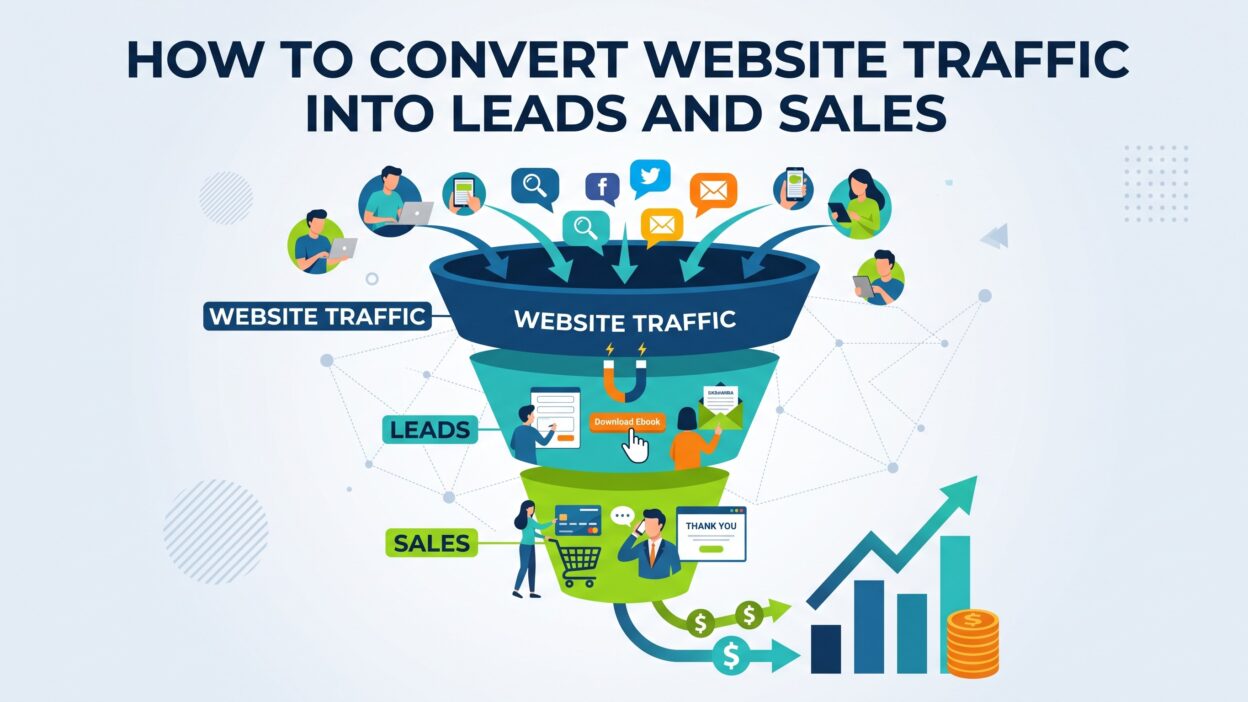
TL:DR You worked hard to get visitors to your website. Your SEO ranks well. Your ads run every day. People click and land on your pages. Yet your sales numbers stay flat. That gap is a real business problem. Converting website traffic into leads and sales is the skill that separates struggling businesses from growing ones. Traffic alone pays no bills. You need a system that grabs attention, builds trust, and pushes visitors toward a clear decision. This guide breaks that system down completely.
Table of Contents
Why Most Website Traffic Never Converts
Many business owners celebrate high traffic numbers. That celebration often comes too early. Raw visitor counts mean nothing without a conversion strategy. Converting website traffic into leads and sales requires more than pretty design and good products.
Most websites fail at conversion for a few simple reasons. Pages load too slowly and visitors leave. Headlines are vague and visitors feel confused. Calls to action are buried and visitors miss them. The offer is unclear and visitors feel no urgency. Each of these problems bleeds money every single day.
Visitors land on your site with a specific problem or question. They want a fast, clear answer. Give them that answer quickly. Show them the next step. That is the entire job of a converting website.
Understanding visitor intent matters enormously. Someone searching “best project management software for small teams” is ready to compare options. Someone searching “what is project management” is just learning. Your content and offer must match where the visitor sits in their buying journey. Mismatching intent destroys conversion rates. Converting website traffic into leads and sales always starts with understanding your visitor.
The Foundation — Know Your Audience Before Everything Else
Great conversion starts with great audience knowledge. You cannot write compelling copy without knowing who reads it. You cannot design helpful offers without knowing what your audience actually needs.
Build a clear profile of your ideal customer. Know their biggest frustrations. Know the words they use to describe their problems. Know what they tried before and why it failed. This depth of knowledge shapes every word on your website.
How to Research Your Target Audience Effectively
Talk directly to existing customers. Ask them why they chose you over competitors. Ask what almost stopped them from buying. Ask what words they would use to describe the problem you solve. These answers become your best copy.
Read reviews on competitor products. Amazon reviews, G2 reviews, and Trustpilot are gold mines. Customers describe their exact pain in their own words. Use those exact words in your headlines and landing pages. This technique alone can lift conversion rates dramatically.
Use Google Search Console to study which queries bring visitors to your pages. Pay close attention to the questions your audience asks. Build content and offers that answer those questions precisely. Converting website traffic into leads and sales gets much easier when your message matches visitor expectations perfectly.
Survey your email list. Short three-question surveys reveal massive insights. Ask what they struggle with most. Ask what they wish existed. Ask what almost stopped them from signing up. Use the answers to reshape your offers and your messaging.
Crafting Landing Pages That Actually Convert
Your landing page is your hardest-working salesperson. It works around the clock. It never takes a day off. A weak landing page wastes every dollar you spend on traffic. A strong landing page multiplies the value of every visitor.
The headline must do heavy lifting. Visitors read headlines first. If the headline does not immediately connect with their problem, they leave. Write headlines that name the problem or the desired outcome. Be specific. “Get More Clients Without Cold Calling” works better than “Grow Your Business Today.”
The subheadline adds context. It supports the headline claim. It gives visitors one more reason to keep reading. Keep it short. Keep it benefit-focused.
Elements Every High-Converting Landing Page Needs
Your hero section must communicate value in under five seconds. Visitors make fast decisions. A strong headline, a clear subheadline, and a visible call to action give them every reason to stay.
Social proof belongs above the fold. Testimonials, star ratings, and client logos reduce buying anxiety immediately. People trust other people. When a visitor sees that others like them got results, hesitation drops. This detail plays a huge role in converting website traffic into leads and sales.
Your call to action button must stand out visually. Use contrasting colors. Use action-driven text. “Start My Free Trial” performs better than “Submit.” “Get My Free Guide” outperforms “Download.” The language must feel like the visitor is gaining something.
Remove distractions ruthlessly. Navigation menus pull visitors away from your conversion goal. Side widgets create noise. Extra links break focus. A landing page built for conversion has one goal and removes everything else. Fewer distractions mean higher conversion rates.
Form length affects conversion directly. The shorter the form, the higher the submission rate. Ask for only what you truly need. For a lead magnet, a first name and email address works perfectly. Save detailed questions for after you have earned the relationship.
Page speed is non-negotiable. Google data consistently shows that pages loading beyond three seconds lose more than half their visitors. Compress your images. Use fast hosting. Minimize unnecessary scripts. A fast page makes every other conversion element work better.
Using Lead Magnets to Capture Email Addresses
A lead magnet is a free offer you give in exchange for a visitor’s contact information. This exchange is the engine behind most online businesses. Converting website traffic into leads and sales depends heavily on having the right lead magnet for the right audience.
The best lead magnets solve one specific problem fast. They deliver immediate value. They make the visitor think “I can’t believe this is free.” Vague, general lead magnets collect low-quality leads. Specific, valuable ones attract serious buyers.
Types of Lead Magnets That Generate Quality Leads
Checklists work extremely well. They are fast to create and fast to consume. A checklist that solves a painful step-by-step problem converts at a high rate. “The 10-Step Website Audit Checklist” attracts business owners who care about their website performance. That is a warm, targeted lead.
Templates save people time. A social media calendar template, a business proposal template, or a financial tracker template delivers immediate practical value. People use the template and associate that value with your brand. Trust grows naturally.
Free mini-courses convert extremely well for education-based businesses. A five-day email course on a specific skill positions you as an expert. It warms leads over several days. By the end, subscribers already trust your knowledge.
Webinars attract high-intent leads. Someone who registers for a live training session is genuinely interested in the topic. They invest their time. They show up. That behavior signals purchase readiness.
Quizzes engage visitors in a unique way. A quiz that diagnoses a problem and delivers personalized results feels personal and valuable. “What Type of Marketing Strategy Fits Your Business?” attracts business owners and delivers a personalized answer. The personalization drives both completion and lead capture.
Place your lead magnet offer where visitors are already engaged. Blog posts are perfect placement spots. End each relevant post with a content upgrade. A post about email marketing strategy pairs naturally with a free email sequence template. The relevance makes the offer feel helpful rather than salesy.
Writing Copy That Moves Visitors Toward a Decision
Copy is the voice of your website. Every word either moves a visitor closer to saying yes or further away. Weak copy talks about features. Strong copy talks about transformation. Converting website traffic into leads and sales demands copy that speaks directly to desire and fear.
Lead with the outcome, not the process. People buy results, not methods. “Wake up Monday morning with a full sales pipeline” sells harder than “Our CRM has 47 automation features.” The outcome is vivid and personal. The feature list is abstract and forgettable.
Copywriting Principles That Boost Conversion
Specificity builds credibility. Vague claims feel like marketing fluff. Specific claims feel like evidence. “Our clients see an average 34% increase in qualified leads within 60 days” is far more believable than “We help businesses grow.” Specificity makes every line of copy land harder.
Address objections directly in your copy. Every visitor carries silent doubts. “Will this work for me?” “Is this worth the price?” “What if I don’t have enough time?” Name those objections and answer them honestly. When you acknowledge doubt and resolve it, trust builds quickly.
Use short sentences. Long sentences tire readers. Short sentences drive energy. Vary your sentence rhythm. Mix short punchy statements with slightly longer explanatory ones. This rhythm keeps readers engaged and moving down the page.
Tell stories. A brief customer story is worth ten bullet points of features. “Sarah was spending 15 hours a week on manual reporting. She started using our tool. Now she spends two hours. She got that time back to close more deals.” That story is relatable, clear, and compelling.
Write in the second person. Use “you” and “your” constantly. Make the visitor feel the copy speaks directly to them. Remove all “we” and “our” language where possible. Visitors care about themselves, not about you. Your copy must reflect that truth.
Optimizing Your Website for Lead Generation at Every Stage
Lead generation does not happen only on landing pages. Every page of your website is an opportunity. Your homepage, blog posts, about page, and even your 404 error page can capture leads. Most businesses ignore this opportunity entirely. Treating every page as a lead capture surface is a key part of converting website traffic into leads and sales.
Your homepage is often the first page a visitor sees. It must clearly communicate who you serve, what you offer, and what they should do next. Place a lead capture element above the fold on the homepage. Make the offer relevant to your widest audience.
Smart Placement Strategies for Lead Capture Elements
Exit-intent popups work when used correctly. When a visitor moves their cursor toward the browser close button, a popup appears. This last-second offer recaptures attention. A well-timed, relevant exit offer can convert 5–10% of visitors who were about to leave. Use this tool carefully. Make the offer genuinely valuable.
Sticky headers and footers keep your call to action visible as visitors scroll. The visitor never loses sight of the next step. Sticky elements perform especially well on long-form content pages.
Content upgrades inside blog posts convert at exceptional rates. A blog post on “How to Write a Cold Email” might offer a free cold email template halfway through the post. Visitors reading that post are already interested in the topic. The upgrade feels like a natural next step.
Chat widgets capture leads from visitors who have questions but are not ready to fill in a form. A well-configured chat bot can qualify leads, answer common questions, and book calls automatically. This removes friction from the decision-making process.
Your thank-you page is often wasted. After a visitor submits a form, most websites show a bland confirmation message. Use that page instead. Offer a one-time special deal. Invite the new lead to book a call. Present an upsell. Converting website traffic into leads and sales means using every touchpoint intelligently.
Building Trust Signals That Reduce Buying Hesitation
Visitors who do not trust your website will not convert. Trust signals make your business feel credible, safe, and professional. Every element on your site either builds or undermines trust. Give this area serious attention.
Testimonials are the most powerful trust signal available. Real words from real customers carry enormous weight. Video testimonials work best. Written testimonials with full names and photos rank second. Anonymous testimonials barely move the needle.
Trust Elements That Lift Conversion Rates
Case studies show proof at a deeper level. A case study walks through a customer’s specific problem, the solution you provided, and the measurable results achieved. “Increased organic traffic by 218% in 90 days” is a result that other customers can picture for themselves.
Security badges matter greatly for e-commerce websites. SSL certificates, payment security logos, and money-back guarantee badges reduce purchase anxiety. Place these near checkout buttons and payment forms. Visitors need to feel their information is safe.
Media mentions build authority quickly. “As seen in Forbes, Inc., and Entrepreneur” on your homepage instantly elevates your credibility. Even small features in industry publications count. Display them prominently.
Your “About” page is a trust page. Write it in a way that connects emotionally. Share your story. Share your mission. Show the faces behind the business. Visitors trust people more than they trust logos and taglines.
Show the number of customers, users, or clients you serve. “Trusted by 14,000+ marketing professionals” is a social proof signal. It tells visitors that many others already chose you. That validation reduces hesitation and drives action. Converting website traffic into leads and sales always comes down to reducing the reason not to buy.
Email Marketing — Turning Leads into Paying Customers
Capturing a lead is only the beginning. Most leads need nurturing before they buy. Email marketing is the most reliable and cost-effective nurturing channel available. An engaged email list turns cold leads into warm buyers consistently.
The welcome email sequence sets the tone for the entire relationship. Send the first email immediately after someone subscribes. Deliver the promised lead magnet. Introduce yourself and your brand. Tell the subscriber what to expect from future emails. A strong welcome sequence alone dramatically improves open rates and engagement going forward.
Email Sequences That Warm Leads and Drive Sales
The nurture sequence builds trust over time. Send valuable, educational emails over several days or weeks. Teach something useful in each email. Share a story. Offer a quick win. Subscribers who receive consistent value start to see you as an authority. Authority makes selling natural.
The conversion sequence moves warm leads toward a purchase. After nurturing, introduce your offer clearly. Lead with the transformation. Include testimonials. Address objections. Add a deadline or scarcity element to create urgency. A well-built conversion sequence can generate significant revenue from your existing list.
Segment your email list by behavior. Separate subscribers who opened multiple emails from those who have not opened anything in 30 days. Send re-engagement campaigns to inactive subscribers. Send stronger offers to highly engaged ones. Segmentation makes every email more relevant, which lifts open rates and conversions.
Personalization goes beyond using someone’s first name. Track what pages they visited on your website. Track which lead magnet they downloaded. Use that behavior data to send hyper-relevant follow-up emails. Converting website traffic into leads and sales through email relies on relevance above all else.
Analyzing Data and Optimizing for Better Results
Guessing is expensive. Data removes guesswork. Every decision about your website and conversion strategy should come from evidence, not opinions. Set up proper analytics from day one.
Google Analytics 4 shows you where visitors come from, which pages they visit, how long they stay, and where they drop off. Study the behavior flow report. See exactly where visitors exit your conversion path. Fix those exit points one at a time.
Key Metrics to Track for Conversion Optimization
Conversion rate is the most important metric. It measures the percentage of visitors who complete a desired action. A 2% conversion rate means 2 out of every 100 visitors convert. Improving that to 4% doubles your results without spending more on traffic.
Bounce rate tells you how many visitors leave after viewing only one page. A high bounce rate signals a mismatch between what visitors expected and what your page delivered. Investigate high-bounce pages and rewrite the content to better match visitor intent.
Heatmaps reveal how visitors actually behave on your pages. Tools like Hotjar and Microsoft Clarity show exactly where people click, scroll, and stop reading. This visual data shows you which elements attract attention and which ones get ignored.
A/B testing removes guesswork completely. Create two versions of a page, headline, or call to action. Send equal traffic to both. Measure which version converts better. Use the winning version going forward. Test one element at a time for clean results.
Session recordings show individual visitor behavior. Watch how real visitors navigate your site. Notice where they hesitate. Notice what they click. Notice where they get confused. These recordings surface usability problems that data alone cannot reveal.
Converting website traffic into leads and sales is an ongoing process. The businesses that win are the ones that test, measure, and improve continuously. Set aside time each month to review your data and run at least one new test.
FAQs — Converting Website Traffic into Leads and Sales
How long does it take to improve website conversion rates?
Most businesses see meaningful improvement within 30 to 60 days of focused effort. Quick wins come from fixing obvious problems: slow pages, unclear headlines, and missing calls to action. Deeper improvements come from months of testing and refinement.
What is a good conversion rate for a website?
Industry averages vary by niche and traffic source. A 2–5% conversion rate is considered solid for most websites. E-commerce sites often aim for 1–3%. Lead generation pages frequently hit 5–15% with strong offers and relevant traffic. Do not compare your rate to broad averages. Compare it to your own previous performance and keep improving.
What is the biggest mistake businesses make with website traffic?
The biggest mistake is sending paid traffic to a homepage or a weak landing page. Paid traffic should go to purpose-built landing pages with a single conversion goal. Homepages serve too many audiences at once. They dilute the message. A focused landing page tailored to the traffic source converts at a far higher rate.
Does website design really affect conversion rates?
Design affects trust, readability, and user experience. All three affect conversion. A cluttered, outdated design signals low credibility. A clean, modern design builds confidence. Readable fonts, strong contrast, and logical layout all make it easier for visitors to find what they need and take action.
How do I convert website traffic into leads and sales without a large budget?
Focus on organic traffic, strong content, and email marketing. These channels are low cost and compound over time. A well-optimized blog post can generate leads for years. A well-built email list can produce sales on demand. Converting website traffic into leads and sales does not require massive ad budgets. It requires consistent, smart execution.
Read More:-Top 5 Marketing Orchestration Platforms: 2026 Buyer’s Guide
Conclusion

Getting website traffic is hard work. Letting that traffic leave without converting is a costly mistake. Every visitor represents a real person with a real need. Your job is to meet that need, earn their trust, and guide them toward a decision.
Converting website traffic into leads and sales is not a single tactic. It is a full system. That system includes knowing your audience deeply, crafting landing pages with precision, using lead magnets strategically, writing copy that connects emotionally, and nurturing leads with email. Every component matters. Every component builds on the others.
Start with the basics. Fix your slowest-loading pages. Rewrite your vague headlines. Add a relevant lead magnet to your top blog posts. Launch a simple five-email welcome sequence. These actions alone can significantly improve your results within weeks.
From there, add layers. Test your calls to action. Add social proof. Build out your email nurture sequences. Study your analytics. Improve what the data reveals. This compounding approach transforms your website from a digital brochure into a genuine revenue machine.
The businesses that master converting website traffic into leads and sales do not rely on luck. They build systems. They measure results. They improve constantly. Start building that system today.