Introduction
TL;DR Most companies still screen resumes the same way they did ten years ago. They scan for keywords. They rank candidates by word matches. They call this process modern.
It isn’t. A keyword-only approach breaks your AI hiring strategy before it even starts. Great candidates get filtered out. Weak candidates slip through. Recruiters waste hours reviewing the wrong pile.
This blog breaks down why keyword matching fails and what a real AI hiring strategy looks like in 2026. You’ll get practical steps, common mistakes to avoid, and answers to the questions hiring teams ask most.
Hiring teams face more pressure than ever. Open roles sit unfilled for weeks. Recruiters juggle hundreds of applications for a single posting. Leadership demands faster results without sacrificing quality. A weak screening process makes every one of these problems worse.
This guide walks through the full picture. It covers where keyword screening came from, why it breaks down in practice, and how to replace it with something that works. Read it as a working reference, not a one-time read.
Table of Contents
The Rise of Keyword-Based Resume Screening
Keyword screening didn’t start as a bad idea. It started as a fast fix for a slow problem.
How ATS Systems Read Resumes
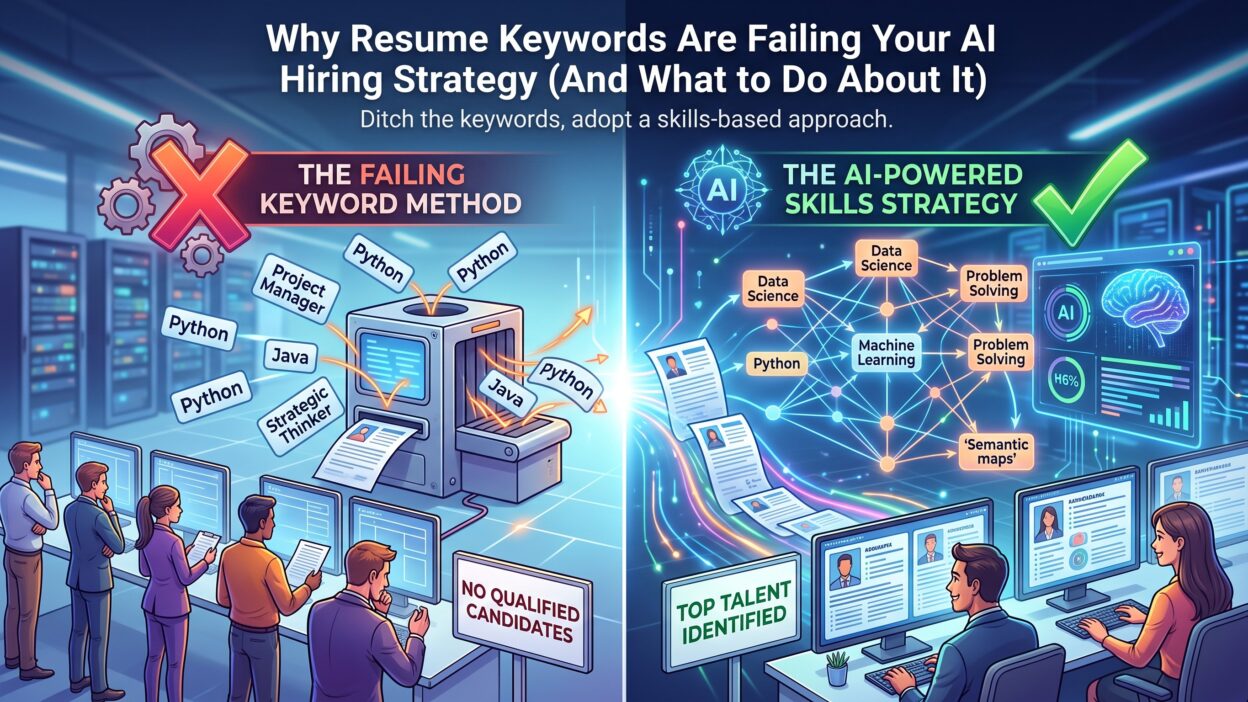
Applicant tracking systems scan resumes for specific terms. A job post lists “project management” and “Agile.” The system searches resumes for those exact words. Resumes without them drop lower in the ranking, or disappear completely.
This method works fine for simple, structured roles. It fails badly for nuanced ones. A candidate might write “led sprint planning” instead of “Agile,” and the system misses the connection entirely. The skill is there. The word isn’t. The system doesn’t know the difference.
Why Companies Trusted Keywords for So Long
Keyword matching felt efficient. It processed thousands of resumes in seconds. It gave recruiters a shortlist without manual reading. For high-volume hiring, that speed mattered.
But speed isn’t the same as accuracy. Companies built their entire AI hiring strategy around a shortcut, not a solution. The shortcut worked until candidates learned how to beat it.
Early ATS platforms launched in the 1990s, long before machine learning became common. Those systems used basic string matching. Nobody expected them to understand context. They simply sorted resumes by presence or absence of specific terms.
Over time, hiring volume grew. Job boards made it easy to apply to dozens of roles in a single afternoon. Recruiters needed a way to manage the flood. Keyword filters became the default answer, and companies rarely questioned whether the answer still fit the problem.
The Real Problem With Keyword Matching in a Modern AI Hiring Strategy
Keyword matching treats a resume like a search query. Real hiring decisions need more than that.
Keywords Miss Context
A resume says “managed a team of five.” Another says “supervised five direct reports.” Both describe the same skill. A keyword system built around the word “managed” might reward one and ignore the other.
Context matters more than phrasing. A strong AI hiring strategy reads intent, not just text. It understands that different words can describe the same experience. Older systems can’t make that connection. They match strings, not meaning.
Consider a marketing candidate. One resume lists “grew email open rates by 30 percent.” Another lists “improved campaign engagement metrics.” Both describe strong performance in the same skill area. A basic keyword filter searching for “email marketing” might reward the second resume and skip the first, simply because the exact phrase never appears.
This gap grows wider in technical fields. Engineers describe the same programming pattern in different ways depending on their previous company’s internal language. A recruiter reading manually would catch the overlap instantly. A rigid keyword filter usually won’t.
Skilled Candidates Get Filtered Out
This is the biggest cost of keyword-only screening. Talented people get rejected because they used different language, not because they lack skills.
A software engineer with ten years of experience might describe their work using industry slang from their previous company. The ATS doesn’t recognize the terms. The resume gets buried. The company never sees the candidate.
Every rejected resume like this weakens your AI hiring strategy. You lose talent to a technical gap, not a skills gap.
Studies on applicant tracking systems show rejection rates well above what hiring managers expect. Some estimates suggest that a large share of qualified applicants never reach a human reviewer at all. Their resumes get filtered out automatically, based purely on missing terms.
This problem compounds over time. Word spreads among job seekers about which companies use harsh keyword filters. Strong candidates start avoiding those postings entirely, assuming the process won’t give them a fair shot. The company never learns why its applicant pool keeps shrinking in quality.
Keyword Stuffing Games the System
Candidates caught on fast. They started stuffing resumes with every possible keyword from the job description, sometimes in white text or tiny fonts. The resume passes the scan. The candidate doesn’t have the actual skills.
This creates a strange result. Your system rewards resume writing skills over job skills. Recruiters interview candidates who look great on paper and struggle badly in person. Trust in the process drops. So does confidence in your entire AI hiring strategy.
Some job seekers now use dedicated resume-optimization tools built specifically to beat ATS filters. These tools scan a job posting, extract every likely keyword, and insert them into a resume automatically. The output often reads awkwardly to a human, but it passes the scan every time.
This arms race helps nobody. Candidates spend hours gaming a system instead of preparing for actual interviews. Recruiters spend hours interviewing people who don’t match the role. The entire hiring funnel slows down, and the company pays for it in lost productivity.
Signs Your AI Hiring Strategy Relies Too Much on Keywords
Some warning signs show up early, if you know where to look.
High Rejection Rate for Qualified Candidates
Check your rejected pile occasionally. Pull ten resumes manually. Read them without the ATS filter. If several candidates look genuinely qualified, your system has a keyword problem, not a talent shortage problem.
Try this test once a quarter. Compare the manual read against the automated ranking. Large gaps between the two point to a filter that needs adjustment. This single habit catches problems long before they show up in hiring metrics.
Slow Time to Hire
Keyword systems often produce long shortlists filled with mismatches. Recruiters spend extra hours weeding out bad fits. This slows down your entire pipeline and adds hidden costs to your AI hiring strategy.
Long time-to-hire numbers rarely come from a lack of applicants. They usually come from too many low-quality matches clogging the funnel. Recruiters waste time on screening calls that go nowhere, pushing back interviews for candidates who deserved a faster response.
Poor Quality of Hire
New hires struggle to perform the role they were hired for. Skills on paper don’t match skills on the job. This usually traces back to a screening process built on exact-word matches instead of real capability checks.
Track early performance reviews for new hires against their original resume screening scores. If high-scoring resumes consistently produce average performers, the scoring model needs a rebuild. Quality of hire tells the real story that keyword rankings can’t.
What Modern AI Hiring Strategy Should Actually Look Like
A better approach exists, and it’s already changing how top companies hire.
Skills-Based Matching
Skills-based matching looks at what a candidate can actually do. It compares real capabilities against real job requirements. A candidate who “built automated testing pipelines” gets matched to a QA role, even without the exact phrase “quality assurance” on their resume.
This shift moves hiring away from vocabulary tests. It moves it toward capability tests. That single change strengthens any AI hiring strategy immediately.
Skills-based matching often uses structured skill taxonomies. These taxonomies group related abilities under one category, so the system recognizes “Python scripting” and “backend automation” as connected skills, even without shared vocabulary. Recruiters get a ranked list built around real capability, not resume phrasing.
Some companies pair this with skills assessments during the application process. A short coding test, a writing sample, or a case study gives concrete proof of ability. This data feeds back into the screening model and sharpens future matches.
Semantic Understanding Over Literal Matching
Modern AI models understand language the way people do. They recognize synonyms. They understand related skills. They connect “customer success” with “client retention” without needing an exact match.
This kind of semantic screening catches candidates that older systems miss. It reduces false rejections. It gives every applicant a fair read, regardless of how they phrased their experience.
Natural language processing models power this shift. These models get trained on massive amounts of text, so they learn how professionals across industries describe similar work in different ways. A resume no longer needs to mirror the job posting word for word to score well.
This approach also handles international candidates better. Someone trained outside the country where the job is posted may use different terminology for the same role. Semantic matching bridges that gap instead of penalizing it.
Human Judgment in the Loop
AI should support recruiters, not replace them. The best AI hiring strategy uses automation for the first pass and puts humans in charge of final decisions. Recruiters bring judgment that no algorithm fully replicates. Culture fit, communication style, and growth potential still need a human eye.
A hybrid model works best in practice. Automation handles the first filter, cutting a pool of five hundred applicants down to fifty strong candidates. A recruiter then reviews those fifty resumes personally, adding context the algorithm can’t capture. This balance saves time without sacrificing fairness.
Companies that skip this human step often face legal and reputational risk. Fully automated rejections can trigger complaints, especially in regions with strict employment regulations. Keeping a person in the loop protects both the candidate and the company.
Building a Smarter AI Hiring Strategy Step by Step
Fixing your hiring process doesn’t require a full rebuild. It requires a clear plan.
Audit Your Current Screening Criteria
Start by reviewing your job descriptions and ATS filters. List every keyword your system searches for. Ask whether each one reflects a real requirement or just common industry jargon. Cut anything that isn’t essential.
Involve the hiring manager in this review, not just the recruiter. Hiring managers know which skills truly matter day to day. They often spot outdated requirements that stayed in a job description simply because nobody updated the template in years.
Document the results of this audit. Keep a running list of required skills versus preferred skills for each role. This list becomes the foundation for every future screening decision, and it keeps your criteria consistent across hiring rounds.
Choose Tools With Semantic Search
Look for recruitment platforms built on natural language processing, not simple keyword matching. These tools read resumes the way a human recruiter would. They connect related skills and experience, even when the exact words differ.
Ask vendors specific questions before signing a contract. Ask how their model handles synonyms. Ask how often they retrain the system. Ask for data on false rejection rates from existing clients. A vendor confident in their technology will share this information openly.
Run a pilot before a full rollout. Test the new tool against your current system using the same batch of resumes. Compare the shortlists side by side. This comparison shows exactly how much talent your old system was missing.
Train Recruiters to Read Beyond Keywords
Give your team guidance on evaluating resumes holistically. Teach them to look for transferable skills and relevant achievements, not just term matches. This training turns your AI hiring strategy into a partnership between people and technology, instead of a fully automated black box.
Run short workshops using real rejected resumes from past hiring rounds. Ask recruiters to evaluate them without seeing the original ATS score. Compare their judgment against the algorithm’s ranking afterward. This exercise builds intuition fast and shows recruiters exactly where the gaps exist.
Encourage recruiters to flag any resume that feels wrongly filtered. Build a simple feedback channel between the recruiting team and whoever manages the ATS configuration. This feedback loop keeps the system improving instead of staying static for years.
Test and Refine Continuously
Run regular audits on your hiring outcomes. Track how many strong hires came through automated screening versus manual review. Adjust your criteria based on real results, not assumptions. A good AI hiring strategy evolves with your data.
Set a review schedule and stick to it. Quarterly reviews work well for most companies. Larger organizations with high hiring volume may need monthly checks instead. Consistency matters more than frequency, since irregular reviews let bad patterns build up unnoticed.
Bring performance data from actual employees into this review. Compare the skills listed on their original resumes against their real strengths on the job. This comparison shows which resume signals actually predict success and which ones don’t.
Common Mistakes Companies Make With AI Hiring Strategy
Even well-intentioned teams fall into predictable traps.
Ignoring Bias in Training Data
AI models learn from historical hiring data. If that data reflects biased decisions from the past, the model repeats those patterns. Companies need to test their systems for bias regularly and adjust training data when problems appear.
A well known example involves resume screening tools that penalized resumes mentioning women’s colleges or women’s sports teams. The model learned this pattern from years of historical hiring data that favored male candidates in technical roles. Nobody programmed that bias directly. It emerged from the data itself.
Run bias audits by testing your system with resumes that differ only in demographic signals, such as names or graduation years. If the scoring shifts without a change in actual qualifications, the model needs retraining. This kind of testing should happen before launch and continue on a regular schedule afterward.
Over-Automating Every Step
Full automation sounds efficient, but it removes accountability. Candidates deserve a human review before rejection, especially for senior roles. An AI hiring strategy without human checkpoints risks losing strong candidates to a machine’s blind spot.
Some companies automate every stage, from resume screening through initial interview scheduling, without a single human touchpoint until the final round. Candidates notice this. Many report feeling like they applied to a machine rather than a company. This experience damages employer brand, even when the automation itself works correctly.
Build clear checkpoints into your process. A human should review any rejection before it goes out, at minimum for roles above entry level. This small step protects candidate experience and catches errors the algorithm might miss.
Not Updating Criteria Regularly
Job requirements change. Skills that mattered two years ago may not matter today. Companies that never update their screening criteria end up filtering for outdated skills instead of current ones.
Technology roles shift especially fast. A framework that dominated job postings three years ago might barely appear in new applications today. A screening system still weighted toward that old framework will rank candidates incorrectly, favoring outdated experience over current, relevant skills.
Set a calendar reminder to revisit every active job description at least twice a year. Compare it against current market trends and internal team needs. This small habit keeps your entire AI hiring strategy aligned with reality instead of drifting toward outdated assumptions.
Secondary Considerations: Tools and Technology
Applicant tracking systems, resume screening software, and skills-based hiring platforms all play a role in a working AI hiring strategy. The right combination depends on company size, hiring volume, and role complexity.
Smaller companies often benefit from simpler tools with strong semantic search. Larger companies need platforms that scale across departments while keeping bias checks and human review built in. Whatever the size, the goal stays the same: match real skills to real roles, not words to words.
Pricing varies widely across this category. Some vendors charge per hire, others charge a flat monthly fee based on employee headcount. Budget matters, but cost should never outweigh accuracy. A cheaper tool that filters out strong candidates costs far more in lost talent than the subscription fee ever saves.
Integration also matters. The best resume screening software connects directly with your existing applicant tracking system instead of requiring a full platform switch. This keeps implementation simple and avoids disrupting a hiring pipeline that’s already in motion.
The Future of Hiring Without Keyword Dependence
Hiring technology keeps moving toward context and meaning. Language models now read resumes closer to how a person reads them. They pick up on tone, relevance, and real accomplishment, not just repeated terms.
Companies that adapt early gain an edge. They reach candidates their competitors miss. They build teams with real capability instead of resume-writing talent. A forward-looking AI hiring strategy treats keywords as one small signal, not the whole decision.
Expect more platforms to combine resume data with skills assessments, portfolio reviews, and even video interview analysis. Each data point adds context that a resume alone can’t provide. Companies that build hiring processes around multiple signals will make better decisions than those still relying on a single filter.
Candidates will keep adapting too. As screening tools grow smarter, resume writing tricks will lose their effectiveness. This shift benefits everyone. Job seekers can focus on real skill development instead of keyword games. Companies can focus on real evaluation instead of chasing the latest filtering trick.
Frequently Asked Questions
What is an AI hiring strategy? An AI hiring strategy uses artificial intelligence tools to screen, rank, and evaluate job candidates. It combines automated technology with human judgment to find the best fit for open roles.
Why do keyword-based resumes fail good candidates? Keyword systems match exact words, not meaning. A qualified candidate who describes their experience differently than the job post often gets filtered out, even with the right skills.
How can companies fix keyword bias in hiring? Companies can switch to semantic search tools, audit their screening criteria regularly, and keep human recruiters involved in final decisions.
Does AI hiring reduce diversity in candidate pools? It can, if the underlying training data carries old biases. Regular audits and diverse training data help reduce this risk.
Should small businesses use AI hiring tools? Yes, but they should choose simple tools with semantic matching instead of basic keyword filters. This keeps the process fair without adding heavy costs.
What replaces keyword matching in modern recruitment? Skills-based matching and semantic understanding replace basic keyword searches. These methods connect related skills and phrases instead of requiring exact word matches.
Read More:-AI for Sales Reporting & Performance Analytics
Conclusion

Keyword matching had its moment, but that moment has passed. Candidates learned to game it. Recruiters learned to distrust it. Companies lost strong talent because of a technical gap between resume wording and actual skill.
A real AI hiring strategy looks past exact words. It reads context. It understands skills. It keeps people involved in the final call. Companies that make this shift hire faster, hire better, and build stronger teams.
The tools exist today. The only question is whether your hiring process still runs on outdated logic or moves toward something smarter.