TL;DR Recruiters have spent decades searching and scrolling. They type a keyword, scan a results page, open ten profiles, and repeat the process for hours. That model built the recruiting industry we know today, but it’s breaking under its own weight.
Agent Recruiting changes the entire equation. Instead of a person manually hunting through databases, an AI agent handles the search, the filtering, and often the first outreach too. This shift isn’t a small upgrade. It’s a full rebuild of how hiring works today.
This guide walks through what Agent Recruiting actually means, why search-and-scroll is failing recruiters today, and how teams can prepare for this shift without losing the human judgment that good hiring still needs.
Table of Contents
What Search-and-Scroll Recruiting Actually Looks Like Today
Before understanding where recruiting is headed, it helps to see clearly where it’s been stuck.
The Daily Reality of Manual Sourcing
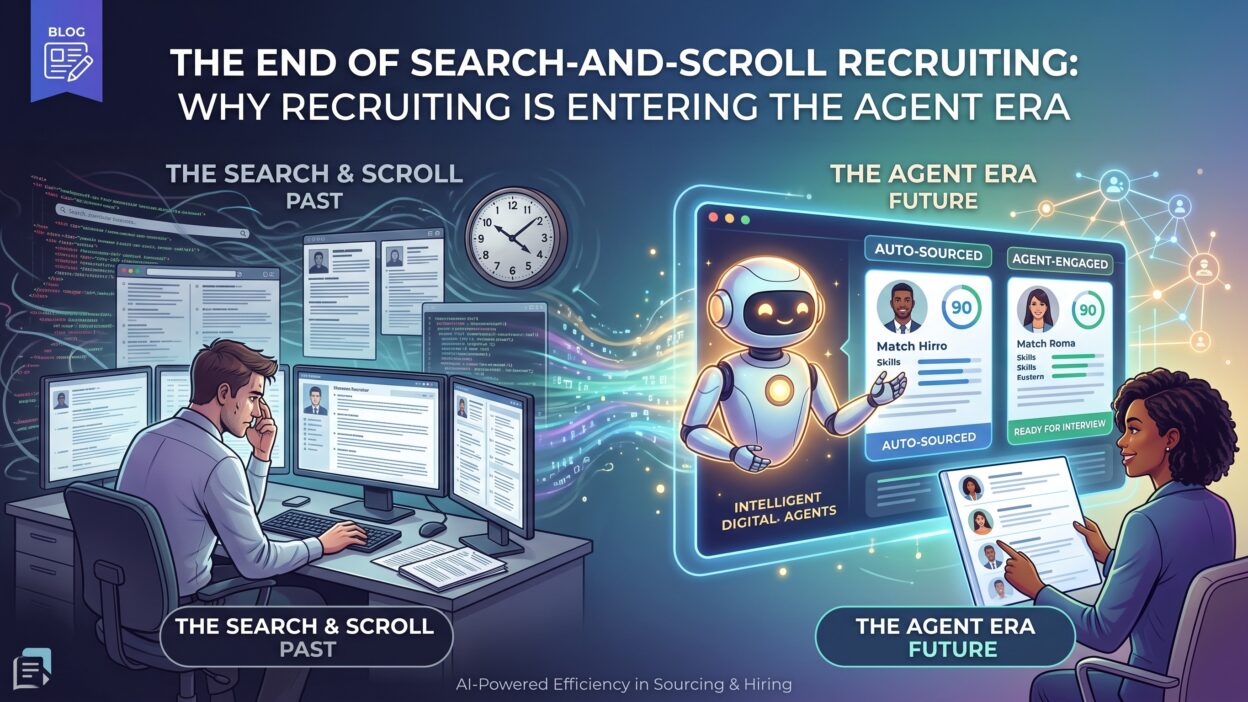
A typical recruiter opens LinkedIn or a job board first thing in the morning. They type a search string, scroll through pages of results, and open profiles one at a time. Each profile takes a minute or two to review properly. Multiply that by fifty or a hundred profiles a day, and the math gets exhausting fast.
This process worked reasonably well when candidate pools stayed smaller and hiring moved at a slower pace overall. Today, a single job posting can attract hundreds of applicants within hours. Manual review simply can’t keep pace with that volume, no matter how skilled the recruiter is.
Recruiters often describe this daily grind as the least favorite part of their job, despite spending most of their working hours on it. Screening calls, interview coordination, and offer negotiation feel meaningful. Scrolling through page after page of loosely related profiles feels like a chore that never actually ends.
The irony runs deep here. Recruiters entered this profession to build relationships and match people with opportunities. Instead, a huge share of their week goes toward mechanical, repetitive searching that has almost nothing to do with why they chose the job in the first place.
Why This Model Is Breaking Down
Search-and-scroll recruiting depends entirely on human attention span and time. Both run out fast. A recruiter juggling five open roles at once can’t give each one the deep, careful search it deserves. Something always gets rushed.
Candidates feel this strain too. Slow response times, generic outreach messages, and missed opportunities all trace back to a recruiter drowning in manual work. This new approach exists specifically to fix that breaking point, not as a novelty but as a practical necessity.
Understanding Agent Recruiting From the Ground Up
The concept sounds futuristic, but the core idea is simple once you break it down.
What an AI Recruiting Agent Actually Does
An AI recruiting agent works like a tireless junior sourcer. It reads a job description, builds search criteria automatically, scans multiple platforms at once, and ranks candidates based on real fit rather than simple keyword overlap. Some agents go further and draft personalized outreach messages too.
The agent doesn’t replace judgment entirely. It handles the repetitive, time-consuming parts of sourcing so a human recruiter can focus on conversations, relationship building, and final decisions. This model works best as a partnership, not a full handoff.
How Agent Recruiting Differs From Traditional Automation
Older recruiting automation followed rigid rules. A tool might auto-reject any resume missing a specific keyword, with no understanding of context. This newer approach works differently. It understands intent, adapts to new information, and makes decisions closer to how an experienced recruiter would.
This distinction matters. Rigid automation often frustrated both recruiters and candidates, rejecting strong matches over a technicality. Agent Recruiting reduces that friction by reasoning through context instead of just matching text.
The Technology Behind Agent Recruiting
Large language models power most of these tools today. These models read job descriptions and resumes the way a person does, picking up on nuance and related skills rather than exact word matches. Combined with search automation, this creates a system that finds and evaluates candidates without constant manual input.
Some platforms add memory to their agents, letting the system remember past searches and outcomes. Over time, the agent gets sharper at predicting which candidates will actually succeed in a given role, based on real hiring history rather than guesswork.
This memory feature separates advanced tools from basic search bots. An agent that remembers which candidate types succeeded in past hires for a similar role brings real institutional knowledge to every new search, something a brand new recruiter simply can’t replicate on their first week at a company.
Integration with a company’s existing hiring data makes this memory even more powerful. When an agent connects to past performance reviews and retention data, it starts recognizing patterns that predict long-term success, not just resume-level qualification.
Data privacy deserves attention in this setup too. Companies feeding sensitive hiring history into an AI agent need clear policies around data handling and candidate consent. A strong platform builds these protections in from the start, rather than treating privacy as an afterthought once a legal team raises concerns.
Why Recruiting Is Entering the Agent Era Right Now
Timing matters here. Several forces are converging at once to make this shift happen faster than most expected.
Talent Pools Have Grown Too Large for Manual Review
Remote work opened hiring beyond local talent pools. A single role can now attract applicants from dozens of countries. This growth benefits companies looking for the best fit, but it overwhelms recruiters still relying on manual search and review.
Global sourcing also adds complexity beyond sheer volume. Different regions use different job title conventions, different résumé formats, and different professional networking habits. A recruiter manually reviewing international candidates needs extra time just to translate context, on top of the usual screening work.
This approach scales in a way manual sourcing simply can’t. An agent reviews thousands of profiles in the time a human reviews a few dozen, without losing accuracy along the way.
Candidate Expectations Have Changed
Job seekers expect fast responses and relevant outreach today. A generic, mistimed message damages a company’s reputation quickly, especially in tight-knit industries where candidates talk to each other. This system helps companies respond faster and with more relevant messaging, since the agent already understands the candidate’s real background before any outreach goes out.
Speed alone doesn’t win candidates over, but slow, generic outreach loses them fast. Companies adopting this approach gain a real edge in a competitive hiring market.
The Cost of Slow Hiring Keeps Rising
Every open role costs a company money in lost productivity. Long hiring cycles compound this cost, and search-and-scroll recruiting simply takes too long for many businesses to absorb comfortably. Agent Recruiting shortens the sourcing phase dramatically, freeing up recruiter time for the parts of hiring that truly need a human touch.
Finance teams increasingly track this cost directly, calculating exactly how much revenue or productivity a vacant role drains each week it stays open. This data pressures hiring teams to move faster, and manual sourcing rarely keeps pace with that expectation.
Faster sourcing also reduces the risk of losing a great candidate to a competing offer. A slow process gives other companies time to swoop in with a faster decision, even when your company was the candidate’s first choice originally.
Core Components of an Effective Agent Recruiting System
Not every AI sourcing tool qualifies as the real thing. A few components separate genuine agents from basic automation.
Autonomous Search Execution
A real recruiting agent builds and runs its own search strategy based on a job description, without needing a recruiter to write out every search string manually. This autonomy saves the most time, since search construction was always one of the slowest parts of manual sourcing.
The agent adjusts its search on the fly too. If an initial search returns too few strong candidates, the agent widens its criteria automatically, testing new angles without waiting for manual intervention.
This adaptive quality separates a true agent from a simple automated script. A basic script runs the same search every time, regardless of results. A genuine agent evaluates its own output and adjusts strategy, much like an experienced sourcer would after noticing their first search returned mostly weak matches.
Contextual Candidate Ranking
Beyond finding candidates, a strong recruiting agent ranks them based on genuine fit. It weighs relevant experience, skill overlap, and even career trajectory, rather than just counting matched keywords. This ranking gives recruiters a prioritized list instead of an unsorted pile of maybes.
Good ranking also flags uncertainty honestly. A well-built agent notes when a candidate’s fit feels ambiguous, prompting human review instead of forcing a confident score onto a genuinely unclear case.
This honesty matters more than raw accuracy in many ways. A ranking system that always sounds confident, even when it shouldn’t, eventually erodes recruiter trust. Recruiters need to know when to double-check an agent’s suggestion, and a system that flags its own uncertainty makes that decision easier.
Personalized Outreach Generation
Many platforms now draft outreach messages automatically, using specific details from a candidate’s background. A message referencing a candidate’s actual project work performs far better than a generic template, and the agent can generate this level of personalization at scale.
Recruiters still review and adjust these drafts before sending, in most well-designed workflows. The agent handles the first draft, and the human adds the final judgment and tone.
How Recruiters Can Prepare for the Agent Era
This shift doesn’t mean recruiters lose their jobs. It means their jobs change shape.
Shifting Focus From Sourcing to Relationship Building
Recruiters who once spent most of their day searching now spend more time actually talking to candidates. This shift plays to a recruiter’s real strength, since building trust and answering questions requires human skill that no agent fully replicates yet.
Companies adopting Agent Recruiting should redesign recruiter workflows around this shift deliberately. Simply adding an agent on top of an unchanged process wastes most of the potential time savings.
Redesigning a workflow starts with an honest audit of where a recruiter’s time actually goes each week. Many teams discover that searching and initial screening eat up far more hours than anyone realized, hours that could shift toward candidate calls and stakeholder conversations once an agent takes over the repetitive work.
Leadership buy-in matters here too. A recruiter freed from manual sourcing still needs clear direction on how to spend that reclaimed time. Without that guidance, freed-up hours sometimes just get absorbed into other administrative tasks instead of higher value work.
Learning to Manage and Oversee AI Agents
Recruiters need new skills to work alongside these tools effectively. Understanding how to review an agent’s ranked output, spot errors, and adjust search parameters becomes part of the modern recruiter’s toolkit.
This oversight role matters enormously. An agent without human review can drift toward biased or inaccurate outcomes over time, especially if its training data carries old patterns. Recruiters who understand the technology catch these issues early.
Building this oversight skill takes deliberate practice, not just a one-time training session. Recruiters benefit from regularly reviewing a sample of agent-generated rankings against their own manual judgment, checking for drift or blind spots before they become a pattern across many hires.
Building Trust With Candidates in an Automated Process
Some candidates worry about talking to a bot instead of a real person. Transparency solves most of this concern. Companies that clearly explain which parts of their process use Agent Recruiting, and which parts involve real human review, build more trust than those who hide the technology entirely.
A short, honest note in outreach messages, explaining that an agent helped identify the candidate’s fit before a real recruiter reached out, often reassures candidates rather than turning them away.
Companies that hide their use of automation entirely risk a worse outcome if candidates find out later through other means. Word travels fast in professional networks, and a company caught being less than transparent about its hiring process often pays a bigger reputational price than one that simply explained the process upfront.
Common Concerns About Agent Recruiting
Every major shift in hiring technology brings valid questions. Agent Recruiting is no exception.
Does Agent Recruiting Increase Bias Risk
AI agents learn from existing data, and biased data produces biased outcomes. This risk is real, and it demands regular auditing. Companies using this technology should test their agents against diverse resume samples periodically, checking for unfair patterns in candidate rankings.
The upside here actually favors careful companies. A well-audited AI agent can reduce bias compared to inconsistent human judgment, since the agent applies the same criteria every time instead of having a good day or a bad day.
Will Agent Recruiting Replace Human Recruiters Entirely
Full replacement seems unlikely for most roles, especially senior or highly specialized positions. Candidates for these roles expect real conversations with real decision makers. Agent Recruiting handles the volume work, freeing recruiters for exactly this kind of high-stakes conversation.
Entry-level and high-volume hiring may see heavier automation sooner. Even there, most companies keep a human checkpoint before any final rejection or offer goes out.
The recruiter’s value has always extended beyond finding resumes. Negotiating an offer, answering a nervous candidate’s questions, and reading the room during a final interview all require emotional intelligence that current technology can’t fully replicate. These skills become more valuable, not less, as sourcing work shifts toward automation.
How Accurate Are AI Recruiting Agents Today
Accuracy varies significantly between platforms. Newer agents built on strong language models perform impressively well at understanding context and matching real skills to real roles. Older or poorly built tools still struggle with nuance, closer to basic keyword automation than a genuine autonomous agent.
Companies evaluating a new platform should request real performance data from existing clients before committing. A vendor confident in their agent’s accuracy will share this information without hesitation, often including case studies from similar industries or company sizes.
Getting Started With Agent Recruiting at Your Company
Adopting this technology doesn’t require an overnight overhaul. A gradual rollout works better for most teams.
Starting With a Pilot Role
Choose one role type to test this approach on first, ideally something with decent hiring volume so results become clear quickly. Compare the agent’s shortlist against a traditional manual search for the same role, and review the quality difference honestly with your team.
This pilot approach builds internal confidence before a wider rollout. It also surfaces any platform-specific quirks early, before the stakes get higher across multiple open roles at once.
Document everything during a pilot phase, including specific examples where the agent performed well and cases where it missed the mark. This record becomes valuable when presenting results to leadership, since concrete examples persuade skeptical stakeholders far more effectively than general claims about efficiency gains.
Choosing the Right Agent Recruiting Platform
Look for platforms with transparent ranking logic, so recruiters understand why the agent scored a candidate a certain way. Black-box scoring erodes trust fast, especially when a recruiter disagrees with a ranking and can’t see the reasoning behind it.
Ask vendors how their agents handle edge cases, like candidates transitioning between industries or those with nontraditional career paths. A strong Agent Recruiting platform handles these situations gracefully instead of penalizing candidates for an unconventional background.
Measuring Success Beyond Speed
Faster sourcing feels like an obvious win, but quality of hire matters more in the long run. Track how candidates sourced through an AI agent perform after they join the company, comparing this data against candidates sourced through traditional methods. Real success shows up in retention and performance, not just a shorter time-to-fill number.
Frequently Asked Questions
What is Agent Recruiting? This model uses AI agents to autonomously search, rank, and often reach out to candidates, reducing the manual search-and-scroll work recruiters traditionally handle themselves.
How does this differ from an applicant tracking system? An applicant tracking system stores and organizes applications after candidates apply. An AI recruiting agent actively searches for and evaluates candidates, including those who haven’t applied at all.
Is this approach only for large companies? No. Many platforms scale down for smaller teams, offering pricing based on hiring volume rather than requiring a large enterprise budget.
Does this technology eliminate recruiter jobs? Most evidence points toward role transformation rather than elimination. Recruiters shift toward relationship building and oversight, while agents handle repetitive sourcing tasks.
How do I know if an AI recruiting agent is accurate? Ask vendors for real performance data and run a pilot on one role before a full rollout. Compare the agent’s shortlist against a manual search to judge accuracy directly.
What skills do recruiters need for this new era? Recruiters benefit from learning how to review AI-generated rankings, spot bias or errors, and focus more time on candidate conversations instead of manual searching.
Read More:-B2B Context Engine: A Guide for GTM Teams
Conclusion

Search-and-scroll recruiting served the industry for years, but candidate volume and expectations have outgrown what manual review can handle. Agent Recruiting steps into that gap, handling the repetitive sourcing work while recruiters focus on judgment, relationships, and final decisions.
This shift doesn’t erase the recruiter’s role. It reshapes it into something more valuable. Companies that adopt Agent Recruiting thoughtfully, with clear oversight and honest candidate communication, will hire faster without losing the human connection that good hiring still depends on.
The recruiting industry is entering a new era, and Agent Recruiting sits at the center of that change. Teams that prepare early will find themselves far ahead of those still stuck scrolling.
The transition won’t happen overnight for every company, and that’s fine. Small, deliberate steps beat a rushed rollout that ignores real oversight and candidate trust. Start with one role, measure honestly, and build from there. The recruiters who treat this shift as a skill to learn, rather than a threat to resist, will come out ahead.