Introduction
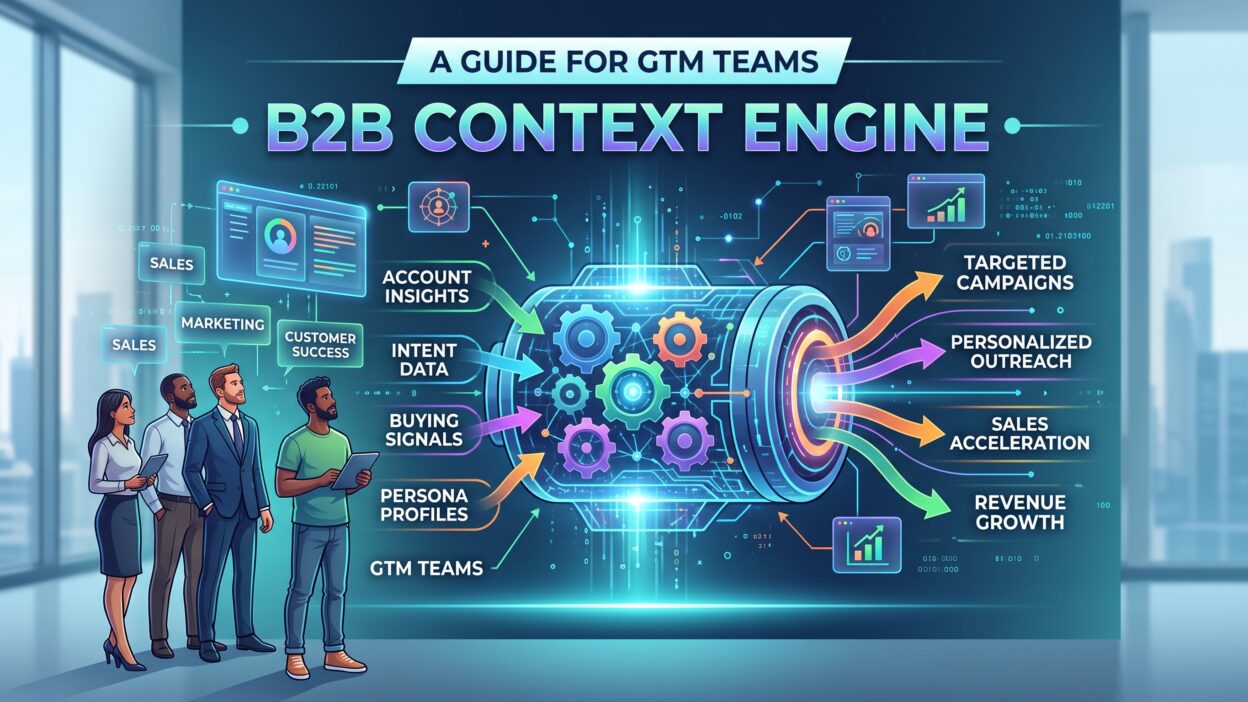
TL;DR Sales and marketing teams drown in scattered data. A prospect’s intent signal sits in one tool. Their firmographic data sits in another. Their engagement history sits somewhere else entirely. A B2B Context Engine solves this problem. It pulls every relevant signal into one place and hands your GTM team a complete picture of each account, in real time.
This guide explains what a B2B Context Engine actually does. It covers how the technology works, why GTM teams need it, and how to roll one out without breaking your existing stack. You will also find real use cases, common pitfalls, and answers to the questions teams ask most.
Table of Contents
What Is a B2B Context Engine?
A B2B Context Engine is a system that gathers, unifies, and interprets data about a company or buyer, then delivers that context exactly when a GTM team needs it. It doesn’t just store data. It connects the dots between signals that usually live in separate silos.
Picture a sales rep about to call a prospect. Without a B2B Context Engine, that rep checks the CRM, then checks a intent data tool, then checks LinkedIn, then checks a support ticket system. Four tools, four logins, ten minutes wasted before the call even starts. A B2B Context Engine pulls all four sources into one clean summary. The rep reads it in thirty seconds and walks into the call prepared.
The word “context” matters here. Raw data alone doesn’t help a seller close a deal. A list of website visits means little without knowing which pages, how often, and who else at that company engaged recently. A B2B Context Engine turns raw signals into a story your team can act on immediately.
Why GTM Teams Need Context, Not Just Data
Most companies already own plenty of data tools. The problem isn’t data scarcity. The problem is fragmentation. Marketing owns campaign data. Sales owns CRM notes. Product owns usage data. Support owns ticket history. None of these teams see the full picture alone.
A B2B Context Engine breaks down these walls. It gives every GTM function access to the same unified account view. Marketing sees which accounts are sales-ready. Sales sees which leads product usage flags as expansion opportunities. Everyone works from the same source of truth instead of guessing.
This shift matters more as buying committees grow larger. A single deal might involve five or six stakeholders across different departments. Tracking every touchpoint by hand becomes impossible past a certain deal size. A B2B Context Engine keeps every interaction visible in one place, so no signal falls through the cracks when a deal has this many moving parts.
Speed also plays a role here. Buyers move fast once they start researching a solution seriously. A rep who responds within minutes of a strong intent signal converts at a much higher rate than one who responds a day later. A B2B Context Engine catches these moments as they happen, not after the opportunity has cooled off.
How a B2B Context Engine Works
A B2B Context Engine runs on three core layers. Each layer plays a distinct role in turning scattered data into usable context.
Data Ingestion Layer
This layer pulls raw data from every connected source. CRM records, intent signals, firmographic databases, website analytics, and support tickets all feed into the engine here. A strong B2B Context Engine connects to dozens of sources without forcing your team to manually export and import files every week.
Enrichment and Unification Layer
Raw data rarely matches perfectly across systems. A contact’s email might differ slightly between your CRM and your marketing tool. A company name might appear three different ways across three data sources. This layer cleans, deduplicates, and enriches the data. It matches records to the correct account and fills in missing details like company size, industry, or tech stack.
Delivery Layer
The final layer surfaces context where your team already works. A good B2B Context Engine doesn’t force reps to open a new tool. It pushes relevant context directly into the CRM, the sales engagement platform, or a Slack notification. The goal stays simple: give the right person the right context at the right moment.
Real-Time vs Batch Processing
Some B2B Context Engine platforms update data in real time. Others run on scheduled batch updates. Real-time processing matters most for time-sensitive signals, like a prospect visiting your pricing page right now. Batch processing works fine for slower-moving data, like firmographic details that rarely change. The best platforms blend both approaches based on the signal type.
Scoring and Prioritization Logic
Beyond storing and delivering context, a B2B Context Engine usually includes a scoring layer. This layer weighs different signals against each other. A recent pricing page visit might carry more weight than an email open from three months ago. Good scoring logic reflects how your specific buyers actually behave, not a generic template borrowed from another industry.
API and Workflow Automation
Many B2B Context Engine platforms expose an API layer. This lets your team build custom automations on top of the core system. A workflow might automatically notify a rep the moment a target account hits a certain intent threshold, or trigger a Slack alert when a champion changes jobs. These automations turn passive context into active, timely nudges for your team.
Key Benefits of a B2B Context Engine
GTM teams adopt a B2B Context Engine for reasons that go beyond convenience. The impact shows up directly in pipeline and revenue numbers.
Faster Sales Cycles
Reps waste less time researching accounts manually. A B2B Context Engine hands them a ready-made summary before every call. This shaves minutes off prep time across hundreds of calls a month, which adds up to real hours saved.
Better Lead Prioritization
Not every lead deserves equal attention. A B2B Context Engine combines intent signals, firmographic fit, and engagement history to score accounts accurately. Sales teams stop chasing cold leads and start focusing on accounts actually showing buying signals.
Tighter Sales and Marketing Alignment
Marketing and sales often argue about lead quality because they work from different data. A B2B Context Engine gives both teams the same unified view. This shared context reduces finger-pointing and builds trust between departments.
Improved Personalization at Scale
Generic outreach gets ignored. A B2B Context Engine gives reps specific details to reference, like a recent product page visit or a competitor mention in a support ticket. This context makes personalization possible even across a large account list, not just a handful of top accounts.
Reduced Tool Sprawl
Teams often stack five or six point solutions trying to solve the context problem piece by piece. A B2B Context Engine consolidates much of this work into one platform. This cuts costs and reduces the training burden on new hires.
Higher Win Rates on Competitive Deals
Deals get lost when a rep misses a key detail, like a competitor evaluation happening in parallel. A B2B Context Engine surfaces these signals early, giving reps time to address objections before a prospect commits elsewhere. This visibility often makes the difference between winning and losing a close competitive deal.
Core Use Cases Across the GTM Motion
A B2B Context Engine touches nearly every stage of the GTM funnel. Here’s where teams see the clearest impact.
Account-Based Marketing
ABM campaigns need precise targeting. A B2B Context Engine identifies which accounts show real buying intent right now, not just accounts that fit a static ideal customer profile. Marketing teams build campaigns around accounts actively in-market, which improves conversion rates significantly.
Sales Prospecting and Outreach
Outbound reps need a reason to reach out that doesn’t sound generic. A B2B Context Engine surfaces trigger events, like a recent funding round, a leadership change, or a spike in website activity. Reps use these triggers to craft outreach that actually gets a response.
Customer Success and Expansion
Existing customers generate signals too. A B2B Context Engine tracks product usage patterns and flags accounts showing expansion potential. Customer success managers get ahead of renewal conversations instead of scrambling at the last minute.
Revenue Operations and Forecasting
RevOps teams need clean, unified data to build accurate forecasts. A B2B Context Engine reduces the manual data reconciliation work that usually eats up a RevOps analyst’s week. Forecasts become more reliable because they’re built on complete account context, not partial CRM data.
Sales Development and Lead Routing
Speed matters when a hot lead comes in. A B2B Context Engine can trigger instant lead routing based on real-time context, sending high-intent leads straight to the right rep instead of sitting in a queue.
Partnerships and Channel Sales
Channel teams often lack visibility into what a partner’s prospect actually cares about. A B2B Context Engine shared across a partner ecosystem gives channel managers the same account intelligence direct sales teams use, which helps close co-sell deals faster and with less back-and-forth.
How to Choose the Right B2B Context Engine
Not every B2B Context Engine fits every GTM stack. A few factors separate the platforms worth serious evaluation.
Integration Depth
Check how many data sources the platform actually connects to out of the box. A B2B Context Engine with shallow integrations forces your team back into manual work, which defeats the entire purpose of adopting one.
Data Freshness
Ask how often the platform updates its signals. Stale data creates false confidence. A B2B Context Engine that only refreshes weekly won’t catch a prospect’s activity from this morning.
Ease of Use for Reps
The best B2B Context Engine feels invisible to the end user. Reps shouldn’t need training to read a context summary. If the interface feels cluttered or complex, adoption will stall no matter how good the underlying data is.
Customization and Scoring Flexibility
Every company defines a “good fit” account differently. A strong B2B Context Engine lets you customize scoring models instead of forcing a generic one-size-fits-all approach onto your specific market.
Security and Data Governance
A B2B Context Engine touches sensitive customer and prospect data. Confirm the platform follows solid security practices, including proper encryption and clear data retention policies. This matters even more if your company operates in a regulated industry with strict compliance requirements.
Pricing and Total Cost of Ownership
Sticker price rarely tells the full story. A B2B Context Engine might charge per user, per contact record, or per data source connected. Factor in implementation costs, ongoing data fees, and the cost of any internal team needed to maintain it. A cheaper platform that lacks key integrations often costs more in the long run once you add workarounds.
Rolling Out a B2B Context Engine: A Practical Approach
Implementation success depends heavily on how you approach the rollout, not just which platform you pick.
Start With a Clear Data Audit
Before connecting a B2B Context Engine to your stack, map out every data source you currently use. Identify gaps, duplicates, and inconsistencies. This audit prevents you from feeding messy data into a system built to clean things up.
Pilot With One Team First
Don’t roll a B2B Context Engine out company-wide on day one. Pick one sales pod or one ABM campaign as a pilot. Measure the impact on response rates, meeting bookings, or deal velocity before expanding further.
Train Reps on Practical Workflows
Show reps exactly how a B2B Context Engine changes their daily routine. A generic training deck won’t stick. Walk through real accounts and show how the context summary changes how they open a call or write an email.
Set Clear Success Metrics
Define what success looks like before launch. Faster response times, higher meeting rates, or shorter sales cycles all work as measurable outcomes. Track these numbers closely during the first ninety days after your B2B Context Engine goes live.
Get Buy-In From Leadership Early
A B2B Context Engine rollout works best when leadership actively champions it, not just the RevOps team pushing it alone. Have a sales leader reference the tool in team meetings. Have a marketing leader tie campaign wins back to the context data. This visibility signals to the whole org that the change matters.
Expand in Phases
Once the pilot proves value, expand a B2B Context Engine team by team rather than all at once. Each team has different workflows and different data needs. A phased rollout gives you room to adjust configurations before scaling further, instead of fixing problems across the entire org simultaneously.
Common Mistakes to Avoid
Teams run into predictable problems when adopting a B2B Context Engine. Knowing these ahead of time saves real headaches.
Treating a B2B Context Engine as a plug-and-play magic box causes the most disappointment. The platform still needs clean source data and clear scoring logic to perform well. Garbage in still means garbage out, no matter how advanced the engine looks on paper.
Ignoring change management also derails rollouts. Reps who don’t understand why context matters will ignore the summaries sitting right in front of them. Leadership needs to reinforce the new workflow consistently during the first few months.
Overloading reps with too much context creates a different problem. A B2B Context Engine that dumps twenty data points onto a rep’s screen defeats its own purpose. Good platforms surface the three or four most relevant signals, not everything available.
Skipping the data audit before implementation causes hidden problems down the line. Duplicate records, mismatched company names, and outdated firmographic data all confuse a B2B Context Engine’s matching logic. Cleaning this up after launch takes far more effort than fixing it beforehand.
Finally, some teams pick a platform based on features alone without checking integration depth. A B2B Context Engine that can’t connect to your specific tech stack leaves major gaps in the context it delivers. Always confirm compatibility with your core systems before signing a contract.
The Future of B2B Context Engines
AI is pushing B2B Context Engine platforms toward more predictive capabilities. Instead of just surfacing what happened, future platforms will suggest what to do next, like the best time to call or the specific message likely to land.
Expect deeper integration with AI agents too. A B2B Context Engine will increasingly feed autonomous agents that draft outreach, schedule meetings, or flag at-risk accounts without a human triggering the action first. GTM teams that build strong context foundations now will adapt faster as these capabilities mature.
Cross-functional context sharing will also expand beyond sales and marketing. Product teams already lean on usage data to guide roadmap decisions. A B2B Context Engine that connects product signals to revenue outcomes gives leadership a clearer view of which features actually drive expansion and retention, not just adoption numbers in isolation.
Frequently Asked Questions
What is a B2B Context Engine?
A B2B Context Engine is a platform that unifies data from multiple sources, like CRM records, intent signals, and firmographic databases, into one clear account view. GTM teams use it to understand accounts faster and act on real-time signals.
How does a B2B Context Engine differ from a CDP?
A customer data platform focuses mainly on storing and organizing data. A B2B Context Engine goes further by enriching, scoring, and delivering that data directly into the tools GTM teams already use, often in real time.
Do small companies need a B2B Context Engine?
Smaller teams with fewer accounts might manage manually for a while. As account volume grows, manual research becomes unsustainable. A B2B Context Engine becomes valuable once a team can’t keep up with account research by hand.
How long does it take to implement a B2B Context Engine?
Timelines vary based on data complexity and integration count. Simple setups can launch in a few weeks. Larger enterprises with many data sources often need a few months for a full rollout.
Can a B2B Context Engine work with an existing CRM?
Yes. Most B2B Context Engine platforms integrate directly with popular CRMs like Salesforce or HubSpot. The engine pulls data from the CRM and pushes enriched context right back into it.
What data sources feed a B2B Context Engine?
Common sources include CRM records, website analytics, intent data providers, firmographic databases, support ticket systems, and product usage data. A strong B2B Context Engine connects as many relevant sources as your stack allows.
Read More:-Tealium Review 2026: Full Platform Breakdown
Conclusion

A B2B Context Engine turns scattered, siloed data into something GTM teams can actually use. It saves reps from manual research. It gives marketing and sales a shared source of truth. It surfaces the right signal at the right moment, instead of burying useful information across five disconnected tools.
The technology isn’t magic on its own. A B2B Context Engine still depends on clean data, thoughtful scoring, and a team willing to change how they work day to day. Teams that treat the rollout seriously, starting with a small pilot and clear success metrics, see the biggest returns.
GTM motions keep getting more complex. Buyers research longer, involve more stakeholders, and expect personalized outreach from the first touch. A B2B Context Engine gives your team the context needed to meet that expectation, consistently and at scale.
Teams that wait too long to adopt a B2B Context Engine often find themselves buried under manual research just as competitors move faster with better-informed outreach. The gap widens quickly once one team in a market starts closing deals with sharper timing and messaging. Start with one team, prove the impact, then expand from there.