Introduction
TL;DR Your HubSpot CRM holds the data your entire revenue team runs on. Sales reps pull contact records to personalize outreach. Marketing teams build audience segments for campaigns. RevOps leaders use account data to build forecasts and territory plans. When that data is incomplete, everything downstream suffers. HubSpot data enrichment solves this problem by automatically appending verified third-party information to your CRM records. It fills missing fields, corrects stale values, and gives your team complete context without requiring hours of manual research. But HubSpot data enrichment is not perfect. It has real limitations that many teams discover only after they have already invested in the platform. This guide covers how HubSpot data enrichment works, where it delivers genuine value, where it falls short, and what smart revenue teams do to close the gaps.
Table of Contents
What Is HubSpot Data Enrichment?
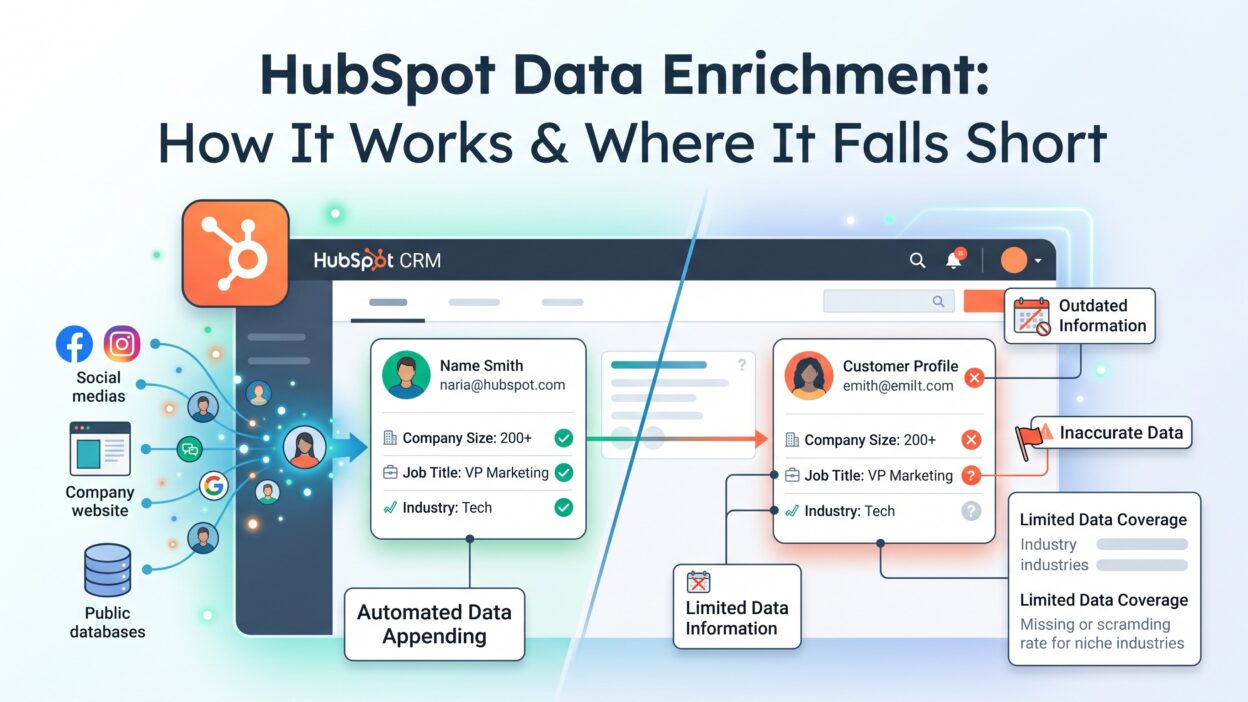
HubSpot data enrichment is the process of automatically appending verified company and contact information to records inside the HubSpot CRM. A contact enters your database with a name and email address. HubSpot data enrichment fills in the company name, industry, employee count, revenue range, job title, and dozens of other fields without requiring any manual input from your team.
How HubSpot Defines Data Enrichment
HubSpot describes enrichment as a way to give sales and marketing teams a fuller picture of every contact and company in their database. The platform pulls data from its own proprietary data network as well as from acquired data assets. The goal is simple. Every record should contain enough information for a rep to have a meaningful conversation or for a marketer to build a relevant segment.
Native vs. Third-Party HubSpot Data Enrichment
HubSpot offers native enrichment through its Breeze Intelligence product, formerly known as Clearbit. It also supports third-party enrichment through integrations available on the HubSpot App Marketplace. Native enrichment is simpler to configure. Third-party enrichment often delivers higher accuracy and broader coverage. Most enterprise revenue teams use a combination of both. Understanding the difference helps you make smarter platform decisions before spending a dollar on tools.
How HubSpot Data Enrichment Works Natively
HubSpot’s native enrichment capability operates through Breeze Intelligence. This product came from HubSpot’s acquisition of Clearbit in 2023. It gives HubSpot users access to a large proprietary database of B2B company and contact records. HubSpot data enrichment through Breeze Intelligence runs automatically on contact and company records inside the CRM.
Breeze Intelligence and the Data Credit System
Breeze Intelligence operates on a credit-based system. Each enrichment action consumes a credit. Credits come in packages tied to your HubSpot subscription tier. When a new contact enters your database, the system uses a credit to look up that contact’s company information and append verified fields. Batch enrichment of existing records also consumes credits. Teams with large databases need to monitor credit consumption carefully. Running out of credits mid-month means new records stop enriching until the next billing cycle.
What Fields Breeze Intelligence Enriches
Breeze Intelligence appends data across several categories. Company-level fields include industry classification, employee count, annual revenue, headquarters country, and company type. Contact-level fields include job title, seniority level, department, and in some cases LinkedIn profile URL. Technographic data is available for select accounts, revealing which software tools a company uses. Intent signals indicate whether a company is actively researching topics relevant to your product. Each field category serves a different function in your sales and marketing workflows.
Trigger-Based Enrichment on Form Submissions
One of the most valuable applications of HubSpot data enrichment is form enrichment. A visitor fills out a short form on your website. They provide a name and work email address. HubSpot data enrichment fires immediately. The system looks up the email domain, identifies the company, and populates all available firmographic fields on the contact record. The sales rep who receives that lead notification sees a fully enriched record. They know the company size, the industry, and the contact’s likely seniority level before picking up the phone.
Workflow-Based Enrichment for Existing Records
HubSpot allows teams to trigger enrichment through workflow automation. A workflow can fire when a contact property changes, when a deal reaches a certain stage, or on a scheduled basis. This makes it possible to refresh stale records automatically. A contact record that has not been enriched in 90 days can trigger a re-enrichment workflow. The system checks for updated information and overwrites outdated field values with fresher data.
The Real Value of HubSpot Data Enrichment for Revenue Teams
HubSpot data enrichment delivers measurable value across sales, marketing, and operations functions. Understanding where the value concentrates helps teams prioritize their enrichment strategy.
Sales Productivity Gains
Sales reps waste significant time researching prospects before outreach. Industry estimates place this figure at 20 to 30 percent of a rep’s working week. HubSpot data enrichment eliminates most of that research. A rep opens a contact record and finds verified company data already populated. They personalize their outreach based on real firmographic context. They reference the company’s industry in the first line of their email. They tailor their pitch to the company’s size. The result is faster outreach, more relevant conversations, and higher reply rates.
Marketing Segmentation Accuracy
Marketing teams build audience segments using contact and company properties. A campaign targeting enterprise companies in the healthcare sector requires accurate industry and employee count data on every record. HubSpot data enrichment makes that segmentation reliable. Fields that were previously empty or inconsistent now hold verified, standardized values. Email campaigns reach the right audience. Ad audiences match the intended profile. Lead scoring models calculate accurate scores because the underlying field values reflect reality.
Faster Lead Routing and Qualification
Lead routing rules depend on CRM field values. A routing rule that sends enterprise leads to one team and SMB leads to another only works if the company size field is populated. HubSpot data enrichment fills that field at the moment of lead creation. Routing fires correctly on the first attempt. The right rep gets the right lead without delay. Speed to lead improves. Pipeline quality improves. The entire inbound motion runs more efficiently.
Improved Reporting and Forecast Accuracy
Revenue leadership relies on CRM data for forecast calls, pipeline reviews, and board reporting. A pipeline report that includes accounts with missing industry or revenue data is hard to interpret. HubSpot data enrichment gives leadership a complete picture. They can slice pipeline by industry, company size, and geography with confidence because those fields hold verified values. Forecast calls become more grounded in real account context.
Where HubSpot Data Enrichment Falls Short
HubSpot data enrichment is a strong product for many use cases. It is not a perfect solution for every team. Understanding its real limitations helps you plan your data strategy more accurately.
Coverage Gaps Outside North America
Breeze Intelligence’s strongest coverage sits in North America. European, APAC, and Latin American data coverage is noticeably weaker. Teams selling into international markets frequently encounter low match rates for contacts and accounts outside the United States. A revenue team with a significant EMEA pipeline may find that a large percentage of records return no enrichment data at all. This gap forces teams to supplement native HubSpot data enrichment with specialized providers that have stronger international coverage.
Contact Data Depth Limitations
Breeze Intelligence delivers solid company-level firmographic data. Contact-level data is less comprehensive. Direct dial phone numbers are often missing or unverified. Personal email addresses are rarely available. For teams that rely heavily on phone outreach, the contact data depth in native HubSpot data enrichment may fall significantly short of what they need. Third-party providers like Cognism or ZoomInfo deliver far more complete contact data, particularly for phone-verified mobile numbers.
Data Freshness Concerns
HubSpot’s underlying data refreshes on a periodic basis. The exact refresh cadence is not always transparent to end users. B2B contact data decays quickly. People change jobs every two to three years. Companies restructure constantly. A record enriched six months ago may already be outdated. Teams with high outbound velocity need assurance that enriched data reflects current reality. Native HubSpot data enrichment does not always provide that assurance at the granularity enterprise teams require.
Credit Consumption at Scale
The credit-based pricing model creates real challenges for teams with large databases. A database of 200,000 contacts requires 200,000 credits for a single full-database enrichment pass. Adding monthly re-enrichment on active contacts adds tens of thousands more credits. Teams that underestimate their enrichment volume face unexpected costs when they exceed their monthly credit allotment. Budgeting for HubSpot data enrichment at scale requires careful volume modeling before committing to a tier.
Limited Intent Data Depth
Intent data signals which companies are actively researching topics relevant to your product. Breeze Intelligence offers intent signals, but the depth and breadth of those signals is more limited than specialized intent providers like Bombora or G2 Buyer Intent. Teams that rely heavily on intent data for prioritizing outreach may find native HubSpot data enrichment insufficient for this specific use case. Dedicated intent data providers deliver more granular, higher-confidence signals.
Technographic Data Coverage
Technographic data reveals which software tools a target company uses. This data is enormously valuable for SaaS companies selling into specific technology ecosystems. Breeze Intelligence offers some technographic coverage, but it does not match the depth of specialized providers like BuiltWith or HG Insights. Teams that need comprehensive technology stack data for a large portion of their accounts should evaluate dedicated technographic providers alongside native HubSpot data enrichment.
Third-Party Tools That Fill the HubSpot Data Enrichment Gaps
Smart revenue teams supplement native HubSpot data enrichment with third-party tools that address specific coverage or data quality gaps.
ZoomInfo for HubSpot
ZoomInfo offers a native HubSpot integration that delivers deep firmographic, technographic, and intent data. It leads the market in North American B2B data coverage. Its intent data layer is significantly more comprehensive than what Breeze Intelligence provides. Enterprise teams that need complete data coverage across all three categories frequently choose ZoomInfo as their primary enrichment source and use HubSpot’s native capabilities as a secondary layer.
Cognism for European Data
Cognism has built a strong reputation for GDPR-compliant contact data with verified mobile phone numbers. Its HubSpot integration syncs contact and company data bidirectionally. Teams with significant EMEA pipeline rely on Cognism to fill the coverage gaps that native HubSpot data enrichment leaves in European markets. The phone-verified data drives notably higher connection rates for outbound calling teams.
Apollo.io
Apollo.io combines a large B2B contact database with a full sales engagement platform. Its HubSpot integration syncs contact and company enrichment data directly to CRM records. Mid-market revenue teams that want enrichment and outreach capabilities in one platform frequently choose Apollo. Its pricing is accessible for growing teams that cannot yet justify ZoomInfo’s enterprise price point.
Bombora for Intent Data
Bombora is the leading independent intent data provider in B2B. Its HubSpot integration surfaces intent surge data directly on account records. Revenue teams that want to prioritize outreach based on active buying signals use Bombora to supplement what native HubSpot data enrichment delivers. The combination of Breeze Intelligence firmographic data and Bombora intent signals creates a powerful account prioritization layer.
Clearbit (Legacy Integration)
Teams that adopted Clearbit before the HubSpot acquisition may still run legacy Clearbit integrations alongside Breeze Intelligence. The transition between the two products has not been seamless for all customers. If your team runs a legacy Clearbit setup, evaluate whether migrating fully to Breeze Intelligence or consolidating on a third-party provider makes more strategic sense for your current data needs.
How to Build a HubSpot Data Enrichment Strategy That Works
Choosing tools is only part of the job. Building a sustainable enrichment strategy requires clear processes, governance policies, and performance measurement.
Start With a Database Audit
Before enriching anything, understand the current state of your HubSpot database. Pull property completion reports for your most important contact and company fields. Identify which fields are most often empty. Measure how many records lack industry, employee count, or revenue data. This baseline tells you where enrichment delivers the highest impact. It also gives you a benchmark to measure improvement against after your enrichment program runs.
Define Your Enrichment Priority Fields
Not every field needs enrichment on day one. Define the fields your lead scoring model, routing rules, and segmentation logic depend on most. For most B2B teams, that includes industry, employee count, revenue range, and contact seniority. Map enrichment coverage requirements to those specific fields first. Expand to secondary fields once your core enrichment program runs reliably.
Build Enrichment Into Your Lead Creation Workflow
The highest-value enrichment happens at the moment a record enters HubSpot. Build your enrichment trigger into the lead creation workflow. Use HubSpot’s native workflow tools to fire enrichment on every new contact. Configure field-level override logic to protect data your team entered manually. Test the workflow with a small batch of real records before enabling full volume. This sequencing prevents costly data cleanup down the road.
Set Clear Field Ownership Rules
Enrichment without field ownership rules creates confusion. Define which fields the enrichment system writes to and which fields your sales team owns. Document these rules in your data governance policy. Share them with your sales team. When reps understand that their manually entered data is protected and that enrichment only fills empty fields, they trust the system more. Trust in the data drives adoption of the CRM more broadly.
Track Enrichment Performance in HubSpot Dashboards
Build a HubSpot dashboard that tracks enrichment coverage over time. Include reports on field completeness by record type, match rates by lead source, and data freshness by enrichment date. Review this dashboard monthly with your RevOps team. Declining match rates signal a provider issue or a shift in your lead source mix. Catching these trends early prevents data quality problems from compounding over time.
Related Topics
Teams researching HubSpot data enrichment also search on closely related terms. Covering these topics connects this content to a broader range of search queries.
HubSpot CRM enrichment is a common variation used by HubSpot admins and RevOps professionals searching for ways to improve contact and company record quality within the platform specifically.
Breeze Intelligence HubSpot targets users researching HubSpot’s native enrichment product specifically. Understanding what Breeze Intelligence delivers — and where it falls short — is core to this audience’s decision process.
HubSpot contact enrichment focuses specifically on the contact object. Marketing operations and sales development teams searching for ways to improve individual contact data quality use this term frequently.
HubSpot company enrichment focuses on the company object. Account-based marketing teams building target account lists in HubSpot use this term when evaluating enrichment options.
B2B data enrichment tools captures a broader audience evaluating enrichment options across multiple CRM platforms. Teams comparing HubSpot-specific options against platform-agnostic solutions use this term during their research phase.
CRM data quality HubSpot attracts teams searching for broader data quality solutions. These teams understand that enrichment is one component of a larger data quality program that includes deduplication and validation.
Frequently Asked Questions About HubSpot Data Enrichment
What is HubSpot data enrichment? HubSpot data enrichment is the process of automatically appending verified third-party data to contact and company records inside HubSpot CRM. It fills missing fields like industry, employee count, revenue range, and job title without requiring manual research from your team.
How does Breeze Intelligence work in HubSpot? Breeze Intelligence is HubSpot’s native enrichment product, acquired from Clearbit in 2023. It uses a credit-based system to look up contact and company information and append verified field values to CRM records. Enrichment can trigger automatically on new record creation or run in batch mode on existing records through workflow automation.
How many credits does HubSpot data enrichment use? Each enrichment action consumes one credit. New contact enrichment, company enrichment, and batch enrichment jobs all draw from your monthly credit allotment. The number of credits included depends on your HubSpot subscription tier and any additional credit packages you purchase. Teams with large databases should calculate expected monthly usage carefully before selecting a tier.
Where does HubSpot data enrichment fall short? Native HubSpot data enrichment has notable gaps in international data coverage, contact phone number depth, data freshness transparency, and intent data breadth. Teams selling outside North America, running high-volume outbound calling, or relying heavily on intent signals often need to supplement native enrichment with specialized third-party providers.
What are the best third-party tools for HubSpot data enrichment? ZoomInfo leads for enterprise North American coverage and deep intent data. Cognism leads for European contact data and GDPR compliance. Apollo.io suits mid-market teams seeking enrichment and engagement in one platform. Bombora is the leading choice for intent data specifically. Each integrates natively with HubSpot through the App Marketplace.
Does HubSpot data enrichment overwrite existing contact data? By default, Breeze Intelligence fills empty fields first. The behavior for existing field values depends on your configuration. You can configure workflows to protect manually entered data by setting enrichment to only populate empty fields. Defining these rules before enabling enrichment prevents unintended data overwrites.
Is HubSpot data enrichment GDPR compliant? HubSpot’s Breeze Intelligence product is designed with GDPR compliance in mind. However, compliance obligations extend to how your team uses and stores enriched data. Review HubSpot’s data processing documentation, establish appropriate data retention policies, and consult your legal team before running large-scale contact enrichment for European markets.
Read More:-Vivun Review 2026: Full Breakdown
Conclusion

HubSpot data enrichment gives B2B revenue teams a significant advantage when it works well. Reps open complete records instead of empty ones. Marketing teams build accurate segments. RevOps leaders report on data they can trust. The native capability through Breeze Intelligence handles most common use cases for North American teams with moderate database sizes. The gaps become real for teams with international markets, high outbound volume, or deep intent data requirements. Knowing where native HubSpot data enrichment excels and where it falls short lets you build a smarter, more complete enrichment strategy. Supplement native tools with specialized providers that address your specific gaps. Build enrichment into your lead workflows from day one. Set field-level rules that protect your team’s manually entered data. Monitor performance with clear dashboards and fix issues early before they compound. Revenue teams that treat HubSpot data enrichment as a strategic program rather than a one-time setup build a data foundation that supports every goal they set. Clean, complete, current data is not a nice-to-have. It is the foundation your entire revenue operation stands on.