Introduction
TL;DR Data is the backbone of every modern revenue operation. Without accurate, real-time business data, sales reps waste time on bad leads. Marketing campaigns miss their target audience. Data engineering teams spend weeks cleaning records that should never have been dirty in the first place. A B2B Data API changes all of that. It delivers structured, reliable business data directly into your systems in real time. RevOps teams use it to enrich CRM records automatically. Data engineers use it to power pipelines, dashboards, and machine learning models. This guide breaks down everything you need to know. It covers what a B2B Data API is, why it matters, how to evaluate providers, and how to build integrations that actually hold up in production.
Table of Contents
What Is a B2B Data API?
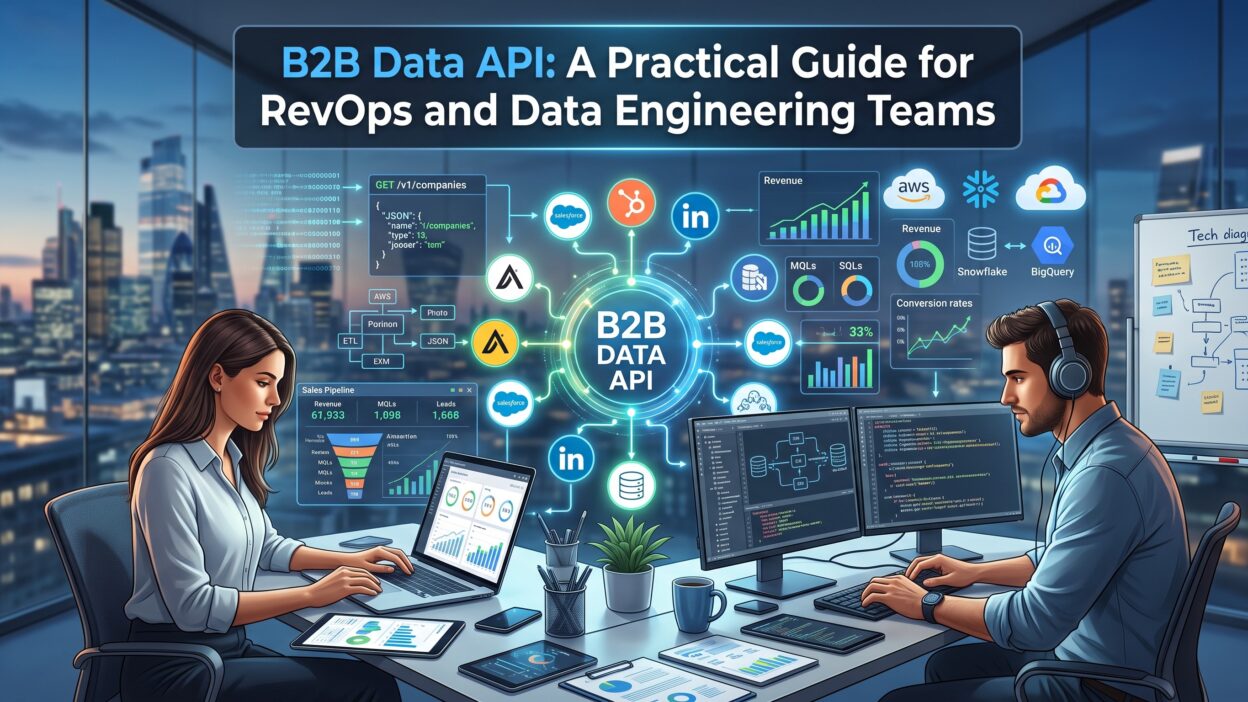
A B2B Data API is a programmatic interface that delivers business-to-business data on demand. It allows software systems to request information about companies, contacts, industries, and markets. The data comes back in a structured format, typically JSON. Developers and data engineers consume this data inside applications, pipelines, and databases.
How It Works at a Technical Level
A B2B Data API operates on standard REST or GraphQL protocols. A system sends a request with specific parameters — a company domain, a contact email, or a firmographic filter. The API processes that request and returns a structured response. That response includes fields like company name, employee count, revenue range, technology stack, location, industry classification, and contact details.
The response time matters. Enterprise-grade APIs return results in under 200 milliseconds. That speed makes real-time enrichment possible. When a lead fills out a form, the CRM enriches the record before the sales rep even opens it. Every second of latency hurts the user experience and the data freshness.
Batch vs. Real-Time API Calls
Most B2B Data API providers support two modes. Real-time calls handle individual records on demand. Batch processing handles thousands or millions of records at once. RevOps teams use real-time calls for form enrichment and lead routing. Data engineering teams use batch processing for database refreshes, data lake updates, and historical enrichment projects.
Knowing which mode fits your use case changes how you design your integration. A misconfigured batch job can exhaust your monthly API credits in hours. Plan your usage model carefully before writing a single line of code.
Why RevOps Teams Need a B2B Data API
Revenue operations teams manage the systems, data, and processes that drive pipeline and revenue. Data quality sits at the center of everything they do. A bad email address wastes a sales rep’s time. An incorrect company size sends an enterprise deal to an SMB rep. A missing industry code breaks your lead scoring model. A B2B Data API eliminates these problems at the source.
Eliminating Manual Data Entry
Sales reps hate data entry. Most of them skip it or do it poorly. A B2B Data API automates the enrichment process. When a new lead enters the CRM, the API fills in the missing fields automatically. The rep sees a complete record without lifting a finger. The data is accurate, current, and consistent across every record in the system.
Improving Lead Scoring Accuracy
Lead scoring models depend on reliable data. If the firmographic fields are empty or outdated, the scoring model fails. A B2B Data API keeps those fields fresh. Revenue teams can score leads on real attributes — actual headcount, verified revenue range, confirmed technology usage. That precision routes the right leads to the right reps at the right time.
Accelerating Territory Planning
Territory planning requires a clear picture of the total addressable market. RevOps teams use a B2B Data API to pull firmographic data at scale. They segment accounts by size, geography, and industry. They identify coverage gaps and realign territories accordingly. The whole process that once took weeks of spreadsheet work now runs in hours with a well-built API integration.
Why Data Engineering Teams Use a B2B Data API
Data engineers build the infrastructure that makes business data useful. A B2B Data API fits directly into that infrastructure. It becomes a source layer in the data stack. Engineers pull from it the same way they pull from internal databases or event streams.
Enriching Data Lakes and Warehouses
Most companies store raw CRM, marketing, and product data in a cloud data warehouse like Snowflake, BigQuery, or Redshift. That raw data often lacks context. A company record might have a domain name but no industry classification. A contact might have a name but no seniority level. A B2B Data API adds that context at pipeline time. Engineers run enrichment jobs nightly or on a trigger. The warehouse always reflects current, enriched data.
Powering Machine Learning Models
Sales forecasting models, churn prediction systems, and propensity models all need rich feature sets. A B2B Data API provides features that internal data cannot. Technology stack data reveals what tools a prospect uses. Growth signals indicate whether a company is hiring, raising capital, or expanding. These external signals improve model accuracy significantly. Data scientists who get access to API-sourced features consistently outperform those working with internal data alone.
Building Real-Time Enrichment Pipelines
Some use cases demand sub-second enrichment. A visitor arrives on your website. Your system identifies the company via IP lookup. The B2B Data API returns firmographic data instantly. The website personalizes the experience in real time. Engineers build these pipelines using streaming frameworks like Apache Kafka or AWS Kinesis. The B2B Data API becomes a real-time lookup service inside a larger event-driven architecture.
Key Data Types Available Through a B2B Data API
Not all B2B Data API providers offer the same data. Understanding the categories helps teams match the right provider to their specific needs.
Firmographic Data
Firmographic data describes companies. It includes company name, employee count, annual revenue, headquarters location, industry vertical, founding year, and ownership type. This is the most foundational data type. Every RevOps and data engineering use case starts here. Firmographic data powers segmentation, scoring, and territory design.
Technographic Data
Technographic data reveals what technology a company uses. It identifies their CRM, marketing automation platform, ERP system, cloud infrastructure provider, and hundreds of other tools. This data is gold for SaaS companies that sell into specific technology environments. A security tool that integrates with AWS benefits from knowing which accounts run on AWS.
Contact and People Data
This data type includes individual contacts at target companies. Fields include job title, seniority level, department, email address, phone number, and LinkedIn profile URL. Contact data drives outreach at scale. Sales engagement platforms consume this data directly. The quality of contact data determines whether outreach reaches real people or bounces back.
Intent Data
Intent data signals that a company is actively researching a topic. It tracks content consumption, search behavior, and topic engagement across the web. A B2B Data API that includes intent data gives revenue teams a timing advantage. They reach accounts in an active buying phase before competitors do.
Funding and Growth Data
Funding data includes investment rounds, investor names, and total capital raised. Growth signals include job postings, news mentions, executive changes, and expansion announcements. These signals help identify accounts at a moment of change. Companies that just raised a Series B are often buying new tools. Companies that just hired a new VP of Sales are often re-evaluating their stack.
How to Evaluate a B2B Data API Provider
Choosing the right provider is one of the most consequential decisions a RevOps or data engineering team makes. The wrong choice leads to months of poor data quality, expensive engineering rework, and frustrated sales teams.
Data Accuracy and Coverage
Accuracy means the data reflects reality. Coverage means the data exists for the accounts and contacts you care about. Ask every provider for match rates on a sample of your existing records. Run a test enrichment job on 1,000 records. Measure how many records returned data and how many of those were accurate. Independent testing beats any vendor benchmark.
Refresh Frequency
Data goes stale fast. People change jobs every two to three years. Companies restructure constantly. A B2B Data API that refreshes its underlying database monthly is not good enough for most enterprise use cases. Look for providers that crawl and verify data weekly or continuously. Stale data costs sales reps credibility and costs RevOps teams countless hours of cleanup.
API Documentation Quality
Good documentation signals a mature, developer-friendly product. Evaluate the reference docs before committing to a provider. Look for clear endpoint descriptions, complete parameter lists, example requests and responses, and error code documentation. A poorly documented B2B Data API will slow down every engineering sprint. Great documentation accelerates integration and reduces support tickets dramatically.
Rate Limits and Pricing Models
Rate limits define how many API calls you can make per second, per minute, and per month. Pricing models vary widely. Some providers charge per record returned. Others charge a flat subscription with usage caps. Understanding the math behind your expected call volume helps you avoid surprise overage charges. Calculate your expected monthly volume before signing a contract.
Data Privacy and Compliance
GDPR and CCPA compliance matter enormously. Any B2B Data API that delivers contact data must demonstrate how it collects, processes, and maintains that data under applicable privacy regulations. Ask for a Data Processing Agreement. Understand where data resides geographically. Legal and procurement teams will ask these questions. Have the answers ready before they do.
Top B2B Data API Providers to Know in 2025
The market includes several established players and a growing number of specialized providers. Each has strengths worth understanding.
Clearbit (Now Breeze Intelligence by HubSpot)
Clearbit built one of the most widely adopted B2B Data API solutions in the market. It offers real-time company and contact enrichment with strong HubSpot integration. Breeze Intelligence, the rebranded version, continues to serve teams that run their revenue stack on HubSpot. The API is well-documented and developer-friendly.
Apollo.io
Apollo.io combines a massive contact database with a full sales engagement platform. Its B2B Data API gives developers access to millions of verified contact and company records. Teams that want both data and outreach capabilities in one place often choose Apollo. The API pricing is competitive for mid-market teams.
ZoomInfo
ZoomInfo is the enterprise standard for B2B data. Its API delivers deep firmographic, technographic, and intent data. Coverage in North America is exceptional. International coverage has improved substantially. Large revenue operations teams with complex data needs often land on ZoomInfo despite its premium price point.
Cognism
Cognism has built a strong reputation for European data coverage and GDPR compliance. Its B2B Data API includes phone-verified mobile numbers, which drives notably higher connection rates for sales teams. Teams selling into EMEA markets should evaluate Cognism carefully.
Diffbot
Diffbot takes a different approach. It uses AI to extract structured data from the open web in real time. Its B2B Data API delivers highly current data because it crawls continuously. Data engineers who need fresh, unstructured web data in a structured format find Diffbot uniquely powerful.
How to Integrate a B2B Data API Into Your Stack
Integration work is where plans meet reality. The technical architecture you choose determines how well the integration performs at scale.
CRM Enrichment Integration
The most common integration pattern is CRM enrichment. A new record enters Salesforce or HubSpot. A webhook fires. The enrichment service calls the B2B Data API. The response data writes back to the CRM record. This pattern requires a middleware layer — a serverless function, a lightweight microservice, or an iPaaS tool like Zapier or Make.
Keep the enrichment logic simple. Map API response fields to CRM fields explicitly. Handle null responses gracefully. Log every enrichment attempt for debugging. Build in retry logic for failed API calls. These small engineering decisions determine whether the integration runs reliably for months or breaks every other week.
Data Warehouse Enrichment Pipeline
For data engineering teams, the integration pattern differs. A scheduled pipeline pulls a list of unenriched company domains from the warehouse. It sends those domains to the B2B Data API in batches. The responses land in a staging table. A transformation job merges the enriched data with the base company table. The whole pipeline runs on a schedule — nightly or weekly depending on freshness requirements.
Use a workflow orchestration tool like Apache Airflow or Prefect to manage the pipeline. Set up alerting for API failures. Monitor your credit consumption per run. Build a dashboard that tracks enrichment coverage and data freshness over time. Data quality is only visible if you measure it.
Real-Time Website Personalization
This integration pattern uses the B2B Data API as a real-time lookup service. A visitor arrives on your website. Their IP address goes to a reverse IP lookup service. That service returns the company domain. The domain goes to the B2B Data API. The API returns firmographic data. The website personalizes the experience — showing the right case study, the right call-to-action, or the right pricing tier — in under one second.
Caching is critical here. Many visitors come from the same company. Cache the API response for each domain for 24 hours. This reduces API calls dramatically and improves response time for repeat visitors.
Common Mistakes Teams Make With a B2B Data API
Even experienced teams make avoidable mistakes when working with a B2B Data API. Knowing the pitfalls ahead of time saves months of painful debugging.
Overwriting Good Data With Bad Data
Enrichment should add data, not replace it. A sales rep who manually entered a direct dial number knows more than the API does about that specific contact. Build enrichment logic that fills empty fields first. Only overwrite existing data when the API returns a higher-confidence value. Define your data hierarchy before writing enrichment code.
Ignoring Enrichment Failure Rates
Every B2B Data API has a match rate. Some records will not enrich. Teams that ignore failure rates end up with a partially enriched database and no visibility into the gaps. Track match rates by record type, data source, and enrichment date. Low match rates on a specific segment often signal a data quality issue upstream. Fix the source data problem, then re-run enrichment.
Not Versioning API Responses
API providers update their response schemas periodically. A field that existed six months ago might disappear in the next version. Store raw API responses alongside the processed enrichment data. This gives you a fallback if schema changes break downstream processes. It also enables historical analysis using richer data than what your pipeline captured initially.
Frequently Asked Questions About B2B Data API
What is a B2B Data API used for? A B2B Data API delivers structured business data to software systems on demand. RevOps teams use it to enrich CRM records automatically. Data engineering teams use it to power data pipelines, enrichment jobs, and machine learning models. Sales teams use it to get complete prospect information without manual research.
How accurate is B2B data from an API? Accuracy varies by provider. Top-tier providers like ZoomInfo, Apollo, and Cognism achieve match rates above 80% on common use cases. Accuracy degrades for smaller companies, international contacts, and rapidly changing roles. Always test a provider with your own data before committing to a contract.
What is the difference between a B2B Data API and a database subscription? A database subscription gives you a static export of records at a point in time. A B2B Data API delivers fresh data on demand. APIs are better for real-time use cases. Database subscriptions work well for one-time enrichment projects or compliance reviews that require a fixed dataset.
How do I stay compliant when using a B2B Data API for contact data? Work with providers that explicitly document their GDPR and CCPA compliance posture. Sign a Data Processing Agreement before accessing contact data. Limit data retention to what your use case requires. Give prospects a clear opt-out mechanism. Consult your legal team before deploying any integration that processes personal data at scale.
Can a small team use a B2B Data API without a dedicated engineer? Yes. Many B2B Data API providers offer no-code connectors for HubSpot, Salesforce, and other common platforms. Tools like Zapier and Make also support API integrations without custom code. Small teams can get meaningful value from a B2B Data API without a full engineering buildout.
How do I choose between real-time enrichment and batch enrichment? Real-time enrichment works best for new record creation — form submissions, inbound leads, and new account additions. Batch enrichment works best for database refreshes, historical enrichment, and large-scale data quality projects. Many teams use both. The two approaches complement each other well.
What data fields should I prioritize when using a B2B Data API? Start with the fields your lead scoring model needs most. For most B2B teams, that includes company size, industry, revenue range, and contact seniority. Add technographic fields if your product has a specific technology dependency. Add intent fields if timing is a key factor in your sales motion. Build from the core outward.
Read More:-How to Convert Website Traffic into Leads and Sales
Conclusion

A B2B Data API is not just a technical integration. It is a strategic investment in the quality of your entire revenue operation. Bad data costs sales reps time, hurts marketing performance, and breaks analytics. A well-integrated B2B Data API eliminates those problems. RevOps teams get enriched, accurate CRM records without relying on manual input. Data engineering teams get a reliable source layer that powers warehouses, pipelines, and predictive models. The implementation decisions you make early determine how scalable and maintainable the integration becomes over time. Choose a provider whose data coverage matches your market. Build enrichment logic that protects existing data quality. Monitor match rates and API performance continuously. Teams that get this right build a data foundation that supports every revenue goal they set. The investment is real. The return is measurable. Start with a clear use case, run a thorough proof of concept, and expand from there.