Introduction
Tl;DR Sales teams want one thing. They want tools that save time and close more deals. Microsoft Copilot for Sales vs Salesforce Einstein ROI is the question every sales leader asks right now. Both platforms promise AI-driven results. Both claim to transform how reps work. The real question is which one actually delivers better returns in the real world.
This blog breaks it all down. We look at features, pricing, real-world performance, and ROI data. You will walk away knowing exactly which tool fits your business best.
Table of Contents
What Is Microsoft Copilot for Sales?
Microsoft Copilot for Sales is an AI assistant built for sales professionals. It connects directly with Microsoft 365 tools. Think Outlook, Teams, and Dynamics 365 CRM. It uses generative AI to help reps write emails, summarize calls, and update CRM records automatically.
Microsoft launched this product to eliminate repetitive admin work. Reps spend hours logging data every week. Copilot handles that. It reads emails and meeting transcripts. It pulls out key deal details and updates the CRM on its own.
The tool also gives smart insights during customer calls. It suggests talking points and flags deal risks in real time. Sales managers get automatic pipeline summaries without chasing their teams for updates.
What Is Salesforce Einstein?
Salesforce Einstein is the AI engine built inside the Salesforce platform. It has been around since 2016. Einstein powers predictive analytics, lead scoring, opportunity insights, and activity tracking. It lives natively inside Sales Cloud.
Einstein GPT launched in 2023 and added generative AI features. Now reps can generate email drafts, get call summaries, and see intelligent deal recommendations. Salesforce positions Einstein as a fully integrated AI layer across its entire CRM ecosystem.
Einstein also supports custom AI model building. Enterprise teams can train models on their own data. This level of customization sets it apart for large organizations with complex sales processes.
Microsoft Copilot for Sales vs Salesforce Einstein ROI: The Core Comparison
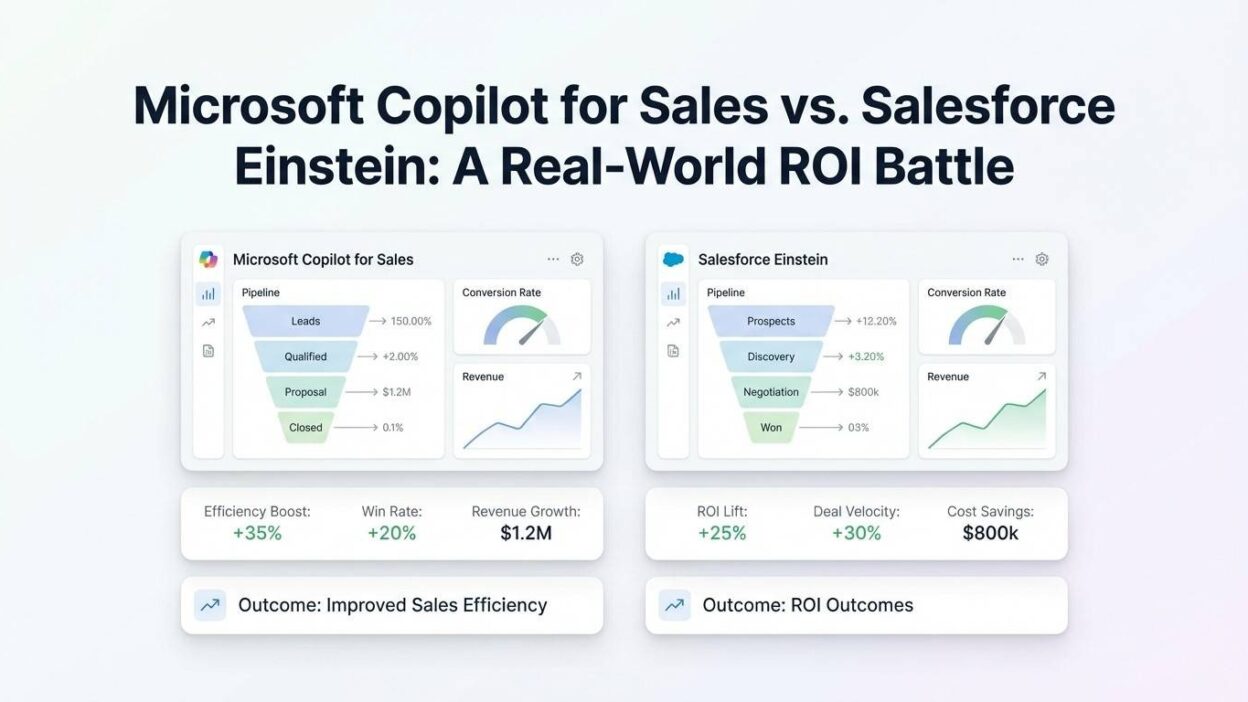
Understanding Microsoft Copilot for Sales vs Salesforce Einstein ROI means looking at measurable outcomes. ROI is not just about features. It is about time saved, revenue gained, and costs reduced. Let us break this down across key categories.
Time Savings for Sales Reps
Microsoft Copilot for Sales saves reps up to 90 minutes per day according to Microsoft’s own data. That time comes from automated meeting summaries, CRM auto-updates, and AI email drafts. Reps spend less time on admin and more time selling.
Salesforce Einstein also saves significant time. Einstein Activity Capture automates data entry from emails and calendar events. Users report saving between 30 to 60 minutes daily. The gap narrows for teams already deep in the Salesforce ecosystem.
For Microsoft 365 shops, Copilot wins on time savings. For pure Salesforce shops, Einstein integrates more naturally and delivers faster productivity gains from day one.
Revenue Impact and Deal Closure Rates
Revenue impact is the truest measure of ROI. Microsoft Copilot for Sales vs Salesforce Einstein ROI gets serious here. Copilot users report an average 9% increase in deals closed per quarter. That number comes from early enterprise pilots run by Microsoft partners.
Salesforce Einstein users report higher win rates when using Einstein Deal Insights. Companies see up to 28% improvement in forecast accuracy. Better forecasting means fewer missed quarters and smarter resource allocation.
Einstein holds a slight edge on revenue metrics for enterprise sales. Copilot leads for mid-market teams who rely heavily on Microsoft Teams and Outlook for customer communication.
Cost and Total Cost of Ownership
Pricing plays a major role in real-world ROI. Microsoft Copilot for Sales costs $50 per user per month. This sits on top of existing Microsoft 365 and Dynamics 365 licenses. Teams already on Microsoft get strong value from that add-on model.
Salesforce Einstein is bundled into various Sales Cloud tiers. Einstein GPT features start at the Enterprise plan, which runs roughly $165 per user per month. The advanced AI features require Einstein 1 Sales, which costs $500 per user per month.
On pure cost, Microsoft Copilot for Sales is more affordable. The ROI math favors Copilot for small and mid-sized teams. Salesforce makes more sense when the full Einstein suite is factored against enterprise sales productivity gains.
Real-World Use Cases: Where Each Tool Shines
Microsoft Copilot for Sales in Action
A regional manufacturing firm with 200 reps deployed Microsoft Copilot for Sales across their Teams environment. Reps used Copilot during customer calls on Teams. The AI transcribed calls in real time and updated Dynamics 365 CRM automatically after each meeting.
The result was a 40% reduction in post-call admin time. Managers got automated deal summaries every morning. The sales cycle shortened by 12% within six months. That is real ROI from a real deployment.
Another example is a financial services company. Their reps were drowning in email threads. Copilot drafted personalized follow-up emails based on meeting notes. Reps reviewed and sent them in seconds. Email response rates improved by 22%.
Salesforce Einstein in Action
A SaaS company with an enterprise sales team used Einstein Opportunity Scoring to prioritize their pipeline. Einstein ranked deals by likelihood to close using historical data. Reps focused on high-probability deals and stopped wasting time on stale opportunities.
Win rates improved by 31% in the first year. Forecast accuracy hit 95% by Q3. The sales team eliminated quarterly forecast panic meetings. That alone saved hundreds of hours of management time.
A global retail brand used Einstein Next Best Action to suggest upsell opportunities. Einstein analyzed purchase history and recommended relevant add-ons during sales calls. Cross-sell revenue increased by 18% in the first two quarters after deployment.
Integration Capabilities: Ecosystem Lock-In vs. Flexibility
Integration depth matters for ROI. Microsoft Copilot for Sales integrates seamlessly with Microsoft 365. It connects to Outlook, Teams, SharePoint, and Dynamics 365. Teams already in the Microsoft ecosystem get instant value with minimal setup.
The catch is that Copilot works best with Dynamics 365 CRM. Salesforce connector options exist but carry limitations. Teams running Salesforce CRM alongside Microsoft 365 may not get the full Copilot experience.
Salesforce Einstein integrates deeply across the entire Salesforce platform. Sales Cloud, Service Cloud, Marketing Cloud, and Commerce Cloud all benefit from Einstein AI. This breadth of integration gives enterprise teams a unified data and AI layer across departments.
Einstein also connects to external data via Salesforce Data Cloud. This makes it more flexible for organizations with complex data architectures. For pure-play Salesforce shops, this ecosystem depth drives superior long-term ROI.
AI Features Head-to-Head
Email and Communication Assistance
Microsoft Copilot for Sales generates email drafts directly inside Outlook. It reads previous email threads and CRM data to personalize suggestions. Reps edit and send without leaving their inbox. The experience feels native and fast.
Einstein GPT also generates emails inside Salesforce. Reps access it within Sales Cloud or the Einstein sidebar. The personalization quality is strong but relies on Salesforce data being complete and accurate.
Copilot wins on ease of use for email workflows. Einstein wins on personalization depth when Salesforce data is rich.
Meeting Intelligence and Call Summaries
Copilot integrates with Microsoft Teams to transcribe and summarize meetings. It identifies action items, highlights objections, and updates CRM records post-call. All of this happens automatically without rep input.
Salesforce offers Einstein Conversation Insights for call intelligence. It requires integration with a calling platform like RingCentral or Dialpad. The summaries are detailed and feed directly into Salesforce opportunity records.
Copilot has a native advantage for Teams-based sales calls. Einstein wins when teams use dedicated calling platforms already integrated with Salesforce.
Pipeline Management and Forecasting
Einstein Forecasting is one of the strongest features in the Salesforce AI stack. It uses machine learning to predict deal outcomes based on historical patterns. It flags pipeline health issues and recommends corrective actions.
Microsoft Copilot for Sales offers pipeline summaries and deal risk alerts but lacks the predictive forecasting depth of Einstein. Copilot surfaces insights generated from CRM data but does not build ML models on historical win-loss patterns.
For forecasting and pipeline management, Einstein delivers superior ROI for enterprise sales organizations.
Microsoft Copilot for Sales vs Salesforce Einstein ROI: Who Wins by Business Size?
Small and Mid-Market Businesses
Small teams benefit most from Microsoft Copilot for Sales. The licensing cost is lower. Setup time is shorter. Reps get AI help in familiar tools like Outlook and Teams without learning new software. ROI shows up within weeks.
Salesforce Einstein requires a larger investment in platform setup, data quality, and training. Smaller teams often lack the admin resources to maximize Einstein’s capabilities. The ROI curve is slower for sub-100 rep organizations.
Enterprise Sales Organizations
Enterprise teams get more from Salesforce Einstein. The platform handles complex sales hierarchies, multi-product portfolios, and global pipeline management. Einstein learns from years of historical data and gets smarter over time.
Microsoft Copilot for Sales serves enterprise Microsoft shops well but still plays second fiddle on advanced AI capabilities. Einstein 1 Sales with full AI capabilities justifies its price tag for large teams chasing aggressive revenue targets.
Common Challenges and Limitations
No AI tool is perfect. Microsoft Copilot for Sales requires good data hygiene in Dynamics 365. Garbage in means garbage out. Teams with messy CRM data see limited AI benefit. Adoption also takes time. Reps resist change even when tools are good.
Salesforce Einstein faces similar data quality issues. Einstein AI is only as smart as the data it trains on. Incomplete opportunity records lead to poor lead scores and inaccurate forecasts. Einstein also demands significant admin effort to configure and maintain.
Both tools require change management. Companies must invest in training, adoption programs, and data cleanup before seeing strong ROI. The platforms do not fix broken processes. They amplify good ones.
Microsoft Copilot for Sales vs Salesforce Einstein ROI: Verdict by Category
Time savings: Microsoft Copilot for Sales wins for Microsoft-first organizations. Salesforce Einstein wins for Salesforce-first teams.
Revenue impact: Salesforce Einstein leads on enterprise deals and forecast accuracy. Copilot leads for mid-market speed-to-close.
Cost efficiency: Microsoft Copilot for Sales is more affordable and delivers faster payback for smaller teams.
AI depth: Einstein offers deeper machine learning and predictive capabilities. Copilot leads on generative AI ease-of-use.
Integration: Einstein wins for pure Salesforce shops. Copilot wins for Microsoft ecosystem organizations.
FAQs:
Which tool gives better ROI for a small sales team?
Microsoft Copilot for Sales delivers faster and more affordable ROI for small teams. The lower cost and easier setup mean smaller organizations see returns within 30 to 90 days. Teams under 50 reps consistently see strong time savings with minimal configuration effort.
Can Microsoft Copilot for Sales work with Salesforce CRM?
Yes, Microsoft Copilot for Sales does support Salesforce CRM integration. It can pull and push data to Salesforce via a connector. The experience is not as seamless as with Dynamics 365. Teams using Salesforce as their primary CRM often prefer Einstein for deeper native integration.
How long does it take to see ROI from Salesforce Einstein?
Most enterprise teams see measurable ROI from Salesforce Einstein within three to six months. Initial setup, data preparation, and user training take time. Teams that invest in data quality and admin resources see results faster. Patience and clean data are the biggest success factors.
What is the biggest difference between Microsoft Copilot for Sales and Salesforce Einstein?
The biggest difference lies in ecosystem depth and pricing. Salesforce Einstein offers deeper AI and predictive analytics within the Salesforce platform. Microsoft Copilot for Sales focuses on generative AI for daily rep workflows within Microsoft tools. Einstein serves complex enterprise needs. Copilot serves everyday rep productivity.
Is Microsoft Copilot for Sales worth the additional licensing cost?
For teams already using Microsoft 365 and Dynamics 365, the answer is yes. The $50 per user per month cost pays for itself quickly when reps save 60 to 90 minutes daily. The admin time reduction alone often covers the cost within two months of full deployment.
Which platform offers better AI email generation?
Microsoft Copilot for Sales edges ahead on AI email generation for Outlook users. The native experience inside Outlook is faster and more intuitive. Salesforce Einstein GPT produces strong emails inside Salesforce but requires reps to work within the CRM interface for best results.
Final Verdict: Picking the Right AI Sales Tool for Your ROI Goals
The Microsoft Copilot for Sales vs Salesforce Einstein ROI debate does not have a single winner. The right choice depends on your existing tech stack, team size, and sales complexity.
Choose Microsoft Copilot for Sales if your team lives in Microsoft 365. It delivers fast, affordable productivity gains with minimal setup. Reps adopt it quickly because it works inside tools they already use every day.
Choose Salesforce Einstein if your organization runs on Salesforce and needs advanced AI for forecasting, lead scoring, and revenue intelligence. The higher cost pays off for large enterprise teams with complex sales cycles and rich CRM data.
The most important step is honest self-assessment. Know your tech stack. Know your team’s pain points. Match the tool to your reality. Both platforms can deliver strong ROI. The winner is the one that fits your organization best.
Read More:-AI in Real Estate: Building a Custom System for Lead Scoring and Follow-ups
Conclusion

Sales AI is not a future trend. It is a present competitive advantage. Microsoft Copilot for Sales vs Salesforce Einstein ROI is a real decision with real money on the line. Both tools deliver measurable results when implemented correctly.
Microsoft Copilot for Sales wins on accessibility, cost, and generative AI for everyday workflows. Salesforce Einstein wins on predictive analytics, enterprise depth, and platform integration breadth. Neither tool is a magic wand. Both require clean data, strong adoption strategies, and committed leadership to deliver results.
Your sales team deserves the best AI advantage available. Take the time to evaluate which platform matches your current systems and future growth plans. Test both with pilot programs if possible. Measure results rigorously. Let data drive your decision.