Introduction
TL;DR Real estate moves fast. Leads go cold in hours. Agents lose deals because they follow up too late or not at all.
Most real estate teams rely on gut feeling to prioritize leads. That approach does not scale. It wastes time on low-intent contacts and ignores high-value ones.AI real estate lead scoring and follow-ups solve this problem directly. They replace guesswork with data. They automate outreach at the right moment. They help agents close more deals with less manual work.
This blog explains how to build a custom system that handles all of it end to end.
Table of Contents
Why Traditional Lead Management Fails Real Estate Teams
Real estate generates leads from many sources. Portal listings, social media ads, open houses, referrals, website forms — the list is long.
Most teams dump all these leads into a CRM. Nobody scores them. Nobody segments them. Everyone gets the same generic follow-up email.
That approach hurts conversion rates. A buyer who visited three property pages and asked about financing needs a different response than someone who clicked one ad and bounced.
Manual follow-up is inconsistent. Agents forget. They get busy. High-priority leads slip through the cracks.
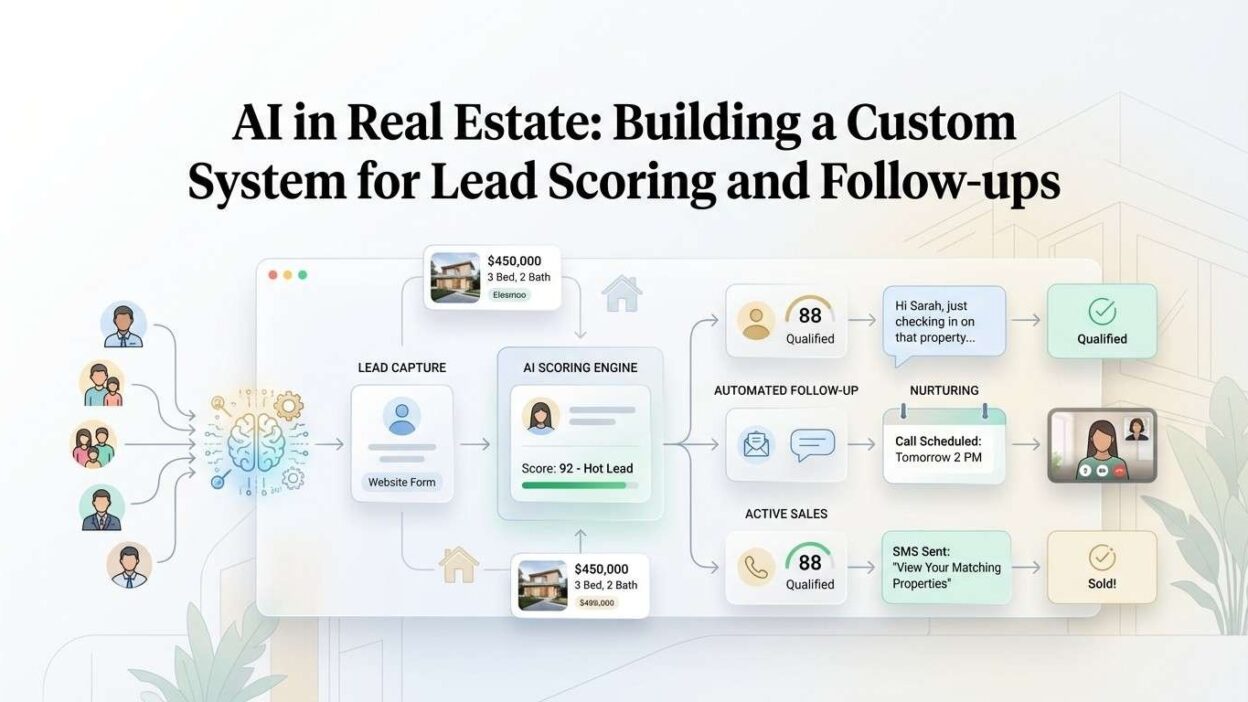
AI real estate lead scoring and follow-ups fix this at the system level. They analyze behavior, intent signals, and historical data. They assign scores automatically. They trigger the right follow-up at the right time.
The result is a more focused sales process. Agents spend time on leads that are actually ready to buy or sell.
What Is AI Lead Scoring in Real Estate
Lead scoring assigns a numerical value to each lead. That value reflects how likely the lead is to convert.
Traditional scoring uses simple rules. A lead who filled out a contact form gets 10 points. A lead who attended an open house gets 20 points. Someone who requested a valuation gets 30 points.
AI scoring works differently. It learns from past conversions. It identifies patterns humans cannot see manually.
An AI model might discover that leads who visit a property page three times within 48 hours convert at five times the average rate. A human analyst would never catch that pattern across thousands of records.
AI real estate lead scoring and follow-ups use machine learning models trained on your own CRM data. They get smarter with every closed deal. They adapt as market conditions change.
The score updates in real time. As a lead takes new actions — opening an email, revisiting a listing, using a mortgage calculator — the score adjusts instantly.
Agents always know which leads deserve attention right now.
What Are Automated Follow-ups in Real Estate
Follow-up is the engine of real estate sales. Most leads do not convert on first contact. Research shows seven to twelve touchpoints are often required before a serious conversation begins.
Manual follow-up at that scale is impossible for a single agent managing hundreds of leads.
Automated follow-ups use predefined sequences triggered by lead behavior or score thresholds. A new inquiry gets an immediate response. A lead that goes quiet for two weeks gets a re-engagement message. A lead whose score jumps gets a call reminder sent to the agent.
AI real estate lead scoring and follow-ups combine these two functions. Scoring tells the system what a lead needs. Automation delivers it without manual effort.
The follow-up content itself becomes smarter too. AI personalizes messages based on lead data. A buyer looking at four-bedroom homes in a specific suburb gets content relevant to that search. They do not get a generic newsletter.
Building a Custom AI Lead Scoring System for Real Estate
Audit Your Existing Lead Data
Every custom system starts with data. Pull your historical CRM records. Identify all leads that converted into clients over the past two to three years.
Look at what those leads had in common. Which sources produced them? What actions did they take before reaching out? How long did it take from first contact to signing?
Clean the data. Remove duplicates. Standardize source labels. Fill gaps where possible.
This audit forms the training foundation for your AI model. Better historical data produces better scoring accuracy.
Define Your Lead Signals
Lead signals are the behaviors and attributes the AI uses to assign scores.
Behavioral signals include website visits, property page views, time spent on site, email opens, link clicks, calculator usage, and form submissions.
Demographic signals include location, property type interest, budget range, timeline, and financing status.
Engagement signals include response speed, message quality, and follow-up consistency.
Combine all three signal types. A lead strong in all three categories scores highest. A lead strong in only one needs more nurturing before a hard pitch.
AI real estate lead scoring and follow-ups that use multi-signal models outperform rule-based systems significantly.
Choose Your AI Model Type
You have several model options for scoring. The right one depends on data volume and team resources.
Logistic regression works well for smaller datasets. It is interpretable and easy to explain to team members. It shows which signals carry the most weight.
Gradient boosting models like XGBoost handle larger datasets well. They capture complex non-linear relationships between signals. They produce highly accurate scores on real estate data.
Neural networks work for very large teams with thousands of monthly leads. They require more training data and technical maintenance.
Most growing real estate teams start with gradient boosting. It balances accuracy with manageability.
Integrate With Your CRM
The scoring model needs to talk to your CRM in real time. Lead scores must update automatically as new activity arrives.
Most modern CRMs support API integrations. Connect your scoring model through the API. Push updated scores back to each lead record.
Set up score tiers. Hot leads score above 80. Warm leads score between 50 and 80. Cold leads score below 50. The CRM can then filter and route leads based on these tiers automatically.
AI real estate lead scoring and follow-ups only deliver full value when the scoring layer connects seamlessly to the communication layer.
Train and Validate the Model
Feed your historical data into the model. Use 70% of records for training and 30% for testing.
Measure accuracy using precision and recall metrics. Precision measures how often a high-scored lead actually converts. Recall measures how often a true converter received a high score.
Aim for precision above 75% before deploying. Low precision means wasting agent time on false positives.
Retrain the model quarterly. Real estate markets shift. Buyer behavior changes seasonally. A model trained only on old data loses accuracy over time.
Building the Automated Follow-up Engine
Designing Follow-up Sequences by Lead Score
Not all leads need the same sequence. Score-based routing ensures each lead gets the right treatment.
Hot leads get immediate personal outreach. A high-scoring lead should receive a direct call or text from an agent within five minutes. Speed matters enormously at this stage. Leads who receive contact within five minutes convert at dramatically higher rates than those contacted after an hour.
Warm leads enter a nurture sequence. This sequence runs over days or weeks. It mixes email, SMS, and social touchpoints. Each message adds value. Market updates, new listings in their target area, financing guides — relevant content keeps them engaged.
Cold leads enter a long-term drip campaign. These contacts are not ready yet. They need consistent, low-pressure communication over months. When their situation changes, the system detects the behavioral shift and re-scores them upward.
Personalizing Follow-up Content With AI
Generic content kills engagement. Every follow-up message should feel personal.
AI personalization uses lead profile data to tailor every message. The system knows the lead’s target suburb, price range, property type, and behavioral history.
An email to a first-time buyer researching condos in downtown looks completely different from an email to a investor tracking rental yields in suburban markets.
AI language models now write personalized message variants at scale. Feed them lead data as context. They produce messages that feel written for that specific person.
AI real estate lead scoring and follow-ups that include AI-personalized messaging show significantly higher open rates and reply rates compared to template-only campaigns.
Timing Automation for Maximum Engagement
Send time matters. A follow-up email at 2 AM gets ignored. The same email at 7 PM on a Tuesday gets opened.
AI send-time optimization analyzes each lead’s historical engagement patterns. It identifies when that specific person is most likely to engage. It schedules delivery accordingly.
For new leads with no engagement history, the system uses population-level data. Research shows early mornings and early evenings work best for real estate communications on weekdays.
Optimize send time per lead, not per campaign. Batch scheduling misses individual patterns. Personalized scheduling lifts engagement substantially.
Multi-Channel Follow-up Strategy
Leads come from different channels. They prefer different communication methods.
Email works for detailed content — market reports, new listing alerts, financing information. It gives leads time to read at their own pace.
SMS works for urgent outreach — price drops, new listings, open house reminders. Response rates for real estate SMS messages run significantly higher than email.
Phone calls work for hot leads and re-engagement after a long silence. A personal voice call signals seriousness.
Social media retargeting reinforces message frequency. A lead who saw your email also sees a relevant ad on Facebook or Instagram. Consistent presence across channels builds trust.
A strong AI real estate lead scoring and follow-ups system coordinates all four channels. It does not repeat the same message across channels. It uses each one for the type of content it suits best.
Technology Stack for Your Custom System
CRM Options That Support AI Integration
Salesforce supports deep AI integrations through its Einstein platform. It suits large brokerages with dedicated tech teams.
HubSpot offers strong API access and native automation tools. It suits mid-sized teams well. Custom scoring models integrate cleanly through webhook connections.
Follow Up Boss was built specifically for real estate. It integrates with most major real estate portals and supports custom automation rules. Many teams pair it with external AI scoring tools through Zapier or direct APIs.
Sierra Interactive and Chime include built-in AI scoring features. They suit teams that want an out-of-the-box solution rather than a fully custom build.
AI and Machine Learning Tools
Python with scikit-learn handles model building for most teams. It requires a data scientist or technical co-founder to set up initially.
AWS SageMaker provides managed model training and hosting. It reduces infrastructure maintenance burden.
Google Vertex AI offers similar managed ML capabilities. It suits teams already in the Google Cloud ecosystem.
OpenAI and Anthropic APIs power the personalized message generation layer. Claude or GPT-4 models write follow-up content at scale given lead data as context.
Automation and Orchestration Tools
Zapier connects tools without code. It works for simple trigger-based workflows. A new lead from a portal fires a scoring request, the score comes back, and the lead gets routed to the right sequence.
Make (formerly Integromat) handles more complex multi-step workflows. It suits teams with branching logic across multiple channels.
Custom Python scripts with task queues like Celery give full control. They suit large teams with technical resources who want maximum flexibility.
Common Mistakes to Avoid
Relying on Too Few Signals
A scoring model built only on email opens will misfire constantly. Email engagement alone does not predict conversion.
Combine behavioral, demographic, and engagement signals. The more signal types the model sees, the more accurate its predictions become.
Neglecting Model Maintenance
A model trained once and left alone degrades in performance. Markets change. Buyer behavior shifts.
Schedule quarterly retraining sessions. Log model performance metrics monthly. Catch accuracy drops before they hurt pipeline performance.
Over-Automating Agent Interactions
Automation handles scale. Humans handle trust. Real estate is a relationship business.
Do not automate every touchpoint for hot leads. Use automation to prepare agents with the right context. Let the agent make the personal call.
AI real estate lead scoring and follow-ups should make agents more effective, not replace human relationship building at critical moments.
Ignoring Lead Source Quality
Not all lead sources produce the same quality. Organic website leads often convert better than paid portal leads.
Track conversion rates by source. Adjust scoring weights accordingly. A lead from a referral might start at a higher base score than a cold portal inquiry.
Measuring Success: KPIs for Your AI System
Lead-to-Appointment Rate
This metric measures how many scored leads book an appointment. It directly reflects follow-up quality and scoring accuracy.
A well-tuned AI real estate lead scoring and follow-ups system raises this metric by identifying high-intent leads faster and triggering the right outreach before they go cold.
Speed to First Contact
Measure the average time between lead creation and first agent contact for hot leads. Every minute of delay costs conversion probability.
Use this metric to fine-tune your alert and routing automation. Hot leads should never wait more than ten minutes for contact during business hours.
Follow-up Sequence Engagement Rate
Track open rates, click rates, and reply rates across each nurture sequence. Low engagement points to content or timing problems.
Test subject lines, message formats, and send times. Use A/B testing across lead segments to find what works for your specific audience.
Cost Per Closed Deal
AI systems reduce cost per acquisition by focusing agent effort on the most likely converters. Track this metric before and after system implementation.
Most teams implementing AI real estate lead scoring and follow-ups report a measurable reduction in cost per closed deal within six months of deployment.
Agent Productivity
Count how many meaningful conversations each agent has per week. An AI-powered routing system increases this number by eliminating time spent on unqualified leads.
More meaningful conversations per agent means more closed deals without adding headcount.
Real-World Impact: What Teams Achieve With AI Lead Systems
A mid-sized residential brokerage in a competitive market might work hundreds of leads per month. Without scoring, agents contact leads randomly. Conversion rates stay flat.
After implementing AI real estate lead scoring and follow-ups, the same brokerage focuses agent energy on the top 20% of leads by score. Appointment rates climb. Response time for hot leads drops to under three minutes. Monthly closed deals increase without hiring additional agents.
A property management company uses scoring to prioritize landlord acquisition leads. Their AI model identifies landlords most likely to list within 90 days. Targeted follow-up sequences reduce the cost per new property listing substantially.
A luxury real estate team uses AI personalization to send hyper-relevant content to high-net-worth leads. Message open rates climb. Their reputation for attentive, relevant communication attracts referrals.
These results are not theoretical. They reflect what teams achieve when scoring accuracy and follow-up automation work together at scale.
Frequently Asked Questions
What is AI lead scoring in real estate?
AI lead scoring assigns a numerical value to each lead based on behavioral, demographic, and engagement signals. The AI model learns from historical conversion data. It predicts which leads are most likely to buy or sell. Agents use scores to prioritize their outreach.
How does AI improve real estate follow-ups?
AI improves follow-ups by triggering the right message at the right time for each lead automatically. It personalizes content based on lead profile data. It routes high-scored leads to agents immediately. It keeps low-scored leads engaged through long-term nurture sequences.
What data does AI need to score real estate leads?
The model needs historical CRM data showing which past leads converted. It needs behavioral data including website visits, email engagement, and property page views. It also needs demographic data like location, budget range, and property type preference.
Is a custom AI lead scoring system expensive to build?
Cost depends on team size and technical resources. Small teams can use existing platforms with built-in scoring features. Mid-sized teams can build custom models using open-source tools. Large brokerages may invest in fully custom systems. ROI typically justifies investment within two to three deal cycles.
How long does it take to build an AI lead scoring system?
A basic system using an existing CRM with automation workflows takes two to four weeks. A custom machine learning model with full API integration takes six to twelve weeks. The timeline depends on data quality, team resources, and integration complexity.
Can AI replace real estate agents in follow-up?
AI handles scale and timing. It cannot replace human judgment, emotional intelligence, or relationship building. The best systems use AI for initial scoring, routing, and nurturing. Human agents take over for high-value conversations and negotiations.
Which CRM works best for AI real estate lead scoring?
Salesforce, HubSpot, Follow Up Boss, and Chime all support AI scoring integrations. The best choice depends on team size, budget, and technical capability. Follow Up Boss suits most growing real estate teams for its real estate-specific design.
How often should I retrain my lead scoring model?
Retrain the model at least quarterly. Monitor accuracy metrics monthly. Retrain immediately after major market shifts or if conversion rates change significantly from model predictions.
What follow-up channels work best for real estate leads?
SMS produces the highest response rates for urgent outreach. Email works best for detailed content and market information. Phone calls work for hot leads and re-engagement. Social retargeting reinforces overall message frequency.
How do I measure ROI from an AI lead system?
Track lead-to-appointment rate, cost per closed deal, speed to first contact, and agent productivity before and after deployment. Most teams see measurable improvements within three to six months of launch.
Read More:-Why 2026 is the Year of the Autonomous Agent
Conclusion

Real estate competition is fierce. Leads expect fast, relevant communication. Agents need focus, not more manual tasks.
AI real estate lead scoring and follow-ups give teams both. They turn behavioral data into predictive scores. They automate outreach with personalized, timely messages. They route the right leads to the right agents at the right moment.
Building a custom system takes planning. It requires clean data, the right model, solid CRM integration, and smart automation design. The investment pays back quickly in higher conversion rates, lower cost per deal, and better agent productivity.
The teams winning in real estate today are not the ones with the most leads. They win with sharper lead intelligence and faster, smarter follow-up.
Start with your historical data. Define your signals. Build your scoring model. Connect it to your follow-up engine. Measure everything.
AI real estate lead scoring and follow-ups are not a future trend. They are a current competitive advantage. The teams that build this system now will outperform those still relying on manual processes for years to come.