Introduction
TL;DR A hands-on guide to the strategies, tools, and mindset shifts powering the next generation of marketing performance.
Why Generative AI for Marketers Is Reshaping the Industry
Marketing has always rewarded speed, creativity, and precision. For decades, those three qualities pulled in opposite directions. Moving fast meant sacrificing quality. Being creative meant slowing down. Being precise meant spending more budget.
Generative AI for marketers changes that equation completely. It compresses the time between idea and execution. It removes the blank-page problem. It helps small teams punch well above their weight.
The marketers gaining ground right now are not the ones with the largest teams or the biggest budgets. They are the ones who learned how to work alongside AI, direct it with sharp prompts, and build workflows that compound their output over time.
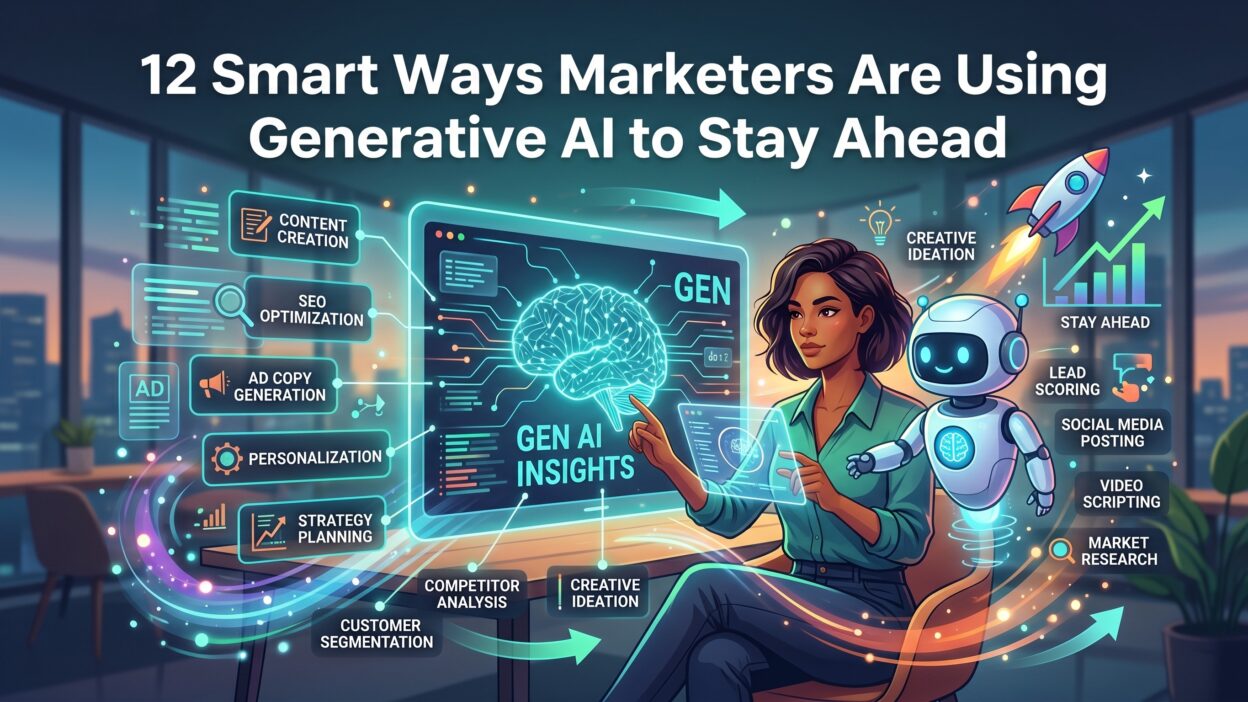
This guide covers twelve concrete ways marketers use generative AI today. Each section includes the why, the how, and the real-world impact. By the end, you will have a clear picture of where to start and what to prioritise.
76%Of marketers who use AI say it saves them significant time each week
5×Faster content production reported by teams using generative AI tools
40%Average reduction in content production costs for AI-powered marketing teams
These numbers are not theoretical. Marketing teams across B2B and B2C sectors report these gains consistently. Generative AI for marketers is not a future advantage. It is a present-day competitive gap.
Table of Contents
Way 1 — Content Creation at Unprecedented Scale
1 Scaling Content Without Scaling Headcount
Content demand has exploded. Every channel needs fresh material. Every audience segment wants relevant messaging. Most marketing teams simply cannot produce enough content manually to keep up with that demand.
Generative AI for marketers makes high-volume content creation possible without proportionally increasing costs or team size. A single content marketer can now manage the output that previously required a team of five writers.
The process works best when humans set the strategic direction. A marketer defines the topic, the audience, the tone, and the key messages. The AI drafts the content. The marketer edits, refines, and approves. The result is content that carries human judgment with AI speed.
Long-form blog posts, landing page copy, case study drafts, whitepapers, and newsletter content all fall into this category. Brands using this approach publish three to five times more content per month without adding headcount. That increase in publishing frequency directly improves organic search visibility and brand authority.
“The best use of generative AI is not replacing the writer. It is removing every obstacle that slows the writer down.”
Quality control matters here. Generative AI can produce content quickly, but it can also produce generic content quickly. A marketer’s job is to inject brand voice, real expertise, and genuine perspective into every AI-assisted draft. That editorial layer is what separates great content from forgettable output.
Way 2 — Hyper-Personalised Email Campaigns
2. Emails That Feel Written for One Person
Generic email blasts are losing effectiveness fast. Open rates drop when subscribers receive the same message as everyone else. Personalisation drives performance, but traditional personalisation only scratches the surface with first names and product recommendations.
Generative AI for marketers enables a deeper level of email personalisation. It can generate unique subject lines, body copy, and calls to action for every segment — or even every individual — based on behavioural data, purchase history, and engagement patterns.
A retail brand can generate 50 variations of a promotional email, each tailored to a specific customer segment’s browsing behaviour and past purchases. A B2B company can craft outreach emails that reference a prospect’s industry, company size, and recent content interactions.
AI-driven email personalisation consistently outperforms batch-and-blast approaches. Open rates improve. Click-through rates increase. Unsubscribe rates fall. The revenue impact per email sent rises significantly when each message feels genuinely relevant to its recipient.
The operational benefit is equally important. Writing 50 email variations manually would take days. With generative AI, a marketer can generate, review, and approve all 50 variations in a single afternoon. That speed allows for more frequent campaign cycles and faster iteration on what works.
Way 3 — SEO Content Strategy and Optimisation
3 Ranking Faster with AI-Assisted SEO
Search engine optimisation requires consistent content production, smart keyword targeting, and deep understanding of search intent. All three are time-consuming when done manually at scale.
Marketers use generative AI to accelerate every stage of the SEO content workflow. AI tools analyse top-ranking pages, identify content gaps, and generate optimised outlines that cover the topics search engines reward.
Keyword clustering, meta description writing, FAQ generation, and internal linking suggestions all become faster with AI assistance. A marketer can brief, outline, and draft an SEO-optimised article in a fraction of the time it previously took.
AI also helps with content refresh strategies. Older articles that have lost rankings can be analysed against current top-ranking pages. The AI identifies what is missing and suggests updates. This approach recovers organic traffic from existing assets without starting from scratch.
The key discipline for SEO content is accuracy. AI-generated content must be fact-checked, especially for topics where outdated or incorrect information would damage brand credibility. A human review step is non-negotiable for any content targeting high-value search queries.
Way 4 — Ad Copy Testing and Iteration
4 Running More Tests, Finding Winners Faster
Paid advertising rewards the marketer who tests the most variations. Every headline, description, and call to action is a hypothesis. The ad platform runs the test. The data reveals the winner.
The bottleneck has always been creative production. Writing ten headline variations for a single ad set takes time. Writing ten variations for twenty ad sets becomes a full-day project. Generative AI for marketers removes that bottleneck entirely.
A paid search manager can generate fifty headline variations in minutes. A social media advertiser can produce multiple creative angles — emotional, rational, humour-driven, urgency-focused — for every target audience segment. The AI handles the volume. The marketer curates the strongest options.
This shift from manual writing to AI-assisted generation increases testing velocity dramatically. More tests mean more data. More data means faster optimisation. Faster optimisation means lower cost per acquisition and higher return on ad spend.
Performance marketers report that AI-generated ad copy, when properly reviewed and refined, performs on par with or better than manually written copy in A/B tests. The creative quality is not the issue. The issue was always the volume of ideas needed to find the top performer.
Way 5 — Social Media Content Planning
5 Staying Consistent Across Every Platform
Social media demands daily output. Each platform has its own format, tone, and audience expectation. LinkedIn requires professional depth. X needs brevity and punch. Instagram rewards visual storytelling. TikTok rewards authenticity and entertainment.
Managing consistent posting across multiple platforms drains creative energy fast. Generative AI for marketers helps by repurposing a single core idea into platform-specific formats simultaneously. One thought leadership article becomes a LinkedIn post, three X threads, two Instagram captions, and a short-form video script.
This content atomisation approach multiplies the value of every piece of original thinking. Marketers who previously struggled to maintain consistent posting schedules find it dramatically easier when AI handles the reformatting and adaptation work.
AI tools can also help with caption writing, hashtag research, content calendar planning, and community management response templates. These tasks are individually small but collectively consume enormous amounts of time across a week. Automating or accelerating them frees the social media manager to focus on strategy and community engagement.
Way 6 — Market Research and Competitive Intelligence
6 Understanding Markets Faster Than Ever Before
Market research traditionally takes weeks. Surveys go out, responses come in, analysts process the data, and a report eventually lands on a marketer’s desk. By then, the market has moved on.
Generative AI for marketers accelerates research by synthesising large volumes of information quickly. AI can analyse customer reviews, social conversations, competitor content, and industry reports to surface patterns and insights a human analyst might take days to identify.
Competitive intelligence is particularly valuable. A marketer can feed an AI tool the publicly available content from five competitors — their websites, blog posts, product pages, and ad copy — and receive a structured analysis of their positioning, messaging angles, and content gaps within minutes.
This kind of rapid intelligence gathering helps marketing teams make faster decisions. They identify the gaps their competitors are missing. They spot the messages resonating with the target audience. They adjust their own strategy with real data rather than assumptions.
Way 7 — Chatbots and Conversational Marketing
7 Conversations That Convert Around the Clock
Website visitors arrive at all hours. They have questions, objections, and interests that determine whether they stay or leave. A human team cannot be available around the clock to address every visitor personally.
AI-powered chatbots built on generative models handle these conversations with a level of nuance and naturalness that older rule-based bots could never achieve. They understand context. They adapt their tone. They handle complex questions without routing visitors to a static FAQ page.
Marketers use these conversational AI tools to qualify leads, recommend products, answer objections, and guide prospects toward the next logical step in the buyer journey. The best implementations feel like speaking to a knowledgeable brand representative — not a script-driven bot.
The marketing benefit extends beyond lead generation. Chatbot conversation data provides rich insight into what prospects actually want to know. Marketers use this data to refine their messaging, improve FAQ content, and identify the objections their human sales team needs to address more effectively.
Way 8 — Video Script and Creative Brief Writing
8 Bringing Video Ideas to Life Faster
Video is the dominant content format across almost every channel. But video production starts long before cameras roll. It starts with a script, a creative brief, a storyboard concept, and a message hierarchy.
These pre-production documents take significant time to write well. A video script for a two-minute explainer video can take a skilled writer several hours to produce. A creative brief for a full campaign can take a day or more.
Generative AI for marketers accelerates this pre-production phase dramatically. A marketer provides the AI with the product details, the audience profile, the key message, and the desired tone. The AI produces a structured script draft within minutes. The marketer refines the draft, adds brand-specific language, and sends it to the production team.
For creative briefs, AI can generate multiple strategic angles simultaneously. A campaign might need a rational approach, an emotional approach, and a humour-driven approach. Getting three fully written briefs from an AI in the time it used to take to write one changes the creative development process entirely.
Way 9 — Customer Segmentation and Persona Building
9 Knowing Your Audience More Deeply
Effective marketing starts with a deep understanding of the customer. But building detailed buyer personas manually requires hours of research, interview synthesis, and writing. Many marketing teams skip it or do it superficially.
AI changes this. A marketer can feed customer data, survey responses, CRM notes, and support ticket themes into an AI tool and receive rich, structured persona profiles in a fraction of the time. The personas include pain points, motivations, preferred channels, objections, and decision-making triggers.
Beyond persona building, generative AI for marketers supports dynamic segmentation. Instead of maintaining a handful of static segments, AI can identify micro-segments within the customer base based on behavioural patterns. Each micro-segment receives tailored messaging that resonates far more precisely than broad-category targeting.
This level of segmentation depth was previously available only to enterprise brands with large data science teams. AI democratises it. A mid-market marketing team can now achieve the same level of audience understanding with far fewer resources.
Way 10 — Product Descriptions and E-commerce Copy
10 Descriptions That Sell at Scale
E-commerce brands with large catalogues face a persistent copy problem. Writing a unique, compelling product description for every SKU is a massive task. Many brands settle for manufacturer descriptions, which add no brand value and hurt SEO performance.
Generative AI for marketers solves this problem at scale. A marketer can input product specifications, category, target audience, and tone guidelines. The AI generates unique descriptions for every product. A catalogue of one thousand products that would take a copywriter months to write becomes a project that takes days.
The quality improvement is measurable. Unique, benefit-focused product descriptions improve search engine rankings for product pages. Better copy increases add-to-cart rates. Reduced bounce rates on product pages suggest the copy is engaging the customer effectively.
Seasonal updates and promotional variations become easier too. Instead of rewriting descriptions manually for sale events or seasonal campaigns, a marketer provides a prompt that updates the tone or adds urgency across an entire category. The AI handles the production. The marketer approves and publishes.
Way 11 — Campaign Reporting and Insight Summaries
11 From Data to Decisions in Minutes
Marketing reporting is essential but time-consuming. Pulling data, formatting charts, writing commentary, and building slide decks for stakeholders absorbs hours that could go toward strategy and execution.
AI tools now help marketers summarise campaign performance data into readable narratives. A marketer exports raw data from their analytics platform, feeds it into an AI tool with context about the campaign goals, and receives a structured performance summary with key insights and recommended actions.
This does not replace analytical thinking. The marketer still needs to validate the insights, add strategic context, and make the final calls on what the data means for future campaigns. But AI removes the mechanical writing work, which often consumed more time than the actual analysis.
For weekly and monthly stakeholder reports, AI can generate consistent summary structures based on predefined templates. Executives receive clear, consistent summaries. Marketing teams spend their time acting on insights rather than formatting presentations. That shift in time allocation directly improves marketing output quality.
Way 12 — Training and Upskilling Marketing Teams
12 Building AI Fluency Across the Team
The biggest barrier to capturing value from generative AI is not access to tools. It is the knowledge gap within marketing teams. Most marketers have heard of these tools. Far fewer know how to use them effectively in their specific workflows.
Forward-thinking marketing leaders use generative AI for marketers as both the subject of training and the delivery mechanism. AI tools can create training materials, practice scenarios, and role-play exercises tailored to each team member’s role and skill level.
A content marketer learns how to write effective prompts for blog drafts. A paid media manager learns how to use AI for ad copy iteration. A brand manager learns how to maintain brand voice consistency when AI produces content at scale.
Building this AI fluency across the team creates compounding returns. Each team member finds their own high-value applications. Best practices spread across the team. The collective capability of the marketing function grows faster than any single AI tool improvement alone could drive.
Team Adoption Principle
AI adoption fails when it feels imposed from above. It succeeds when individual marketers discover personal time savings and performance improvements. The best marketing leaders create space for experimentation and share wins openly across the team.
What to Avoid When Adopting Generative AI
Publishing Without Review
AI-generated content requires human review before publication. AI can produce factually incorrect statements confidently. It can miss brand nuances. It can default to generic phrasing that lacks a brand’s distinct voice. Every AI output needs a human eye before it reaches an audience.
Using AI to Replace Strategy
Generative AI executes. Humans strategise. The marketer sets the direction, defines the audience, chooses the message hierarchy, and decides what success looks like. AI works inside that framework. Teams that hand strategy to AI end up with fast production of content that points in the wrong direction.
Ignoring Brand Voice Consistency
AI default outputs sound like AI. They need significant prompting, example-feeding, and editing to sound like a specific brand. Investing time upfront in creating detailed brand voice guidelines and training prompts saves significant editing time later. A brand guide built for AI use is different from a brand guide written for human writers. Make both.
Treating All Tools as Equivalent
Not every generative AI tool performs equally for every use case. Some tools excel at long-form content. Others are better for short copy, image generation, or data analysis. Testing multiple tools for specific tasks before committing to a stack saves money and prevents frustration.
Skipping the Measurement Step
AI adoption creates genuine improvements only when teams measure the before and after. Track time saved per task. Track content output volume. Track campaign performance for AI-assisted campaigns versus manually produced ones. Data justifies continued investment and reveals where AI adds the most value for your specific team.
FAQs: Generative AI for Marketers
What is generative AI for marketers, exactly?
Generative AI for marketers refers to AI tools that create original text, images, audio, or video content based on prompts or data inputs. In marketing contexts, these tools help produce copy, plan campaigns, personalise communications, and analyse performance at speeds no human team could match manually.
Is generative AI going to replace marketing jobs?
Generative AI replaces specific tasks, not entire roles. It takes over the mechanical, repetitive, and production-heavy parts of marketing work. It does not replace strategic thinking, creative judgment, relationship-building, or brand expertise. Marketers who learn to direct AI effectively become significantly more productive and valuable to their organisations.
Which generative AI tools should marketers start with?
The best starting points depend on the use case. For written content, Claude, ChatGPT, and Jasper are widely used. For image generation, Midjourney and Adobe Firefly lead the market. For ad copy and email, tools like Copy.ai and Persado offer marketing-specific features. Start with one tool for your highest-priority use case before expanding your stack.
How do I maintain brand voice with generative AI?
Create a detailed brand voice prompt document that includes tone descriptors, style rules, writing examples, and words or phrases to avoid. Feed this document into every content generation workflow. Train your team to review AI outputs specifically for brand voice deviations. Over time, your prompting will become more precise and your editing time will decrease.
Is AI-generated content bad for SEO?
AI-generated content is not inherently bad for SEO. Low-quality, generic, or thin content is bad for SEO regardless of how it was produced. Well-researched, human-reviewed, and genuinely helpful AI-assisted content performs well in search. The key is editorial quality, not the production method. Google evaluates content quality, not content origin.
What secondary keywords relate to generative AI for marketers?
Key related terms include: AI content creation, AI marketing tools, AI copywriting, marketing automation AI, AI personalisation, ChatGPT for marketing, AI email marketing, prompt engineering for marketers, AI-generated content strategy, and machine learning in digital marketing.
How much can generative AI reduce content production costs?
Cost reductions vary by team size, content volume, and current production costs. Most marketing teams report 30 to 50 percent cost reductions in content production after implementing AI tools effectively. The savings come from reduced freelance copywriter spend, faster internal production, and the ability to produce more content without hiring additional staff.
Read More:-9 Best B2B Prospect Research Tools for 2026
Conclusion

Generative AI for marketers is not a trend that will pass. It is a structural shift in how marketing work gets done. The tools will improve. The use cases will multiply. The marketers who build fluency now will have a compounding advantage over those who wait.
The twelve ways covered in this guide are practical starting points. Not every approach applies to every team. Start with the one or two that address your biggest time bottleneck or your most pressing performance challenge.
Content creation at scale, email personalisation, ad copy testing, SEO optimisation, social media planning — each area rewards experimentation. Pick one. Test it for thirty days. Measure the output and the impact. Then expand.
The goal is not to replace the marketing team’s creativity and judgment. The goal is to remove every obstacle that slows those qualities down. Generative AI for marketers does exactly that when deployed thoughtfully.
The most effective marketing teams in 2025 are not the largest ones. They are the ones who direct AI with the clearest strategic intent, review its output with the sharpest editorial eye, and act on the results with the most speed.
That combination of human judgment and AI capability is the defining advantage of modern marketing. Build it deliberately. Build it now.