Introduction
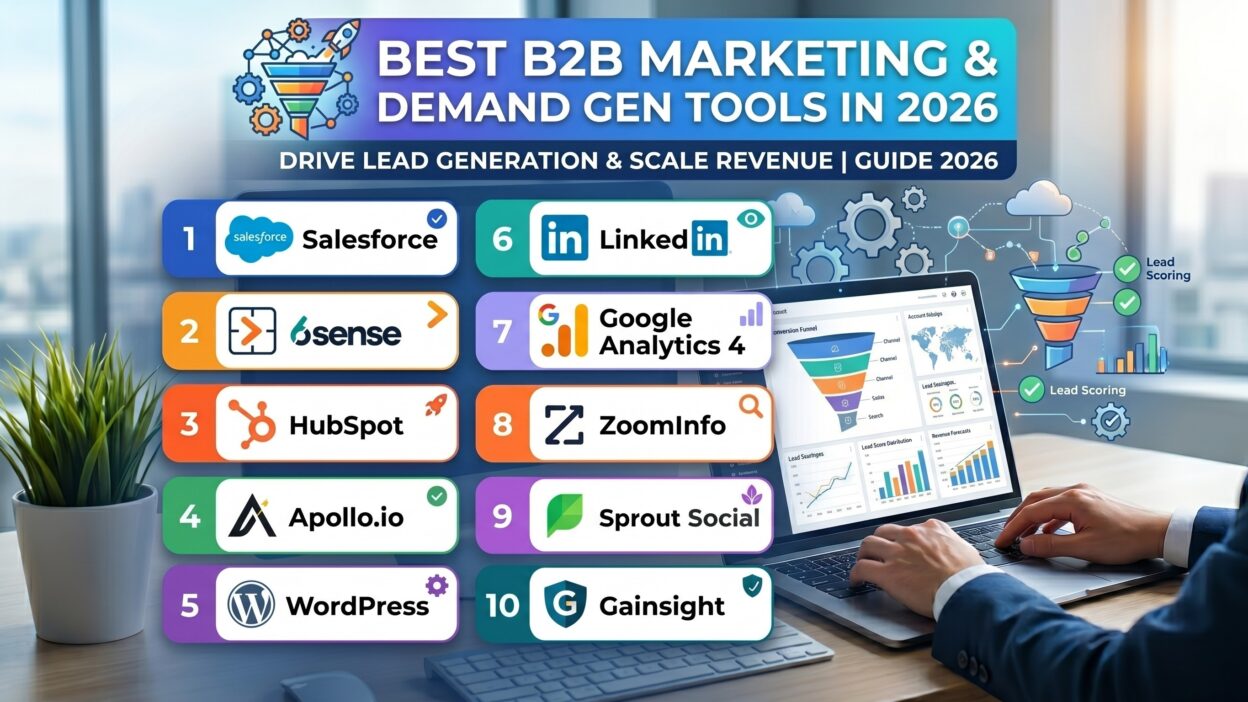
TL;DR Every B2B company wants a steady pipeline of qualified leads. Without the right tools, that goal stays out of reach. The market for B2B Marketing & Demand Gen Tools has grown rapidly in 2026. Buyers now expect personalized outreach at every stage. Marketing teams must work smarter, not just harder. Choosing the right stack separates fast-growing companies from stagnant ones. This guide covers the best platforms, features, and strategies available today.
Table of Contents
Why B2B Marketing & Demand Gen Tools Matter More Than Ever in 2026
Buying committees are larger than they were five years ago. A single deal can now involve seven to ten decision-makers. Each person needs the right content at the right moment. Manual outreach cannot scale to meet that demand. B2B Marketing & Demand Gen Tools fill that gap with automation, data, and intelligence.
Sales cycles have also grown longer. Buyers research independently before talking to any vendor. Demand generation tools help brands show up early in that research phase. They capture intent signals and turn anonymous visitors into known prospects. That early visibility shortens the sales cycle significantly.
Revenue alignment between marketing and sales is no longer optional. Modern platforms connect both teams through shared data and shared goals. When marketing and sales work from the same playbook, conversion rates climb.
Key Features to Look for in B2B Marketing & Demand Gen Tools
Intent Data and Buyer Signals
Intent data tells you which companies are actively researching your category. Platforms like Bombora and G2 Buyer Intent track content consumption across the web. When a target account surges on relevant topics, your team gets an alert. That signal drives timely outreach before a competitor does.
Good B2B Marketing & Demand Gen Tools surface these signals inside your CRM. Sales reps can then prioritize accounts showing the highest intent. The result is better conversion with less wasted effort.
Account-Based Marketing (ABM) Capabilities
ABM focuses your resources on a defined set of high-value accounts. The best tools let you build target account lists using firmographic and technographic data. You can then run coordinated campaigns across display, LinkedIn, and email. Every touchpoint feels personal and relevant to each account.
Platforms like Demandbase and 6sense lead in this space. They combine intent data with AI-driven scoring. Marketers know which accounts to prioritize and which messages resonate. ABM done right dramatically improves pipeline quality.
Marketing Automation and Lead Nurturing
Lead nurturing keeps prospects engaged between sales touches. Automation tools send the right content based on a prospect’s behavior. A prospect who downloads a whitepaper receives a follow-up email with related content. That sequence moves them closer to a buying decision without human intervention.
HubSpot, Marketo, and Pardot remain the dominant automation platforms in 2026. Each offers advanced segmentation, dynamic content, and multi-channel workflows. Marketers can build complex nurture paths that feel human and natural.
Multi-Channel Campaign Orchestration
Buyers interact with brands across many channels. Email, LinkedIn, display ads, webinars, and search all play a role. The best B2B Marketing & Demand Gen Tools coordinate campaigns across all of these channels. They ensure consistent messaging and prevent overlap or contradictory outreach.
Orchestration tools track every touchpoint and attribute revenue to each channel. Marketers see what drives pipeline and can invest accordingly. That data-driven approach eliminates guesswork from budget decisions.
Analytics and Revenue Attribution
Attribution is one of the hardest problems in B2B marketing. A deal might involve fifteen touchpoints across six months. Single-touch attribution misses most of the story. Multi-touch and algorithmic attribution models give a clearer picture.
Platforms like Bizible (now Adobe Marketo Measure) and Rockerbox specialize in attribution. They connect marketing activity directly to closed revenue. CFOs and CMOs can finally have a shared conversation about marketing ROI.
Top B2B Marketing & Demand Gen Tools to Use in 2026
6sense — AI-Powered Revenue Intelligence
6sense is one of the most sophisticated B2B Marketing & Demand Gen Tools available today. It uses AI to predict which accounts are in an active buying cycle. The platform aggregates intent data from millions of sources. Sales and marketing teams get a prioritized list of accounts ready for outreach.
The platform also includes campaign activation features. You can push target account lists directly to LinkedIn, programmatic display, and email. Everything runs from one dashboard. 6sense customers report significant improvements in pipeline velocity and deal size.
Best for: Enterprise teams with complex ABM programs and large target account lists.
HubSpot Marketing Hub — All-in-One Demand Generation
HubSpot remains a top choice for mid-market B2B companies. Its Marketing Hub combines email marketing, SEO tools, landing pages, and automation in one platform. The CRM integration is seamless and real-time. Every interaction is logged and visible to both marketing and sales teams.
HubSpot’s reporting suite covers everything from website traffic to deal influence. Marketers can trace how a blog post contributed to a closed deal. The platform is user-friendly and requires minimal technical setup. It earns its place among the leading B2B Marketing & Demand Gen Tools for its balance of power and usability.
Best for: Growing B2B companies that want a unified marketing and CRM platform.
Demandbase — ABM Platform Built for Enterprise
Demandbase is purpose-built for account-based marketing at enterprise scale. The platform combines a B2B data cloud, advertising, and sales intelligence in one suite. It identifies accounts visiting your website and reveals the buying stage they are in. Marketers can trigger personalized ads and outreach the moment an account shows interest.
Demandbase integrates with Salesforce, HubSpot, and most major marketing automation tools. The data layer is one of the richest in the industry. Firmographic, technographic, and intent data all combine to build detailed account profiles. It stands out among B2B Marketing & Demand Gen Tools for its depth of account intelligence.
Best for: Enterprise B2B companies running sophisticated ABM programs with large sales teams.
Marketo Engage — Enterprise Marketing Automation
Marketo Engage by Adobe is the gold standard for enterprise marketing automation. It handles email campaigns, lead scoring, nurture programs, and event marketing. The platform scales to millions of contacts without slowing down. Custom workflows can be as simple or complex as your team needs.
Marketo’s integration ecosystem is expansive. It connects with Salesforce, Microsoft Dynamics, and hundreds of other tools. Advanced reporting shows how marketing programs influence pipeline. It remains one of the most powerful B2B Marketing & Demand Gen Tools for large organizations with mature marketing operations.
Best for: Enterprise marketing teams with dedicated MOps resources and complex campaign requirements.
Apollo.io — Prospecting and Outreach at Scale
Apollo.io combines a massive B2B contact database with outreach automation. Sales and marketing teams can find verified contacts at target accounts. They can then launch personalized email sequences directly from the platform. The database includes over 200 million contacts with real-time verification.
Apollo’s engagement tools track email opens, clicks, and replies. AI writing assistance helps craft better subject lines and messages. The platform is affordable and easy to use. It ranks among the most accessible B2B Marketing & Demand Gen Tools for teams that need to move fast.
Best for: Sales-led growth teams, SDR teams, and small-to-mid-market B2B companies.
Drift — Conversational Marketing and Pipeline Acceleration
Drift brings real-time conversation into the demand generation mix. Its AI-powered chatbots engage website visitors the moment they land on key pages. The platform qualifies visitors, books meetings, and routes conversations to the right sales rep. No form fills. No waiting.
Drift integrates with Salesforce, HubSpot, Marketo, and Salesloft. It identifies target accounts visiting your site and triggers personalized playbooks. The result is faster pipeline creation and higher meeting conversion rates. Drift earns its spot among leading B2B Marketing & Demand Gen Tools for its impact on pipeline velocity.
Best for: B2B companies with high website traffic that want to convert more visitors into sales conversations.
LinkedIn Marketing Solutions — B2B Advertising at Its Best
LinkedIn remains the dominant paid channel for B2B demand generation. Sponsored Content, Message Ads, and Lead Gen Forms reach decision-makers directly. The targeting options are unmatched — job title, company size, industry, seniority, and more. No other platform offers that level of professional audience targeting.
LinkedIn’s Campaign Manager has improved significantly in 2026. Connected TV campaigns now reach buyers off the platform too. Revenue attribution tools connect LinkedIn spend to CRM opportunities. For reach and brand awareness, LinkedIn stands alone among B2B Marketing & Demand Gen Tools in the paid media category.
Best for: Any B2B company that wants to reach senior decision-makers through paid advertising.
Bombora — B2B Intent Data Leader
Bombora operates the largest B2B intent data cooperative in the market. It aggregates content consumption data from thousands of publisher websites. When a company surges on topics relevant to your product, Bombora flags it. Your team can act on that signal before the account reaches out to a competitor.
Bombora data integrates with almost every major platform — Salesforce, HubSpot, Demandbase, 6sense, and more. Marketers use it to prioritize campaigns and suppress accounts already in-pipeline. Sales teams use it to time outreach perfectly. Bombora is an essential data layer for serious B2B Marketing & Demand Gen Tools stacks.
Best for: Teams that want to add intent data to an existing martech stack without replacing current platforms.
Salesloft — Sales Engagement and Pipeline Management
Salesloft bridges the gap between marketing-generated leads and sales follow-up. Its cadence builder creates structured outreach sequences across email, phone, and LinkedIn. Managers can see exactly where reps are in each cadence. Coaching tools help improve rep performance over time.
In 2026, Salesloft’s AI features have expanded significantly. The platform now suggests the best next action for each prospect. It identifies at-risk deals before they go cold. Integration with Gong adds conversation intelligence to the mix. Salesloft completes the demand generation loop in many B2B Marketing & Demand Gen Tools stacks.
Best for: B2B sales teams with SDR and AE functions that need structured, measurable outreach cadences.
Clearbit (now Breeze Intelligence by HubSpot) — Real-Time Data Enrichment
Clearbit, now integrated into HubSpot as Breeze Intelligence, enriches your CRM records in real time. When a new lead comes in, the platform appends company size, industry, technology stack, and contact data automatically. Sales reps spend less time researching and more time selling.
The enrichment layer improves lead scoring accuracy significantly. Forms can be shortened because Clearbit fills in the missing fields. Website personalization engines use Clearbit data to tailor content by industry or company size. It adds essential data depth to most B2B Marketing & Demand Gen Tools stacks.
Best for: HubSpot users and any team that wants cleaner, richer CRM data without manual research.
How to Build a High-Performance B2B Demand Gen Stack in 2026
Start With Your ICP and Target Account List
Every strong demand gen program begins with a clear Ideal Customer Profile. Define the industries, company sizes, geographies, and roles you target. Build a target account list from that definition. Your tools should then activate around that list.
Layer in Intent Data Early
Intent data changes how you prioritize every campaign. Add a data provider like Bombora or G2 Buyer Intent to your stack early. Use those signals to focus ad spend and outreach on accounts already researching your category. That efficiency multiplies the impact of your budget.
Connect Marketing Automation to Your CRM
Your marketing automation platform must sync in real time with your CRM. Lead scores, engagement history, and campaign membership all need to be visible to sales. When marketing and sales share the same data, handoffs become clean. Pipeline leakage drops dramatically.
Invest in Multi-Touch Attribution
Single-touch attribution misleads budget decisions. Invest in a proper multi-touch attribution solution early. It shows which campaigns drive pipeline, which channels close deals, and where to invest next quarter. Data-driven decisions replace gut-feel budget discussions.
Measure Pipeline, Not Just Leads
Lead volume is a vanity metric. Measure marketing-sourced pipeline, marketing-influenced pipeline, and win rate by channel. Those metrics connect marketing activity directly to revenue. They also earn marketing more credibility in the boardroom.
Related Topics Covered in This Guide
This blog naturally addresses several secondary topics relevant to readers searching for B2B Marketing & Demand Gen Tools:
Account-based marketing platforms, intent data providers, marketing automation software, lead generation tools for B2B, sales engagement platforms, revenue attribution tools, B2B advertising platforms, CRM data enrichment tools, demand generation strategy 2026, and ABM software for enterprise.
Frequently Asked Questions About B2B Marketing & Demand Gen Tools
What are B2B Marketing & Demand Gen Tools?
They are software platforms that help B2B companies generate awareness, capture leads, nurture prospects, and convert opportunities into revenue. They include marketing automation, ABM platforms, intent data providers, sales engagement tools, and analytics solutions.
How many tools does a B2B demand gen stack need?
A typical mid-market stack includes five to eight tools. That usually covers a CRM, marketing automation, intent data, sales engagement, and analytics. Enterprise stacks are often larger. The key is integration — tools must share data cleanly.
What is the difference between lead generation and demand generation?
Lead generation focuses on capturing contact information through forms and gated content. Demand generation focuses on creating market awareness and interest before a lead ever fills out a form. Modern B2B programs do both. B2B Marketing & Demand Gen Tools now support the full funnel, not just the bottom.
Is intent data worth the investment for B2B companies?
For most B2B companies, yes. Intent data reduces wasted outreach by showing which accounts are actively researching your category. It improves conversion rates and shortens sales cycles. The ROI is typically clear within two to three quarters of consistent use.
How do I measure the ROI of demand generation tools?
Measure marketing-sourced pipeline, cost per opportunity, and marketing-influenced revenue. Compare those numbers to the cost of your tool stack. A well-run demand gen program should generate three to five dollars in pipeline for every dollar spent. Attribution tools make that measurement possible.
What is ABM and why does it matter for demand generation?
Account-Based Marketing is a strategy that focuses resources on a defined list of high-value accounts. It treats each account like its own market. B2B Marketing & Demand Gen Tools with ABM capabilities coordinate personalized campaigns across every channel. ABM typically delivers higher win rates and larger deal sizes than broad-based lead generation.
Which demand gen tools work best for small B2B companies?
Apollo.io, HubSpot Marketing Hub, and LinkedIn Marketing Solutions are excellent starting points. They are affordable, easy to use, and scale as your team grows. Small teams can run effective demand generation programs with those three tools and the right strategy.
How important is personalization in B2B demand generation in 2026?
Personalization is now a baseline expectation, not a differentiator. Buyers ignore generic outreach. B2B Marketing & Demand Gen Tools with dynamic content, AI writing assistance, and account-level personalization help teams stand out. The tools that do personalization well drive significantly higher engagement rates.
Read More:-Customer Pain Points: How to Identify and Solve Them in B2B Sales
Conclusion

B2B demand generation has never been more competitive. Buyers are informed, cautious, and surrounded by competing vendors. The right tools give your team a real advantage. B2B Marketing & Demand Gen Tools help you find the right accounts, reach them with the right message, and convert more pipeline into closed revenue.
The platforms covered in this guide — from 6sense and Demandbase to HubSpot and Apollo.io — represent the best of what the market offers in 2026. Each serves a different stage of the funnel and a different type of team. Your job is to build a stack that fits your ICP, budget, and go-to-market motion.
Start with the fundamentals: a strong CRM, solid marketing automation, and quality intent data. Layer in ABM capabilities as your program matures. Add attribution tools to prove ROI and earn more budget. Revisit your stack every six months. The market moves fast. The best teams move faster.
The companies that invest in the right B2B Marketing & Demand Gen Tools today will own their category tomorrow.