Introduction
TL;DR A practical guide to uncovering what your buyers truly struggle with — and turning those struggles into closed deals.
Table of Contents
Why Customer Pain Points in B2B Sales Define Every Deal
Every B2B purchase starts with a problem. A process breaks down. A cost spirals out of control. A team misses a target because the tools they rely on cannot keep up with the work. Somewhere in that frustration, a buying decision begins.
Sales teams that understand this truth sell differently. They stop leading with features. They stop opening calls with company overviews. They start with a question, and they listen carefully to the answer.
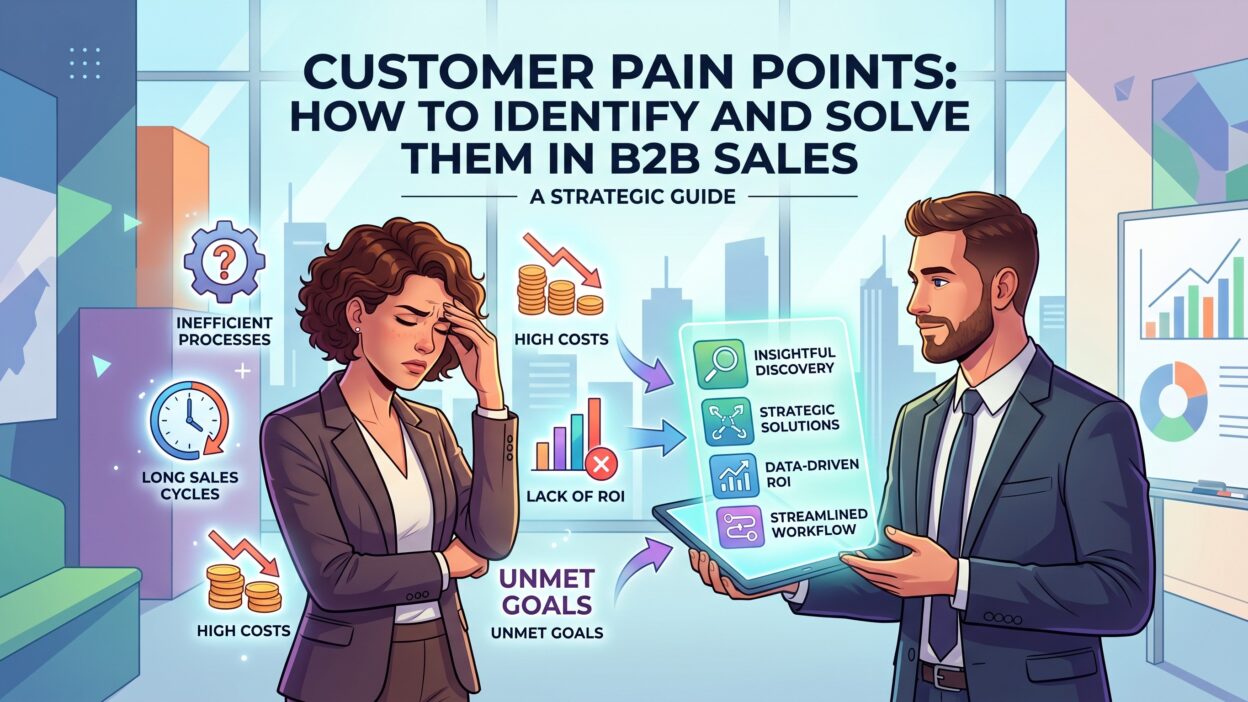
Customer pain points in B2B sales are the specific problems, frustrations, and inefficiencies that drive a business to seek a new solution. They are not vague dissatisfactions. They are real, measurable, often costly challenges that someone in the buying organisation wants to fix.
Understanding these pain points is not just a sales technique. It shapes every part of the revenue function — marketing messages, product positioning, customer success strategy, and renewal conversations.
This guide covers how to identify those pain points precisely, how to map them to your solution, and how to build a sales approach that resonates at every stage of the buyer journey.
68%Of B2B buyers say reps don’t understand their business problems
3×Higher close rate for reps who lead with pain before solution
79%Of lost deals trace back to failure to establish clear business need
These numbers are not coincidental. The gap between reps who consistently hit quota and those who struggle almost always traces back to how well each rep understands and articulates customer pain points in B2B sales.
What Are Customer Pain Points? A B2B Definition
A pain point is any problem a business faces that creates enough discomfort, cost, or risk to motivate action. In B2B sales, pain points tend to fall into two categories — acknowledged pain and latent pain.
Acknowledged pain is the problem a buyer knows about and can articulate. The buyer says, “Our sales cycle is too long.” Or, “We’re spending too much on manual data entry.” These are surface-level pain points that the buyer has already diagnosed. They are searching for a solution actively.
Latent pain is deeper. It is the problem a buyer has not yet framed as a problem. They know something feels off. Results are inconsistent. The team is stretched thin. Deadlines slip regularly. A skilled sales rep helps the buyer name that feeling, quantify its impact, and understand its root cause.
Surfacing latent pain is one of the most powerful skills in B2B selling. It positions the rep as a trusted advisor rather than a product vendor. It creates urgency that the buyer did not feel before the conversation. It differentiates the rep in a market where every competitor pitches the same features.
“The best B2B sales reps don’t find customers who need their product. They find customers who have a problem — and then show them exactly what that problem is costing them.”
Understanding the difference between acknowledged and latent customer pain points in B2B sales shapes how you approach every stage of the sales process. Discovery questions change. Proposal structure changes. The entire conversation changes.
The Four Core Categories of B2B Customer Pain Points
B2B pain points cluster into four broad categories. Knowing which category a buyer’s pain falls into helps a sales rep respond with the right depth, the right data, and the right urgency.
01 Financial Pain Points
These are cost-related problems. A company spends too much on a current vendor. A process requires excessive manual labour that drives up overhead. A tool has hidden fees that the finance team now questions every quarter. Financial pain is highly motivating because it has a direct number attached. Buyers feel it in their budget reviews, their P&L reports, and their board conversations. Any solution that credibly reduces this cost gets serious attention fast.
02 Productivity Pain Points
These are efficiency problems. Teams spend too much time on tasks that should take minutes. Systems don’t talk to each other, forcing manual data transfers. Approvals take days instead of hours. Reporting requires a full-time analyst pulling data from multiple disconnected sources. Productivity pain affects morale, output, and the ability to scale. When a business grows but its processes don’t, productivity pain intensifies fast.
03 Process Pain Points
These are operational problems. The current way of doing something creates risk, inconsistency, or compliance exposure. A sales process lacks structure, so outcomes vary wildly by rep. An onboarding workflow has no standard steps, so new customers have inconsistent experiences. A procurement process creates bottlenecks that delay time-to-value. Process pain often sits below the surface until something breaks visibly enough to demand attention.
04 Support and Strategic Pain Points
These are relationship and direction problems. The current vendor is unresponsive. Support tickets go unresolved for days. The buyer feels like a small account getting minimal attention. Or the pain is strategic — leadership wants to move in a new direction but the current tech stack cannot support that vision. Strategic pain points often have the longest sales cycles but also the largest deal sizes, because the stakes are highest.
Most B2B deals involve pain points from multiple categories. A prospect might have financial pain driving urgency, process pain explaining why the current situation is unsustainable, and strategic pain motivating executive sponsorship. Identifying all active categories helps a rep build a business case that resonates at every level of the buying committee.
How to Discover Customer Pain Points Before Your Competitors Do
Speed matters in B2B sales. The first rep to clearly articulate a prospect’s pain point owns the framing of the entire evaluation. Every competitor who follows must argue against that established narrative.
Discovering pain early requires deliberate research before the first call. Reps who show up informed earn immediate credibility. Reps who ask for information the prospect already made public waste trust they cannot afford to lose.
Pre-Call Research That Surfaces Pain
Start with the company’s own communications. Earnings calls, press releases, and investor presentations often describe strategic challenges in plain language. A CFO who says “we need to reduce operational overhead by 20 percent next year” is describing a financial pain point directly.
Job postings reveal internal problems. A company hiring five data analysts while simultaneously posting for a “data operations manager” suggests their current data workflow is broken. A string of customer success manager postings suggests retention challenges. Job boards are a remarkably honest window into a company’s operational struggles.
Review sites like G2, Capterra, and Trustpilot expose pain with their current vendor. A pattern of reviews complaining about poor support, missing integrations, or steep learning curves tells a sales rep exactly where dissatisfaction lives. That intelligence shapes every conversation that follows.
LinkedIn activity from decision-makers often signals pain directly. A VP of Operations who posts about process improvement frustrations or shares articles about automation challenges is showing you their priorities. Engaging with that content authentically before an outbound touch creates warm context for the first outreach.
Research Principle
The goal of pre-call research is not to collect facts. The goal is to form a hypothesis about the buyer’s most pressing pain point. That hypothesis guides the discovery conversation and gives the rep something specific to validate or disprove.
A rep who opens with “Based on what I read about your Q4 results, I thought you might be dealing with X — is that accurate?” earns more respect in thirty seconds than a rep who asks “So tell me about your business” earns in thirty minutes.
Research Methods That Surface Real Pain Points
Beyond pre-call research, B2B sales teams benefit from systematic methods to understand the pain landscape across their target market. These methods feed marketing strategy, product roadmaps, and sales enablement equally.
Win/Loss Interviews
Speaking with buyers after a deal closes — whether won or lost — reveals the actual pain points that drove the decision. Win interviews show which pain points your solution addressed most compellingly. Loss interviews show which pain points competitors articulated better or which problems your solution failed to address credibly.
Most sales teams conduct informal win/loss analysis. Few conduct structured interviews with open-ended questions designed to surface the full emotional and rational journey of the buying decision. The structured approach reveals patterns that informal analysis misses entirely.
Customer Advisory Boards
Gathering a small group of current customers to discuss their ongoing challenges serves two purposes. It deepens the relationship with existing accounts. It also surfaces emerging pain points that the market is beginning to feel but hasn’t yet articulated widely. Companies that run customer advisory boards consistently build stronger product-market fit because they hear problems before they become obvious.
Sales Call Analysis
Conversation intelligence tools record, transcribe, and analyse sales calls. Reviewing these recordings reveals the exact language buyers use to describe their pain points. That language is gold. It informs email subject lines, case study headlines, website copy, and ad creative. The buyer’s own words resonate with other buyers in identical situations far more powerfully than any marketing-crafted phrase.
Support Ticket Patterns
Customer support tickets document real pain in real time. Categories of recurring tickets often reveal a product gap, an onboarding failure, or a communication breakdown. Sales teams that review support data regularly understand where customers struggle after purchase — and use that knowledge to set more honest expectations during the sales process.
How to Run Discovery Calls That Expose True Pain
Discovery is the most important skill in B2B selling. A well-run discovery call reveals the full scope of a prospect’s pain, the business impact of that pain, and the emotional weight it carries for the buyer personally. A poorly run discovery call collects surface facts and leaves the rep with no differentiated understanding of the opportunity.
Ask About Impact, Not Just Problems
Most reps ask “What are your biggest challenges?” That question gets a list of problems. A better question is “What does that challenge cost you in time or revenue each quarter?” That question forces the buyer to quantify their pain. Quantified pain is urgent pain. It becomes a business case on its own.
The follow-up question matters equally. “What happens if this problem isn’t solved in the next six months?” introduces time pressure organically. The buyer articulates the consequence of inaction. That consequence becomes the most compelling reason to move forward — and the buyer said it themselves.
Listen for Emotional Language
Customer pain points in B2B sales are not only rational. They carry emotional weight. A VP of Sales frustrated that their team can’t hit quota is not just managing a metric problem. They are managing pressure from the CEO, stress within the team, and concern about their own position.
When a buyer uses words like “frustrated,” “embarrassed,” “overwhelmed,” or “worried,” those are emotional signals. Acknowledge them. A simple “That sounds genuinely stressful — how long has the team been dealing with this?” shows empathy and deepens trust. Buyers remember how a rep made them feel far longer than they remember any feature list.
Map the Buying Committee’s Pain
B2B purchases involve multiple stakeholders. Each stakeholder has their own pain point. The end user cares about daily workflow friction. The manager cares about team performance and reporting. The CFO cares about cost and ROI. The IT leader cares about security, integration, and implementation risk.
A discovery conversation with one person reveals one perspective. The rep’s job is to map the full organisational pain landscape across the committee. Asking “Who else in your organisation feels the impact of this problem?” opens the door to multi-threaded discovery and multi-stakeholder alignment.
Discovery Call Best Practice
Take notes on exact phrases the buyer uses to describe their pain. Repeat those phrases back in your proposal, your follow-up email, and your business case document. When a buyer reads their own words reflected in your proposal, it confirms that you truly heard them. That confirmation builds the emotional trust that closes deals.
Mapping Pain Points to Your Solution
Identifying a pain point is only half the work. The other half is connecting that pain point to a specific capability or outcome your solution delivers — clearly, credibly, and without overstatement.
Build a Pain-to-Outcome Matrix
A pain-to-outcome matrix is a simple internal tool. On one axis, list the most common customer pain points in B2B sales your team encounters. On the other axis, list the specific outcomes your solution produces for each pain type. For each intersection, document a customer proof point — a case study, a data metric, or a direct customer quote.
This matrix becomes the foundation for every proposal, every demo, and every objection-handling conversation. It removes ad hoc storytelling and replaces it with consistent, proven narratives that resonate across the buying committee.
Prioritise the Pain That Drives Action
Not all pain points carry the same urgency. A prospect might have ten problems, but only two of them create enough discomfort to justify a budget conversation right now. A skilled rep identifies those two problems early and anchors the entire solution narrative to them.
Trying to address every pain point in a proposal dilutes the message. A focused proposal that solves the buyer’s most acute problem convincingly closes deals faster than a comprehensive overview of every feature relevant to every marginal concern.
Use Customer Stories as Pain Mirrors
Case studies work because buyers see themselves in other buyers. When a rep shares a story about a company in the same industry, the same size, facing the same pain, the prospect’s recognition is immediate. “That’s exactly what we’re dealing with” is the most valuable sentence a prospect can say during a sales conversation.
Structure customer stories around pain first. Start with the problem the customer faced, the specific impact of that problem, and the consequence of continuing without a solution. Then introduce your solution and its outcome. This structure mirrors the buyer’s internal narrative and makes the story far more compelling than leading with the product.
Writing Messaging That Speaks Directly to Pain Points
Great sales messaging does not describe a product. It describes a problem the buyer recognises and a future state the buyer desires. Every word in a prospecting email, a landing page headline, or a case study title either earns attention or loses it.
Lead with the Problem, Not the Solution
Cold outreach that opens with “We help companies like yours improve sales productivity” describes a benefit the prospect has heard a dozen times this week. Cold outreach that opens with “Most RevOps leaders we speak with are dealing with one of two problems this quarter — inconsistent pipeline data or sales cycle drag. Does either of those sound familiar?” earns a response because it names a specific, real pain.
The same principle applies to website copy, ad creative, and event presentations. Lead with the problem. The prospect leans forward when they recognise themselves in your opening line. That lean-forward moment is the only thing that makes the rest of the message matter.
Use the Buyer’s Language Precisely
Sales and marketing teams often describe customer pain in internal language rather than buyer language. The buyer says “our reporting takes forever.” The marketer writes “streamline your analytics workflow.” Those two phrases describe the same problem, but only one makes the buyer feel understood.
Mining call recordings, reviews, and customer interviews for the exact words buyers use pays dividends across every channel. When marketing messaging mirrors the language buyers use to describe their pain, conversion rates improve at every stage of the funnel — ads, landing pages, emails, and proposals alike.
Handling Objections Rooted in Unresolved Pain
Most B2B sales objections are not really about price, timing, or features. They are expressions of unresolved pain or unaddressed risk. A buyer who says “we don’t have budget right now” often means “we haven’t yet connected the cost of this problem to the cost of your solution convincingly enough to prioritise it.”
The “No Budget” Objection
When a prospect says budget is unavailable, the pain case is incomplete. A well-quantified pain point creates its own budget justification. If a prospect acknowledges that a broken process costs their team 200 hours per month in manual work, and your solution eliminates 80 percent of that waste, the ROI calculation writes itself. Budget objections dissolve when the cost of inaction clearly exceeds the cost of the solution.
The “Not the Right Time” Objection
This objection almost always means the urgency of the pain point has not landed. The buyer feels the problem but doesn’t yet feel the consequence of delay. Asking “What does it cost the business for every additional quarter this problem continues?” forces a calculation that reframes the timing question entirely. Urgency comes from the buyer’s own math, not from a sales rep’s pressure tactics.
The “We’ll Build It Internally” Objection
This objection appears most often in technical B2B sales. The buyer believes their team can solve the problem without purchasing an external solution. Responding to this objection requires deepening the pain case — specifically around time, opportunity cost, and the risk of distraction from core priorities. A team building a solution internally is a team not building their core product. That trade-off has a cost that rarely appears in the initial build-vs-buy analysis.
Common Mistakes B2B Sales Teams Make with Pain Points
Assuming the Pain Without Validating It
Pre-call research creates hypotheses about pain, not facts. A rep who skips the validation step and pitches directly to an assumed pain point risks missing the real issue entirely. Always confirm your hypothesis before building your solution narrative around it. One question — “Is this actually the biggest challenge you’re facing, or is there something more pressing?” — prevents hours of misdirected selling.
Pitching Before Pain Is Established
Moving to product demonstration before a pain point is clearly articulated and emotionally acknowledged is the most common mistake in B2B selling. A demo without established pain is a feature tour. A demo that shows exactly how a specific pain point disappears is a buying conversation. The sequence matters enormously.
Solving the Wrong Level of Pain
Customer pain points in B2B sales exist at different organisational levels. A rep might address the end user’s daily frustration while completely missing the executive sponsor’s strategic concern. A winning proposal addresses both. The end user needs to see their daily experience improve. The executive needs to see a business outcome they can defend to the board. Both conversations need to happen.
Treating Pain as a One-Time Conversation
Pain points evolve throughout a long B2B sales cycle. A prospect’s priorities shift as the internal evaluation progresses, as more stakeholders join the conversation, and as the market changes around them. A rep who identified the primary pain point in the first discovery call and never revisited it three months later often finds the deal has shifted in a direction they didn’t anticipate. Regular check-ins on pain point relevance keep the rep aligned with where the buyer actually is.
FAQs: Customer Pain Points in B2B Sales
What are the most common customer pain points in B2B sales?
The most common pain points cluster around four areas: financial inefficiency (overspending on current solutions or processes), productivity loss (time wasted on manual or broken workflows), process inconsistency (lack of standardisation creating risk or poor outcomes), and poor vendor support (unresponsive current partners who don’t deliver on their commitments). Most B2B deals involve pain from more than one category simultaneously.
How do you identify customer pain points during a sales call?
The most effective approach combines open-ended questions with active listening for emotional language. Ask about the impact of current problems, the cost of those problems per quarter, and the consequence of not solving them in the next six months. Listen for words like “frustrated,” “overwhelmed,” or “worried” as signals of emotional weight. Map every stated problem to a business impact before moving to any product discussion.
What is the difference between a pain point and a need in B2B sales?
A need is the solution a buyer thinks they require. A pain point is the underlying problem driving that perceived need. A buyer might say “we need a better CRM” — that’s a need. The pain point underneath might be that the current CRM creates inconsistent data that makes pipeline forecasting unreliable. Selling to the pain point rather than the stated need creates far more compelling, differentiated sales conversations.
How do customer pain points affect B2B marketing strategy?
Pain points shape every element of marketing strategy. They determine which topics attract the right audience through SEO and content. They define the messaging on landing pages, ads, and email campaigns. They inform the angle of case studies and the structure of webinars. Marketing teams that build their content calendar around validated customer pain points consistently generate higher-quality pipeline than teams that lead with product features.
How do you create urgency around a customer pain point?
Urgency comes from quantifying the cost of the current pain and projecting the consequence of continued inaction. Ask the buyer to calculate what the problem costs per month, per quarter, or per year. Then ask what changes internally if that cost continues for another year. The buyer’s own calculation creates urgency more powerfully than any external pressure a rep could apply. Urgency rooted in the buyer’s math is durable. Urgency rooted in a sales deadline is fragile.
What secondary keywords relate to customer pain points in B2B sales?
Key related terms include: B2B buyer pain points, identifying customer needs, sales discovery questions, pain point selling, B2B sales challenges, understanding customer problems, consultative selling, business pain points, value-based selling, and B2B sales objections handling.
How should sales teams document customer pain points internally?
The most effective teams maintain a centralised pain point library inside their CRM. Every sales rep documents the primary pain category, the buyer’s exact language, the quantified impact, and the proof point used to connect the pain to the solution. This library improves onboarding for new reps, informs marketing campaign briefs, and creates the foundation for a structured pain-to-outcome matrix that drives consistent proposal quality across the team.
Read More:-Highspot vs. Outreach: Key Differences Explained
Conclusion

Customer pain points in B2B sales are not just a sales technique or a discovery framework. They are the foundation of every meaningful buyer relationship and every deal that closes with genuine value on both sides.
The best B2B sales teams build their entire approach around pain — finding it early, quantifying it clearly, mapping it precisely to their solution, and returning to it throughout a long sales cycle. They train their reps to listen more than they speak. They build marketing messages around the language buyers use, not the language product teams prefer.
The discipline of understanding customer pain points deeply is also the discipline of treating buyers as people with real problems, real pressures, and real stakes attached to every purchase decision. That respect earns trust. Trust shortens sales cycles. Shorter cycles with higher close rates is the commercial outcome every revenue leader wants.
Start with research. Validate with discovery. Quantify with follow-up questions. Map to outcomes with evidence. Return to the pain throughout the cycle. Build your messaging around the words buyers use.
Do that consistently, and customer pain points in B2B sales become your clearest competitive advantage — not because you have a better product, but because you understand your buyer’s world better than anyone else in the room.