Introduction
TL;DR Most B2B deals fail before a sales rep ever makes contact. The reason is simple. Buyers move through a complex decision process long before they talk to any vendor. They research, evaluate, compare, and consult colleagues — all on their own timeline. Brands that understand this process win more deals. Brands that ignore it lose to competitors who pay closer attention. B2B Buyer Journey Mapping is the discipline that gives revenue teams that understanding. It reveals exactly how buyers think, what they need at each stage, and where your marketing must show up to earn their trust.
This guide covers what B2B Buyer Journey Mapping is, why it matters, how to build one, and how to use it to drive measurable revenue growth.
Table of Contents
What Is B2B Buyer Journey Mapping?
B2B Buyer Journey Mapping is the process of documenting every step a business buyer takes from the moment they recognize a problem to the moment they select a vendor and sign a contract. It captures the buyer’s actions, questions, emotions, information needs, and decision criteria at each stage of the purchase process.
A journey map is not a sales funnel. A sales funnel reflects how your internal team views the pipeline. A buyer journey map reflects how the buyer experiences the purchase. Those two perspectives are often very different. B2B Buyer Journey Mapping forces organizations to adopt the buyer’s point of view rather than their own internal process.
The output of a mapping exercise is a visual or documented framework that marketing, sales, and customer success teams use to align their activities. Each team sees what the buyer needs at every stage. Content, outreach, and enablement materials all get built around those needs. The result is a buying experience that feels helpful and relevant rather than pushy and generic.
Why B2B Buyer Journey Mapping Matters in 2026
B2B buying has changed dramatically over the past decade. Buyers now complete sixty to seventy percent of their research before speaking with a vendor. Buying committees have grown larger. The average enterprise deal now involves six to ten decision-makers, each with different priorities and questions. Sales cycles have extended. Budget scrutiny has intensified.
B2B Buyer Journey Mapping gives revenue teams a way to navigate that complexity. It shows where buyers seek information, which channels they trust, and what content moves them forward. Without a map, marketing and sales operate on assumptions. With a map, they operate on evidence.
Organizations that invest in B2B Buyer Journey Mapping consistently see higher marketing ROI, shorter sales cycles, and better alignment between marketing and sales. The map becomes a shared language across the entire go-to-market team. Everyone understands the buyer’s experience and their role in improving it.
The Key Stages of the B2B Buyer Journey
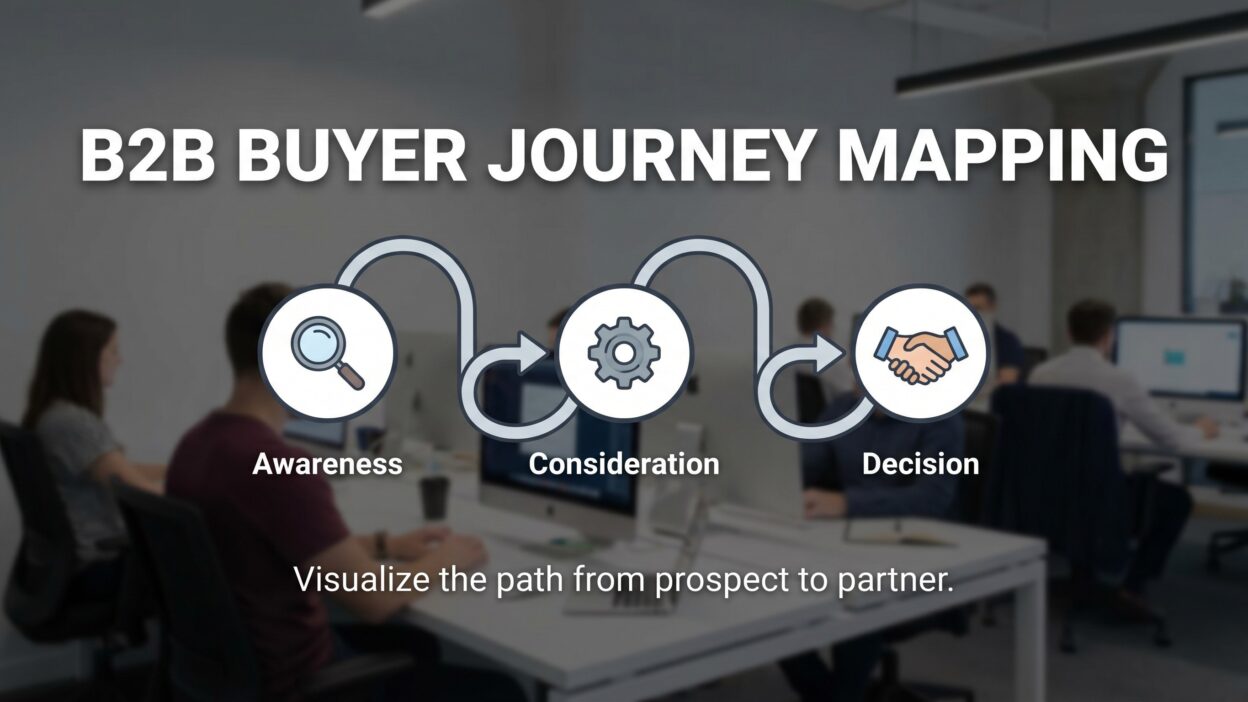
Stage One — Awareness and Problem Recognition
Every purchase begins with a problem. A company’s revenue growth stalls. Their current software creates manual inefficiencies. Their compliance risk increases. Something triggers the recognition that the status quo is no longer acceptable.
At this stage, buyers are not looking for vendors. They are looking for information. They read industry reports, search for educational content, and talk to peers. B2B Buyer Journey Mapping at this stage focuses on understanding what triggers buyers to start searching and what questions they ask first.
Marketing’s job at the awareness stage is to be present when that search begins. Blog posts, thought leadership articles, LinkedIn content, and SEO-optimized educational resources all serve that purpose. The goal is not to sell. The goal is to help buyers understand their problem more clearly.
Stage Two — Consideration and Solution Exploration
Once buyers understand their problem, they begin exploring categories of solutions. They look at how other companies have solved similar challenges. They read case studies, watch webinars, attend industry events, and consult analyst reports. Buying committees form at this stage. Different stakeholders bring different perspectives.
B2B Buyer Journey Mapping at the consideration stage maps the questions each buying committee member asks. A CFO asks about ROI and total cost of ownership. A CTO asks about security and integration. An end user asks about ease of use and training requirements. A single piece of content rarely serves all of them.
Marketing must produce role-specific content at this stage. Comparison guides, ROI calculators, analyst reports, and solution overviews all help buyers evaluate their options. Sales development reps should be active on the channels buyers use most during this phase.
Stage Three — Decision and Vendor Evaluation
Buyers now have a shortlist of vendors. They conduct demos, run proof-of-concept pilots, check references, and negotiate contracts. Internal champions present recommendations to senior leadership. Legal and procurement teams enter the process. Risk assessment intensifies.
B2B Buyer Journey Mapping at the decision stage reveals what objections kill deals, which stakeholders have veto power, and what evidence buyers need to build internal consensus. Case studies from similar companies, security documentation, implementation roadmaps, and executive briefings all matter at this stage.
Sales reps need strong enablement materials to carry deals across the finish line. Marketing must provide customer proof, competitive battlecards, and reference contacts. The smoother the buying experience at this stage, the higher the close rate.
Stage Four — Purchase and Onboarding
The contract is signed. But the journey does not end there. A poor onboarding experience creates early churn and negative word-of-mouth. A strong onboarding experience creates loyal customers who refer new business and expand their own contracts.
B2B Buyer Journey Mapping extends into the post-purchase phase for exactly this reason. Customer success teams use the map to understand what buyers expect after signing. Onboarding content, training materials, check-in cadences, and success milestones all align with the buyer’s expectations rather than an internal checklist.
Stage Five — Retention, Expansion, and Advocacy
Happy customers buy more. They expand into new product lines, add seats, and upgrade tiers. They refer colleagues at other companies. They speak at events and write reviews on G2, Capterra, and Trustpilot. That advocacy feeds new buyer awareness at the top of the funnel.
A complete B2B Buyer Journey Mapping framework captures this expansion and advocacy loop. It shows how customer marketing, community programs, and renewal outreach all connect back to new revenue generation. The journey is cyclical, not linear.
Who Is Involved in the B2B Buyer Journey?
The Economic Buyer
The economic buyer controls the budget. They care about financial impact, risk, and strategic alignment. They often enter the process late but carry the most authority. A deal without economic buyer support rarely closes. B2B Buyer Journey Mapping must identify who holds this role at each target account type and what they need to say yes.
The Technical Buyer
The technical buyer evaluates whether the solution fits the organization’s technology infrastructure. They assess security, scalability, integration complexity, and compliance requirements. They can block a deal with a single objection. Their questions require detailed, credible technical documentation.
The End User
End users care about usability, workflow fit, and daily impact. They often influence the shortlisting process even when they do not hold formal decision authority. A solution that end users reject rarely gets approved regardless of the economic case. Journey mapping must address their concerns explicitly.
The Champion
The champion is an internal advocate who drives the purchase forward. They believe in the solution and work to build consensus inside their organization. Enabling the champion with the right content, data, and talking points is one of the highest-leverage activities in the entire buying process. B2B Buyer Journey Mapping helps marketing and sales identify champion profiles and create tools specifically for them.
The Influencer and Gatekeeper
Consultants, advisors, industry analysts, and procurement managers all play roles in the B2B buying process. They may not make the final decision, but they shape it. A journey map that ignores these stakeholders misses significant influence points.
How to Build a B2B Buyer Journey Map
Step One — Define Your Ideal Customer Profile
Every journey map begins with clarity on who you are mapping. Define your Ideal Customer Profile by industry, company size, geography, technology stack, and growth stage. Segment your ICP by buying motion — some buyers are product-led, others are sales-led, and others are community-led. A different ICP often means a different journey.
Step Two — Conduct Buyer Interviews
Real buyer data is the foundation of accurate B2B Buyer Journey Mapping. Interview twelve to twenty recent buyers across won deals, lost deals, and no-decision outcomes. Ask them to walk through their purchase process step by step. Identify what triggered the search, which channels they used, which content helped most, which objections slowed them down, and why they made their final decision.
Win-loss analysis firms like Clozd and Primary Intelligence specialize in this research. Their structured interview methodology surfaces insights that internal teams rarely discover on their own.
Step Three — Map Buyer Actions and Questions at Each Stage
For each stage of the journey, document what buyers do and what they ask. At the awareness stage, they search Google and read industry blogs. At the consideration stage, they watch demos and request pricing. At the decision stage, they check references and review security documentation.
Each action and question reveals a content need, a channel opportunity, or a sales enablement gap. B2B Buyer Journey Mapping turns those insights into a prioritized content and outreach plan.
Step Four — Identify Emotional States and Pain Points
Buyers are not purely rational. Fear of making a wrong decision, pressure from leadership, frustration with internal politics, and anxiety about implementation risk all influence buying behavior. A journey map that captures emotional states helps marketing and sales communicate with empathy rather than just logic.
A CFO who fears budget scrutiny needs ROI validation, not product features. A CTO who fears implementation failure needs a detailed deployment roadmap, not a demo. Understanding emotional context makes every interaction more relevant.
Step Five — Align Content and Channels to Each Stage
Every stage of the B2B Buyer Journey Mapping framework needs corresponding content and channel activation. Awareness demands SEO content, thought leadership, and social presence. Consideration demands case studies, comparison guides, and webinars. Decision demands ROI tools, references, and executive engagement.
Map your existing content library against each stage. Identify the gaps. Build a content roadmap that fills those gaps systematically. Prioritize content types that match how your buyers actually consume information — video, long-form text, interactive tools, or peer community discussions.
Step Six — Define Handoff Points Between Marketing and Sales
One of the most valuable outputs of B2B Buyer Journey Mapping is a clear definition of when marketing hands a buyer to sales. That handoff must be based on buyer behavior, not just demographic fit. A buyer who downloads a product comparison guide and attends a webinar shows more buying intent than one who simply matches the ICP.
Define lead scoring criteria that reflect actual journey stage progression. Set service level agreements between marketing and sales for lead follow-up timing. Document what sales should say at each stage to match where the buyer is in their process.
Step Seven — Validate and Iterate the Map
A journey map is not a static document. Buyer behavior changes as markets evolve, as new competitors enter, and as your own product and messaging mature. Review your B2B Buyer Journey Mapping framework every six months. Update it with new buyer interview data, updated win-loss analysis, and changes in content performance metrics.
The teams that treat journey mapping as an ongoing discipline rather than a one-time project consistently outperform those that treat it as a box to check.
Common Mistakes in B2B Buyer Journey Mapping
Mapping the Sales Process Instead of the Buyer Process
The most common error in B2B Buyer Journey Mapping is building a map that reflects internal sales stages rather than actual buyer behavior. Lead, MQL, SQL, and Opportunity are internal labels. They do not reflect how buyers experience their purchase journey. Start with buyer interviews, not your CRM pipeline.
Ignoring the Full Buying Committee
Many journey maps focus exclusively on one persona — typically the primary decision-maker. That approach misses the technical buyer who blocks deals, the end user who drives adoption, and the champion who builds internal consensus. A map that covers only one stakeholder creates blind spots.
Building the Map and Never Using It
A journey map stored in a shared drive folder that no one opens has zero value. The map must live in the daily workflow of marketing, sales, and customer success. Use it in content planning meetings. Reference it in sales training. Update it with new buyer data. A map that informs decisions earns its investment. A map that gathers dust does not.
Skipping the Post-Purchase Journey
Many organizations end their B2B Buyer Journey Mapping at the contract signature. That decision leaves retention, expansion, and advocacy entirely unmapped. Customer churn often traces back to unmet expectations that a post-purchase journey map would have revealed. Include the full customer lifecycle in your mapping framework.
Tools for B2B Buyer Journey Mapping
Research and Interview Tools
Clozd and Primary Intelligence provide structured win-loss analysis. Wynter specializes in B2B message testing with real buyers. Gong and Chorus capture and analyze actual sales conversations for buyer language and objection patterns. Survey tools like Typeform and SurveyMonkey support quantitative buyer research.
Visualization and Mapping Tools
Miro and Lucidchart are the most widely used tools for visual journey map creation. They support collaborative workshop formats where cross-functional teams build and refine maps together. Smaply specializes specifically in journey mapping and persona development. Notion and Confluence work well for documenting and distributing the finished map across teams.
CRM and Analytics Integration
Salesforce and HubSpot CRM data validate journey map assumptions with real deal data. Content performance data from platforms like Contently, Uberflip, and Pathfactory shows which assets buyers engage with at each stage. That data closes the loop between the qualitative journey map and quantitative campaign results.
Related Topics Covered
This blog naturally covers the following secondary keywords that buyers and marketers search for alongside the primary keyword. Those terms include: B2B buyer journey stages, B2B purchase decision process, buyer persona development, B2B content mapping, buying committee mapping, B2B sales funnel vs buyer journey, customer journey mapping for B2B, win-loss analysis, B2B demand generation strategy, buyer intent signals, B2B go-to-market alignment, and sales and marketing alignment.
Each secondary topic appears organically within the relevant sections of this content, supporting full-funnel SEO coverage without disrupting the natural reading flow.
Frequently Asked Questions About B2B Buyer Journey Mapping
What is the difference between a B2B buyer journey and a sales funnel?
A sales funnel represents how your internal team tracks prospects through their pipeline stages. A buyer journey represents how the buyer actually experiences their purchase decision. B2B Buyer Journey Mapping focuses on the buyer’s perspective — their actions, questions, and emotions at each stage — rather than your internal process labels.
How many stages does a typical B2B buyer journey have?
Most B2B buyer journeys cover five stages: awareness, consideration, decision, purchase and onboarding, and retention and advocacy. The length and complexity of each stage vary by deal size, industry, and buying committee size. Enterprise deals often involve longer consideration and decision stages with more stakeholders.
How long does it take to build a B2B buyer journey map?
A basic journey map for one ICP segment takes four to six weeks to build properly. That timeline includes buyer interviews, internal stakeholder workshops, content auditing, and map documentation. A comprehensive mapping project covering multiple segments and personas can take two to three months. Rushing the process produces a map built on assumptions rather than evidence.
How often should you update your B2B buyer journey map?
Review and update your B2B Buyer Journey Mapping framework every six months. Major market shifts, new competitive entrants, product launches, and significant changes in win rates all signal the need for an immediate update. Treat the map as a living document that evolves with your market.
What is the ROI of B2B buyer journey mapping?
Organizations that invest in B2B Buyer Journey Mapping report shorter sales cycles, higher close rates, better content ROI, and stronger marketing-sales alignment. Quantifying the exact ROI depends on your baseline metrics and how consistently you activate the map across your go-to-market teams. Most organizations see measurable pipeline improvement within two to three quarters of consistent application.
Who should own B2B buyer journey mapping in an organization?
Product marketing typically owns the journey mapping process because the discipline sits at the intersection of buyer research, messaging, and content strategy. Revenue operations, demand generation, and sales enablement all contribute to the process. Leadership from the CMO and CRO ensures the map drives actual go-to-market decisions rather than becoming a theoretical exercise.
How is B2B buyer journey mapping different from B2C?
B2B journeys are longer, involve multiple decision-makers, carry higher financial stakes, and require more rational justification than B2C purchases. B2B Buyer Journey Mapping accounts for committee dynamics, procurement processes, legal review, and technical evaluation — none of which typically appear in consumer journey maps. B2B maps also extend deeper into the post-purchase phase because retention and expansion revenue matter enormously in subscription and enterprise business models.
Can small B2B companies benefit from buyer journey mapping?
Absolutely. Small B2B companies often benefit most from journey mapping because their resources are limited. A clear map helps them focus their content, outreach, and sales activities on the highest-impact moments in the buyer’s process. They stop wasting budget on activities that do not match where buyers actually are. The investment in B2B Buyer Journey Mapping pays back quickly when a small team applies it consistently.
Read More:-Signals & AI: How Today’s Top Marketers Find Buyers Faster
Conclusion

B2B buying is complex, committee-driven, and increasingly self-directed. Vendors that understand the buyer’s process earn trust early and hold it through the entire deal. Vendors that operate on assumptions lose deals to competitors who pay closer attention to how buyers actually behave.
B2B Buyer Journey Mapping is not a marketing luxury. It is a strategic capability that drives revenue across every function — marketing, sales, customer success, and product. The map tells your team where to show up, what to say, and how to help buyers at every stage of their process.
Build your map on real buyer interviews, not internal assumptions. Document every stage, every question, every objection, and every emotional state. Align your content, channels, and outreach to match. Define clean handoffs between marketing and sales. Extend the map into the post-purchase experience. Review and update it regularly.
The organizations that commit to B2B Buyer Journey Mapping as an ongoing discipline consistently outperform those that treat it as a one-time project. The buyers you want to reach are already on their journey. The only question is whether your brand shows up at the right moments to earn their business.
Start mapping. Start winning.