Introduction
TL;DR Every B2B marketer eventually hits the same wall. Leads come in. Most of them go nowhere. Sales teams chase contacts who were never serious buyers. Marketing budgets burn on campaigns targeting the wrong companies at the wrong time. The core problem is simple — most B2B marketing lacks precision. It targets broadly and hopes the right accounts respond. That approach no longer works in competitive markets. What is Demandbase and why does it matter? Demandbase is the platform that solves this precision problem at scale. It helps B2B companies identify, target, and engage the exact accounts most likely to buy — before those accounts ever fill out a form or talk to a sales rep. This guide covers everything you need to know about Demandbase, how it works, what it does, and whether it fits your business.
Table of Contents
What is Demandbase?
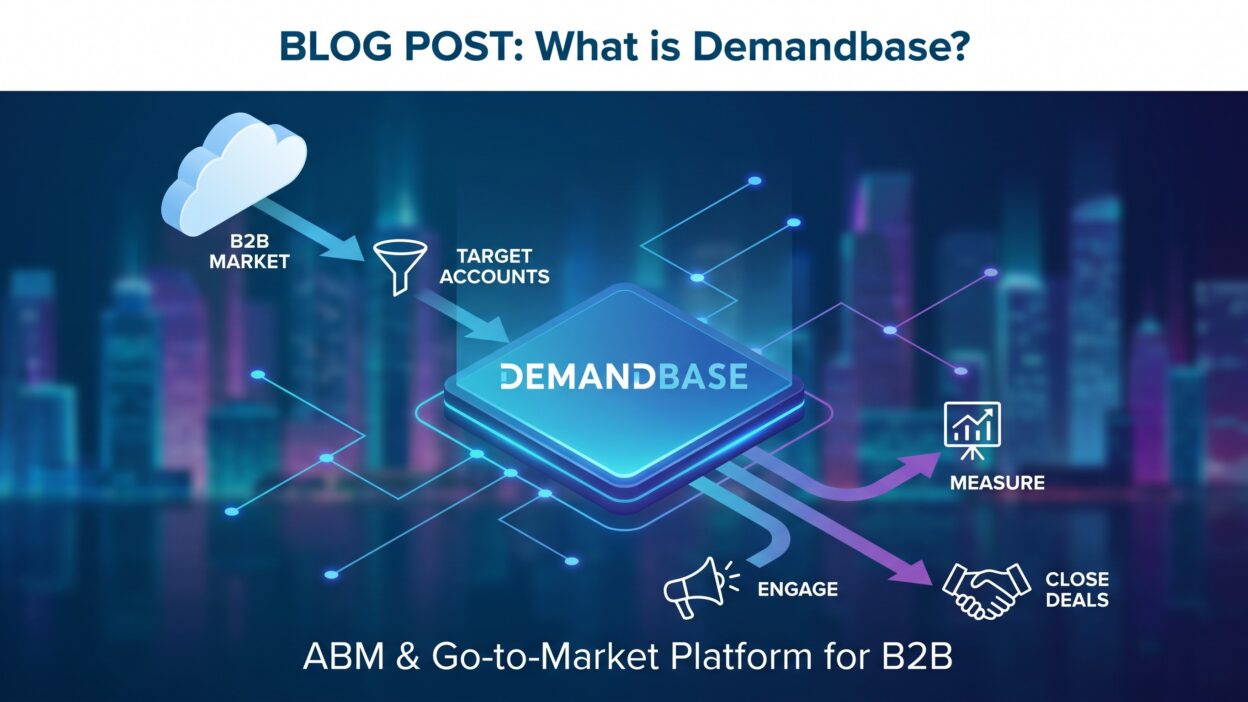
What is Demandbase at its core? Demandbase is an account-based marketing and go-to-market intelligence platform built specifically for B2B companies. It combines a massive B2B data cloud, AI-powered account intelligence, advertising capabilities, and sales intelligence tools in one unified platform. The platform helps marketing and sales teams identify high-value target accounts, understand their buying intent, reach them with personalized campaigns across multiple channels, and measure the revenue impact of every program they run.
Demandbase was founded in 2007 in San Francisco. The company pioneered the concept of account-based marketing as a mainstream B2B strategy. Over the years, Demandbase expanded from a website personalization tool into a full go-to-market platform that serves enterprise and mid-market B2B companies across technology, financial services, manufacturing, and professional services industries.
The simplest answer to what is Demandbase is this — it is the intelligence layer that sits between your data and your go-to-market execution. It tells you which accounts to prioritize, when to reach them, what messages resonate with each stakeholder, and how to measure whether your efforts drive real revenue.
The Core Problem Demandbase Solves
Understanding what is Demandbase requires understanding the problem it addresses. B2B buying has fundamentally changed. The average enterprise buying committee now includes six to ten decision-makers. Each person researches independently across dozens of digital channels. Most of that research happens long before any vendor contact occurs. Buyers are sixty to seventy percent through their decision process before they talk to sales.
Traditional marketing automation tools were built for a different era. They capture leads through forms and nurture them through email sequences. That model works for simple, low-cost purchases with single decision-makers. It fails for complex, high-value B2B sales that involve committees, long cycles, and heavy scrutiny.
Demandbase fills that gap. It identifies accounts showing active buying behavior even when no one at those accounts has filled out a form. It uses intent data, behavioral signals, and AI to surface the accounts most likely to buy right now. That intelligence changes how marketing allocates budget and how sales prioritizes outreach. Companies that understand what is Demandbase use it to stop guessing and start acting on evidence.
Key Features and Capabilities of Demandbase
The Demandbase B2B Data Cloud
The foundation of the platform is the Demandbase B2B Data Cloud. This is one of the largest and most comprehensive B2B data assets in the market. It contains detailed profiles on millions of companies worldwide. Each profile includes firmographic data — industry, company size, revenue, employee count, and geographic location. It also includes technographic data — the technology tools and platforms each company uses. That technographic layer is especially valuable for software and technology vendors targeting companies that use specific platforms or are likely to replace existing tools.
The Data Cloud continuously updates account profiles as companies change. Acquisitions, leadership changes, technology stack shifts, and headcount fluctuations all appear in the platform. Sales and marketing teams always work from current intelligence rather than stale CRM records. The data cloud is the answer to a core component of what is Demandbase — a trusted, rich source of B2B account intelligence.
Intent Data and Buying Signals
One of the most powerful features inside Demandbase is its intent data engine. The platform aggregates behavioral signals from across the web — content consumption, topic searches, peer review site activity, and third-party publisher engagement — and maps those signals to specific companies. When a company’s employees collectively consume large volumes of content related to a specific topic, Demandbase registers a surge in intent for that topic.
This capability is central to understanding what is Demandbase as an intelligence platform. Intent data tells you which target accounts are actively in a research and buying mode. A company that surges on cloud security topics represents a high-priority account for a cloud security vendor. Demandbase surfaces those signals before competitors identify the same opportunity. Marketing can increase campaign intensity toward that account. Sales can reach out with relevant, timely messaging. The result is engagement at precisely the right moment in the buying cycle.
AI-Powered Account Scoring and Prioritization
Demandbase uses artificial intelligence to score every account in your target market across two dimensions — fit and intent. Fit scoring evaluates how closely a company matches your Ideal Customer Profile based on firmographic and technographic attributes. Intent scoring evaluates how actively that company is researching topics related to your solution.
The combination of fit and intent creates a prioritization matrix. High-fit, high-intent accounts represent the most immediate sales opportunities. High-fit, low-intent accounts need awareness-building campaigns. Low-fit, high-intent accounts may represent emerging segments worth investigating. This AI-driven scoring is a defining element of what is Demandbase as a revenue intelligence tool. It replaces human guesswork with data-driven account prioritization that updates in real time.
Account-Based Advertising
Demandbase includes a built-in account-based advertising platform. It lets you run display ads targeted specifically to your named accounts across the web. Unlike broad programmatic advertising that targets individual cookies or demographics, Demandbase advertising targets IP addresses and device graphs associated with specific companies. Your ads reach employees at your target accounts wherever they browse online.
The advertising platform integrates directly with the intent data and account scoring layers. High-intent accounts receive more ad impressions. Accounts progressing through the buying cycle receive ads with stage-appropriate messages. Creative personalization at the account, industry, or persona level makes each ad more relevant and more likely to drive engagement. This advertising capability directly answers what is Demandbase for demand generation leaders who need precise paid media execution.
Website Personalization
Demandbase identifies the company behind every visit to your website in real time. When a target account employee visits your site, Demandbase recognizes the company and triggers personalized content experiences. The homepage headline changes to reference the visitor’s industry. Featured case studies shift to show examples from similar companies. Call-to-action language adapts to match the visitor’s likely buying stage.
Website personalization powered by Demandbase significantly improves engagement rates for target accounts. Visitors who see content relevant to their specific situation stay longer, consume more pages, and convert at higher rates. This real-time personalization capability is a critical feature in understanding what is Demandbase as a full-funnel engagement platform rather than just an advertising tool.
Sales Intelligence and Alerts
Demandbase delivers account intelligence directly to sales reps inside Salesforce and other CRM platforms. Reps see which of their accounts are showing intent spikes, which stakeholders are engaging with marketing campaigns, which competitors a target account is also evaluating, and which topics are driving that account’s current research activity.
Sales alerts notify reps the moment a target account shows a significant increase in buying signals. That alert prompts a timely, relevant outreach attempt rather than a generic cold call. Reps who reach out with insight-driven messaging — referencing what the account is researching — open far more conversations than those sending standard templates. This sales intelligence layer is an underappreciated answer to what is Demandbase for revenue teams that want marketing and sales to operate from shared account intelligence.
Multi-Channel Engagement Orchestration
Demandbase orchestrates engagement across every channel in the B2B marketing mix. Display advertising, LinkedIn advertising, email marketing, direct mail, website personalization, and sales outreach all coordinate through the platform. When a target account moves from low intent to high intent, the platform adjusts campaign intensity and messaging across every active channel simultaneously.
That orchestration ensures that every touchpoint — whether a sales email, a display ad, or a website visit — reinforces the same message at the same time. Coordinated multi-channel engagement dramatically outperforms siloed single-channel programs in both brand recall and conversion rates.
Revenue Attribution and Pipeline Measurement
Demandbase connects every marketing and sales activity to pipeline and revenue outcomes. The attribution engine tracks which campaigns influenced which deals, how engagement history correlates with win rates, and how account-level investment maps to closed revenue. Marketing teams use this data to prove ROI and justify budget decisions. Sales leaders use it to understand which marketing programs actually help them close deals faster.
Revenue attribution is essential to the value of what is Demandbase for CFOs and CMOs who demand proof that ABM investment drives business outcomes rather than just marketing activity metrics.
How Demandbase Fits Into the B2B Go-To-Market Stack
Demandbase and Your CRM
Demandbase integrates natively with Salesforce and Microsoft Dynamics. Account intelligence, intent scores, engagement data, and campaign membership all sync directly into CRM account and contact records. Sales reps see Demandbase data without leaving their existing workflow. Marketing teams see CRM pipeline data inside Demandbase dashboards. That bidirectional integration eliminates data silos between marketing intelligence and sales execution.
Demandbase and Marketing Automation
Demandbase integrates with Marketo, HubSpot, Pardot, and Eloqua. Account-level intent scores and engagement signals from Demandbase trigger marketing automation workflows. When a target account surges in intent, Demandbase automatically enrolls that account in a higher-intensity nurture program. That automated escalation keeps high-priority accounts moving through the pipeline without manual intervention from the marketing team.
Demandbase and Sales Engagement Platforms
Demandbase connects with Salesloft, Outreach, and similar sales engagement platforms. Account intelligence and intent data from Demandbase inform which accounts sales reps prioritize in their outreach cadences. Reps who use Demandbase intent data to time their outreach report significantly higher reply rates than those following static account lists.
Demandbase and LinkedIn
Demandbase integrates directly with LinkedIn Campaign Manager. Target account lists built in Demandbase push directly to LinkedIn for Matched Audiences campaigns. That integration ensures your LinkedIn advertising budget reaches exactly the right companies rather than relying on LinkedIn’s job title and demographic targeting alone. The combination of Demandbase account intelligence and LinkedIn’s professional audience reach creates one of the most precise B2B advertising combinations available.
Who Uses Demandbase?
Enterprise B2B Technology Companies
Large B2B software, cloud, and infrastructure companies represent Demandbase’s core customer base. These companies sell complex, high-value solutions to large buying committees at Fortune 1000 enterprises. Their sales cycles run six to eighteen months. The precision and intelligence that Demandbase provides directly shortens those cycles and improves win rates. Understanding what is Demandbase matters most to this audience because the platform was built specifically for their go-to-market challenges.
Mid-Market B2B Companies with Named Account Strategies
Mid-market B2B companies with clear target account lists benefit enormously from the Demandbase platform. They typically have defined ICP segments and a sales team organized around named accounts. Demandbase gives those teams the intelligence and activation tools to run sophisticated ABM programs that previously required enterprise-level marketing budgets and teams.
Marketing Operations and Revenue Operations Teams
MOps and RevOps professionals use Demandbase as the data and intelligence backbone of their go-to-market stack. They configure the account scoring models, manage the CRM integrations, build the attribution reporting, and govern the data layer that every other team depends on. For these professionals, understanding what is Demandbase is understanding the infrastructure that makes account-based go-to-market execution possible.
Demand Generation Leaders
Demand gen leaders use Demandbase to run account-targeted advertising campaigns, manage content syndication programs, and measure pipeline contribution from every marketing investment. The platform gives them precise audience targeting, campaign orchestration tools, and attribution reporting in one place. That combination replaces the fragmented collection of point solutions many demand gen teams previously relied on.
Demandbase Pricing and Packages
Demandbase does not publicly publish detailed pricing. The platform operates on a subscription model with pricing based on the modules selected, the size of the target account universe, the number of users, and the level of managed services support required. Most mid-market implementations start in the range of sixty to one hundred thousand dollars annually. Enterprise deployments with full module access and managed services can run significantly higher.
Demandbase offers modular packaging. Companies can start with the Data Cloud and intent data modules and add advertising, website personalization, and sales intelligence layers as their program matures. That modular approach lets organizations invest incrementally rather than committing to the full platform before they understand the value of each component.
For accurate pricing, Demandbase requires a discovery conversation with their sales team. That conversation scopes the target account universe, identifies the relevant modules, and builds a custom proposal. Most organizations benefit from requesting a proof-of-concept engagement before committing to a full annual contract.
Demandbase vs. Competitors
Demandbase vs. 6sense
Both Demandbase and 6sense answer the question of what is Demandbase and what does an AI-powered ABM platform look like. 6sense leads with predictive AI and buying stage modeling. Demandbase leads with data breadth, advertising capabilities, and website personalization depth. Enterprise companies that prioritize rich account data and multi-channel advertising often prefer Demandbase. Companies that prioritize AI-driven pipeline prediction often prefer 6sense. Many organizations evaluate both before choosing.
Demandbase vs. Terminus
Terminus focuses primarily on account-based advertising and website engagement. Demandbase offers a broader platform that includes the B2B Data Cloud, intent data, sales intelligence, and deeper CRM integration. For companies that need a comprehensive go-to-market intelligence platform rather than primarily an advertising tool, Demandbase typically wins the evaluation. Terminus suits smaller teams that need focused advertising capabilities without the broader data infrastructure.
Demandbase vs. Rollworks
Rollworks targets mid-market companies with a more accessible price point. Demandbase targets enterprise and upper mid-market companies with deeper data and more sophisticated orchestration capabilities. Understanding what is Demandbase relative to Rollworks comes down to scale and complexity — Demandbase supports larger target account universes, more complex scoring models, and deeper integration ecosystems than Rollworks currently offers.
Related Topics Covered
This blog addresses multiple secondary topics that readers search for alongside the primary keyword. Those topics include: Demandbase ABM platform, Demandbase features, Demandbase pricing, Demandbase vs 6sense, account-based marketing software, B2B intent data platform, Demandbase integrations, Demandbase alternatives, B2B advertising platform, account-based experience platform, Demandbase review, and B2B go-to-market intelligence.
Each secondary keyword appears organically within relevant sections of this content, supporting comprehensive SEO coverage across the full Demandbase topic cluster.
Frequently Asked Questions About What is Demandbase
What is Demandbase used for?
What is Demandbase used for in practice? It is used to identify high-value B2B target accounts, understand their buying intent, run personalized multi-channel marketing campaigns, deliver real-time website personalization, provide sales teams with account intelligence inside their CRM, and measure how marketing and sales activities contribute to pipeline and revenue.
Is Demandbase only for large enterprise companies?
Demandbase serves both enterprise and mid-market B2B companies. The platform scales well for companies with defined target account lists ranging from a few hundred to tens of thousands of named accounts. While the platform’s full capability set is most valuable for larger organizations with complex ABM programs, mid-market companies with clear ICP definitions and named account strategies also see strong ROI.
How does Demandbase get its intent data?
Demandbase aggregates intent signals from multiple sources. These sources include third-party publisher networks, B2B content consumption platforms, peer review sites like G2 and TrustRadius, and Demandbase’s own first-party data from the websites of its customers. That multi-source approach gives more comprehensive intent coverage than platforms relying on a single data provider.
Does Demandbase replace marketing automation?
No. Demandbase complements marketing automation platforms rather than replacing them. It integrates with Marketo, HubSpot, and Pardot to add account-level intelligence and orchestration capabilities on top of existing email and nurture workflows. Understanding what is Demandbase includes understanding that it works alongside your existing marketing technology stack rather than replacing core components.
What results can companies expect from Demandbase?
Results vary by industry, target account universe size, and program maturity. Common outcomes include higher marketing-to-sales pipeline conversion rates, shorter average sales cycles for ABM-targeted accounts, larger average deal sizes from named accounts, improved win rates against competitors, and stronger marketing ROI measured against pipeline contribution. Most companies begin seeing measurable engagement improvements within the first ninety days and pipeline impact within six months.
How long does Demandbase implementation take?
A standard Demandbase implementation takes four to eight weeks. That timeline includes CRM integration setup, target account list configuration, account scoring model calibration, advertising campaign launch, and sales intelligence dashboard deployment. Demandbase provides dedicated implementation support and customer success resources to guide the onboarding process. More complex enterprise implementations with multiple CRM instances and advanced integrations may take longer.
What is the Demandbase Account-Based Experience (ABX) platform?
Demandbase evolved its positioning from account-based marketing to account-based experience — ABX. The distinction reflects the recognition that every interaction a target account has with your brand — marketing campaigns, website visits, sales outreach, customer success touchpoints — shapes the overall account experience. The Demandbase ABX platform coordinates intelligence and activation across all of those touchpoints rather than treating them as separate programs. Understanding what is Demandbase today means understanding it as an ABX platform, not just an ABM tool.
Can Demandbase identify anonymous website visitors?
Yes. Demandbase identifies the company behind anonymous website visits in real time using IP resolution and device graph technology. When an employee from a target account visits your website without filling out a form, Demandbase recognizes the company and logs the visit as an account engagement signal. That anonymous identification capability turns your website into an active intelligence source rather than a passive content repository.
Read More:-Top 10 Account-Based Marketing Services
Conclusion

B2B marketing without account intelligence is fundamentally inefficient. Budget spreads thin. Outreach misses its mark. Sales teams chase leads that do not convert. The companies winning in competitive B2B markets today share one characteristic — they know exactly which accounts to pursue, when to reach them, and what to say when they do. What is Demandbase if not the platform that makes that precision possible?
Demandbase combines B2B data depth, intent intelligence, AI-powered scoring, multi-channel advertising, website personalization, and sales intelligence in one integrated platform. It serves as the intelligence backbone that aligns marketing and sales around the same account priorities and the same revenue goals. Marketing stops generating noise. Sales stops chasing cold leads. Both teams focus on the accounts most likely to become significant, long-term customers.
Understanding what is Demandbase is understanding a fundamental shift in how B2B go-to-market execution works. The old model — cast wide, capture leads, nurture with email — worked when buyers had fewer options and less information. Today’s buyers are independent, informed, and surrounded by competing messages. They expect vendors to understand their specific situation before making contact. Demandbase gives marketing and sales teams the intelligence to meet that expectation consistently.
If your B2B company sells complex, high-value solutions to enterprise or mid-market accounts, Demandbase deserves serious evaluation. Start with a proof-of-concept engagement. Map the platform’s capabilities to your specific go-to-market challenges. Measure account engagement, pipeline contribution, and win rate changes over the first two quarters. The data will tell you whether the platform fits your growth strategy.
The answer to what is Demandbase is ultimately simple. It is the platform that helps B2B companies stop guessing and start growing with purpose.