Introduction
TL:DR Marketing teams face more pressure than ever before. Audiences expect personalized experiences. Campaigns must run across dozens of channels simultaneously. Data volumes grow faster than any human team can process. The old model — manual campaign setup, batch email blasts, and static audience segments — simply cannot keep pace. That is exactly where AI Marketing Automation: What It Is and How It Works becomes critical knowledge for every modern marketer. Artificial intelligence has fundamentally changed what marketing automation can do. It no longer just executes predefined rules. It learns, predicts, adapts, and personalizes at a scale no human team could ever match. This guide breaks down the full picture — what AI marketing automation is, how it works, which capabilities matter most, and how businesses use it to drive real revenue growth in 2026.
Table of Contents
What Is AI Marketing Automation?
Understanding AI Marketing Automation: What It Is and How It Works starts with a clear definition. AI marketing automation is the use of artificial intelligence technologies — machine learning, natural language processing, predictive analytics, and generative AI — to plan, execute, optimize, and measure marketing programs without constant human intervention.
Traditional marketing automation follows rules that humans define in advance. If a prospect downloads a whitepaper, send them a follow-up email. If they open three emails, add them to a sales sequence. Those rules work for simple, linear scenarios. They fail when buyer behavior becomes complex, unpredictable, or highly individualized.
AI marketing automation operates differently. It does not wait for humans to define every rule. It analyzes behavioral patterns across millions of data points and determines the best action, message, timing, and channel for each individual contact at each moment. The system continuously learns from outcomes and improves its own recommendations over time.
That self-improving intelligence is the core distinction at the heart of AI Marketing Automation: What It Is and How It Works. It replaces static rule logic with dynamic, data-driven decision-making that gets smarter with every campaign, every click, and every conversion.
Why AI Marketing Automation Matters in 2026
The scale of modern marketing has outpaced human capacity. A mid-size B2B company might manage campaigns across email, LinkedIn, Google Ads, programmatic display, webinars, direct mail, and its own website simultaneously. Each channel generates data. Each contact in the database has a unique behavioral history. Each campaign interacts with others in ways that affect overall performance.
No human team can optimize all of those interactions manually at acceptable speed or accuracy. AI marketing automation addresses that capacity problem directly. It processes data continuously, makes decisions in milliseconds, and adjusts campaigns in real time based on what the data shows — without waiting for a weekly marketing meeting or a quarterly strategy review.
Understanding AI Marketing Automation: What It Is and How It Works also means understanding its financial impact. Companies that deploy AI-powered automation consistently report higher marketing ROI, lower cost per acquisition, shorter sales cycles, and stronger customer lifetime value compared to those using traditional rule-based automation. The performance gap between AI-powered and manual marketing programs widens every year.
Core Technologies Behind AI Marketing Automation
Machine Learning and Predictive Analytics
Machine learning is the engine that powers most AI marketing automation capabilities. ML models train on historical data — past campaign performance, customer purchase patterns, behavioral engagement sequences, and conversion outcomes. Once trained, those models predict future outcomes with significantly higher accuracy than any human analyst could achieve manually.
Predictive lead scoring is one of the clearest applications of ML in marketing automation. The AI analyzes hundreds of data points for each prospect — firmographic attributes, behavioral signals, engagement history, and purchase intent indicators — and assigns a probability score for conversion. Marketing teams prioritize budget and attention toward high-scoring prospects. Sales teams focus outreach on accounts the model identifies as most likely to close. This predictive capability is fundamental to understanding AI Marketing Automation: What It Is and How It Works at a technical level.
Natural Language Processing
Natural language processing gives AI the ability to understand, generate, and optimize written content at scale. NLP powers email subject line optimization, chatbot conversations, sentiment analysis of customer feedback, and content recommendation engines.
Modern NLP models analyze thousands of subject lines to determine which linguistic patterns drive the highest open rates for specific audience segments. They generate multiple variations of ad copy and predict performance before a single dollar of budget goes live. They read customer support tickets and social media mentions to extract sentiment trends that inform campaign messaging. That language intelligence is a defining feature of advanced AI Marketing Automation: What It Is and How It Works platforms in 2026.
Generative AI for Content and Creative Production
Generative AI has transformed content production inside marketing automation platforms. Tools like Jasper, Copy.ai, and the AI assistants embedded in HubSpot, Salesforce Einstein, and Marketo now generate first-draft email copy, ad variations, landing page headlines, and social media posts at scale.
This generative capability does not replace human marketers. It accelerates their output significantly. A campaign that once required a copywriter to spend two days producing ten email variations now takes two hours. The human reviews, refines, and approves. The AI handles the initial production volume. That speed advantage compounds across every campaign the team runs over the course of a year.
Behavioral AI and Real-Time Personalization
Behavioral AI tracks every interaction a contact has with your brand — every email opened, every page visited, every ad clicked, every video watched — and uses that data to determine the next best action in real time. That real-time intelligence powers dynamic email content, personalized website experiences, adaptive ad sequences, and intelligent product recommendations.
This behavioral layer is central to the full picture of AI Marketing Automation: What It Is and How It Works. The system does not treat every contact the same. It builds an individual profile for each person in the database and continuously updates that profile with new behavioral data. Every touchpoint becomes more relevant because it responds to what that specific person has already shown interest in.
How AI Marketing Automation Works Step by Step
Data Collection and Unification
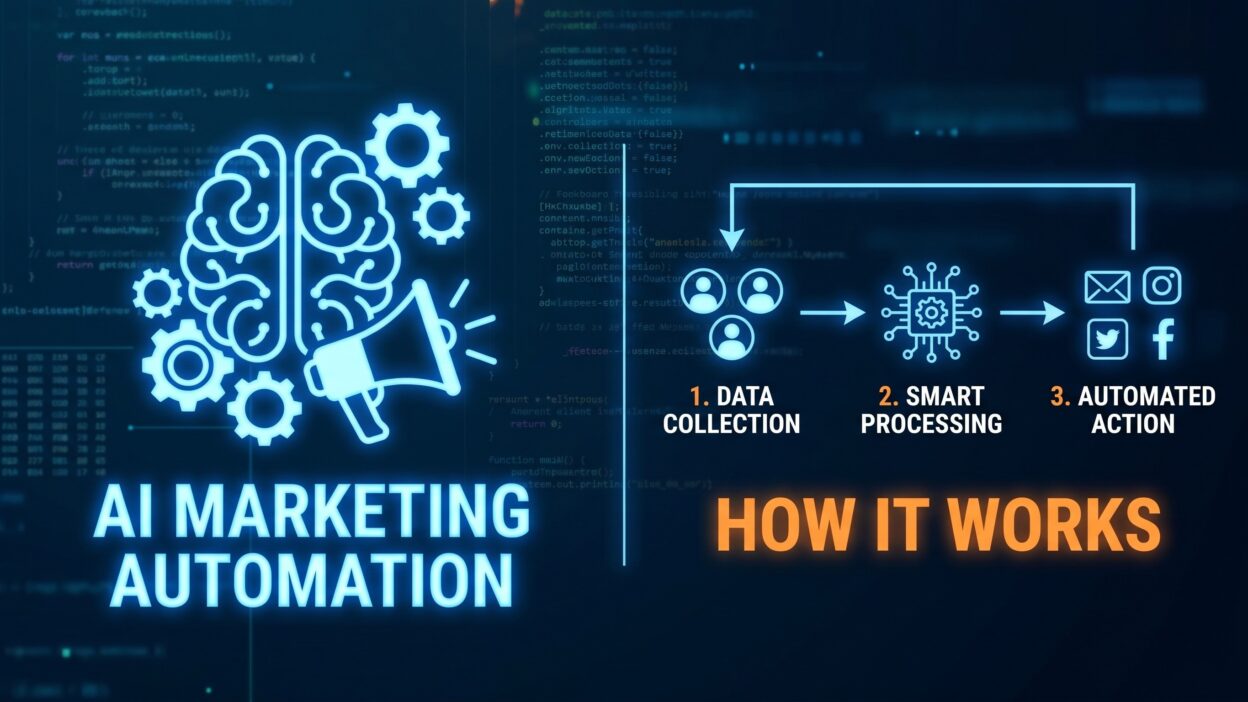
AI marketing automation starts with data. The platform collects first-party behavioral data from your website, email campaigns, CRM, social media channels, and product usage logs. It connects that data to third-party enrichment sources — firmographic data, intent signals, and demographic attributes. A customer data platform or data warehouse typically serves as the central repository that unifies all of those data streams.
Without clean, unified data, AI models produce poor predictions and irrelevant recommendations. Data quality is the foundational requirement for any AI Marketing Automation: What It Is and How It Works implementation to deliver meaningful results.
Audience Segmentation and ICP Scoring
Once data unifies, the AI segments the audience dynamically. It does not rely on static lists defined by a marketer in a spreadsheet. It continuously groups contacts based on behavioral patterns, engagement signals, firmographic fit, and predicted intent. Segments update in real time as contact behavior changes.
AI-powered ICP scoring assigns every account in the database a fit score — how closely it matches the profile of your most successful existing customers — and an intent score — how actively it is researching your category right now. Those two scores combined determine which accounts receive the most campaign investment and sales attention. That prioritization logic is a key mechanism in understanding AI Marketing Automation: What It Is and How It Works from an operational perspective.
Content Personalization and Dynamic Delivery
With segments defined and contacts scored, the AI personalizes every piece of content it delivers. An email sent to five thousand contacts does not show the same subject line, body copy, or call to action to every recipient. The AI selects the subject line most likely to drive an open for each individual based on their past behavior. It chooses the offer most aligned with their stage in the buying cycle. It determines the send time most likely to produce engagement for their specific activity patterns.
Website personalization works similarly. The homepage a CFO sees differs from the homepage a technical buyer sees. The product page a returning visitor from a financial services firm sees differs from what a first-time visitor from a manufacturing company sees. Real-time personalization at that level was impossible before AI. It is now standard inside leading AI Marketing Automation: What It Is and How It Works platforms.
Multi-Channel Campaign Orchestration
AI marketing automation coordinates campaigns across email, paid social, programmatic display, SMS, push notifications, in-app messaging, and direct mail from a single platform. It determines which channel each contact is most responsive to at each stage of their journey. It adjusts channel mix in real time based on engagement performance.
A contact who consistently opens email but never clicks LinkedIn ads receives more email-centric touchpoints. A contact who engages primarily with display retargeting gets heavier investment there. That channel-level personalization maximizes engagement rates without increasing total campaign budget.
Continuous Optimization Through AI Testing
Traditional A/B testing requires a marketer to define a hypothesis, run the test for a predetermined period, analyze results, and implement the winner. That cycle takes days or weeks. AI-powered multivariate testing runs hundreds of variations simultaneously, allocates more traffic to better performers in real time, and produces statistical conclusions far faster than manual testing cycles allow.
Every campaign the AI runs becomes a training data point that improves future performance. Subject lines that outperform get weighted more heavily in future send decisions. CTAs that drive conversions appear more frequently in dynamic content blocks. The system never stops learning and never stops improving. That continuous optimization loop is one of the most powerful aspects of AI Marketing Automation: What It Is and How It Works in practice.
Attribution and Revenue Reporting
AI marketing automation platforms connect every campaign activity to revenue outcomes through multi-touch attribution models. The AI analyzes the full sequence of touchpoints that contributed to each closed deal and assigns credit proportionally across channels and campaign types. Marketing leaders see which programs drive pipeline, which content accelerates deals, and which channels deliver the strongest ROI.
That attribution intelligence feeds back into budget allocation decisions. Channels and programs that consistently contribute to closed revenue receive more investment. Those that show weak pipeline correlation receive less. The AI handles this optimization cycle continuously rather than quarterly.
Key Capabilities of AI Marketing Automation Platforms
Predictive Lead Scoring
Every serious AI marketing automation platform includes predictive lead scoring. The AI assigns each lead and account a conversion probability score based on hundreds of behavioral and firmographic variables. Those scores update in real time as new engagement data arrives. Marketing teams set score thresholds that trigger different campaign tracks or sales alert workflows automatically.
Email Send Time Optimization
AI analyzes each individual contact’s historical email engagement patterns and determines the precise day and time they are most likely to open and click a new message. That individual-level optimization outperforms any fixed send time a marketer could choose manually. Platforms like Salesforce Marketing Cloud, HubSpot, and Marketo all include this capability as a standard feature.
Conversational Marketing and AI Chatbots
AI-powered chatbots engage website visitors, qualify leads, book meetings, answer product questions, and route conversations to the right sales rep — all in real time without human involvement. Modern chatbot platforms use NLP models that understand conversational context, follow-up questions, and intent signals with high accuracy. Drift, Intercom, and Qualified all deploy this capability as part of their broader AI Marketing Automation: What It Is and How It Works value propositions.
Dynamic Content and Personalization Engines
AI content personalization engines deliver unique content experiences to every visitor and every email recipient based on their individual profile. Product recommendation engines in e-commerce, content recommendation modules in B2B content hubs, and dynamic email blocks that change by segment all rely on AI to select the most relevant asset for each person in real time.
Churn Prediction and Retention Marketing
AI models analyze customer usage patterns, support ticket history, and engagement data to predict which customers are at risk of churning before they show obvious signals of disengagement. Customer success and retention marketing teams use those predictions to intervene early — triggering personalized re-engagement campaigns, proactive check-in calls, or customized training programs — before the customer reaches a cancellation decision.
Leading AI Marketing Automation Platforms in 2026
HubSpot with AI Features
HubSpot has embedded AI capabilities across its entire platform. Breeze Intelligence enriches CRM records in real time. AI-powered content generation assists copywriters inside the email, landing page, and blog editors. Predictive lead scoring assigns conversion probabilities to every contact. Smart send time optimization improves email engagement rates automatically. For mid-market B2B companies, HubSpot represents the most accessible entry point into AI Marketing Automation: What It Is and How It Works without requiring a dedicated marketing operations team.
Salesforce Marketing Cloud with Einstein
Salesforce Einstein powers AI capabilities across Marketing Cloud, Sales Cloud, and Service Cloud. Einstein Engagement Scoring predicts how likely each contact is to engage with upcoming campaigns. Einstein Send Time Optimization determines the best delivery moment for each individual. Einstein Copy Insights analyzes email subject line performance patterns and recommends improvements. For enterprise organizations already on the Salesforce platform, Einstein represents the natural AI marketing automation layer.
Marketo Engage with AI
Adobe’s Marketo Engage includes predictive audiences, AI-assisted content recommendations, and account-level intent scoring through its integration with the Adobe Experience Cloud. Enterprise marketing operations teams use Marketo’s AI capabilities to manage complex, multi-touch nurture programs across large contact databases with minimal manual intervention.
ActiveCampaign
ActiveCampaign brings AI marketing automation capabilities to the small and mid-market segment at an accessible price point. Its predictive sending, win probability scoring, and AI-assisted content generation features give smaller teams access to intelligence capabilities that were exclusive to enterprise platforms just three years ago. ActiveCampaign earns strong marks for making the practical reality of AI Marketing Automation: What It Is and How It Works accessible to businesses with modest marketing budgets.
Common Challenges in AI Marketing Automation Implementation
Data Quality and Integration Gaps
AI models are only as good as the data they train on. Organizations with fragmented CRM records, inconsistent data entry standards, and siloed marketing databases struggle to get accurate predictions from AI automation platforms. Investing in data hygiene and CRM integration quality before deploying AI capabilities dramatically improves outcomes.
Over-Automation and Loss of Human Voice
AI marketing automation can produce campaigns that feel robotic and generic if teams rely on AI output without human review and refinement. The best programs pair AI efficiency with human judgment. AI handles scale and personalization logic. Humans provide creative direction, brand voice, and strategic oversight. That partnership produces better results than either approach alone.
Attribution Model Selection
Multi-touch attribution in AI platforms requires decisions about which model best reflects how your business actually generates revenue. Data-driven attribution, time-decay models, and custom algorithmic models each produce different credit distributions across channels. Marketing leaders must understand which model fits their sales cycle structure before trusting AI attribution outputs for budget decisions.
Related Topics Covered
This blog addresses multiple secondary topics readers search for alongside the primary keyword. Those topics include: AI marketing tools, marketing automation software, predictive lead scoring, personalized email marketing AI, AI-powered demand generation, machine learning in marketing, marketing AI platforms, generative AI for marketing, B2B marketing automation, chatbot marketing automation, AI content personalization, and automated customer journey mapping.
Each secondary keyword appears organically within relevant sections of this content, supporting comprehensive SEO coverage across the full AI marketing automation topic cluster.
Frequently Asked Questions About AI Marketing Automation
What is AI marketing automation and how does it work?
AI Marketing Automation: What It Is and How It Works can be summarized clearly. AI marketing automation uses machine learning, natural language processing, and predictive analytics to execute, optimize, and personalize marketing programs at scale without constant human intervention. It collects behavioral and firmographic data, segments audiences dynamically, personalizes content for each individual, orchestrates multi-channel campaigns, and continuously optimizes performance based on real-time outcome data.
How is AI marketing automation different from traditional marketing automation?
Traditional marketing automation follows predefined rules set by human marketers. If this happens, do that. AI marketing automation replaces static rule logic with dynamic, learning-based decision-making. The AI determines the best action, message, channel, and timing for each contact individually based on predictive models trained on historical data. It improves continuously without requiring humans to rewrite rules manually.
What data does AI marketing automation need to work effectively?
AI marketing automation requires clean, unified behavioral data — email engagement history, website visit records, form submissions, CRM contact attributes, purchase history, and intent signals. The richer and more consistent the data, the more accurate the AI predictions become. Most platforms integrate with CRM systems, marketing automation databases, CDP platforms, and third-party intent data providers to build the data foundation the AI needs.
How long does it take to see results from AI marketing automation?
Most organizations begin seeing measurable engagement improvements within sixty to ninety days of deploying AI marketing automation capabilities. Pipeline impact typically appears at the four-to-six-month mark as the AI models accumulate sufficient data to make accurate predictions. Revenue attribution improvements become clear at the six-to-twelve-month mark. Patience during the initial data accumulation phase is essential to long-term program success.
Is AI marketing automation suitable for small businesses?
Yes. Platforms like ActiveCampaign, HubSpot, and Klaviyo bring accessible AI marketing automation capabilities to small businesses at price points that do not require enterprise budgets. The core value of understanding AI Marketing Automation: What It Is and How It Works applies at every business scale — better personalization, smarter send timing, and predictive scoring all improve marketing performance regardless of company size.
What are the risks of AI marketing automation?
The primary risks include over-reliance on AI output without human creative oversight, poor data quality that produces inaccurate predictions, and privacy compliance failures if the platform’s data sourcing does not meet GDPR or CCPA requirements. Organizations mitigate those risks by maintaining strong data governance standards, applying human editorial review to AI-generated content, and verifying platform compliance certifications before deployment.
Which AI marketing automation platform is best for B2B companies?
HubSpot suits most mid-market B2B companies for its combination of usability and AI capability breadth. Marketo Engage suits large enterprise marketing operations teams with complex multi-touch nurture requirements. Salesforce Marketing Cloud with Einstein suits organizations already running on the Salesforce platform. 6sense and Demandbase suit enterprise ABM programs that need AI-powered account intelligence combined with marketing automation capabilities.
Can AI marketing automation replace human marketers?
No. AI marketing automation amplifies human marketing capability — it does not replace it. The AI handles data processing, pattern recognition, content variation testing, send time optimization, and real-time personalization at a scale no human team can match. Human marketers provide creative strategy, brand direction, ethical judgment, and customer empathy that AI cannot replicate. The most successful marketing teams in 2026 treat AI as a high-performance tool that makes every human on the team more productive and more impactful.
Read More:-What Is B2B Buyer Journey Mapping?
Conclusion

Marketing has entered a new era. The tools available today are fundamentally more powerful than anything that existed five years ago. AI does not just automate repetitive tasks. It learns from data continuously, personalizes every interaction individually, optimizes campaign performance in real time, and connects marketing activity to revenue outcomes with precision that traditional analytics could never deliver.
Understanding AI Marketing Automation: What It Is and How It Works is no longer optional knowledge for serious marketers. It is the foundational literacy required to compete effectively in every B2B and B2C market in 2026. Teams that deploy AI marketing automation thoughtfully — with clean data, strong human oversight, and a clear connection between automation decisions and business goals — consistently outperform teams relying on manual processes and static rule-based workflows.
The technology is mature. The platforms are accessible. The results are well-documented. The only remaining question is not whether AI marketing automation works. The question is how quickly your organization will deploy it, how well you will integrate it with your existing data and teams, and how consistently you will act on the intelligence it surfaces.
Start with data quality. Choose a platform that fits your team’s current capability level. Deploy one AI capability at a time and measure its impact before layering in the next. Build the organizational habit of trusting AI recommendations while maintaining human editorial judgment. That combination — AI intelligence guided by human strategy — is what the full understanding of AI Marketing Automation: What It Is and How It Works ultimately points toward.
The future of marketing belongs to teams that embrace AI with clear strategy and disciplined execution. Start building that capability today.