Introduction
TL;DR Most B2B marketing teams start small with ABM. They pick 20 or 30 high-value accounts. They craft personalized messages. They see real results. Then the pressure hits. Leadership asks: “Can we do this with 2,000 accounts?”
That question is the beginning of a real challenge.
ABM at scale sounds straightforward. But the moment you try to expand, cracks appear fast. Personalization suffers. Sales teams lose confidence. Messages become generic. The entire program loses its edge.
This blog breaks down how to grow your ABM program the right way. You will learn how to keep relevance alive across hundreds or thousands of accounts. You will learn which tools, frameworks, and strategies make scaling possible without sacrificing quality.
Whether you are a marketing director, a demand gen lead, or a revenue operations manager, this guide gives you a clear and practical path forward.
Table of Contents
What Is ABM at Scale and Why Does It Matter?
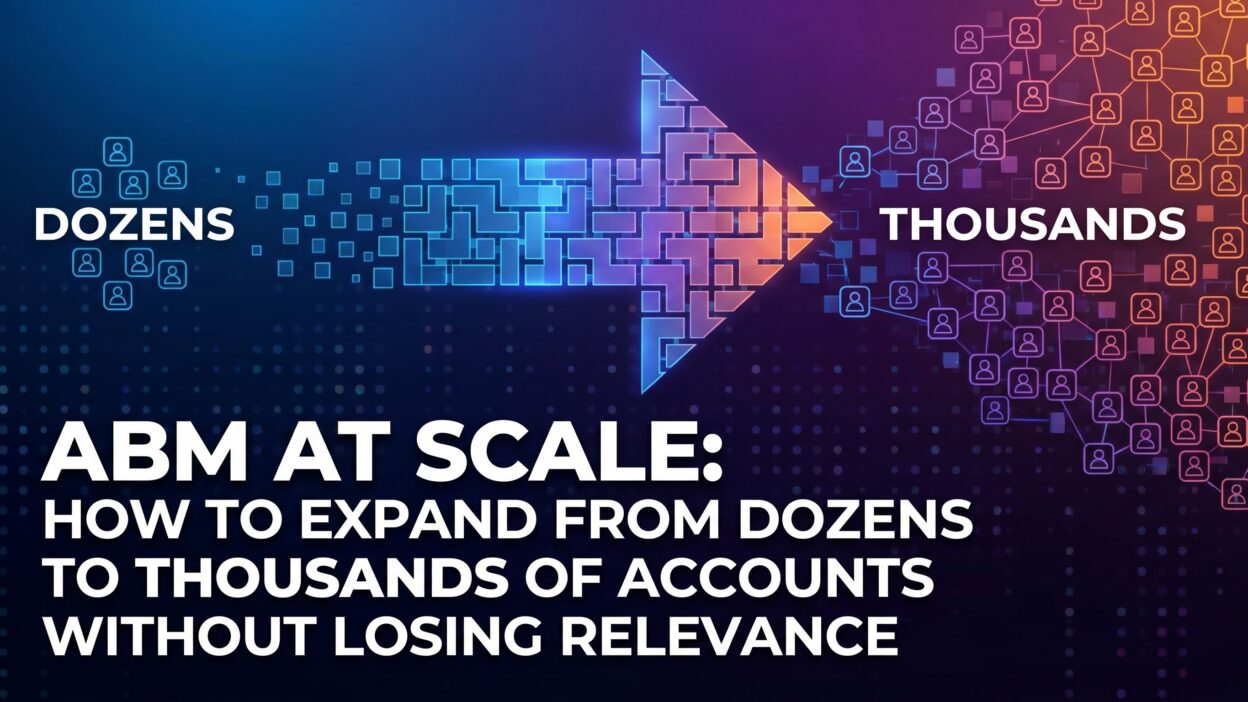
ABM at scale means running account-based marketing programs across a large volume of target accounts. It is not about doing the same thing for 1,000 accounts that you did for 30. It is about building systems that deliver the right message to the right account at the right time — automatically and intelligently.
Traditional ABM works beautifully in small batches. A dedicated team can research each account deeply. They can build custom landing pages, personalized emails, and tailored ad campaigns. This produces strong results. But it does not scale without a structural change.
ABM at scale requires a shift in mindset. You stop thinking about individual accounts as the unit of work. You start thinking in tiers, segments, and clusters. You use data to do the heavy lifting that humans once did manually.
This approach matters because B2B buying cycles are complex. Multiple stakeholders are involved. Buying committees grow larger every year. Sellers need marketing support across more accounts simultaneously. A scalable ABM program gives sales the air cover they need without burning out the marketing team.
Companies that run ABM at scale effectively see higher pipeline velocity, better win rates, and stronger account expansion revenue. The math becomes compelling very quickly.
The Three Tiers of ABM: Building Your Foundation
Before you scale, you need a clear framework. Most mature ABM programs run on a three-tier model. Each tier represents a different level of personalization and investment.
Tier 1 — One-to-One ABM (1:1)
This tier covers your highest-value, most strategic accounts. Think of your top 10 to 50 accounts. Every touchpoint is deeply personalized. Custom research goes into each account. Sales and marketing work hand-in-hand. This is high cost, high effort, and high return.
Tier 2 — One-to-Few ABM (1:Few)
This tier targets clusters of accounts that share similar characteristics. Industry, company size, tech stack, and pain points group these accounts together. Personalization happens at the segment level, not the individual account level. You can run this tier across 50 to 500 accounts with the right tools.
Tier 3 — One-to-Many ABM (1:Many)
This is where ABM at scale lives. This tier covers hundreds or thousands of accounts. Personalization relies heavily on automation and intent data. Messages are tailored by industry, persona, or buying stage rather than by individual account. The goal is relevant, not bespoke.
A strong foundation across these three tiers sets you up for sustainable growth. You do not need to collapse everything into Tier 3. You need to know when to move accounts between tiers based on their fit, engagement, and potential.
How to Build Your Ideal Customer Profile for Scale
Scaling ABM without a sharp ICP is like driving without a destination. Your Ideal Customer Profile defines which accounts deserve your attention.
At small scale, many teams rely on gut feeling and sales input to define their ICP. That works when you handle 30 accounts. It breaks down fast when you need to identify 3,000.
A scalable ICP uses firmographic data, technographic data, and behavioral signals together. Firmographic data includes company size, industry, revenue range, and geography. Technographic data tells you what tools and platforms a company uses. Behavioral signals show you who is actively researching problems your product solves.
When you combine these three layers, you get a dynamic ICP. Accounts score automatically based on how well they match your profile. High-scoring accounts rise to the top. Lower-scoring accounts stay in Tier 3 until they show stronger signals.
This data-driven ICP is the backbone of ABM at scale. It removes human bias from account selection. It ensures your program targets accounts with the highest probability of converting.
Update your ICP quarterly. Market conditions shift. Your product evolves. Your best customers change over time. An outdated ICP quietly ruins pipeline quality.
Intent Data: The Secret Engine Behind ABM at Scale
Intent data transforms ABM at scale from guesswork into precision. It tells you which accounts are actively researching solutions like yours right now.
There are two types of intent data worth understanding.
First-Party Intent Data
This comes from your own channels. Website visits, content downloads, webinar registrations, pricing page views, and demo requests all signal interest. You control this data completely. It is highly accurate because it comes from direct engagement with your brand.
Third-Party Intent Data
This comes from external sources. Platforms like Bombora, G2, and TechTarget track content consumption across thousands of publisher sites. They tell you when a target account is reading articles, comparing vendors, or downloading whitepapers in your category — even before they visit your site.
At scale, third-party intent data becomes essential. It lets you prioritize accounts inside your large Tier 3 pool. You do not treat all 2,000 accounts the same. You identify the 200 that are surging in intent right now. You concentrate your resources on those.
Intent data also feeds your personalization engine. When you know an account is researching a specific problem, you can serve content that speaks directly to that problem. This makes your outreach feel relevant even in high-volume campaigns.
Integrate intent data into your CRM and marketing automation platform. Build workflows that automatically promote high-intent accounts to a more active tier. Let the data drive prioritization so your team focuses energy where it counts most.
Technology Stack for ABM at Scale
Running ABM at scale without the right technology is extremely difficult. The right stack brings automation, intelligence, and coordination to your program.
Core ABM Platforms
Platforms like Demandbase, 6sense, and Terminus serve as the command center for large-scale ABM. They bring together account identification, intent data, advertising, and engagement scoring in one place. These platforms help you run coordinated campaigns across digital ads, email, and website personalization simultaneously.
CRM and Marketing Automation
Salesforce, HubSpot, and Marketo are table stakes. They need to be tightly integrated with your ABM platform. Account-level data should flow between systems in real time. Sales reps should see exactly which accounts are engaging, which content they consumed, and what stage they are at.
Personalization Tools
At scale, manual personalization is impossible. Tools like Mutiny and Intellimize let you personalize your website dynamically based on the visitor’s company, industry, or job function. A manufacturing company sees different messaging than a SaaS startup — even if they land on the same page.
Analytics and Reporting
You cannot improve what you cannot measure. Platforms like Bizible (now Marketo Measure) and Dreamdata give you account-level attribution. They show which touchpoints influenced pipeline and revenue across your entire account list. This data helps you optimize your ABM at scale program continuously.
Do not build your stack all at once. Start with your CRM, add an ABM platform, then layer in personalization and analytics. A phased approach prevents technology overload.
Segmentation Strategies That Preserve Relevance at Scale
Segmentation is the bridge between mass marketing and true personalization. Smart segmentation keeps ABM at scale relevant without requiring custom work for every account.
Think beyond basic industry segmentation. One-dimensional segmentation produces mediocre results. The best ABM programs use multi-dimensional clustering.
Cluster accounts by the problems they face, not just the industry they are in. A 500-person professional services firm and a 500-person tech company might face identical challenges around workforce management. They belong in the same cluster even if they are in different verticals.
Use technographic data to create clusters around tech stack gaps. If your product integrates with Salesforce, a cluster of Salesforce users becomes a high-priority segment. You already know they have a compatible environment. Your messaging can reference their existing investment.
Build clusters around buying stage. Early-stage accounts need awareness content. Mid-stage accounts need comparison and proof. Late-stage accounts need case studies, ROI calculators, and demo invitations. Serve each cluster what matches their current mindset.
Dynamic segmentation is even more powerful. As accounts show new signals — visiting your pricing page, downloading a competitive comparison guide — they move into a different cluster automatically. Your messaging adapts without manual intervention.
This is how you maintain relevance in ABM at scale. You are not sending the same message to everyone. You are sending the right message to the right cluster at the right moment.
Building Personalization at Scale Without Burning Out Your Team
Personalization at scale sounds contradictory. But it is entirely achievable with the right approach.
The key is to separate personalization into layers. Not every element of a campaign needs individual customization. Some layers stay constant. Others change dynamically based on account data.
The first layer is your core message. This stays consistent across your entire program. It reflects your brand positioning and core value proposition. Every account sees this foundation.
The second layer is industry or persona-level customization. You create variations of your messaging for each major segment. A healthcare buyer sees different language than a financial services buyer. This takes upfront effort but applies automatically across hundreds of accounts in each segment.
The third layer is account-specific personalization. This layer is reserved for Tier 1 and high-priority Tier 2 accounts. Human effort goes here. Sales reps add personal touches. Marketing creates custom assets for named accounts.
This layered model allows your team to run ABM at scale without recreating every asset from scratch. You invest heavily in the foundation and segment layers. You reserve bespoke effort for your most important accounts.
Use modular content design. Build content blocks that swap in and out based on account attributes. A case study module shows the most relevant customer story for each account’s industry. A pain point module highlights the challenge most relevant to their segment.
Your team creates the modules once. The system assembles personalized experiences automatically.
Sales and Marketing Alignment: The Non-Negotiable for Scaling ABM
ABM at scale fails without sales and marketing alignment. This is one of the most consistent reasons ABM programs stall when they try to grow.
At small scale, alignment is manageable. You hold weekly syncs with a handful of account executives. You review accounts together. Decisions happen quickly.
At large scale, alignment needs structure. You cannot have weekly reviews of 2,000 accounts. You need agreed-upon processes that run without constant meetings.
Start with a shared account list. Sales and marketing agree on which accounts are in the program. Neither team adds or removes accounts unilaterally. This shared ownership creates mutual accountability.
Define clear handoff criteria. When does marketing pass an account to sales for active outreach? When does sales escalate back to marketing for nurture? Document these thresholds clearly. Build them into your CRM as automated triggers.
Create shared dashboards. Sales reps should see real-time account engagement data. They should know when a key contact visited the pricing page or opened a proposal-stage email. This context makes every sales conversation more relevant.
Run regular pipeline reviews focused on ABM accounts. Not every account, but the top tiers. Discuss what is working. Identify accounts that need a different approach. Celebrate wins publicly so both teams feel invested in the program.
Strong alignment turns ABM at scale into a revenue machine. Without it, even the best technology and strategy produce mediocre results.
Measuring ABM at Scale: Metrics That Actually Matter
Many ABM teams measure the wrong things. Tracking email open rates and ad impressions tells you nothing about revenue impact.
ABM at scale needs account-centric metrics. These metrics show how well your program moves target accounts through the funnel.
Account engagement score is your primary leading indicator. It measures the level of activity and interaction from each target account. A rising score signals growing interest. A flat score signals disengagement.
Pipeline influence tells you how many open opportunities exist within your target account list. It shows the direct relationship between your ABM program and sales pipeline. Track this number weekly.
Target account win rate compares your close rate on ABM accounts versus non-ABM accounts. This is often the clearest proof of ABM’s effectiveness. A higher win rate on target accounts validates the investment.
Account penetration measures how many contacts you have engaged within each target account. ABM programs often under-invest in multi-threading. Engaging only one contact per account is a fragile strategy.
Time to close shows whether ABM is accelerating your sales cycle. If target accounts close faster than non-target accounts, your program is creating urgency and readiness.
Expansion revenue tracks growth within existing accounts. A mature ABM at scale program should produce measurable net revenue retention improvements among target accounts.
Build a monthly reporting cadence around these metrics. Share results with leadership. Use the data to refine your account list, adjust messaging, and reallocate budget toward what works.
Common Mistakes When Scaling ABM
Teams make predictable mistakes when they push ABM at scale. Knowing these pitfalls in advance saves you significant time and budget.
The first mistake is scaling too fast. Moving from 50 accounts to 5,000 overnight collapses quality. Start with 200, refine your process, then expand in controlled stages.
The second mistake is treating all accounts equally. Not every account in your program deserves the same resources. A tiered model with clear prioritization prevents wasted effort on low-fit accounts.
The third mistake is underinvesting in data quality. Your entire ABM at scale program depends on accurate account and contact data. Poor data produces irrelevant targeting, wasted ad spend, and frustrated sales reps. Audit your database regularly.
The fourth mistake is ignoring the customer journey inside the account. B2B buying involves multiple stakeholders. If you only engage with one persona, you miss the full buying committee. Map each account’s stakeholder landscape and engage accordingly.
The fifth mistake is treating ABM as a marketing-only initiative. Sales has to be an equal partner. Marketing builds the foundation. Sales executes personalized outreach. Both need skin in the game.
FAQs: ABM at Scale
Q: How many accounts should I target in an ABM at scale program? The right number depends on your sales team capacity and technology stack. A common starting point is 500 to 1,000 accounts across all tiers. Quality of targeting matters more than raw volume.
Q: What is the difference between ABM at scale and demand generation? Demand generation targets broad audiences with the goal of generating inbound leads. ABM at scale targets specific accounts with coordinated, personalized outreach. ABM is account-centric. Demand gen is lead-centric.
Q: How long does it take to see results from ABM at scale? Pipeline impact typically appears within three to six months. Revenue impact can take six to twelve months depending on your average sales cycle length. Patience and consistent execution are essential.
Q: Do I need a dedicated ABM team to scale? Not necessarily. Many companies run effective ABM at scale programs with a lean team supported by strong technology. However, having at least one dedicated ABM manager significantly improves execution quality.
Q: How do I keep messaging relevant across a large account list? Invest in dynamic segmentation and modular content. Use intent data to prioritize accounts. Rely on your ABM platform to deliver personalized experiences automatically based on account attributes and engagement signals.
Read More:-Best Alternatives to 6sense for ABM
Conclusion: Scale With Purpose
ABM at scale is not a shortcut. It is a discipline.
The companies that do it well invest in the right foundations. They build sharp ICPs. They choose technology that works together. They create content in modular, reusable formats. They align sales and marketing around shared goals and shared data.
They also stay patient. Scale does not happen in 60 days. It builds over quarters. Each stage of growth teaches you something. You refine your targeting. You improve your messaging. You expand your account list with greater confidence.
The reward is a revenue program that compounds over time. Target accounts convert faster. Customers expand their contracts. Sales cycles shorten. Win rates climb.
Most importantly, your marketing feels relevant. Buyers do not feel like one of thousands. They feel like you understand their specific situation. That feeling is what separates great ABM at scale from mass marketing with a new name.
Start with your foundation. Build your tiers. Invest in data. Align your teams. Then scale with purpose.
The size of your account list is not the measure of your ABM program. The quality of your relationships at scale is.