Introduction
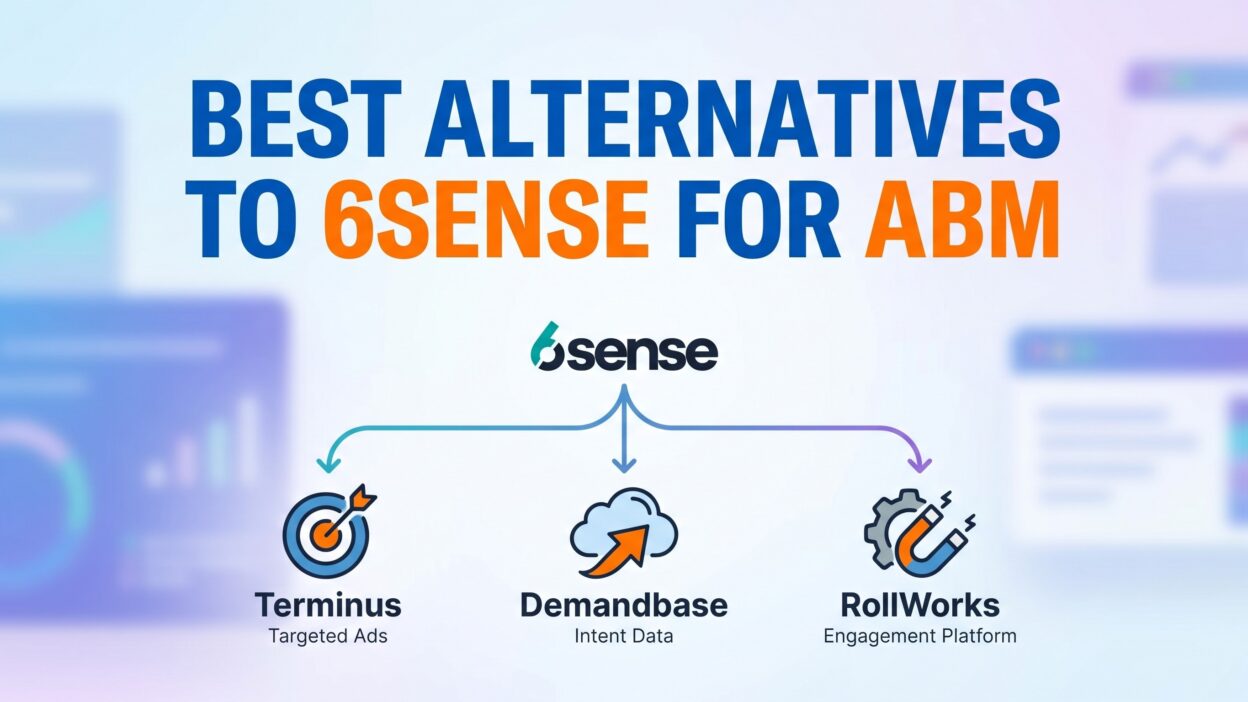
TL;DR 6sense is one of the most recognized names in account-based marketing. Its AI-powered revenue intelligence and buying stage prediction capabilities have earned strong adoption among enterprise B2B companies. But 6sense is not the right fit for every organization. The pricing is steep. The implementation is complex. Smaller teams often find the platform overwhelming rather than empowering. Some companies need different data strengths, tighter CRM integration, or a more focused set of capabilities at a lower cost. That is exactly why exploring strong alternatives to 6sense matters. The ABM technology market has matured significantly. Multiple platforms now deliver excellent account intelligence, intent data, and multi-channel activation at various price points and complexity levels. This guide covers the best alternatives to 6sense available in 2026, what each platform does well, who it serves best, and how to choose the right one for your go-to-market program.
Table of Contents
Why Teams Look for Alternatives to 6sense
Understanding why marketing and sales teams seek alternatives to 6sense helps clarify exactly what you need from your next platform. Several consistent themes emerge from teams that evaluate or switch away from 6sense.
Pricing is the most common concern. 6sense operates at enterprise price points that put the platform out of reach for many mid-market and growth-stage companies. Annual contracts often start at six figures and scale significantly with additional modules, seats, and account coverage. Teams with tighter budgets find that the investment cannot be justified without a mature ABM program already generating measurable pipeline.
Implementation complexity is the second frequent challenge. 6sense requires meaningful marketing operations investment to configure properly. AI models need time to train. Integrations need careful setup. Companies without dedicated MOps or RevOps resources often struggle to extract full value quickly. That slow time-to-value frustrates revenue teams under quarterly pressure.
Data coverage gaps in specific geographies or verticals push some teams toward alternatives to 6sense that offer stronger account data in European markets, specific industry sectors, or mid-market company profiles. 6sense’s data is strongest for US enterprise accounts. Coverage thins in some international and mid-market segments.
Finally, some teams want a more focused tool. 6sense is a broad platform with many modules. Some organizations want strong intent data and account identification without paying for an entire revenue intelligence suite they may not fully use.
What to Look for in Alternatives to 6sense
Account Intelligence and Data Depth
Every serious alternatives to 6sense candidate must deliver strong account-level intelligence. That means firmographic data — company size, industry, revenue, headcount, geography — combined with technographic data showing which platforms and tools each account uses. Rich account profiles help marketing teams build precise ICP definitions and accurate target account lists without supplementing from external sources.
Intent Data Quality and Source Diversity
Intent data is the core value proposition of 6sense. Any viable alternatives to 6sense must offer comparable quality. Look for platforms that aggregate intent signals from multiple independent sources rather than relying on a single data cooperative. Bombora data integration, G2 buyer intent signals, first-party behavioral data, and publisher network consumption signals all contribute to a more comprehensive intent picture.
Multi-Channel Campaign Activation
Account intelligence without activation capability is a research tool, not a revenue tool. The best alternatives to 6sense connect account scores and intent signals directly to campaign execution across LinkedIn advertising, programmatic display, email marketing, and sales engagement platforms. That activation layer is what converts intelligence into pipeline.
CRM and Marketing Automation Integration
Deep, bidirectional integration with Salesforce, HubSpot, Marketo, and other core revenue stack tools separates useful platforms from ones that create more work than they save. Account scores, engagement timelines, and intent signals must flow into existing CRM workflows automatically. Sales reps should never need to log into the ABM platform to access the intelligence they need.
Pricing Accessibility and Scalability
The best alternatives to 6sense serve teams at different budget levels without sacrificing core functionality. Evaluate whether the platform offers modular pricing — paying for intent data separately from advertising activation, for example — so you can align investment with your current program maturity and scale up as results justify expanded investment.
Best Alternatives to 6sense for ABM in 2026
1. Demandbase — The Enterprise ABM Standard
Demandbase is the most direct and comprehensive among all alternatives to 6sense for enterprise B2B companies. The platform combines a proprietary B2B data cloud, AI-powered account scoring, intent data, account-based advertising, website personalization, and sales intelligence in one unified platform. That breadth matches and in some areas exceeds what 6sense offers.
The Demandbase B2B Data Cloud is one of the richest in the market. It covers firmographic, technographic, and contact-level data across millions of global accounts. Intent data aggregates from Bombora, G2, and Demandbase’s own first-party network. Account scoring combines fit and intent into a prioritization matrix that updates in real time. Sales reps receive account intelligence inside Salesforce through a native integration that shows intent spikes, engagement history, and competitor evaluation signals without leaving the CRM.
Where Demandbase separates from 6sense most clearly is in advertising capability depth and website personalization quality. The advertising platform runs account-targeted display campaigns across the open web with strong frequency controls and creative personalization options. Website personalization dynamically adjusts homepage headlines, featured case studies, and CTAs based on the visiting account’s industry and buying stage. For enterprise teams evaluating alternatives to 6sense with a need for a complete ABM platform, Demandbase is the strongest direct comparison.
Best for: Enterprise B2B companies that want a full-stack ABM platform with strong advertising capabilities, deep data assets, and comprehensive CRM integration.
Pricing: Custom enterprise pricing. Comparable to 6sense at the enterprise level with modular options for mid-market entry.
Rollworks — Accessible ABM for Mid-Market Teams
Rollworks is one of the most compelling alternatives to 6sense for mid-market B2B companies that need capable ABM functionality without enterprise pricing complexity. The platform, a division of NextRoll, combines account identification, intent data integration, cross-channel advertising, and CRM-native reporting in a package that smaller marketing teams can deploy and manage effectively.
The Rollworks account scoring engine uses machine learning to evaluate every account in your target market across fit and intent dimensions. Fit scoring measures how closely each account matches your ICP based on firmographic and technographic attributes. Intent scoring measures how actively each account is researching topics relevant to your solution. The combination drives intelligent budget allocation — directing more campaign spend toward high-priority accounts while maintaining lighter-touch programs for accounts earlier in their research cycle.
Rollworks integrates natively with HubSpot and Salesforce. Account engagement data, advertising performance metrics, and intent score changes all sync directly into CRM records. Marketing and sales teams share the same account intelligence without platform-switching friction. Pricing is significantly more accessible than 6sense or Demandbase, making Rollworks the leading choice among alternatives to 6sense for growth-stage and mid-market companies building their first serious ABM program.
Best for: Mid-market B2B companies with lean marketing teams that want proven ABM capability at an accessible price point with strong HubSpot and Salesforce integration.
Pricing: Plans start at approximately $975 per month, scaling with account volume and feature access.
3. Terminus — Account-Based Advertising and Engagement Hub
Terminus focuses its platform capabilities on account-based advertising, website engagement, chat-based conversion, and email signature marketing. It earns its position among top alternatives to 6sense for teams that want strong multi-channel account engagement activation rather than a broad intelligence platform.
The Terminus Engagement Hub centralizes all account-level signals — ad impressions, website visits, email interactions, chat conversations — into a single account view. That unified engagement timeline gives sales reps clear context about which target accounts are actively engaging with the brand and which channels are driving that engagement. The account engagement score updates in real time and syncs to Salesforce and HubSpot.
Terminus’s advertising capabilities run across LinkedIn, programmatic display, and connected TV with strong account-level frequency management. The website personalization tool identifies visiting companies and dynamically adjusts page content to match the visitor’s industry, company size, or CRM status. Chat-based engagement through the Terminus Conversica integration captures visiting accounts in real-time conversations that qualify and route to appropriate sales reps immediately.
For companies that prioritize advertising execution quality and multi-channel engagement breadth over predictive AI sophistication, Terminus delivers strong ROI among alternatives to 6sense without requiring the organizational investment that 6sense demands.
Best for: B2B companies that want strong account-based advertising across multiple channels combined with website personalization and real-time chat engagement capabilities.
Pricing: Custom pricing based on account volume and modules selected. Generally more accessible than 6sense for mid-market buyers.
4. Bombora — Intent Data Foundation for Any ABM Stack
Bombora operates differently from the other alternatives to 6sense on this list. It is not a full ABM platform. It is the most trusted and widely used B2B intent data provider in the market. Bombora’s Company Surge data aggregates content consumption signals from thousands of B2B publisher websites through its data cooperative. When a company’s employees collectively consume large volumes of content on specific topics, Bombora registers a surge and flags that account as actively researching that category.
Bombora data integrates into virtually every major ABM platform, CRM, marketing automation tool, and sales engagement platform. That universality makes it an essential layer in any ABM stack — including those built as alternatives to 6sense using multiple best-of-breed tools rather than a single platform. Companies that find 6sense’s intent data coverage too narrow or too US-centric often supplement or replace it with Bombora’s broader cooperative intent dataset.
Using Bombora as a standalone intent data layer combined with an execution platform like Rollworks, Terminus, or HubSpot gives teams significant ABM capability at a lower total cost than a full 6sense deployment. That modular approach to building alternatives to 6sense suits teams who prefer best-of-breed toolsets over single-platform consolidation.
Best for: Any B2B marketing or sales team that wants to add high-quality intent data to an existing ABM or CRM stack without committing to a full ABM platform replacement.
Pricing: Bombora pricing is based on the number of topics tracked and the volume of accounts monitored. Custom plans available for different team sizes and use cases.
5. HubSpot ABM Tools — CRM-Native ABM for Growing Teams
HubSpot’s native ABM features have matured significantly and now represent a legitimate entry among alternatives to 6sense for growth-stage and mid-market B2B companies already on the HubSpot platform. HubSpot ABM includes target account identification, ICP scoring, buying role classification, account-level engagement tracking, and LinkedIn Ads integration — all within the core HubSpot CRM and Marketing Hub environment.
HubSpot’s integration with Bombora intent data through its data marketplace adds third-party intent signals directly to account records inside the CRM. Marketing teams see which target accounts are surging on relevant topics without leaving HubSpot. Sales reps access that intelligence in their existing workflow without learning a new platform. That seamless integration is a significant operational advantage over platforms that require separate logins, separate dashboards, and complex bidirectional sync configurations.
For companies not yet ready to invest in a dedicated ABM platform, HubSpot’s native ABM capabilities provide a strong foundation that scales with program maturity. Teams that outgrow HubSpot’s ABM depth can layer in tools like Rollworks or Bombora without rebuilding their CRM infrastructure. HubSpot represents the most operationally efficient starting point among alternatives to 6sense for teams already in the HubSpot ecosystem.
Best for: B2B companies using HubSpot CRM that want to add ABM capabilities without adopting a separate platform, particularly those at early-to-mid ABM program maturity.
Pricing: HubSpot ABM features are included in Marketing Hub Professional and Enterprise plans starting at approximately $800 per month.
6. ZoomInfo Marketing — Data-Rich ABM and Demand Generation
ZoomInfo Marketing leverages ZoomInfo’s industry-leading B2B contact and company database to power account-based marketing programs. As one of the data-richest alternatives to 6sense, ZoomInfo Marketing offers intent data through its proprietary Streaming Intent product, which captures real-time buying signals from across the web and maps them to company and contact records in the ZoomInfo database.
The platform includes account-based advertising capabilities that activate ZoomInfo’s audience data across programmatic display, LinkedIn, and Facebook. Audience segments built on ZoomInfo’s contact attributes — job title, company size, industry, technology use, and intent topics — launch directly into advertising campaigns without requiring data export or third-party audience matching. That closed-loop between data and activation is a genuine efficiency advantage.
ZoomInfo Marketing also integrates directly with ZoomInfo SalesOS, creating a shared intelligence layer between marketing campaigns and sales prospecting. Marketing can suppress accounts already in active sales cycles from advertising campaigns. Sales teams see which accounts marketing has been targeting and what engagement those accounts showed. That coordination reduces the friction that commonly undermines ABM execution between marketing and sales teams. For companies already using ZoomInfo for sales intelligence, ZoomInfo Marketing represents the most natural path among alternatives to 6sense to build an integrated ABM program.
Best for: B2B companies already using ZoomInfo for sales prospecting that want to extend their existing data investment into account-based marketing campaign activation.
Pricing: ZoomInfo Marketing pricing is add-on based on existing ZoomInfo subscription tier. Custom pricing applies based on contact database access and advertising activation features.
7. TechTarget Priority Engine — Intent Data for Technology Buyers
TechTarget Priority Engine is a highly specialized option among alternatives to 6sense for technology vendors targeting IT buyers, enterprise technology decision-makers, and technology purchasing committees. TechTarget operates one of the largest B2B technology media networks — including sites like SearchCIO, SearchSecurity, TechRepublic, and dozens of others — and captures first-party intent data from millions of registered technology professional readers.
That first-party intent data is what makes TechTarget Priority Engine uniquely valuable. When a CTO or IT director reads multiple articles about cloud security on a TechTarget property, Priority Engine flags that individual’s company as actively researching that topic. The signal is first-party and verified rather than modeled from third-party behavioral patterns. That data quality advantage makes TechTarget one of the highest-precision alternatives to 6sense for technology marketers who need to identify accounts showing genuine, verified purchase intent.
Priority Engine integrates with Salesforce and major marketing automation platforms. It delivers purchase intent data at both the account level and the individual contact level — showing which specific people at a target account are consuming content relevant to your solution. Sales reps use that contact-level intelligence to personalize outreach with direct references to the topics the prospect has been researching. That conversation-starting precision drives significantly higher reply rates than generic cold outreach.
Best for: B2B technology vendors targeting IT decision-makers who want high-quality first-party intent data from a verified audience of active technology researchers.
Pricing: Priority Engine pricing is subscription-based and varies by the number of topics tracked, accounts monitored, and user seats. Contact TechTarget for current pricing.
8. Clearbit (Breeze Intelligence by HubSpot) — Data Enrichment and Account Identification
Clearbit, now integrated into HubSpot as Breeze Intelligence, offers a focused set of capabilities that make it one of the most practical alternatives to 6sense for teams that need data enrichment, website visitor identification, and account intelligence without a full ABM platform investment.
Breeze Intelligence enriches every CRM record in real time with firmographic, technographic, and contact-level data. Shortened forms capture just an email address while Clearbit fills in the company name, industry, size, and technology stack automatically. Website visitor identification reveals which companies browse your site anonymously, enabling marketing and sales teams to prioritize outreach toward high-intent accounts before a form gets submitted.
For HubSpot users, Breeze Intelligence creates a seamless data foundation that powers smarter segmentation, better lead scoring, and more relevant website personalization. Teams that previously used 6sense primarily for account identification and data enrichment find Breeze Intelligence a cost-effective replacement that integrates more deeply into their existing HubSpot workflows than a separate ABM platform would.
Best for: HubSpot users who want automated CRM enrichment, website visitor identification, and form-shortening capabilities as a lightweight but high-value ABM data foundation.
Pricing: Breeze Intelligence is available through HubSpot with credit-based pricing for enrichment actions. Plans scale based on the volume of enrichment credits used monthly.
How to Choose the Right Alternative to 6sense
Assess Your ABM Program Maturity First
The right choice among alternatives to 6sense depends heavily on where your ABM program currently sits. Early-stage programs with no existing target account infrastructure benefit most from accessible platforms like HubSpot ABM, Rollworks, or Breeze Intelligence. More mature programs with defined ICP lists, proven campaign playbooks, and dedicated MOps resources can leverage Demandbase or ZoomInfo Marketing at full depth.
Prioritize the Capability You Need Most
Every platform on this list has distinct strengths. Bombora leads in intent data breadth. Demandbase leads in advertising activation and data cloud depth. Terminus leads in multi-channel engagement execution. TechTarget leads in technology buyer first-party intent. ZoomInfo leads in contact-level data richness. Identify which capability gap matters most for your revenue goals and match your platform selection to that priority rather than choosing based on feature count alone.
Calculate Total Cost of Ownership Accurately
Platform licensing is just one part of the true cost of any alternatives to 6sense deployment. Factor in implementation time, integration development costs, ongoing platform management, content production requirements, and the opportunity cost of delayed time-to-value. A cheaper platform that takes six months to produce results may cost more in total than a more expensive platform with faster onboarding and proven deployment support.
Validate Integration Quality with Your Current Stack
Before committing to any platform among the alternatives to 6sense, request a technical integration demonstration using your specific CRM instance. Verify that account scores sync bidirectionally, that engagement data flows into the right objects, and that alerts reach the right sales rep workflows. Weak integrations create data silos that undermine program performance regardless of the underlying platform quality.
Related Topics Covered
This blog naturally covers multiple secondary keywords and related topics that readers search for alongside the primary keyword. Those topics include: 6sense competitors, 6sense alternatives for mid-market, ABM platforms comparison, Demandbase vs 6sense, Rollworks vs 6sense, account-based marketing software, B2B intent data platforms, ABM tools for small teams, account intelligence platforms, ABM pricing comparison, B2B buyer intent data, and account-based marketing technology stack.
Each secondary keyword appears organically within relevant sections of this content, supporting full SEO coverage across the ABM platform comparison topic cluster.
Frequently Asked Questions About Alternatives to 6sense
What are the best alternatives to 6sense for ABM?
The strongest alternatives to 6sense include Demandbase for enterprise full-stack ABM, Rollworks for accessible mid-market ABM, Terminus for multi-channel engagement, Bombora for intent data, ZoomInfo Marketing for data-rich activation, TechTarget Priority Engine for technology buyer intent, and HubSpot ABM Tools for CRM-native account-based programs. The best choice depends on your team size, program maturity, budget, and primary capability need.
Is Demandbase a good alternative to 6sense?
Yes. Demandbase is the most direct and comprehensive alternative to 6sense for enterprise B2B companies. It matches 6sense’s capability breadth across intent data, account scoring, advertising, personalization, and sales intelligence. Many enterprise teams evaluate both platforms simultaneously. Demandbase often wins on advertising capability depth and data cloud richness. 6sense often wins on predictive AI sophistication. Both rank among the best alternatives to 6sense depending on specific program priorities.
What is a cheaper alternative to 6sense?
Rollworks, Terminus, and HubSpot ABM Tools offer the most accessible pricing among alternatives to 6sense. Rollworks starts at under $1,000 per month for mid-market plans. HubSpot ABM features are included in existing Marketing Hub Professional subscriptions. Terminus pricing is competitive for companies that primarily need advertising and engagement activation rather than the full intelligence suite that 6sense provides at enterprise pricing.
Can I build an ABM stack without a dedicated ABM platform?
Yes. Many teams build highly effective ABM programs using a combination of standalone tools rather than a single platform. Combining Bombora for intent data, HubSpot or Salesforce for CRM and marketing automation, LinkedIn Campaign Manager for advertising, and a data enrichment tool like Breeze Intelligence creates a functional ABM stack that competes with the outputs of integrated platforms. This modular approach to alternatives to 6sense suits teams that prefer best-of-breed tools and have the operational capability to manage multiple integrations.
How long does it take to see results from 6sense alternatives?
Most alternatives to 6sense show measurable account engagement improvements within sixty to ninety days of deployment. Pipeline contribution typically becomes visible at the four-to-six-month mark. Revenue attribution improvements require twelve months of consistent program data given typical B2B sales cycle lengths. Platforms with faster onboarding — HubSpot ABM, Rollworks, Breeze Intelligence — tend to deliver early value signals more quickly than enterprise platforms requiring complex configuration.
Does Rollworks compare favorably to 6sense for mid-market companies?
Yes. For mid-market B2B companies, Rollworks is one of the strongest alternatives to 6sense. It delivers core ABM functionality — account scoring, intent data integration, cross-channel advertising, and CRM integration — at a price point that mid-market budgets can sustain. It lacks 6sense’s deep predictive AI sophistication but delivers strong ROI for programs that do not require enterprise-scale buying stage modeling.
Read More:-Healthcare Email Lists: Doctors, Nurses, Hospitals & More
Conclusion

6sense built a strong reputation in the ABM market. Its predictive intelligence and buying stage modeling capabilities remain genuinely impressive for enterprise programs with the budget, team, and operational maturity to leverage them fully. But 6sense is not the universal answer for every B2B company building an ABM program.
The market for alternatives to 6sense has matured considerably. Demandbase matches 6sense at the enterprise level with different capability strengths. Rollworks delivers ABM accessibility for mid-market teams. Terminus excels at multi-channel engagement execution. Bombora provides the best standalone intent data layer available. ZoomInfo Marketing extends existing sales intelligence into marketing activation. TechTarget Priority Engine serves technology marketers with verified first-party buyer intent. HubSpot ABM Tools give CRM-native teams a seamless starting point.
The right choice among alternatives to 6sense is never about which platform has the most features. It is about which platform delivers the specific capabilities your program needs at a price your budget supports with integration depth that your team can actually leverage. A simpler, well-deployed platform consistently outperforms a sophisticated platform that takes a year to implement and never reaches full utilization.
Define your primary capability need clearly. Match it to a platform with proven strength in that area. Validate integration quality with your existing stack before committing. Set realistic timelines for measuring program impact. Invest in clean data before expecting AI predictions to be accurate.
The ABM category gives B2B marketers more powerful tools than ever before. The best alternatives to 6sense prove that excellent account intelligence, precise campaign targeting, and measurable pipeline contribution do not require choosing the most expensive platform in the category. The right fit for your business is out there. This guide gives you the framework to find it.